
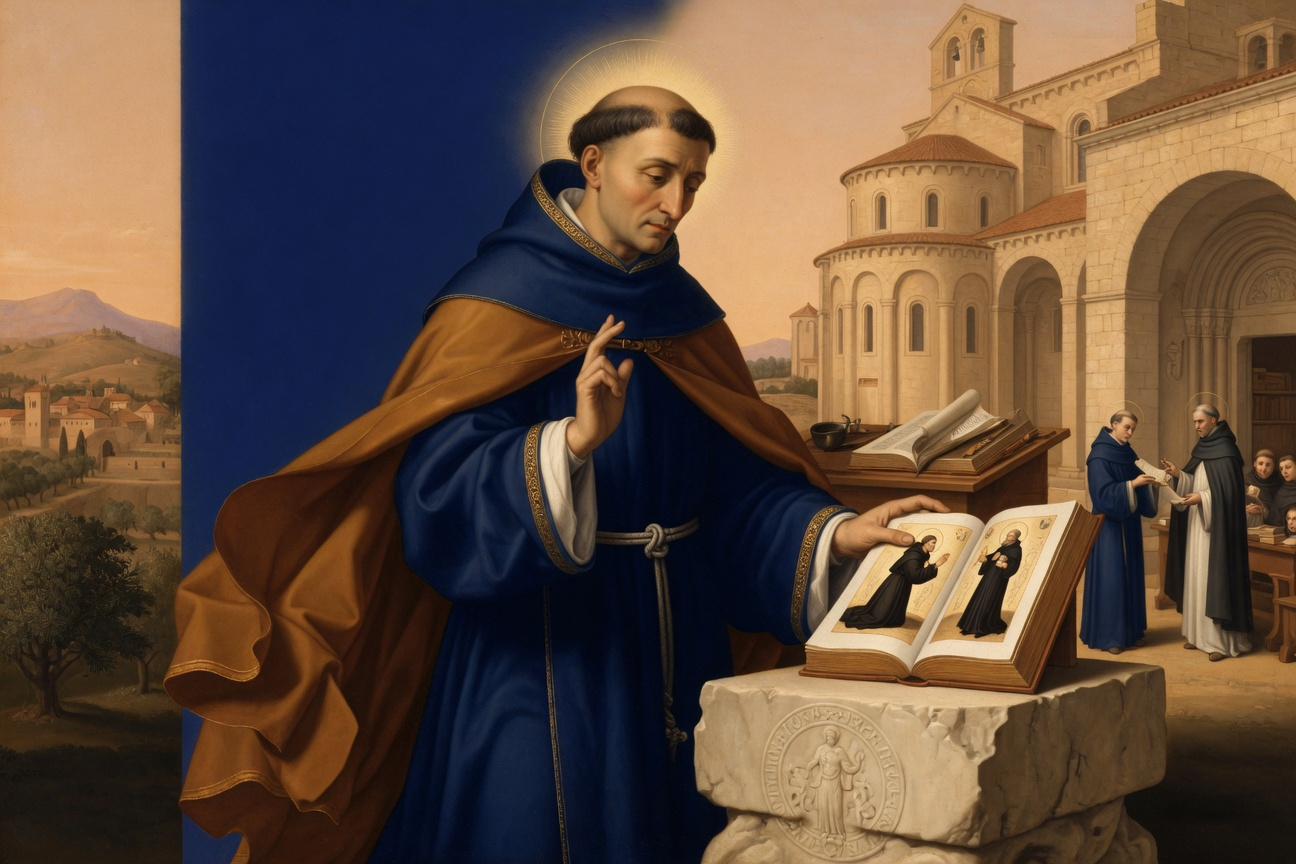
A 9th-century Frankish monk born in Languedoc, Ardon (born Smaragdus) was the disciple and biographer of Saint Benedict of Aniane. Moderator of the abbey's schools and administrator of the monastery from 814, he is recognized for his knowledge and piety. He died in 843 after contributing to the intellectual and religious influence of the Carolingian era.
Contemporaries

Figures and markers around the normalized period for this entry.
Guided reading
6 reading sections
SAINT ARDON, MONK OF THE ABBEY OF ANIANE, IN LANGUEDOC (843).
Introduction and justification
The author justifies the inclusion of Ardon in his collection due to his connection with the land of France, despite a life considered less spectacular than that of other saints.
Although the life of Ar don offers nothing remarkable from the point of view of holiness, we make special mention of him, our rule being to pass over in silence, as much as possible, none of the Saints who were born or sanctified on our beautiful land of France.
Origins and monastic formation
Of Frankish origin and born in Languedoc, Smaragdus changed his name to Ardo and became the favored disciple of Saint Benedict of Aniane.
According to the most common opinion, Ardo was a Frank, and not a Goth. He was born in Languedoc, and changed his name fr om Smaragdus to that of Ardo. He was one of the first disci ples of Saint Benedic t of Aniane. His knowledge and virtue earned him elevation to the priesthood and the dignity of moderator of the house schools. His abbot had such esteem for him that he usually chose him as his companion on his travels.
Imperial relations and administration
Ardon received the consideration of Charlemagne and succeeded Benedict of Aniane as head of the monastery in 814, when the latter left for Aachen.
It was apparently during one of these journeys that he became known to Charlemagne. This great emperor showed him his consideration by presenting him, in the very year of his death, with a stone that resonated like bronze. The same year, that is to s ay in 814, S aint Benedict, before leaving Languedoc to go and settle in Aachen, near Louis t he Pious, cast his eyes on Ardon to entrust him with the administration of the monastery of Aniane.
Death and literary legacy
Ardon died in 843, leaving behind a biography of his master, Saint Benedict of Aniane, written at the request of his brother monks.
The other actions of this great man are unknown. The Aniane breviary states that Ardon died on March 9, 843. The only authentic production that remains to us from Ardon's pen is the Life of S aint Benedict of Aniane, whi ch he undertook to write at the solicitation of his brothers. His holiness is beyond doubt, since, for a long time, he has been honored at Aniane as an illustrious servant of God.
The School of Aniane and Monastic Knowledge
Under the direction of Ardon, the school of Aniane became a major intellectual center, training bishops and disseminating its method throughout Carolingian Europe.
But what must be admired above all in this ninth-century monk is knowledge united with piety. In these centuries of transformation, all the sciences were in the hands of the monks and, without them, they would have perished forever.
The school of Aniane, of which Saint Ardon was moderator, deserves special mention among those that, in that remote era, distributed instruction to the youth. Saint Benedict, its founder, had amassed a considerable library there and established several skilled masters. Among these masters, there were some for chant; others to teach reading; some to teach grammar and belles-lettres; and finally, theologians to explain the Holy Scripture. Many who had attended this school were later raised to the episcopate, and a greater number served to restore sound studies, according to the method of Aniane, in a large number of monasteries in France, Italy, and Germany.
Historical sources
References to the Histoire littéraire de la France for further study of the life of Ardon.
Hist. litt. de la France , vol. V, p. 31 et seq.; vol. IV, p. 16, 17 and passim.
Iconography
Signs and attributes


Entities
Narrative network
The names, places, and concepts most present in the entry, weighted by centrality in the text.
Frequently asked questions about Saint Ardon (Smaragdus)
Who was Saint Ardon (Smaragdus)?
A 9th-century Frankish monk born in Languedoc, Ardon (born Smaragdus) was the disciple and biographer of Saint Benedict of Aniane. Moderator of the abbey's schools and administrator of the monastery from 814, he is recognized for his knowledge and piety. He died in 843 after contributing to the intellectual and religious influence of the Carolingian era.
What is Saint Ardon (Smaragdus) the patron saint of?
Patronage of Saint Ardon (Smaragdus): Aniane Abbey.
How is Saint Ardon (Smaragdus) depicted in Christian art?
In iconography, Saint Ardon (Smaragdus) is recognizable by: stone resonating like bronze and book (Life of Saint Benedict).
Which saints were contemporaries of Saint Ardon (Smaragdus)?
Contemporaries include: Saint Ansgar (Apostle of the North), Saint Bernard of Menthon (Apostle of the Alps), Saint Rumold (Rombaud) and Saint Zachary, Pope.
When did Saint Ardon (Smaragdus) die?
Saint Ardon (Smaragdus) died around 900.
What are the other names of Saint Ardon (Smaragdus)?
Other forms of the name: Smaragde.
Annexes & related entities
Structured data for exploration: events, miracles, quotes, places, attributes, patronages, and important entities cited in the text.
Key Events
- Born in Languedoc
- Becomes a disciple of Saint Benedict of Aniane
- Ordination to the priesthood and direction of the schools of Aniane
- Meeting with Charlemagne and receipt of a gift in 814
- Appointed to the administration of the monastery of Aniane in 814
- Writing of the Life of Saint Benedict of Aniane