
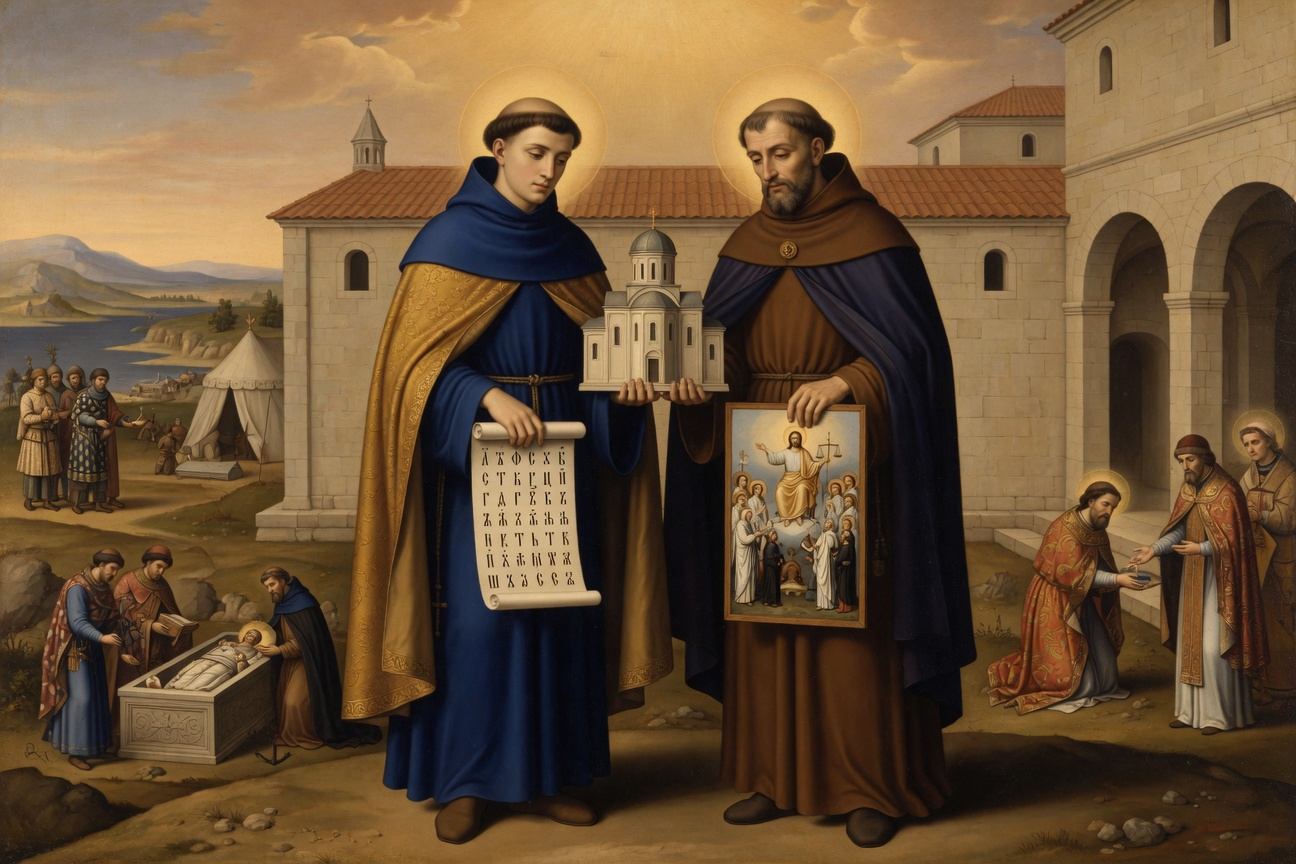
Brothers from Thessalonica in the 9th century, Cyril and Methodius are the apostles of the Slavic peoples. They evangelized the Khazars, Bulgarians, and Moravians, translating sacred texts through the invention of the Slavonic alphabet. Despite opposition regarding the use of the Slavic language in the liturgy, they received the support of the papacy to establish the Church in Central Europe.
Contemporaries

Figures and markers around the normalized period for this entry.
Guided reading
8 reading sections
SAINT CYRIL AND SAINT METHODIUS
BROTHERS AND APOSTLES TO THE SLAVS
Youth and formation of Cyril
Born in Thessalonica, Constantine (the future Cyril) distinguished himself through his studies in Constantinople and his theological opposition to Patriarch Photius.
Constantin e, who would later go to bury his glory in a monastery in Rome and substitute his first name with that of Cyril, was born in Thessalonica to a senatorial family. His parents having sent him to Constantinopl e to study let ters, he made such rapid progress in these studies that he was given the nickname of Philosopher: but he was even more distinguished by his virtue than by the variety and extent of his knowledge. The important services he rendered to the Church, once he had been raised to the priesthood, led to the highest opinion of him. Here is a circumstance where he gave the most unequivocal proof of the purity of his zeal. Photius was disparaging Saint Ignatius, who h ad been plac ed on the patriarchal see of Constantinople in 846, and was teaching that there were two souls in every man. Cyril did not fear to reproach him for such a scandalous error; and as the latter replied that he had no intention of offending anyone, and that he had only wanted to test the capacity and dialectics of the patriarch: "What," replied the Saint, "you have launched your arrows into the midst of the crowd, and you claim that no one will have been wounded! You may well pride yourself on the lights that your wisdom gives you, but they are obscured by the vapors rising from that fund of avarice and jealousy which is in your heart. Your passion against Ignatius blinds you and plunges you into thick darkness."
Mission to the Khazars
Cyril is sent to evangelize the Khazars, learns their language in Crimea, and discovers the relics of Pope Saint Clement I.
It was around this time that the Khazars resolved to embrace the Christian religion. These Khazars were a tribe of Turks, the most numerous and powerful people among the Huns who inhabited European Scythia. They had settled in a region neighboring Germania, and which extends along the Danube. Having formed the plan to submit to the Gospel, they sent a solemn embassy to the Emperor of Constantinople, Michael III, and to the pious Empress Theodora, his mother, to ask them for priests who would be willing to take on the task of instructing them. Theodora summoned Saint Ignatius to confer with him about it. The patriarch, after having examined everything, concluded by proposing to put Cyril at the head of this important mission, which was definitively decided (848). As the Khazars spoke the Turkish language, as did the Huns and the Tartars, our Saint went to study it in Cherson, in Tauris (Crimea), where he had the good fortune to discover the relics of Saint Clement I, Pope. He lea rned it in a short time, beca use the zeal for the salvation of souls animated him to devour all the difficulties that usually accompany such work. No sooner was he able to make himself understood than he began to preach the Gospel. All eyes opened to the light that struck them. The Khan or prince received baptism, and his example was soon followed by the entire nation. Cyril founded churches, which he provided with excellent ministers, and returned to Constantinople. The prince and the people wanted to give him rich gifts; but it was not possible to persuade him to accept anything. Such disinterestedness made a happy impression on the minds of these new Christians: he had been content to ask for the release of all foreign slaves; which was granted to him.
The Evangelization of Bulgaria
Methodius joins his brother to convert King Bogoris of Bulgaria, notably through a striking painting of the Last Judgment.
Cyril was then tasked with going on a mission to Bulgaria. His brother Methodius, who was a monk of eminent holiness, w as asso ciated with him in this good work; but we must take things up from a little earlier. The Bulgarians, a Scythian people, had a common origin with the Slavs. It appears that they first settled in the vicinity of the Volga, and that they were driven from there along with the Avars by the Turks. They seized ancient Moesia and Dacia, that is to say, Wallachia, Moldavia, and a part of Hungary. The Greeks whom they took prisoner during the reign of the Emperor Basil, surnamed the Macedonian, cast among them some seeds of Christianity; but they did not convert until long after. Here is how it happened: Bogoris, King of the Bulgarians, had a sister who had becom e a Chr istian in Constantinople, where she had been taken captive. It was the Empress Theodora who procured for her the happiness of knowing the truth. The princess, having subsequently returned to her brother, continued to follow with fervor the maxims of the religion in which she had been instructed; she even tried to inspire in Bogoris the sentiments with which she was imbued. Unfortunately, human motives prevented this prince from yielding to his sister's solicitations. In the end, however, the moment of mercy arrived. The King of the Bulgarians having asked the Emperor of Constantinople for a skilled painter, the latter sent him the holy monk
Volga, as far as the Danube, under the reign of the Emperors Maurice and Tiberius, who made an alliance with them and sent them two magnificent embassies, the description of which can be found in Constantine Porphyrogenitus (Pandeste Hist. de Legationibus), and in Theophylact Simocatta. It is from these ancient Turks that some authors trace the descent of those among the Gygycian Tartars who inhabit Asia, as well as the Crimean Tartars. Constantine Porphyrogenitus (L. de regendo Imper. ad Roman. filium) and the other authors of the Byzantine corpus also give the name of Turks to the Hungarians and the nations that are to the north of Europe and Asia.
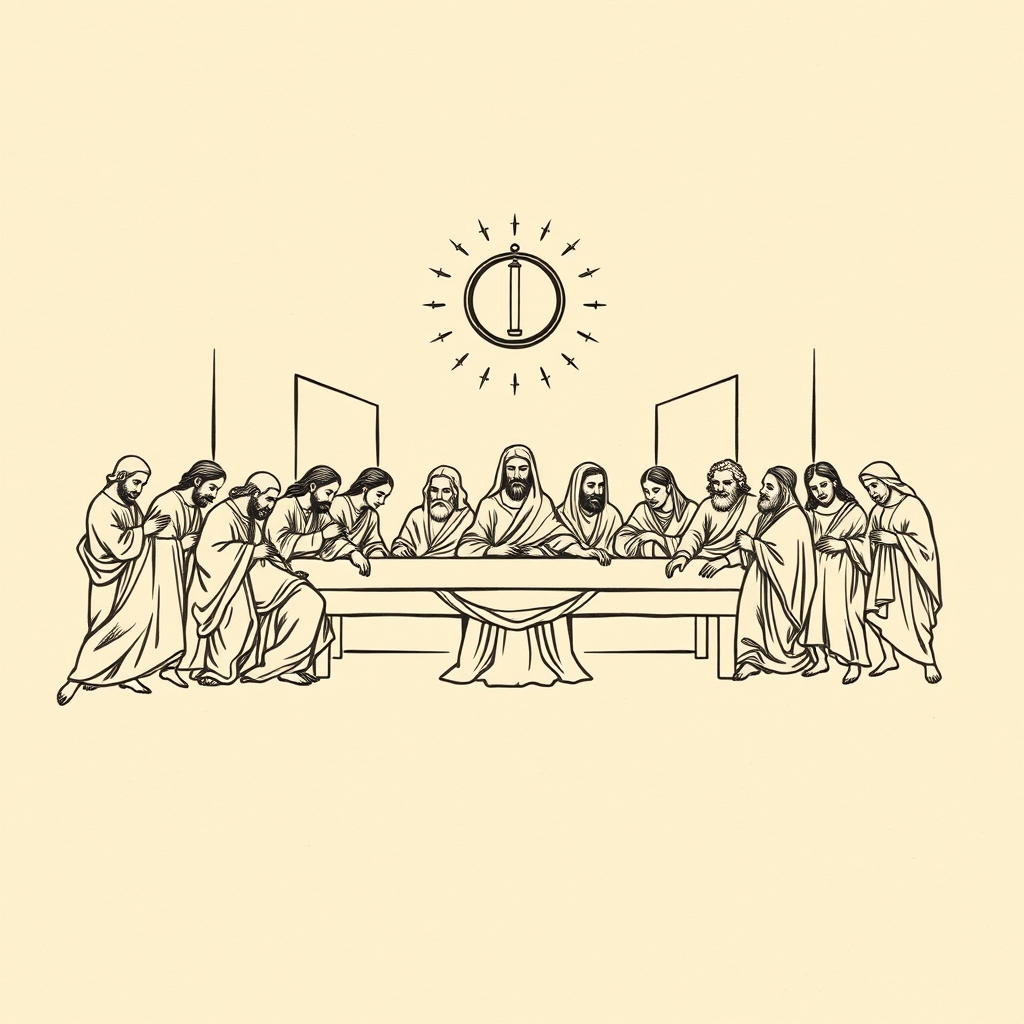
Methodius, who excelled in this art. (There were at that time many monks who succeeded perfectly in devotional paintings.) Scarcely had Methodius arrived at his destination when Bogoris asked him for some pieces capable of contributing to the decoration of the palace he had just had built; he recommended to him, among other things, to imagine a subject whose representation could freeze the spectators with terror. The Saint resolved to take advantage of the king's dispositions: he undertook to paint the Last Judgment. One saw Jesus Christ surrounded by angels, on the right and on the left, seated on a throne radiant with glory, and clothed in the formidable apparatus of an angry judge. All men, without any distinction of rank, were assembled before his tribunal, where they waited, trembling, for the sentence that was to decide their eternal fate. Moreover, there was, in the different parts of the painting, a strength, an energy, a vividness, and a warmth of expression that added even more to the terrible nature of the subject. The work finished, it was shown to the king, who was singularly moved by it; but his emotion increased greatly when the painter came to explain each of the parts that composed his painting as a whole. He could not bear it, and, responding from then on to the grace that spoke to him through a sensible object, he asked to be instructed in the mysteries of the Christian religion. Methodius worked without delay to clarify his doubts and to give him all the enlightenment he might need. No sooner had the prince known the doctrine of the Gospel than he received the sacrament of regeneration and took the name of Michael.
But, although he had been baptized at night, the nobles of his court, having learned of it, stirred up all the people against him and came to besiege him in his castle. He did not fail to go out against them, carrying the cross in his bosom and accompanied only by forty-eight men who had remained faithful to him. These, although so few in number, so astonished the rebels that they could not withstand the shock, and their defeat appeared a miracle. The king put to death fifty-two of the most seditious nobles and pardoned the multitude. Then he exhorted them all to become Christians and persuaded a great number; then he asked the emperor for uncultivated lands on his border to expand his people, who were too confined in their country, and the emperor granted him a district that they named Zagora.
This conversion of the Bulgarians happened in the year 865, and the following year, their king, Michael, sent ambassadors to King Louis of Germany, with whom he had peace and alliance, asking him for a bishop and priests. Those who came on his behalf said that, when he went out of his castle against the rebels, seven clerics were seen walking before him, each of whom carried a lighted candle, that the rebels thought they saw a great burning house falling upon them, and that the horses of those who accompanied Michael walked on their hind legs and struck the rebels with their front feet; that they were so terrified by this that, without thinking of fleeing or defending themselves, they remained stretched out on the ground.
The Intervention of the Holy See
Pope Nicholas I welcomes the Bulgarians and sends legates to organize the local Church in the face of tensions with Constantinople.
King Louis asked his brother Charles the Bald for sacred vessels, priestly vestments, and books for the clerics he was to send there, and King Charles drew a large sum for this purpose from the bishops of his kingdom. The following year, Louis sent Bishop Ermanric to Bulgaria, with priests and deacons; but when they arrived, they found that the bishops sent by the Pope had already preached and baptized throughout the country; therefore, they took leave of the King of the Bulgarians and returned home. Indeed, this king had sent his own son to Rome at the same time with several lords, carrying offerings to Saint Peter, among others the weapons that King Michael had when he defeated the rebels. They were tasked with consulting the Pope on a host of religious questions and asking him for bishops and priests. They arrived in Rome in the month of August 866, and Emperor Louis, having learned of this, asked the Pope for the weapons and other gifts that the King of the Bulgarians had made to Saint Peter, which, no doubt, was very ungenerous. The Pope sent him a portion of them.
Pope Nicholas felt extreme joy at the arrival of the Bulgarians, not only for their conversion in itself, but also because they had come from afar to seek the instructions of the Holy See. He appointed, to go and instruct them, Paul, Bishop of Populonia (Piombino), in Tuscany, and Formosus, Bishop of Porto, prelates of great virtue, and charged them with his response to their consultations, as well as several copies of the Holy Scripture and other books he deemed necessary.
As these legates were bishops, they administered the sacrament of confirmation to the Bulgarians baptized by the Greek priests; they also prescribed that they fast every Saturday, which was highly disapproved of by Photius, the schismatic Patriarch of Constantinople. Some of the new converts, having been baptized in urgent cases by the hands of laypeople, and even infidels, addressed the Pope to know what they should hold on this subject. Nicholas replied that their baptism was valid, and that it should not be repeated. He also resolved other difficulties that had been proposed to him. The letter of Pope Nicholas I to the Bulgarians is one of the beautiful monuments of the civilizing influence of Catholicism.
Moravia and the Slavonic Alphabet
At the request of King Rastislav, the two saints evangelize Moravia and Cyril invents the Slavonic alphabet to translate sacred texts.
After the conversion of the Bulgarians, which had been the principal fruit of the zeal of Cyril and Methodius, these two apostolic men set out to preach the Gospel in Moravia. They had been drawn to this country by the pious King Rastislav, who received baptism at their hands, as did the greater part of his subjects. The Moravians had all the less difficulty in abandoning their superstitions, as they already thought quite favorably of Christianity, especially since the conversion of the Bavarians by Saint Rupert, Bishop of Worms and founder of the archiepiscopal see of Salzburg.
Our two saints had an advantage over the Latin missionaries: they knew the language of the country. Cyril inven ted a s pecific Slav onic alphabet a nd translated the Bible and other writings from Greek and Latin into the Slavic language for the use of the Moravians. This alphabet has been preserved to this day in Bulgaria, Serbia, Bosnia, Moldavia, and Wallachia (867).
Defense of the Slavonic Liturgy
After the death of Cyril in Rome, Methodius defended the use of the Slavonic language in the liturgy against the criticisms of German bishops.
Around the year 867, the two missionaries undertook the journey to Rome, where Cyril became a monk and died shortly after his a rrival. Methodius was elected by Pope Adrian II as Bishop of Moravia and Pannonia. When he returned to his vast diocese, some German bishops saw with displeasure the restriction of the extent of their jurisdiction by the creation of this new bishopric. One of them, the Bishop of Passau, in the name of his clergy, accused Methodius in Rome of teaching errors and of having introduced the use of the Slavonic language into divine worship, instead of the Latin languag e. Pope John VIII made these two reproaches to our Saint in his letter of 879, and invited him to come and justify himself; in the meantime, he forbade him to celebrate Mass in the Slavonic language, ordering him to use the Latin or Greek language, in use throughout the world for the divine office; but he could preach in Slavonic.
Saint Methodius, following the Pope's order, returned to Rome the following year, 880. The Pope, having received from him the clarifications he desired regarding his faith and conduct, sent him back with a letter to Count Svatopluk, prince of the Slavs established in Moravia and successor to Rastislav. In it, he praises this prince with paternal tenderness for his filial devotion to Saint Peter and his successor, a devotion which had led him, in concert with his nobility and all his people, to choose him as their patron and defender, in preference to all the princes of the earth. He adds: "We have questioned your venerable archbishop Methodius, in the presence of our brother bishops, whether he believed the Symbol of the faith and sang it at Mass as the Roman Church holds it and as it was received in the six universal councils. He declared that he held and sang it according to the tradition of the Roman Church. Thus, having found him orthodox in his doctrine and capable of serving the Church, we send him back to you to govern the one entrusted to him, and we order you to receive him with the appropriate honor; for we have confirmed his privilege as archbishop, so that, according to the canons, it is for him to regulate all ecclesiastical affairs.
"Finally, we approve the Slavonic letters, invented by the philosopher
of the Slavs seized Illyria, and subdued the Goths and Huns during the reign of the Emperor Justinian, as we learn from Constantine Porphyrogenitus, and from Procopius, etc. (See Jos. Assemani, vol. III, p. 309; Badrius, in the history of Ragusa, and John Lucius, in his book on the reign of Dalmatia and Croatia.) The Slavs then acquired new settlements in Poland and Bohemia. The affinity of the languages spoken in these two countries is proof of this. Here is what one reads in the first chapter of the Chronicon Slavorum: "The Danes and the Swedes inhabit the northern coast of the Baltic Sea; but the southern coast of the same sea is inhabited by the Slavs. Under this denomination are included the Russians who are to the east, the Poles, who have the Prussians to the north, and to the south the Bohemians, the Moravians, and the Carinthians". Mr. Jos. Assemani has demonstrated, in his Scriptores Slavorum, vol. II and III, that the Slavs originally inhabited part of Scythia and Sarmatia, and that they left it to spread into Germany, Poland, Bohemia, Pannonia, Dalmatia, and Illyria. The kingdom of Bohemia was founded, around the year 650, by Zechus and Chems, who were Slavs, and even brothers according to some authors. The Pechenegs, who were also originally from Scythia, threw themselves upon the frontiers of the Roman Empire, seized ancient Dacia, and gave the Greeks much occupation; but in the end, they were defeated and subdued by John Komnenos. The Greeks gave them the name of Litches. These are today the Vlachs. See John Lucius, loc. cit., i. vi, n. 5.
philosopher Constantine (otherwise Cyril), and we order the actions and praises of Jesus Christ to be published in the same language, since the Holy Scripture warns us to praise the Lord, not in three languages only, but in all languages, saying: Praise the Lord, all you nations; praise him together, all you peoples; and that Saint Paul also says that every tongue must confess that Our Lord Jesus Christ is in the glory of God the Father. It is not contrary to the faith to use the same Slavonic language to celebrate Mass, read the Gospel and the other scriptures of the Old and Ne w Testament, well translated, nor to sing the other offices of the hours in it. He who made the three principal languages, Hebrew, Greek, and Latin, also made all the others for his glory. We wish, however, that, to show more respect for the Gospel, it be read first in Latin, then in Slavonic, for the sake of the people who do not understand Latin, as is practiced in some churches; and if you and your officers prefer to hear the Mass in Latin, we wish for it to be said to you in Latin". This letter is from the month of June 880.
There are authors who think that, if Pope John VIII had held more firmly to the use of Latin in the sacred liturgy, he would have made the schism and the perversion of the Slavonic nations less easy.
Expansion into Bohemia
Methodius converted Duke Borzivoy of Bohemia and his wife, Saint Ludmila, extending Christian influence among the Slavs.
Saint Methodius therefore returned to continue his work, but it was not without opposition; this is evident from a letter that Pope John wrote to him the following year to console and encourage him. Previously, the holy apostle of the Moravians had already suffered great tribulations. The prince or king Svatopluk, the very one to whom John VIII would later address a letter full of praise, and who began to reign in the year 870 after the expulsion of Rastislav—who was confined to a monastery by Louis the German and deprived of his sight—initially showed himself to be a tyrant and impious. Saint Methodius, who struck him with anathema, was driven from the country; but the prince soon repented, sent to beg the Saint to return, and promised to make amends for his initial faults. He kept his word, and Methodius found himself amply compensated for his first tribulations. It was the same for those that followed; they earned him the grace to convert another nation. One day the young Duke of the Bohemians (his name was Borzivoy) came to visit King Svatopluk, upon whom he was dependent. The king received him with honor; but at the meal, he made him sit on the ground, following the custom of the pagans, for he was still one of them, and did not admit him to his table with the Christian lords. Saint Methodius, sensitive to the insult done to the young duke, took the opportunity to instruct him on the vanity of idols and the truth of Christianity. Borzivoy, after having listened well and reflected, asked for baptism, along with thirty of his counts. Saint Methodius, after instructing them and having them observe solemn fasts, baptized them and gave them a priest to st rengthen them in the faith. The young duke had married a woman of the Slavic nation; she was named Ludmila, and had much piety and zeal for idols. The example of her husband and the instructions of the priest he had brought made her open her eyes; she converted with all her heart and became a saint; we shall even see her end her life through martyrdom and leave a grandson who is also counted among the Saints. One part of the Bohemian nation followed the example of its prince, the other part remained idolatrous. The latter even expelled Duke Borzivoy because he was a Christian and chose another for themselves; but in the end, the Christian part of the nation prevailed; Borzivoy, who had taken refuge with Svatopluk, was recalled and reigned in peace.
Heritage and Posterity
The text details the lasting influence of the Slavic language and the veneration of the two saints as apostles of the Slavic nations.
It is unknown at what time Saint Methodius went to receive the reward for his labors in heaven. According to some authors, he did not die before 910.
[It gave] birth to the idioms spoken in Russia, Muscovy, Poland, Vendalia, Bohemia, Croatia, Dalmatia, Walsche, and Bulgaria. It is thought to hold a middle ground between the Hebrew and other languages, both of the East and the West, and that it is suitable for all climates. Some add that it appears to have everything necessary to become a universal language. There have been authors who attributed to Saint Jerome the invention of the Slavonic alphabet and the translation of the Bible into that language; but their opinion is certainly false. Saint Jerome tells us himself that he translated the Bible into his own language. Now, the language of Saint Jerome was Latin. See Banduri, Anband. in Constantin. Porpôgrog. de administr. imper., p. 117.
Slavonic letters have no affinity with Gothic; they were invented by Saint Cyril and Saint Methodius, who formed them after the Greek alphabet. The Slavs have two other alphabets for ordinary use: one, which is of a fine character, is current mainly in Dalmatia, Carinthia, and Istria; the other, which has almost no resemblance to the first, appears to have been borrowed from the Croats and the Serbians. (See Kuhlins, Introduct. ad Hist. Slavon., and Jos. Assemani, 1. rv.) Of all the dialects of the Slavonic language, none has been as cultivated as Polish. The Lithuanians do not have a common origin with the Slavs. This is proven by the diversity of their language, which is a dialect of the Sarmatian. For more details, see the history of the Bohemian language and literature, by Dombrouwsky. Prague, 1792.
N. B. The particle ski, with which Polish names end, corresponds to our article 'de': thus one should not say 'the Count of Jablonski', but 'Count Jablonski, or the Count of Jablon'.
The Greeks and the Muscovites honor him on May 11; they celebrate the feast of Saint Cyril on February 14.
The Roman Martyrology names these two saints on March 9. Their relics are preserved in Rome, in the church of Saint Clement: the church of Saint Peter, in Brünn, Moravia, possesses a bone from the arm of Saint Cyril. Stredowski, in his Sacra Moravia historia, calls Saint Methodius and Saint Cyril apostles of Moravia, Upper Bohemia, Silesia, Cazeria, Croatia, Circassia, Bulgaria, Bosnia, Russia, Dalmatia, Pannonia, Dacia, Carinthia, Carniola, and the greater part of the Slavic peoples.
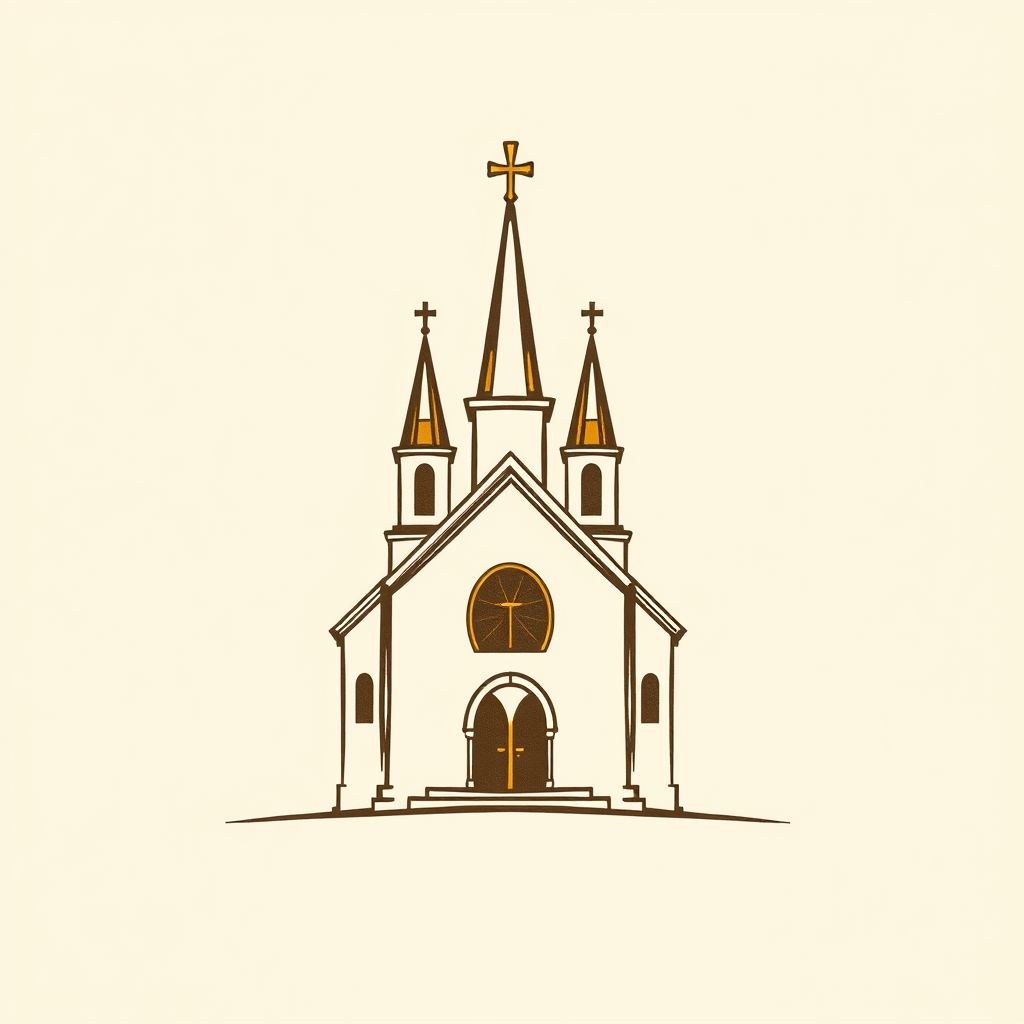
Saints Cyril and Methodius are depicted facing one another and together supporting a church: this manner recalls that they are the founders of the Slavic and Bohemo-Moravian Church. An old Prague missal adds the letters of the Slavonic alphabet to the edifice. — They are also depicted together holding the painting of the Last Judgment painted by Saint Methodius for the intention of Bogoris.
Taken from the two lives of these Saints, published by Henschenius, under the 9th of March. See Kuhlins, in Hist. codicis surri Slavonici, and Introduct. in hist. et rem. litter. Slavorum, Altonaica, 1739; Stredowski, Sacra Moravia historia; Culeynski, Specimen Ecclesiae Ruthenica, an. 1733; Rohrbacher, Histoire de l'Église; Godescard, etc.
Iconography
Signs and attributes
Entities
Narrative network
The names, places, and concepts most present in the entry, weighted by centrality in the text.
The supernatural in their life
The miracles of Saints Cyril and Methodius
Frequently asked questions about Saints Cyril and Methodius
Who was Saints Cyril and Methodius?
Brothers from Thessalonica in the 9th century, Cyril and Methodius are the apostles of the Slavic peoples. They evangelized the Khazars, Bulgarians, and Moravians, translating sacred texts through the invention of the Slavonic alphabet. Despite opposition regarding the use of the Slavic language in the liturgy, they received the support of the papacy to establish the Church in Central Europe.
What is Saints Cyril and Methodius the patron saint of?
Patronage of Saints Cyril and Methodius: Slavic peoples, Moravia, Bohemia and Bulgaria.
How is Saints Cyril and Methodius depicted in Christian art?
In iconography, Saints Cyril and Methodius is recognizable by: Supporting a church together, Painting of the Last Judgment and Slavonic alphabet.
What miracles are attributed to Saints Cyril and Methodius?
1 miracle are attributed to this saint, notably: Vision / apparition and Sign / wonder.
Which saints were contemporaries of Saints Cyril and Methodius?
Contemporaries include: Saint Ansgar (Apostle of the North), Saint Bernard of Menthon (Apostle of the Alps), Saint Rumold (Rombaud) and Saint Zachary, Pope.
When did Saints Cyril and Methodius die?
Saints Cyril and Methodius died around 900.
What are the other names of Saints Cyril and Methodius?
Other forms of the name: Constantin, Cyrille, Méthode and Philosophe.
Who are the relatives of Saints Cyril and Methodius?
Relatives of Saints Cyril and Methodius: Cyrille (brother) and Méthode (brother).
Annexes & related entities
Structured data for exploration: events, miracles, quotes, places, attributes, patronages, and important entities cited in the text.
Key Events
- Mission to the Khazars (848)
- Discovery of the relics of Saint Clement I in Crimea
- Conversion of King Boris (Michael) of the Bulgarians (865)
- Invention of the Slavonic alphabet by Cyril
- Translation of the Bible into the Slavic language
- Journey to Rome and approval of the Slavonic liturgy by John VIII (880)
- Conversion of Duke Borivoj of Bohemia
Quotes
-
Bene patienter erunt ut annuntient.
St. Greg., Mur. xx. -
You have launched your arrows into the midst of the crowd, and you claim that no one will have been wounded!
Cyril to Photius