
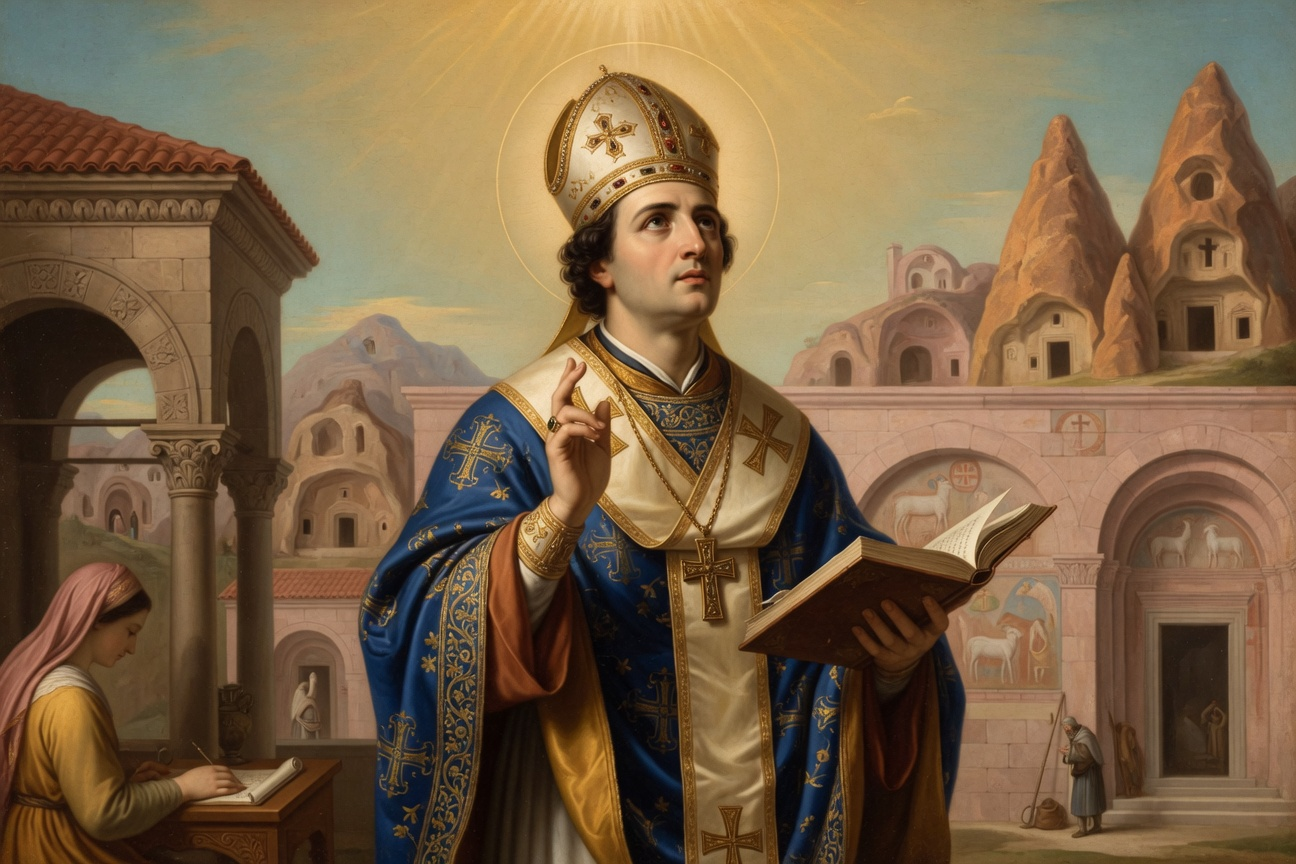
Brother of Saint Basil and Saint Macrina, Gregory of Nyssa was an illustrious theologian and bishop of the 4th century. After a career as a rhetorician and a marriage, he embraced ecclesiastical life and became Bishop of Nyssa, where he fought firmly against Arianism despite exile. A great defender of orthodoxy at the Councils of Constantinople, he left behind an immense literary and philosophical body of work.
Contemporaries

Figures and markers around the normalized period for this entry.
Guided reading
6 reading sections
SAINT GREGORY OF NYSSA, BISHOP
AND DOCTOR OF THE CHURCH
Origins and secular life
Born in Cappadocia into a family of saints, Gregory studied letters and married before committing himself to the ecclesiastical path.
This illustrious Doctor of the C hurch was born in Cappadocia, around the year 331, into a family of Saints. Saint M acrina and S aint Basil, his elders, contributed to his education as much as his parents. As soon as his age permitted, he studied human letters. Theodoret also expressly states that he led a monastic life for some time; but he did not commit himself to it. He even chained himself to the world through the bonds of marriage. He later regretted this in his *Treatise on Virginity*; he groaned at not being able to benefit himself from what he said about this virtue, and he lamented the loss of a good he had known too late. He nevertheless married a woman of great merit, who became the companion of his virtue. Living together in a manner consistent with the Gospel, they were not far from the perfection of those in their family who served God in celibacy.
After a certain time, which history does not specify, Gregory embraced the ecclesiastical state and fulfilled the function of reader. But, seduced either by ambition or by the charms of profane letters, he ceased reading the sacred books to the faithful in order to teach rhetoric to young people. This was a scandal among the Christians; one saw in this conduct a kind of desertion of the ecclesiastical career and a great danger for the one who embarked upon it. Sain t Gregory of Nazianzus, hi s friend, addressed to him in a letter, on this subject, remonstrances equally full of vehemence and charity. One is led to believe that these reproaches touched our Saint. It is certain, in any case, that he was not a rhetorician for long, and that having returned to the ecclesiastical state, he was raised to the priesthood.
It was a few years later, according to some authors, that he lost his wife, of whom Saint Gregory of Nazianzus gave such a beautiful eulogy; he says "that she was the ornament of the Church; he calls her a sacred person, a true wife of a priest, equal in honor and dignity to her husband, and worthy of great mysteries." These words have led many to believe that, having voluntarily separated from her husband when he entered the priesthood, she had been honored with the office of deaconess.
The Episcopate and the Struggle Against Arianism
Appointed Bishop of Nyssa by his brother Basil, he suffered persecution by the Arians and exile under Emperor Valens before being restored by Gratian.
Saint Basil, surnamed the Great , brother of our Saint, raised in 370 to the see of Caesarea, the metropolis of Cappadocia, thought to employ the great talents of Gregory in the public service of the Church. Th e see of Nyssa, a city of Cappadocia, thirty leagues from Caesarea towards Galatia, having become vacant six or seven months later, he had it filled by his brother. In announcing this election to Eusebius of Samosata, he said to him: "I would have wished that my brother Gregory had an Church to govern proportionate to his merit and his capacity; that is to say, the whole Church which is under the sun. But since that cannot be, one must be content that Gregory honors the place where he will be bishop. True greatness does not consist only in being capable of great things, but in being able to make small things appear great."
Our Saint did not share these sentiments regarding his merits; he believed himself far below the dignity and the office of the episcopate; it was necessary for the bishops of the province to use force to oblige him to receive the laying on of hands. Their choice was soon justified by the conduct of this holy prelate. He practiced poverty upon himself to enrich the poor; he consecrated his patrimony to them. Zealous, charitable, and prudent, his profound learning did not prevent him from making himself accessible to all. We shall speak later of the writings he produced to regulate the morals and discipline of the Church; he watched over the observance of the canons with even more vigor than his brother. He fought error no less keenly than vice, and no human consideration ever halted his episcopal ardor. As a doctor, he served the universal Church with his pen; as a bishop, he worked with all his strength, both by example and by preaching, for the good of the Church of Nyssa; this was a title to the hatred of the Arians. These heretics slandered him to Demosthenes, Vicar of Pontus, a great enemy of the Catholics, like his master, the Emperor Valens. Demosthenes sent soldiers to arrest the holy bishop. The latter at first allowed himself to be taken without resistance; but when he saw that they would grant him no relief, despite the poor state of his health and the severity of the season, he escaped from the hands of the soldiers. In vain did Basil, in a respectful letter, try to soften Demosthenes, explaining to him on behalf of all the bishops of Cappadocia the innocence of his brother.
The council that was charged with judging him at Nyssa was composed entirely of Arians. What caused our Saint the most pain was less the persecution he suffered than the progress of the heresy and the sad fate of his flock, governed by an intruder without faith, without morals, and without capacity. He wrote about this to Saint Gregory of Nazianzus, who replied that he should put his trust in God and hope that error would not triumph over truth for long. This prediction was realized in 378, at the death of the Emperor Valens. Gratian, his successor, recalled the exiled bishops and restored their churches to them.
Eastern Missions and Family Mourning
After the death of Basil, Gregory participated in the Council of Antioch and visited Arabia and Palestine to reform the Churches.
The exile of Saint Gregory of Nyssa was by no means lost to the Church; it was perhaps the finest moment of his life, for the churches in the places where it was known he would pass called upon him to pacify and regulate them. Saint Gregory of Nazianzus says that this continual change of place made him like the sun, which, without ever stopping in any one place, brings warmth, light, and fertility everywhere. Our Saint therefore returned to his see; but he had scarcely tasted the joy of seeing his people again when he was called to Caesarea by the death of his brother, Saint Basil, whom he had always regarded as his guide and his oracle. Only the thoughts of religion could give him enough strength to bear the loss of a person so dear, at the very moment when the peace restored to the Church was about to allow them to correspond and see each other more freely (379). The same year, he had to go to Antioch, where the patriarch Saint Meletius held a council. Saint Gregory of Nyssa received the commission there to visit Arabia and Palestine to reform the churches. But he did not make these journeys until the following year, that is to say, in 380.
The final moments of Saint Macrina
Gregory assists his sister Macrina in her final moments and presides over her funeral, marked by accounts of miracles and great piety.
Upon leaving the council, he returned to Nyssa, then departed to visit his si ster, Saint Ma crina, whom he had not seen for eight years. He needed to find consolation with her for the death of Saint Basil, but he found a new subject of sorrow; when he was near the monastery where Saint Macrina was superior, he learned that she was ill. The monks who lived in the same place, under the guidance of Saint Peter, her brother, came to meet him, according to their custom; the virgins awaited him in the church. After the prayer, they bowed their heads to receive his blessing and withdrew modestly, without a single one remaining. He saw by this, for they were veiled, that his sister was not there. He went to see her in her room, where he found her lying on the ground, on a board; she was turned toward the East to be able to pray. The conversation soon fell upon Saint Basil: "My spirit," said Saint Gregory, "was all troubled by it, my face cast down, and I could not hold back my tears. But she, far from letting herself be cast down like me, took advantage of it to say such wonderful things about Divine Providence and the future life that I was completely transported out of myself." These thoughts later served our Saint to compose a Treatise on the Soul and the Resurrection.
In these sweet outpourings of the sister and the brother, where each recounted what had happened, Gregory spoke to her of the disgraces he had suffered under the Emperor Valens, his exile, his deprivations. "What! my brother," Saint Macrina said to him, "do you take that for disgraces? It would be ungrateful not to look upon them as great favors from heaven." The Bishop of Nyssa, delighted by this heavenly conversation, would have wished it to last longer; but they heard the chanting of the psalms for the prayer of the lamps, that is to say, Vespers; his sister sent him to the church and prayed on her side; the next morning, he found her exhausted by fever, and saw well that she would not survive the day: but she, overcoming the violence of her illness and the difficulty of breathing, strove to dispel by her conversations the sadness that appeared on her brother's face. Toward evening, feeling herself dying, she ceased speaking to him and began to pray, but in a voice so low that one could barely hear it. Meanwhile, she joined her hands and made the sign of the cross over her eyes, her mouth, and her heart. When light had been brought, one recognized, by the movements of her lips and eyes, that she was performing, as much as she could, the evening prayer, the end of which she marked by making the sign of the cross over her face; and, heaving a deep sigh, she ended her life with her prayer. Saint Gregory, whom she had asked to close her eyes and mouth, found her eyelids gently lowered, as if she had been asleep, her mouth and her hands on her chest, in short, her whole body so well composed that there was no need to touch it to bury her.
Saint Gregory asked two of the principal nuns, an illustrious widow named Vestiana and a deaconess named Lampadia, who, under the deceased, led the community, to help him render funeral honors to his sister. He asked them if they did not have in reserve some precious garments to adorn his sister's body, according to custom. Lampadia replied while weeping: "You see everything she had. Here is her cloak, her veil, and her shoes, all worn out." Saint Gregory was therefore reduced to using one of his own cloaks; for the clothing of men and women consisted of large draperies that several could use interchangeably. Vestiana, while adorning the head of the deceased, said to Saint Gregory: "This was her necklace." While saying this, she detached it from behind and showed him a cross and a ring, both of iron, which the Saint always wore over her heart. "You may keep the cross," said Saint Gregory, "I will be content with the ring, for I also see a cross engraved on it." — "You have not chosen badly," replied Vestiana, "the ring is hollow at that spot and contains wood from the true cross."
Vestiana pointed out to him, below Macrina's neck, a black spot as large as a needle prick, and said to him: "It is a m onument to the piety a nd protection of God toward her. Having one day a kind of cancer in that spot, she never wanted to suffer the surgeons to lay a hand on it; her modesty made her look upon this remedy as something worse than the evil. As her mother wanted to force her to undergo the operation, the Saint spent a night in the church in prayers and tears. The next day, her mother returned to the charge; Macrina then begged her to only make the sign of the cross over her breast. The mother did so, and the cancer was found entirely healed; there remained only the small black mark that you see."
The night was spent singing psalms, as in the feasts of the martyrs; and, the day having come, as a very great multitude of people had rushed in, Saint Gregory arranged them into two choirs, the women with the virgins, the men with the monks. The bishop of the place, named Araxius, was also there with all his clergy. Saint Gregory and he took the front of the bed on which the body was, two of the first of the clergy took it from behind, and they carried it thus slowly, stopped by the crowd of people who walked in front and pressed all around. Two rows of deacons and other ministers walked before the body, carrying wax torches, and psalms were sung with one voice, from one end of the procession to the other. Although there were only seven or eight stadia to the place of burial, that is to say about a thousand paces, they spent almost the whole day doing it. It was the church of the forty martyrs, where the father and mother of Saint Macrina were buried. Having arrived there, the customary prayers were said; and, before opening the sepulcher, Saint Gregory took care to cover the bodies of his father and mother with a white sheet, so as not to fail in respect by exposing them to view disfigured by death. Then, he and Araxius took the body of Saint Macrina from the bed and placed it, as she had always desired, beside Saint Emily, her mother, saying a common prayer for both. Everything being finished, Saint Gregory prostrated himself on the tomb and kissed the dust. This is how he himself describes the funeral of Saint Macrina, his sister, in the letter to the monk Olympius, which contains the life of this Saint.
Pilgrimage to the Holy Land and Great Councils
He traveled to Jerusalem, participated in the Ecumenical Council of Constantinople in 381, and established himself as a pillar of orthodoxy.
Saint Gregory, after having performed the final duties for his sister, returned to Nyssa at the end of the year 379. He remained there until the fine season allowed him to visit Arabia and Palestine. The emperor granted him the use of public carriages for this journey: a chariot was placed at his disposal, and it served him and those who accompanied him as both church and monastery. They sang psalms along the way and observed fasts. He thus visited Arabia, then Bethlehem, Calvary, the Mount of Olives, and the Holy Sepulchre, to satisfy his devotion; but he found so much disorder and corruption among the inhabitants of that land that he considered this pilgrimage dangerous, especially for women and religious, whose virtue was greatly exposed there. He later explained this in a discourse in the form of a letter; it is not that he absolutely condemned pilgrimages, since he made one himself, but he pointed out their perils. The affairs of the Church were in no better state than the morals of the inhabitants, despite the zeal of Saint Cyril, Bishop of Jerusalem. Saint Gregory was no more successful in reforming that Church; he was obliged to return, having done nothing other than increase his merits through noble intentions and courageous efforts.
The following year (381), he was present at the famous Council of Constantinople, which, though composed only of Eastern bishops, became ecumenical because the entire Church adopted its decrees. It is one of the four councils that Pope Saint Gregory respected as the four Gospels; there he made the acquaintance of Saint Jerome, and he showed him, as well as Saint Gregory of Nazianzus, a book he had written against the heretic Eunomius. He delivered there the funeral oration for Saint Meletius of Antio ch, pres ident of the assembly; furthermore, he was one of the prelates established in the East as the center of Catholic communion; so that if anyone had refused to communicate with him, they would not have been considered as belonging to the true Church. He also attended another council in Constantinople the following year (382), where he delivered a beautiful discourse on the divinity of the Son and the Holy Spirit. Three years later (385), he was obliged to return to the imperial city and make a long stay there: he delivered two funeral orations: one for the young princess Pulcheria, daughter of Emperor Theodosius; the other for the empress, the first wife of Theodosius and mother of Pulcheria. The latter is "excellent and accomplished, says Father Giry; it contains the virtues proper to queens and princesses; it can be read by ladies, who will find in it a model of Christian perfection, well suited to persons of their condition."
Last years and literary work
He ended his life between 394 and 404, leaving behind an immense theological and philosophical body of work, earning him the title of Father of Fathers.
Upon returning to Nyssa, our Saint often saw his rest disturbed by Helladius, Bishop of Caesarea, successor to Saint Basil, his brother, a restless man of very mediocre merit, who applied himself only to persecuting and wearying, without reason, the relatives and friends of his holy predecessor. Saint Gregory, despite his patience and humility, was obliged to entrust to Saint Flavian, Patriarch of Antioch, the task of defending him from these unjust attacks. In the year 394, Saint Gregory attended another council in Constantinople for the dedication of the church of Rufinus; he was placed among the metropolitans, a great distinction granted to his person and his merit, for his episcopal see was of little consequence. He ended his glorious career between the year 394 and the year 404: the exact year is not known.
[APPENDIX: NOTICE ON THE WRITINGS OF SAINT GREGORY OF NYSSA.]
1st The Hexaemeron, or book on the work of the six days. It is a supplement to the homilies of Saint Basil on the same subject. The latter had omitted all the questions that were above the reach of the people. Saint Gregory undertook to explain them, at the request of several persons commendable for their science and virtue, and he did so with an accuracy worthy of a brother of the great Basil. He shows in this work that he had a perfect knowledge of ancient philosophy.
2nd The Treatise on the Formation of Man can be regarded as a continuation of the previous work, although it was composed first, that is to say around the year 379. It is very curious and full of erudition: one finds there very beautiful things on the excellence and dignity of man, on his likeness to God, on the spirituality of his soul, on the resurrection of bodies, etc.
3rd The book on the Life of Moses or on the perfect life, is addressed to a certain Caesarius, who had prayed the Saint to teach him in what the perfect life consists, so that he might strive to attain it. Saint Gregory traced for him an accomplished model of all virtues in the person of Moses.
4th The two Treatises on the Inscription of the Psalms, and the Homily on the Sixth Psalm. Saint Gregory gives in these two treatises a general idea of the psalms, of which he shows the marvelous utility for the sanctification of the faithful. He says that in his time, Christians of all ages, of all sexes, and of all conditions, constantly had these divine canticles on their lips.
5th The eight Homilies on the first three chapters of Ecclesiastes. They contain admirable instructions on virtues and vices, and on the effects that follow from them.
6th The fifteen Homilies on the Song of Songs, which were all preached, are addressed to a virtuous lady of Constantinople named Olympias, who, having become a widow after about twenty months of marriage, distributed her goods to the poor and to the churches. The holy doctor says there that the book of the Song of Songs should only be read by those who have a pure heart, detached from the love of the senses.
7th The five Homilies on the Lord's Prayer, which were also preached, contain very useful instructions on the necessity and efficacy of prayer.
8th The eight Homilies on the eight Beatitudes are of the same style as the preceding ones. One finds there solid instructions on humility, meekness, poverty of spirit, etc.
9th The Treatises on the Submission of the Son, and on the Pythoness, and the Discourse on the Ordination of Saint Gregory. It is not certain that the first work is by our holy doctor. The error of the Origenists regarding the cessation of the punishments of the damned appears to be taught there. Those who attribute this treatise to Saint Gregory say that the error found there was added after the fact by some Origenist. The treatise on the Pythoness is in the form of a letter, addressed to a bishop named Theodosius. Saint Gregory there debates the question of the evocation of the soul of Samuel, and thinks that it was the demon who, under the figure of Samuel, spoke to Saul. The discourse on the ordination, which should rather be called the discourse on the dedication, was delivered in 394, on the occasion of the dedication of a magnificent church that Rufinus, Praetorian Prefect, had built in the village of the Oak, near Chalcedon.
10th The Antirrhetic, or treatise against Apollinaris. There was only a fragment of it in the editions of the works of Saint Gregory; but Laurent Zacagnius, librarian of the Vatican, gave it in its entirety in 1698, from a manuscript more than seven hundred years old. Leontius of Byzantium, Euthymius, and Saint John Damascene cite several passages from it under the name of Saint Gregory, and the sixth general council attributes it to him. One cannot therefore doubt that this Father is its author. It was composed around the year 377. The holy doctor proves there, against Apollinaris, that the divinity is impassible, that Jesus Christ has a soul, that he unites in his person the divine nature and the human nature, etc.
11th The Discourse on the Love of Poverty, which is a pathetic exhortation to almsgiving. The Book against Fate, where it is proven that everything happens by the Order of Providence. It was composed around the year 381, and is written in the form of a dialogue. The Treatise on Common Notions, which is a philosophical exposition of the terms that the ancients used to explain the mystery of the Trinity.
12th The Canonical Epistle to Letoius, Bishop of Melitene, metropolis of Armenia. It is part of the penitential canons published by Beveridge. Saint Gregory prescribes penances there for the most enormous sins. B. Ceillier has shown, vol. VIII, pp. 265 and 266, the lack of solidity in the reasons that determined some Protestants to strike this epistle from the catalog of the works of Saint Gregory of Nyssa.
13th Discourse against those who delay their baptism. Sinners are exhorted there to penance, and catechumens to receive baptism, by very strong reasons drawn mainly from the uncertainty of the hour of death, and the various accidents that can at any moment precipitate us into the grave.
14th The Discourses against fornication and usury, on penance and almsgiving, offer a very beautiful exposition of Christian morality on these various points. The Discourse against usury deserves particular attention, for the strong and interesting manner in which the matters are treated there.
15th Discourse on Pentecost. Testimony against the Jews. One only had the first work in Latin; but Zacagnius published it in Greek from three manuscripts of the Vatican library.
Saint Gregory proposes, in the second work, to prove the mystery of the Trinity against the Jews by the very words of Scripture. One did not have it in anything other than Latin, before Zacagnius published the Greek text. This scholar, not having found in the manuscripts the last three chapters of the old Latin editions, concluded, with reason, that they were supposed, and instead of these three chapters, he gave four others which form a sequence and make the work complete.
16th The twelve books against Eunomius. Saint Gregory there avenges the memory of Saint Basil, his brother, attacked by Eunomius, and proves there, against this heresiarch, the divinity and consubstantiality of the Word. He says there that independently of the Holy Scripture, which he uses with marvelous sagacity, tradition alone would suffice to confound the heretics.
17th The Treatise to Ablarius, and the Treatise on the Faith. It is a defense of various points of Catholic doctrine against the Arians.
18th The Great Catechism, divided into forty chapters, is cited by Theodoret, Leontius of Byzantium, Euthymius, Saint Germanus of Constantinople: the last twenty lines were added after the fact. In this work, Saint Gregory of Nyssa teaches catechists how they must prove, by reasoning, the mystery of the faith.
19th The Book on Virginity is divided into twenty-four chapters, not including the prologue. The holy doctor shows there the excellence of virginity, and the advantages it has over the state of marriage.
20th The ten Syllogisms against the Manichaeans, and the Book on the Soul and the Resurrection. It is proven, in the first work, that evil is not an incorruptible and uncreated nature, any more than the devil, who is its father and author. The second is a dialogue or account of a conversation that Saint Gregory had with his sister on the eve of her death, concerning that of Saint Basil. It was composed around the year 380.
21st The Letter to Theophilus, Patriarch of Alexandria, against the Apollinarists. It is cited in the fifth general council and in the Panoply of Euthymius.
22nd Three Treatises on Christian Perfection. Saint Gregory examines in the first what the name and profession of Christian obliges one to; he traces, in the second, rules for arriving at perfection; in the third, entitled The Goal of the Christian, he develops and brings into full light the holiest maxims of the Gospel.
23rd The Discourse against those who do not wish to be reproved, and the Treatise on children who die prematurely. Several interesting questions are treated in the second work.
24th The Discourse on the Nativity of Jesus Christ, and the two Panegyrics of Saint Stephen. D. Ceillier proves, vol. VIII, p. 345, that one cannot contest the discourse to Saint Gregory. It speaks there, not only of the birth of Jesus Christ, but also of the murder of the innocents. One only found the first panegyric in the old editions; one is indebted to Zacagnius for the publication of the second.
25th Discourse on the baptism, resurrection, and ascension of Jesus Christ. The first, which is entitled in some editions, On the Day of Lights, was delivered on the feast of the Epiphany, the day on which catechumens were baptized in the churches of Cappadocia. Of the five discourses on the resurrection, only the first, the third, and the fourth appear to be by Saint Gregory.
26th Discourse on the divinity of the Son and the Holy Spirit. One finds there the refutation of the errors of the Arians and the Eunomians.
27th The Panegyrics of Saint Basil and the forty Martyrs, the Funeral Orations of Pulcheria and Flacilla; the Lives of Saint Gregory Thaumaturgus, Saint Theodore, Saint Meletius, Saint Ephrem, and Saint Macrina.
28th The Discourse on Death has been much mistreated by heretics. The goal of Saint Gregory was to provide motives of consolation to Christians who grieved excessively over the death of their loved ones.
29th Several letters. In the one entitled: On the Pilgrimage to Jerusalem, the saint rises against several abuses that some Christians committed under the pretext of visiting the holy places; but he does not condemn pilgrimages in themselves, as several Protestants have claimed. Besides the letters of which we have just spoken, Zacagnius gave fourteen others, from a Vatican manuscript. Jean-Baptiste Carraccioli, professor of philosophy at the college of Pisa, also had seven printed, which had never been published, in Florence, 1731, in-fol. He had taken them from a manuscript in the library of the Grand Duke of Tuscany.
Saint Gregory of Nyssa can be compared to the most famous orators of antiquity, for the purity, ease, sweetness, strength, fertility, and magnificence of his style; but he surpasses himself in a way in his polemical works. He shows there a singular penetration of mind, and a marvelous sagacity in unmasking and confounding the sophisms of error. He is the one of all the Fathers who best refuted Eunomius. Saint Gregory has only been reproached for having given too much to allegory, and for having sometimes explained, in a figurative sense, texts of Scripture that it would have been more natural to take literally.
The best edition of the works of Saint Gregory of Nyssa is the one that Fronton le Duc gave in Greek and Latin in Paris, in 1615, 2 vols. in-fol.; but one must add to it the third volume also in-fol., which the same Fronton le Duc gave in 1618 as an appendix. This edition with the supplement is preferred to the one that appeared in Paris, in 1638, 3 vols. in-fol.
One will find a very correct, Greek-Latin edition in the Patrology of M. Migne.
The ancients granted great praise to our Saint: they call him the worthy brother of Saint Basil, because of his faith, his good life, his virtue, and his wisdom (Vincent... Liricensis... in commonit... cap. xxxi); they called him the faith and the rule of all virtues (Nazianzen. Orat. 6, p. 138); they said that these two brothers were an accomplished model of the moderation to be kept in prosperity and the strength with which one must endure adversity (idem. epist. 37, p. 799). In the second council of Nicaea, he was given the title of Father of Fathers (Concil., t. vii, p. 477). We had to rewrite the history of this life, which was incomplete in the collection of Father Giry.
Iconography
Signs and attributes

Entities
Narrative network
The names, places, and concepts most present in the entry, weighted by centrality in the text.
The supernatural in their life
The miracles of Saint Gregory of Nyssa
Frequently asked questions about Saint Gregory of Nyssa
Who was Saint Gregory of Nyssa?
Brother of Saint Basil and Saint Macrina, Gregory of Nyssa was an illustrious theologian and bishop of the 4th century. After a career as a rhetorician and a marriage, he embraced ecclesiastical life and became Bishop of Nyssa, where he fought firmly against Arianism despite exile. A great defender of orthodoxy at the Councils of Constantinople, he left behind an immense literary and philosophical body of work.
How is Saint Gregory of Nyssa depicted in Christian art?
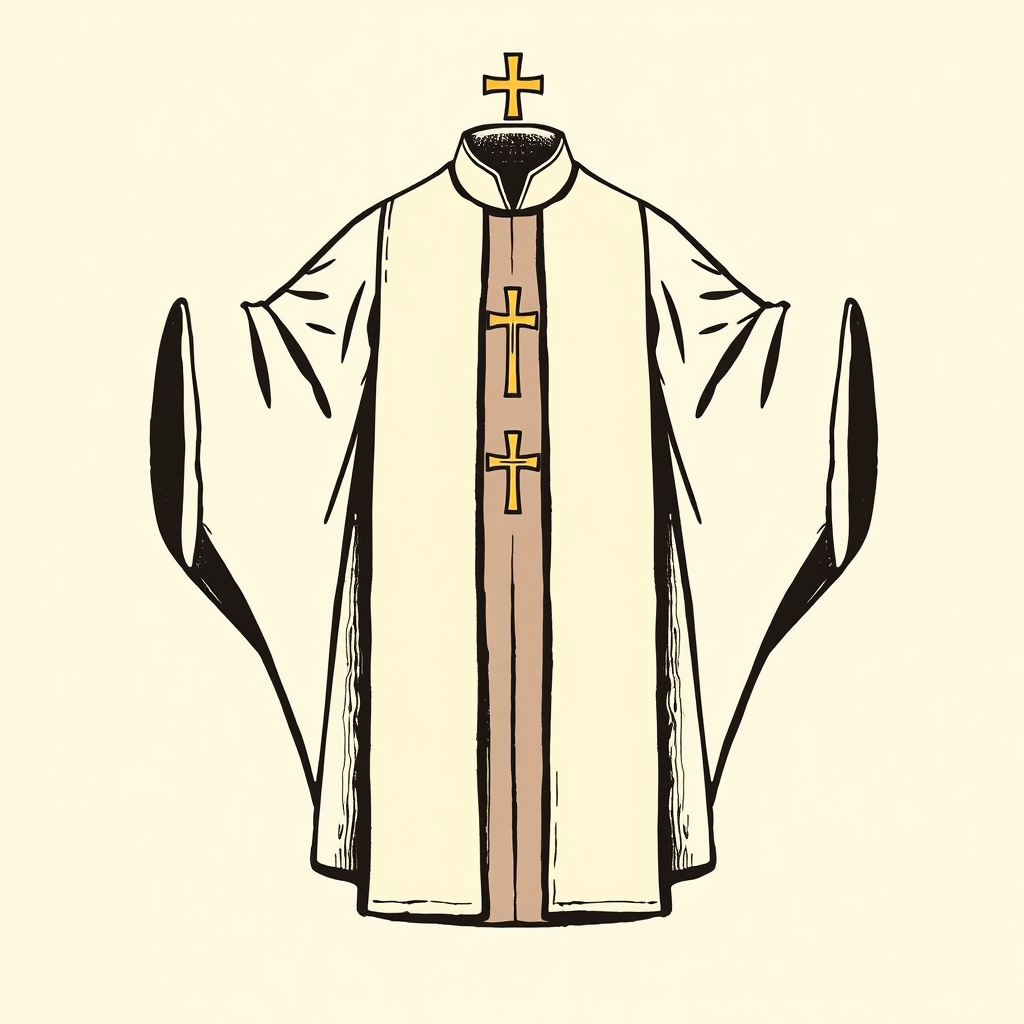
In iconography, Saint Gregory of Nyssa is recognizable by: episcopal vestments and book of a doctor.
What miracles are attributed to Saint Gregory of Nyssa?
1 miracle are attributed to this saint, notably: Healing.
Which saints were contemporaries of Saint Gregory of Nyssa?
Contemporaries include: Saint Blaise, Saint Hilary of Poitiers, Saint Basil the Great (Archbishop of Caesarea) and Saint Baudilus.
When did Saint Gregory of Nyssa die?
Saint Gregory of Nyssa died around 394.
Who are the relatives of Saint Gregory of Nyssa?
Relatives of Saint Gregory of Nyssa: Saint Basile le Grand (brother), Sainte Macrine (sister), Saint Pierre (brother), Sainte Emélie (mother) and Inconnue (wife).
Annexes & related entities
Structured data for exploration: events, miracles, quotes, places, attributes, patronages, and important entities cited in the text.
Key Events
- Born in Cappadocia around 331
- Marriage to a woman of merit
- Career as a rhetorician followed by entry into the priesthood
- Election to the see of Nyssa in 371
- Exile under Emperor Valens due to the Arians
- Return from exile in 378 upon the death of Valens
- Participation in the Council of Constantinople in 381
- Travels to Arabia and Palestine in 380
- Attended the funeral of his sister Saint Macrina
Quotes
-
True greatness does not consist only in being capable of great things, but in being able to make small things appear great.
Saint Basil the Great (cited in the text)