
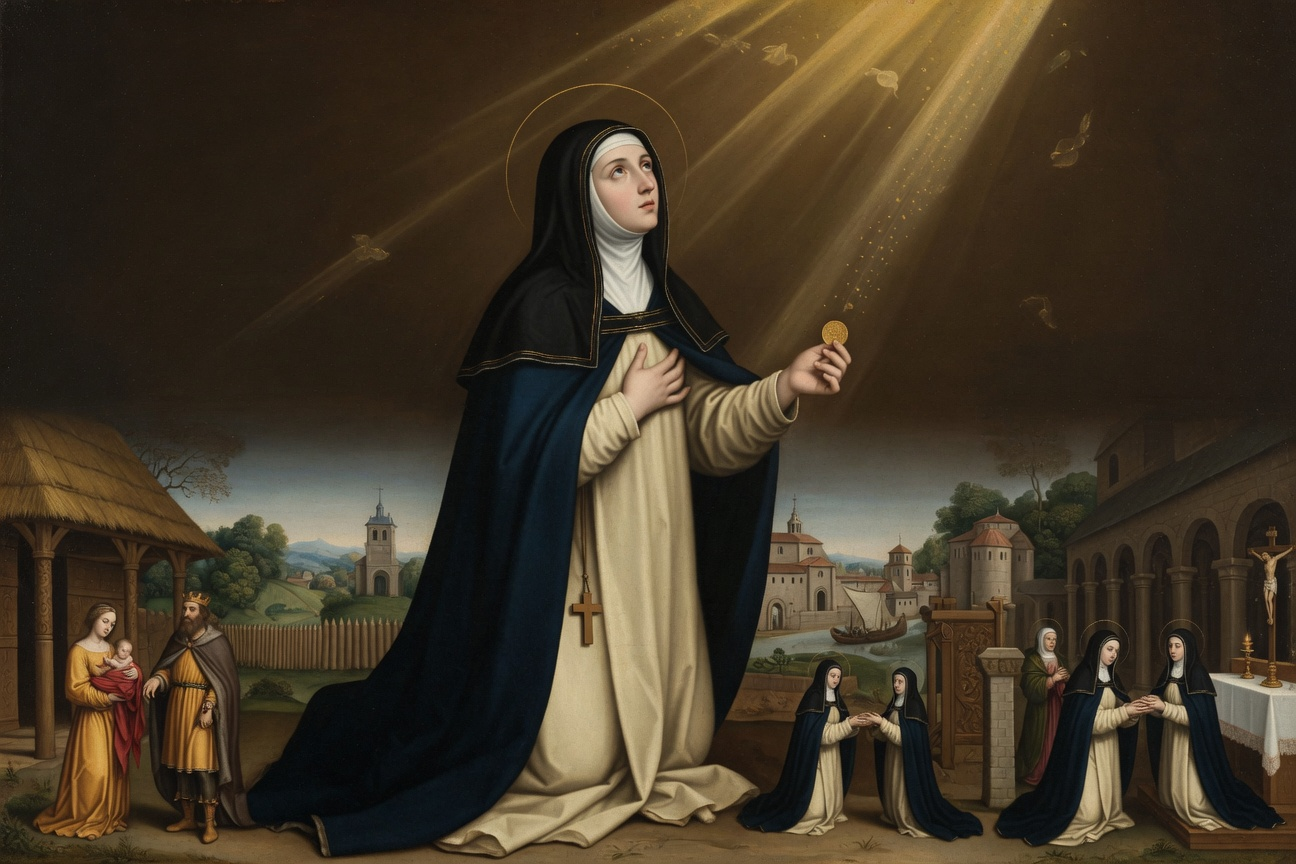
A princess of Kent and daughter of King Eorcenberht, Eartongathe retired to the monastery of Sainte-Fare in France. Warned of her impending death by a celestial vision, she passed away in the 8th century surrounded by miraculous signs. Her body was interred in Meaux at the church of Saint-Étienne.
Contemporaries

Figures and markers around the normalized period for this entry.
Guided reading
4 reading sections
SAINT EARTONGATHE, NUN OF SAINTE-FARE (8th century).
Royal origins and education
Eartongathe, daughter of King Ercombert of Kent and Sexburge, is sent young to the monastery of Saint-Fare to be educated by her aunts.
Ercongode, at Meaux. Eartongath e was born in the county of Kent, around the middle of the 7th century. Her father was King Ercomb ert, who was the first to destroy idols in the country and to enforce the observance of the Lenten fas t; her m other was Sexburge, daughter of Anna, the most pious k ing of the East Angl es. Her sister Hermenilda, and several of her relatives, of both sexes, have attained the glory of the Blessed. She was brought, while still v ery young, to the famous monastery of Saint-Fare, to be raised under the gu idance of h er aunts Sætride and Adalberge.
Vocation and premonitory vision
Consecrated to virginity, she receives a heavenly vision announcing her imminent death, which prompts her to prepare herself spiritually among her sisters.
In imitation of these holy women, she vowed her virginity to Jesus Christ, and resolved to lead a life absolutely hidden in Him. Her divine Spouse found her pleasing, and He deigned to let her know that the time of reward was approaching. Indeed, the virgin saw in a dream a crowd of people dressed in white entering the monastery, saying that they had come to fetch, to carry off to heaven, the gold c oin brought from England to this pl ace. Eartongathe, understanding by this that her end was not far off, began to go through the cells of the servants of Christ, especially those who were old and infirm, and to commend herself to their prayers.
Death and miraculous signs
She died at dawn accompanied by celestial chants; her tomb at the church of Saint Stephen exhaled a sweet odor when it was moved.
A few days later, she departed this world towards the dawn of the day. Celestial concerts were heard around the house where her body lay, and her holy soul was seen ascending to the abode of joy, all dazzling with light. The spouse of Christ was buried in the churc h of Saint Stephen, the first martyr. Three days later, the stone covering the tomb was lifted and lowered to a greater depth in the same place. During this operation, the most sweet odor rose from the depths of the sepulcher and spread throughout the monument. God honored her with several miracles, which were recounted in the time of the venerable Bede.
Sources and mentions
The life of the saint is attested by the Venerable Bede and mentioned in the liturgical sources of Meaux.
Poupre de Meaux.
Iconography
Signs and attributes


Entities
Narrative network
The names, places, and concepts most present in the entry, weighted by centrality in the text.
The supernatural in their life
The miracles of Saint Eartongathe (Ercongode)
Frequently asked questions about Saint Eartongathe (Ercongode)
Who was Saint Eartongathe (Ercongode)?
A princess of Kent and daughter of King Eorcenberht, Eartongathe retired to the monastery of Sainte-Fare in France. Warned of her impending death by a celestial vision, she passed away in the 8th century surrounded by miraculous signs. Her body was interred in Meaux at the church of Saint-Étienne.
How is Saint Eartongathe (Ercongode) depicted in Christian art?
In iconography, Saint Eartongathe (Ercongode) is recognizable by: religious habit, celestial light and gold coin (symbolic).
What miracles are attributed to Saint Eartongathe (Ercongode)?
3 miracles are attributed to this saint, notably: Vision / apparition and Sign / wonder.
Which saints were contemporaries of Saint Eartongathe (Ercongode)?
Contemporaries include: Saint Hidulph of Trier, Saint Ghislain (Guillain), Saint Lambert (Landebert) and Saint Amand of Maastricht.
When did Saint Eartongathe (Ercongode) die?
Saint Eartongathe (Ercongode) died around 800.
What are the other names of Saint Eartongathe (Ercongode)?
Other forms of the name: Ercongode and Eartongathe.
Who are the relatives of Saint Eartongathe (Ercongode)?
Relatives of Saint Eartongathe (Ercongode): Ercombert (father), Sexburge (mother), Anna (maternal grandfather), Herménilde (sister), Sætride (aunt) and Adalberge (aunt).
Annexes & related entities
Structured data for exploration: events, miracles, quotes, places, attributes, patronages, and important entities cited in the text.
Key Events
- Born in the county of Kent
- Arrival at the monastery of Sainte-Fare for her education
- Vow of virginity
- Premonitory vision of her death (the gold coin)
- Visited the infirmary cells before her passing