
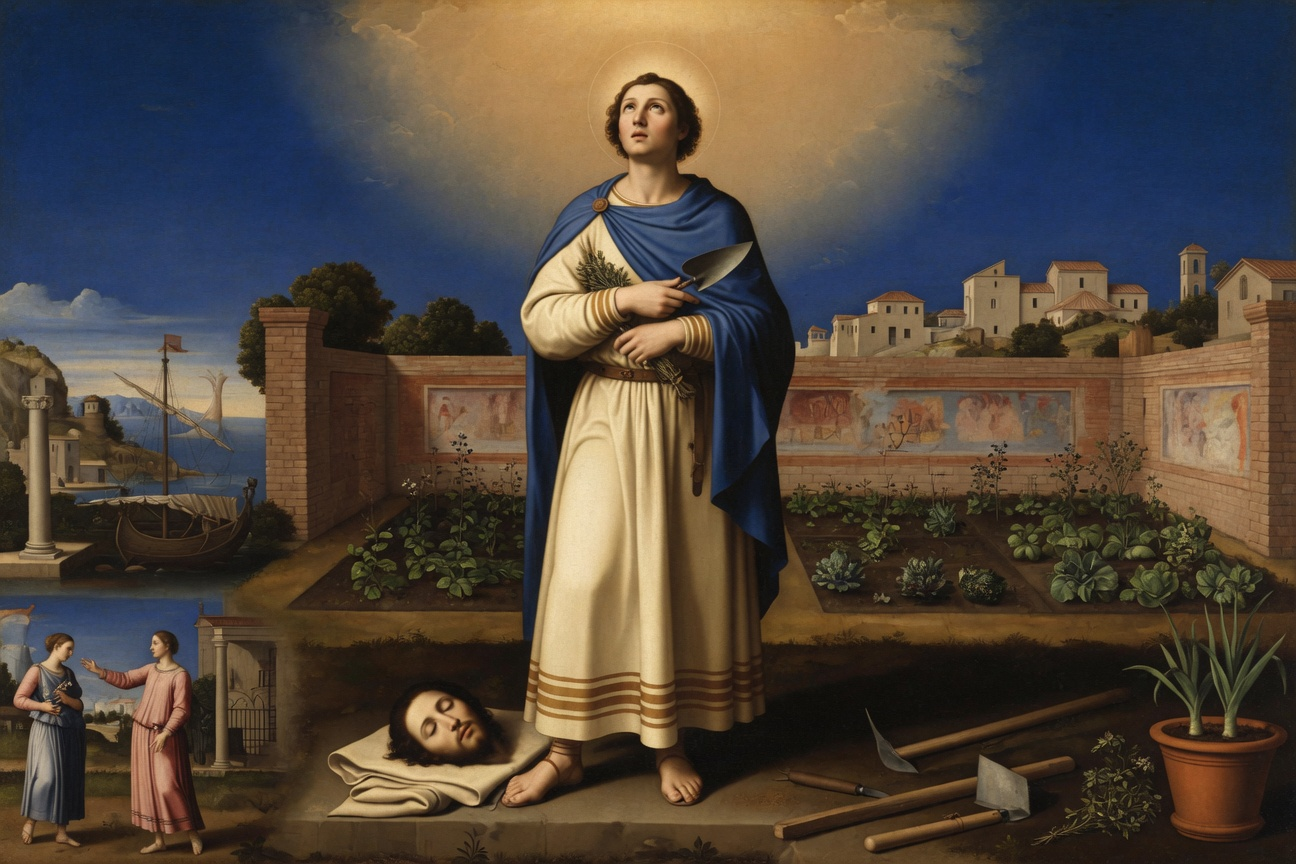
Of Greek origin, Serenus retired to Sirmium to live as a Christian gardener. Falsely denounced by a woman he had reprimanded for her immodesty, he confessed his faith before the governor. He was beheaded in 307 and his relics were later transferred to Billom in Auvergne.
Contemporaries

Figures and markers around the normalized period for this entry.
Guided reading
5 reading sections
SAINT SERENUS OR CERNEUF, GARDENER, MARTYR
Vocation and Solitary Life
Serenus, of Greek origin, retired to Sirmium in Pannonia to lead a life of prayer and manual labor as a gardener.
Dichoum, honus, in clientes secca rorem. Good gardener, call down upon us the divine dew. Hymn of Matins from the Office of Saint Cerneuf.
Serenus, Greek by birth, left his possessions, his friends, and his homeland to go and serve God in solitude, that is to say, to live in celibacy and in the exercises of prayer and penance. He came to Sirmium, in P annonia , whe re he b ought a garden that he cultivated himself and whose fruits and vegetables provided for his subsistence. The persecution having ignited, he hid himself for fear of being arrested; but after some time, he returned to his garden. One day, while he was occupied with his work, a woman, accompanied by two young girls, entered as if to take a walk. "What are you looking for?" Serenus said to her upon seeing her. "I am enchanted by your garden," she replied, "and I have come with the intention of walking in it." "A woman of your station," replied Serenus, "does not walk about at such an hour; you should be at home at this time. It is certain that a motive other than that of a walk brings you here. I am not as you think; so leave as soon as possible, and be henceforth more attentive to maintaining the restraint that I require of your sex."
The garden incident
Serenus reprimands a woman who entered his garden improperly, which leads to a slanderous complaint to Emperor Maximian.
This woman, stung by the Saint's remonstrances, withdrew covered in confusion and firmly resolved to take revenge; she therefore wrote to her husband, who was in the guar ds of Emperor Maxim ian, to complain to him of an alleged violence that Serenus had committed against her. The husband, having received this letter, went to find the emperor and asked him for justice for his outraged honor. 'Lord,' he said to him, 'while our lives are consumed in your service, our wives, separated from us, find themselves exposed to the insolence of a corrupter.' The prince gave him a rescript addressed to the governor of the province, who was enjoined to have all kinds of satisfaction given to this insulted husband. The husband left for Sirmium, presented the rescript to the governor, and begged him to avenge the outrage he had received in the person of his wife. 'Eh! Who is the insolent man,' said the governor, 'who dared to attempt the honor of a woman whose husband approaches the person of the emperor so closely?' — 'It is,' replied the officer, 'a miserable gardener named Serenus.' The governor sent for him immediately; and when he had arrived, he began by asking his name. 'My name is Serenus,' he replied. — THE GOVERNOR. 'What is your profession?' — SERENUS. 'I am a gardener.' — THE GOVERNOR. 'How did you have the audacity to insult the wife of an officer of such distinction?' — SERENUS. 'It has never happened to me to insult any woman.' — THE GOVERNOR. 'Let him be put to the question to make him confess the crime he committed in his garden.' — SERENUS. 'I remember that a lady came, some time ago, into my garden at an undue hour, with the intention, she said, of walking there. It is true that I took the liberty of pointing out to her that it was not decent for a person of her sex and quality to leave her home at such an hour.' This speech opened the husband's eyes to his wife's conduct; he left covered in confusion, without further pressing the governor to avenge him against a man whose innocence he saw.
Trial and martyrdom
Cleared of the accusation of outrage, Serenus was nonetheless questioned about his faith, declared himself a Christian, and was finally beheaded on February 23, 307.
However, the governor, struck by Serenus's response, saw that he was a good man; and considering, moreover, that far from being guilty, he had rebuked this woman with generous freedom, he suspected him of being a Christian. He therefore continued to question him to clarify this point. "Who are you," he said to him, "and what is your religion?" — "I am a Christian," replied Serenus without hesitating for a moment. — THE GOVERNOR. "Where have you been hiding, and how have you been able to exempt yourself from sacrificing to the gods?" — SERENUS. "It pleased the Lord to reserve me for this time. He seemed to have rejected me as a stone not very suitable for entering his edifice; but he has the kindness to take me back today to place me there. Furthermore, I am ready to suffer everything for his name, so that he may receive me into his kingdom with his Saints." — "Well then," the governor said to him in anger, "since you have wanted to elude the edicts of the emperors by flight and have hidden yourself so as not to sacrifice to the gods, as reparation for these crimes, you shall have your head cut off." Scarcely had this sentence been pronounced than the Saint was taken away and led to the place of execution, where he had his head cut off on February 23, 307.
Cult and relics in Auvergne
His relics were transferred to Billom by Bishop Juvenal, where his cult was durably established through a collegiate church.
The relics of Saint Serenus were some time later brought to Billom by Juvenal, Bishop of Auvergne. The place where they were first deposited was called Jardin-Saint-Cerneuf . Later , they were placed in the church of Notre-Dame: they perished due to the misfortunes of time. Nevertheless, the memory of Saint Serenus or Cerneuf, as they say in Auvergne, has remained famous in Billom. There was formerly, in this town, a collegiate church by the name of Saint-Cerneuf: it i s today the parish church.
Traditions and sources
Invoked for fair weather, the saint is mentioned in various ancient martyrologies, notably that of Saint Jerome.
Saint Serenus is invoked for fair weather. Is this a play on words, or is it in memory of his profession as a gardener for which he needed favorable weather? We prefer the latter explanation.
The ancient Martyrology attributed to Saint Jerome, an d published in Lucca by Florentinius, joins our Saint to sixty-two other Christians who suffered at Sirmium at different times; but the other Martyrologies, and especially the Roman one, count only fifty-two.
Taken from his sincere Acts, published by D. Ruinart .
Iconography
Signs and attributes


Entities
Narrative network
The names, places, and concepts most present in the entry, weighted by centrality in the text.
Frequently asked questions about Saint Serenus (Cerneuf)
Who was Saint Serenus (Cerneuf)?
Of Greek origin, Serenus retired to Sirmium to live as a Christian gardener. Falsely denounced by a woman he had reprimanded for her immodesty, he confessed his faith before the governor. He was beheaded in 307 and his relics were later transferred to Billom in Auvergne.
What is Saint Serenus (Cerneuf) the patron saint of?
Patronage of Saint Serenus (Cerneuf): gardeners and Billom.
What is Saint Serenus (Cerneuf) invoked for?
Saint Serenus (Cerneuf) is invoked for: good weather.
How is Saint Serenus (Cerneuf) depicted in Christian art?
In iconography, Saint Serenus (Cerneuf) is recognizable by: gardening tools and severed head.
How did Saint Serenus (Cerneuf) die?
Saint Serenus (Cerneuf) suffered martyrdom for the Christian faith (4th century).
Which saints were contemporaries of Saint Serenus (Cerneuf)?
Contemporaries include: Saint Blaise, Saint Hilary of Poitiers, Saint Basil the Great (Archbishop of Caesarea) and Saint Baudilus.
What are the other names of Saint Serenus (Cerneuf)?
Other forms of the name: Cerneuf and Serenus.
Annexes & related entities
Structured data for exploration: events, miracles, quotes, places, attributes, patronages, and important entities cited in the text.
Key Events
- Departure from Greece to serve God in solitude
- Settled in Sirmium as a gardener
- Confrontation with a woman in his garden
- Slanderous denunciation to Emperor Maximian
- Interrogation by the governor and profession of Christian faith
- Decapitation
Quotes
-
I am a Christian. It has pleased the Lord to reserve me for this time. He seemed to have rejected me as a stone unfit to enter into his edifice; but he has the kindness to take me back today to place me there.
Response to the governor