
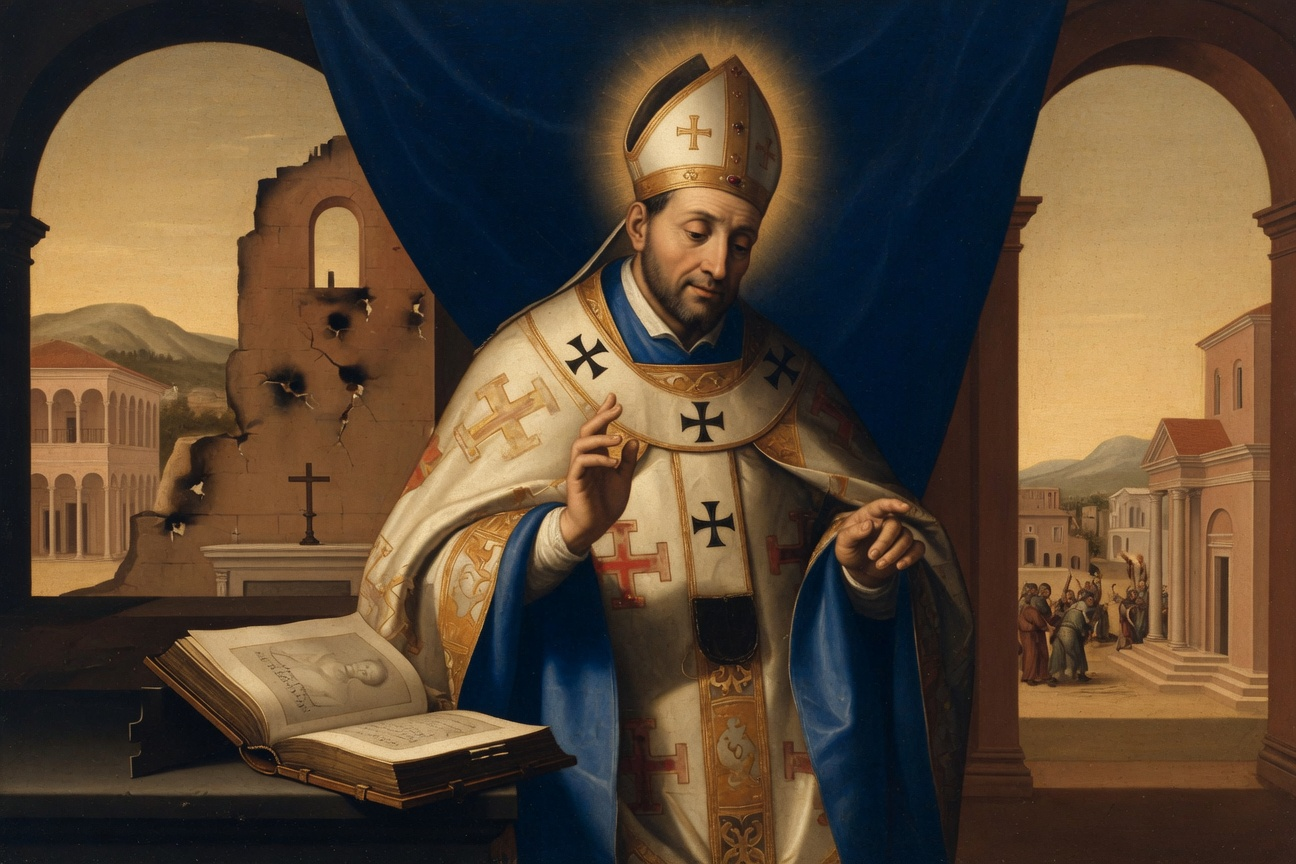
A famous disciple of Saint Augustine and Bishop of Calama in Numidia, Possidius was a defender of the faith against the Donatists and pagans. After the destruction of his see by the Vandals, he attended Saint Augustine in his final moments and wrote his biography. He is honored as a patron in Italy, notably in Mirandola.
Contemporaries

Figures and markers around the normalized period for this entry.
Guided reading
5 reading sections
SAINT POSSIDIUS OR POSSIDONIUS, BISHOP OF CALAMA (5th century).
Episcopacy and Donatist persecutions
A disciple of Saint Augustine, Possidius became bishop of Calama in 397 and suffered violent persecutions at the hands of the Donatists.
Saint Possidius, bishop of Calama in Numidia, was one of the most famous disciples of Saint Augustine. Elected bishop of Calama in 397, he suffered greatly at the hands of the Donatists, who drove him from his episcopal house in 404 and treated him with such cruelty that he nearly lost his life: yet he took no revenge upon them, other than to plead for their pardon before the emperor.
Pagan unrest and the Conference of Carthage
Following deadly pagan riots in 408, Possidius interceded for the guilty and participated in the decisive 411 Conference of Carthage against Donatism.
In the year 408, pagans celebrating one of their gods' festivals danced in front of the church, to which they subsequently set fire after killing a clergyman with stones and wounding several others who escaped death only by flight.
Those pagans who had not been involved in this excess, fearing that they might be included in the punishment of the guilty, wrote to Saint Augustine so that he might intercede on their behalf. Possidius, for his part, interceded for the guilty, and the emperor was content, as the only punishment, to have the pagans' idols broken, with a prohibition against offering sacrifices or celebrating superstitious festivals. In the year 411, Possidius attended, along with Saint Augustine, Saint Alypius, and other bishops of Africa, the famous conference held at Carthage, which dealt a mortal blow to the Donatist party.
Relics of Saint Stephen and the Vandal invasion
The bishop obtained relics of Saint Stephen before seeing his diocese ruined by the Vandal invasion in 429, forcing him to take refuge in Hippo.
When the relics of Saint Stephen, the first martyr, discovered near Jerusalem the previous year, were brought into the province around the year 416, the bishop of Calama obtained a portion for his church. He had the sorrow of seeing his episcopal church entirely ruined by the Vandals of Numidia in the year 429, which forced him to withdraw to Hippo, which the barbarians came to besiege soon after.
Death of Saint Augustine and literary legacy
Possidius attended Saint Augustine in his final moments in 430 and wrote his biography, becoming his first hagiographer.
He closed the eyes of Saint Augustine, who died the following year and whose Life he wrote.
Exile, uncertain death, and legacy
Forced into exile by the destruction of Calama, he ended his life in obscurity, possibly in Italy where he is honored as a patron in Mirandola and Reggio.
As Calama was nothing more than a heap of ruins, he could not return to his flock, which was destroyed or dispersed; but the place and year of his death remain unknown. The Italians claim that having crossed into Italy he died in Mirandola, and this city as well as that of Reggio honor him as their patron; as he had established clerics at Calama who followed the rule instituted by Saint Augustine, the Canons Regular count him among one of the most illustrious Fathers of their Order.
Propre d'Alger; — Souvenirs de l'Église d'Afrique, by Father Calder; — See, for more details, May 17.
Additional passages recovered from the sources
These passages from Les Petits Bollandistes supplement the entry. The references identify their context in the original volume.
Read the supplementary notes and passages (1)
SAINT POSSIDIUS, BISHOP OF CALAMA, IN NUMIDIA, BIOGRAPHER OF SAINT AUGUSTINE.
Historical supplement of Les Petits Bollandistes, transcribed from the images of the 19th-century edition. Traditions, assessments, and expressions describing a "current" situation are those of the source in its time; they do not constitute contemporary verification.
Possidius, one of the most famous disciples of Saint Augustine, was elected, in 397, bishop of Calama, a city in Numidia. The Donatists and the pagans gave much exercise to his zeal. The former, having banded together against him in 404, drove him from his house, treated him cruelly, and came close to taking his life. He took revenge on them only by asking the emperor for their pardon. Four years later, the pagans, having celebrated their sacrilegious feast on the first day of June, had the insolence to dance around the church, throw stones at it, and set fire to it. They wounded several ecclesiastics, killed one, and would have treated the others in the same manner had they not fled. Those of the pagans who had taken no part in these excesses feared that they might be included in the punishment of the guilty. Nectarius, their leader, wrote to Saint Augustine to beg him to avert the effects of the emperor's justice. In his letter, he based his plea chiefly on the obligation of Christian pastors to devote themselves to works of mercy, and to show that they are angels of peace. Possidius also interceded for the guilty, so that the emperor's orders required only that the idols of the pagans be broken, and that in the future they should no longer be permitted either to offer sacrifices or to celebrate their superstitious feasts. When the relics of Saint Stephen were brought to Africa, around the year 410, Possidius obtained a portion of them, with which he enriched the church of Calama. We learn from Saint Augustine (1) that several miracles were then wrought by the virtue of these relics. There can be no doubt that Possidius was among the bishops who established among the clergy of their cathedral the monastic rule instituted by Saint Augustine. This Saint himself speaks of the poor religious of Calama. (1) L. XXII, de Civit., c. 8. The invasion of the Vandals put the patience and zeal of Saint Possidius to severe trials. These barbarians, long accustomed to carnage, passed from Spain into Africa to the number of eighty thousand. They soon made themselves masters of Mauritania, Numidia, and the Proconsular province; only three places resisted them: Carthage, Cirta, and Hippo. They plundered the whole country and all the towns that lay in their path. Calama was entirely ruined, and it does not appear that it ever recovered from its fall. During the fury of the war, Possidius retired to Hippo. There he closed the eyes of Saint Augustine, who died in 430 during the siege of the city, which soon afterwards fell into the hands of the barbarians. He wrote the life of his beloved master, to which he joined the catalogue of his works. From that time on, he always lived separated from his flock. The place and year of his death are unknown. The Italians claim that Saint Possidius passed from Africa to Italy, and that he died at Mirandola. That city, as well as that of Reggio, honors him as its patron. The Canons Regular celebrate his feast on May 17, and count him among the most illustrious Fathers of their Order. See the Life and writings of Saint Augustine. See also Father Papebroch, t. IV, May, and Dom Cellier. The learned Jesuit shows that Saint Possidius must not be confused with Possidonius, a bishop in Africa, who is sometimes named in the same councils.
Paul Guérin, Les Petits Bollandistes, tome 5, p. 621, 622. Bibliothèque nationale de France: https://gallica.bnf.fr/ark:/12148/bpt6k307355
Iconography
Signs and attributes

Entities
Narrative network
The names, places, and concepts most present in the entry, weighted by centrality in the text.
Frequently asked questions about Saint Possidius (Possidonius)
Who was Saint Possidius (Possidonius)?
A famous disciple of Saint Augustine and Bishop of Calama in Numidia, Possidius was a defender of the faith against the Donatists and pagans. After the destruction of his see by the Vandals, he attended Saint Augustine in his final moments and wrote his biography. He is honored as a patron in Italy, notably in Mirandola.
What is Saint Possidius (Possidonius) the patron saint of?
Patronage of Saint Possidius (Possidonius): Mirandola, Reggio and Canons Regular.
How is Saint Possidius (Possidonius) depicted in Christian art?
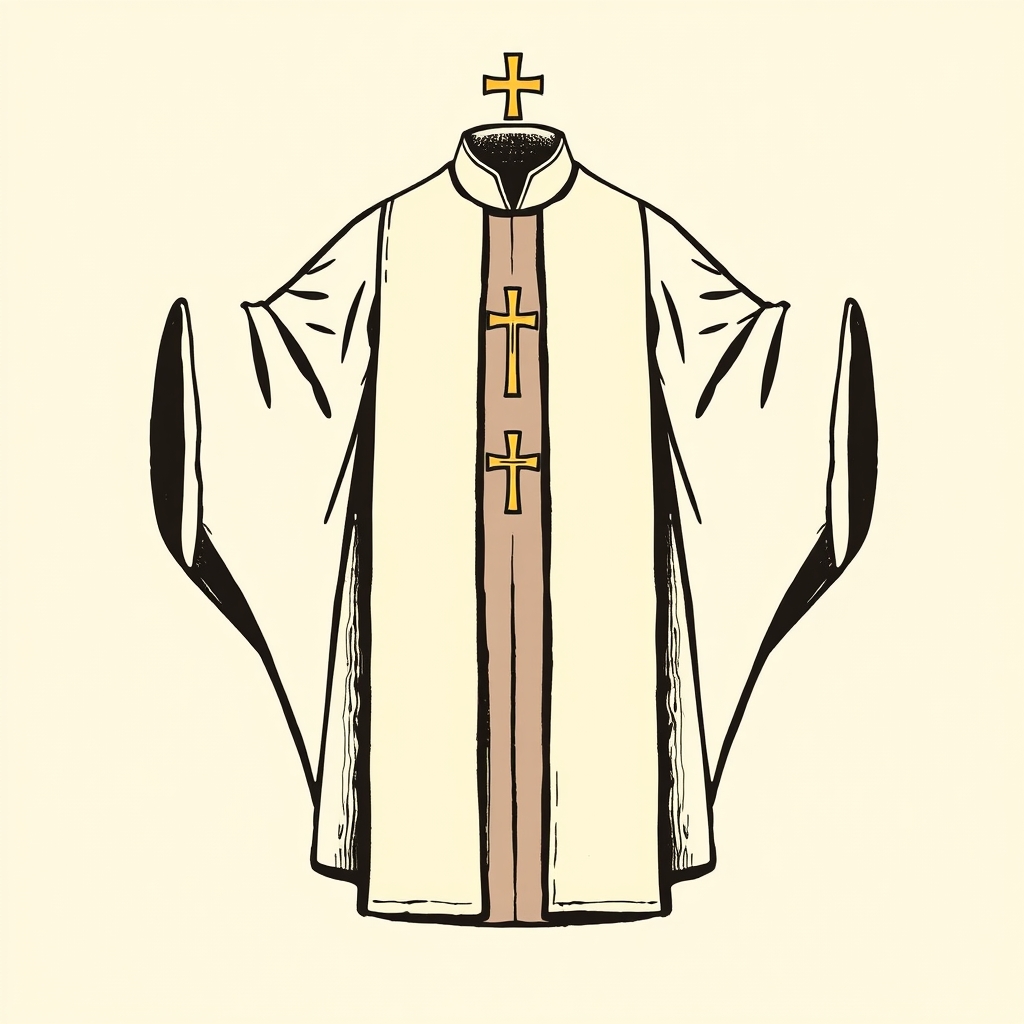
In iconography, Saint Possidius (Possidonius) is recognizable by: episcopal vestments, book (biography of Augustine) and livre (biographie).
Which saints were contemporaries of Saint Possidius (Possidonius)?
Contemporaries include: Saint Augustine of Hippo, Saint Honoratus of Arles, Saint James of Tarentaise and Saint Jerome of Stridon.
When did Saint Possidius (Possidonius) die?
Saint Possidius (Possidonius) died around 500.
What are the other names of Saint Possidius (Possidonius)?
Other forms of the name: Possidonius and Possidius.
Annexes & related entities
Structured data for exploration: events, miracles, quotes, places, attributes, patronages, and important entities cited in the text.
Key Events
- Elected Bishop of Calama in 397
- Persecution by the Donatists in 404
- Attack on the church by pagans in 408
- Participation in the Conference of Carthage in 411
- Reception of the relics of Saint Stephen in 416
- Fled to Hippo during the Vandal invasion in 429
- Present at the death of Saint Augustine in 430
- Writing of the Life of Saint Augustine
- Attack on the church by pagans in 408
- Reception of the relics of Saint Stephen around 410
- Vandal invasion and ruin of Calama
- Present at the death of Saint Augustine in Hippo in 430
- Writing of the life of Saint Augustine