
Born around 990 in Aquitaine, Gautier was educated at Le Dorat before becoming Abbot of l'Esterp. Recognized for his charity toward the poor and his ascetic rigor, he received extensive spiritual powers from Pope Victor II. He died in 1070 after seven years of blindness, leaving the image of a pastor devoted to the healing of souls.
Contemporaries

Figures and markers around the normalized period for this entry.
Guided reading
8 reading sections
SAINT GAUTIER, CANON REGULAR
ABBOT OF L'ESTERP, IN LIMOUSIN
Origins and family
Gautier was born around 990 into a noble family of Aquitaine, son of Raymond and Galburge, at the castle of Confolens.
Saint Gautier was born around the year 990, of one of the best families of Aquitaine; several of his ancestors had been honored with the consular dignity; his father, Raymond, and his mother, Galburge, both enjoyed great consideration. They lived in the castle of Confolens, at the confluence o f the Vienne and the Goire. His maternal great-grandfather, descended from a noble Frankish family, had had under his command three important cities of Aquitaine.
Education at the Abbey of Le Dorat
Placed under the direction of Saint Israel at Le Dorat, the young Gautier distinguished himself by his precocious intelligence, his thirst for reasoning, and his exemplary piety.
The youth, even the childhood of young Gautier, were so well inspired by wisdom that, from the tenderest age, he could serve as an example even to the elderly. After he had received from his pious mother the care and education of early childhood, the time came to send him to a monastery so that he might study letters, as was the custom for most children of noble families: it was to the Abbey of Le Dorat that he was entrust ed, thanks to the reputation of Saint Israel . Scarcely a mong the canons of Le Dorat, young Gautier shone among all their students for his vivacity of spirit, the gentleness of his manners, and the elegance of his conduct. Grasping obscure sentences with ease, he retained them with great sureness of memory. It was not enough for his mind to accept assertions that rested solely on the authority of the master; rather, in every question, he sought evidence and consulted the lights of his reason. By this method, he surpassed, with extraordinary rapidity, the limits of the first elements that were taught to him and even those of his age. Asking, like his fellow students, numerous questions on matters analogous to those of his instruction, he learned, so to speak, more than he was taught. "Never," says his biographer, "did he need, like most other children, to be constrained to work by the whip"; for his voluntary love for science increased his ardor for study every day: neither games nor the frivolity of childhood ever diminished his eagerness for his books and his tablets.
As a simple schoolboy, he was already, by his conduct, a living example: he considered it a shame for one who studies the laws of language to be ignorant of the much more useful rules that must direct one's conduct, and he carefully avoided everything that one should blush for, not only in his actions but also in his words: his conversation revolved only around useful things. He held anger and envy in horror, as well as pride, which is the father of both. He never lent his tongue to the slightest slander. He willingly yielded to those who were inferior to him either by birth or by knowledge, and he won the friendship of his rivals. All his actions carried within them such a character of perfection that one felt in them much less the work of nature than that of grace.
Hervée's Lesson on Prayer
By secretly observing Hervée of Tours praying in silence and tears, Gautier understands that interior fervor surpasses learned formulas.
One day, the community of Le Dorat was stirred by the arrival of a great personage who came, while passing through, to ask for hospitality: it wa s Herv ée, treasurer of the monastery of Saint-Martin of Tours, whose famous basilica he was rebuilding. All the conversations of the canons and their students naturally revolved around the eminent qualities of Hervée, and especially his fervor, which was so well known that people from all parts commended themselves to his prayers, as we can still see today through several letters from his contemporaries. These conversations inflamed the ardor and curiosity of young Gautier, who, wishing to become powerful himself through his prayers to God, resolved to steal from Hervée the secret of making them more effective.
At the moment when this personage entered the church to prostrate himself before the Blessed Sacrament, young Gautier slipped furtively into the interior of the prie-dieu that had been prepared for him in the choir, and from there he lent an attentive ear to catch the words and formulas of prayer that Hervée would address to God. But the holy man, filled with emotion and happiness to find himself in the sanctuary after several days of travel, shed abundant tears without uttering a single word, without making any articulated sound. Gautier understood by this that sighs and tears were worth more before the Lord than the most learned words, and it was this kind of prayer that he practiced thereafter.
This pious mischief could not remain secret: Hervée, having become aware of it, admired in such a tender age this ardent desire for spiritual progress; then he showed his retinue and those of the canons who surrounded him that a model of perfection was hidden under the modest exterior of this young child, and he announced the greatest things about him. "How remarkable indeed is such an intention in a child! While the levity and dissipation of the other schoolboys took advantage of the presence of a venerable guest to indulge in games, Gautier alone, thanks to the maturity of his judgment, did not want the passage, even if brief, of a pious man to be useless to his soul."
Canonical life and temporary exile
Having become a canon at Le Dorat, he led a life of asceticism but had to withdraw to Confolens following a disagreement with his superior, whose character he was attempting to soften.
Gautier later became a canon of Le Dorat. Whether he was in the choir or at home, he was always occupied with the presence of God in prayer. He continually mortified his flesh through fasting, the hair shirt, vigils, and by cutting off everything that might have been capable of flattering the senses. He soon lost his master, the blessed Israel, but he was already walking with such a firm step in the narrow paths of evangelical perfection that, with the grace of God, he never strayed from them and never turned back. Although he was regarded by his brethren as their model, he did not cease to observe them in order to study their virtues and imitate them; he even knew how to profit from their faults to correct his own, and to watch over himself with continual precaution. Having incurred the indignation of the abbot or prior of his church for having tried to soften the ferocious mood with which he treated the canons, and seeing that everything he did to win his heart only served to embitter him against him, he withdrew to the town of Conflans or Confolens, whose principal inhabitants were his relatives. The reputation that his virtue had acquired for him soon made him known to the Canons Regular of Lesterp, an abbey in the diocese of Limoges, eight le agues fr om that city, eleven from Angoulême, and fourteen from Poitiers. These religious spared no effort to attract him to their community, and they had no difficulty in succeeding. No sooner had he entered than he became the object of their admiration in all his conduct; and they conceived the plan of choosing him as their superior as soon as their abbot should pass away. A pilgrimage of devotion, which he later made to the Holy Land, did not make them lose this resolution, and God, to have them execute it, permitted that the return of Gautier and the death of the abbot should occur at the same time. Our Saint at first refused this charge: his resistance was long, but it was overcome in the end by the pressure they exerted upon him, and by the authority of Aymard, lord of the land. He was then ab out fo rty-two years old; he applied himself to governing his community, less by his authority than by the examples of his life, the lights of his instructions, and the heavenly aid that his continual prayer drew upon himself and others. He considered himself only as the last among them; he saw in his rank of superior the obligation to walk first in the painful and narrow path of religious perfection, and to have others follow him. He watched over all as exactly as if he had only one to lead; he studied their temperament, their strengths, their inclinations, and made himself all things to all men; he sometimes modified or changed general regulations in favor of individuals, persuaded that what is useful to one may become harmful to another. He knew so happily how to discern what was vice from what was nature, that he uprooted the one while sparing the other, with more skill and assurance than the most skillful physicians have for removing dead and corrupt flesh without damaging that which is living and healthy.
Abbot of Lesterp
After a pilgrimage to the Holy Land, he was elected abbot of Lesterp at the age of 42, where he governed with great psychological insight and individual attention to his monks.
Despite the continual care of his monastery, he did not neglect the surrounding populations. In all seasons, he made large distributions of alms; he fasted to have the means to appease the hunger of the poor, and suffered the cold to be able to cover their nakedness and protect them from the harshness of winters; being severe only to himself, he denied himself everything to give everything to others. He was not content with mistreating his body with the ordinary austerities of penance; he would rise at night and scourge himself in the darkness, without witnesses. This torment was not to punish his flesh, which had long been very submissive to him, for any revolt, but to ensure it would never be capable of revolting. When he noticed that this harsh discipline no longer caused him enough suffering, due to habit and also because his arm lacked the strength to administer it, he made a secret agreement with a robust man to lend him his own. Pope Victor II learned what fame was publishing abo ut the great talents that God had given our Saint to work for the salvation of others; so that his services could be more useful to the Church, he sent him the power to hear the confessions of all those who wished to present themselves to him, to bind and loose according to his prudence, and even to exclude from the Church through excommunication, and to bring sinners back into it through absolution. Gautier gave reason to believe that God had attached the salvation of many people to the use he made of this power: he used it to bring an infinity of sinners back into the paths of penance, to protect some from despair and others from presumption. In the midst of all his occupations, God purified his virtue from time to time through the fire of adversities and tribulations. He exercised his patience, lastly, through the loss of his sight, which he lost seven years before his death. After having tested him in this way for a long time, and having found him always equal in his constancy and fidelity, He called him to the eternal reward on May 11, in the year 1070. He was then eighty years old, and during his final days, neither age nor illness could take away the vigor of this intrepid soul. Death was for him only a duty that he fulfilled like all the others, as a calm and fervent Christian. He began with a great speech of consolation to his brothers, had the sacrament of Extreme Unction and that of the Holy Eucharist administered to him. Then he had himself carried to the church, and there, lying on ashes before the altar of the Mother of God, while some verses of Holy Scripture were read to him to excite the flight of his soul, it flew toward God. His body was buried in the same church, in the midst of an immense crowd that had rushed there at the news of his death. God honored his tomb with various miracles that served to confirm the opinion held of his holiness. Gautier had also performed some during his lifetime for the healing of bodies. But, according to the remark of the author of his life, they must be of very little consideration compared to those he had obtained from God to heal souls of their vices. His feast was established as early as the year 1091; but, although his cult has always been public since the beginning of the 13th century, it nevertheless appears that it was hardly in use except among the Canons Regular.
Ministry and apostolic privileges
Pope Victor II granted him exceptional powers of confession and excommunication to work for the salvation of souls in the region.
See Baillet and the Bollandists, May, volume II, page 701 and following.
Final years and posterity
Having become blind seven years before his death, he passed away in 1070 at the age of 80. His tomb became a place of miracles and his cult spread among the regular canons.
Lives of Saint Israel and Saint Theobald, canons of the collegiate church of Le Dorat; History of their relics and their cult, by Abbé Rougerie, professor of theology at the minor seminary of Le Dorat: 1 vol. in-9°; Le Dorat, Sorénean, Bookseller-publisher, 1871.
Sources and references
The main sources include the works of the Bollandists, Baillet, and Abbé Rougerie in the 19th century.
See Baillet and the Bollandists, May, volume II, page 701 et seq.
Lives of Saint Israel and Saint Theobald, canons of the collegiate church of Le Dorat; History of their relics and their cult, by Abbé Rougerie, professor of theology at the minor Seminary of Le Dorat: 1 vol. in-9°; Le Dorat, Sorénean, Bookseller-publisher, 1871.
Iconography
Signs and attributes


Entities
Narrative network
The names, places, and concepts most present in the entry, weighted by centrality in the text.
The supernatural in their life
The miracles of Saint Walter of Esterp
Frequently asked questions about Saint Walter of Esterp
Who was Saint Walter of Esterp?
Born around 990 in Aquitaine, Gautier was educated at Le Dorat before becoming Abbot of l'Esterp. Recognized for his charity toward the poor and his ascetic rigor, he received extensive spiritual powers from Pope Victor II. He died in 1070 after seven years of blindness, leaving the image of a pastor devoted to the healing of souls.
What is Saint Walter of Esterp the patron saint of?
Patronage of Saint Walter of Esterp: Canons Regular.
What is Saint Walter of Esterp invoked for?
Saint Walter of Esterp is invoked for: healing of the vices of the soul and healing of the body.
How is Saint Walter of Esterp depicted in Christian art?
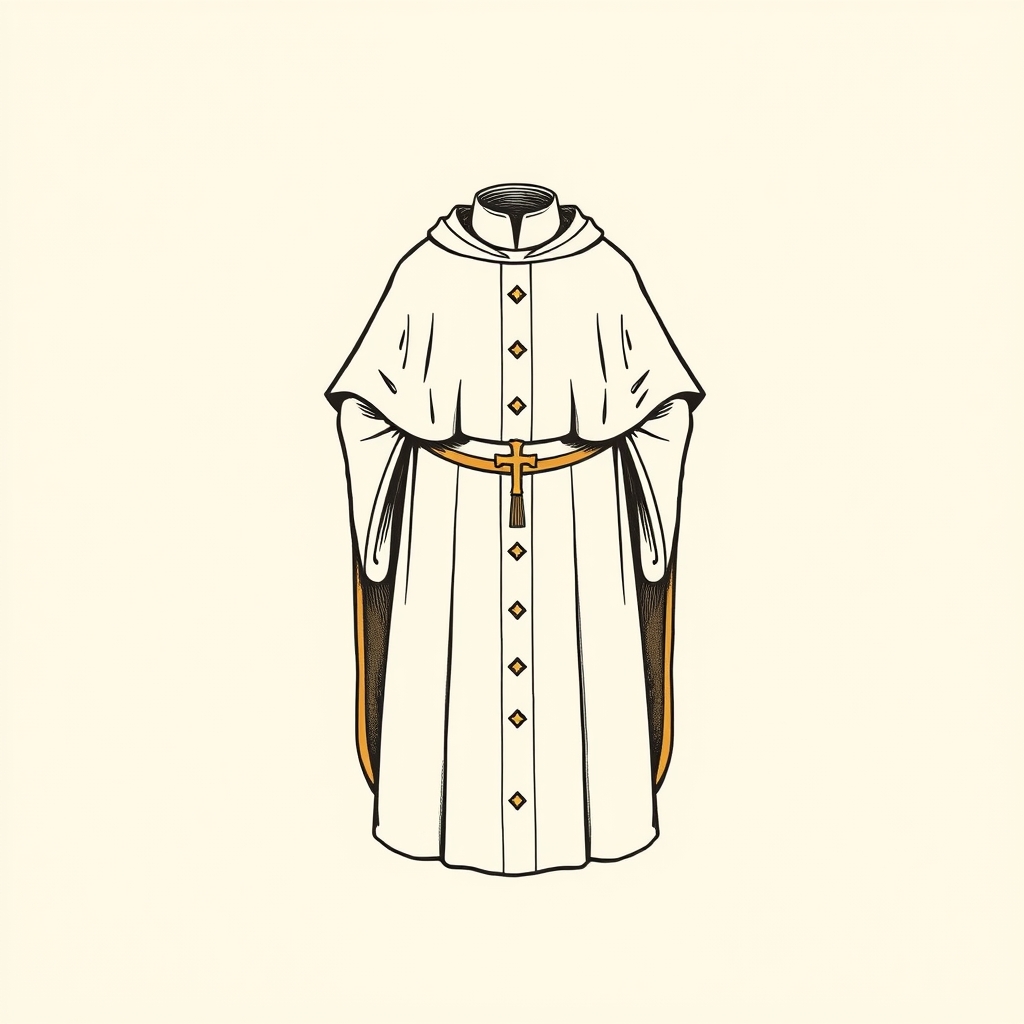
In iconography, Saint Walter of Esterp is recognizable by: canon's habit, abbot's crosier and discipline (whip).
What miracles are attributed to Saint Walter of Esterp?
2 miracles are attributed to this saint, notably: Healing and Sign / wonder.
Which saints were contemporaries of Saint Walter of Esterp?
Contemporaries include: Saint Bernard of Menthon (Apostle of the Alps), Saint Stephen of Hungary, Saint Norbert of Magdeburg and Saint Bernard of Clairvaux.
When did Saint Walter of Esterp die?
Saint Walter of Esterp died around 1070.
What are the other names of Saint Walter of Esterp?
Other forms of the name: Gautier and Walter.
Who are the relatives of Saint Walter of Esterp?
Relatives of Saint Walter of Esterp: Raymond (father) and Galburge (mother).
Annexes & related entities
Structured data for exploration: events, miracles, quotes, places, attributes, patronages, and important entities cited in the text.
Key Events
- Born around 990 in Confolens
- Education at Le Dorat Abbey under Saint Israel
- Retirement to Confolens following a conflict with his superior
- Entered the Abbey of Lesterp
- Pilgrimage to the Holy Land
- Elected abbot of Esterp at the age of 42
- Received the power to bind and loose from Pope Victor II
- Blindness during the last seven years of his life
Quotes
-
Sighs and tears were worth more before the Lord than the most learned words.
Gautier's observation regarding Hervée's prayer