
A hermit at Chaunay and later the founding abbot of Mairé in the 6th century, Saint Junien was the spiritual friend of Saint Radegund. Under the protection of King Clotaire I, he established the Benedictine rule in his monastery. He died miraculously on the same day and at the same hour as Radegund in 587.
Contemporaries

Figures and markers around the normalized period for this entry.
Guided reading
7 reading sections
SAINT JUNIEN, CONFESSOR,
FOUNDER AND ABBOT OF MAIRÉ, IN THE DIOCESE OF POITIERS.
Retreat at Chaunay and Spiritual Friendship
Junian settled as a recluse in Chaunay, where his reputation for holiness attracted the attention of Saint Radegund, with whom he formed a deep spiritual friendship.
587. — Pope: Pelagius II. — King of France: Guntram.
Vere vita boni monachi crux est et dux paradisi. The life of a true religious is truly a cross, but a cross that leads to paradise. Thom. à Kemp., de Imit. Christi, lib. III, c. 56.
Junian was born at the beginning of the 6th century, at Champagné-le-Sec, an estate that his parents, of noble and distinguished origin, owned in the territory of Brioux, which today forms one of the southern divisions of the department of Deux-Sèvres. According to certain historians, he was baptized by Saint Remigius, who had been Bishop of Reims since the year 460, and whom a friendship probably united with his family. If this is so, one might attribute great favors from heaven upon the precious child to this spiritual fatherhood. Indeed, from his earliest youth, in addition to the amiable qualities of body and mind, there was observed in him a pronounced taste for study and a singular aptitude for serious things, which augured great success for him. Thus he made rapid and remarkable progress in humane letters and in the science of the Scriptures, which he doubtless studied at Poitiers; for that city was already famous since Saint Hilary for a school whose lessons people came from very far to seek.
The young man's future was, however, arranged by Providence quite differently from what his talents led one to foresee. With the knowledge imparted by Christian teachers, he had received an esteem for divine truths, a treasure preferable to all those which the spirit of pride causes men to seek so earnestly. He despised all the more the temporal advantages of the career open to him, and turned to Jesus Christ alone, happy to have Him for all gain. To fully persuade his family and friends of what his future plans were, he retired for a time to Champagné, cut his hair there himself as a sign of renunciation of the world, and, from that moment, persuaded everyone of the holiness of his vocation through a truly clerical life. Devoted to study and prayer, fleeing noisy gatherings, avoiding the luxury of table and dress, he crowned these virtues further with an innocence of morals and a chastity that enhanced their pure brilliance.
It is rare for God not to bless such a generous surrender to His guidance by adding an increase of grace. This regularity was therefore rewarded in Junian with a greater desire for perfection, and to work towards it more securely, he thought of retiring into a solitude in order to embrace there the stricter silence of anchorites. He thus passed from Champagné to Chaunay, which was not far away, but where thick and little-frequented woods were better suited to favor his retreat.
There he built himself a cell in which he lived as a recluse, unknown to men and conversing only with God and with himself, in a continual exercise of psalmody and contemplation. But however secret this angelic life was, God allowed, as for many others, its good odor to exhale, and the region soon knew that a new Saint was protecting it before God. Something of this fragrance reached Saint Radegund, who was then living in her monastery at Poitiers. The noble and holy foundress desired to know the solitary and to be edified by him. The latter, for his part, was not unaware of the miracles of piety that shone in that life at once so illustrious and so humble. Regular relations were thus established between them: but their sole purpose was their mutual advancement in virtue. Such, indeed, are truly holy friendships; faithful souls desire them only to exercise true charity therein: for them it is still the love of God.
The pious union of Junian and Radegund had that character which detaches the heart from the senses, and leaves nothing in the feelings that cannot be perpetuated in heaven. Through the credit that his virtue and his miracles gained him in the world, and later through the sacred functions of the priestly ministry, the Saint rendered important services to the Saint. Their letters, their conversations, worthy of two heavenly souls, must have been full of a sweet and ineffable sweetness, and why do we no longer have what it seems time ought to have respected? But their mutual prayers above all brought them together, and if, by an act of renunciation imaginable in so pure an affection, they had to restrict the number of visits that Junian might have made to Sainte-Croix, often at least pious attentions recalled them to one another, and, from the great monastery to the humble cell, served as testimonies to their friendship. Thus Radegund had taken it upon herself to supply the solitary of Chaunay with clothing. The latter, for his part, fashioned in his solitude some of the instruments of penance that she used. He had sent her a hairshirt of goat hair and an iron chain that she wore as a belt, and in the 9th century these blessed pledges of charity and mortification were still kept at Poitiers as interesting relics. From these relations of unctuous piety arose a mutual trust, the most touching result of which was the promise that as soon as one of them died, the other would be informed by a message arranged in advance, so that the survivor might pray for the deceased.
Priesthood and the influx of disciples
Faced with the influx of disciples seeking his guidance, Junien agrees to receive the priesthood from the hands of the Bishop of Poitiers to better serve their souls.
What was known of our Saint awakened around him a legitimate and praiseworthy admiration. As always, his examples excited the zeal of a certain number of the righteous and sinners who, whether to advance in goodness or to work toward their conversion, turned toward him and implored him to take care of their souls. Junien found himself troubled by this in his love for absolute solitude: his dear cell was no longer for him a place of tranquil meditation, and he resisted these meritorious assaults that threatened to change his vocation. But he could not hold out for long against repeated and daily more numerous entreaties: he therefore consented to receive disciples, and as they multiplied around him, where they lived in separate cells, they obtained that, to be more useful to them, he would consent to receive the priesthood. The Saint understood well that, indeed, this august dignity, of which he had always believed himself unworthy, was becoming an indispensable resource for his zeal, and he received Holy Orders, probably from the hand of Daniel or Saint Pient, two bishops who succeeded each other immediately at that time on the see of Poitiers.
Foundation of the Abbey of Mairé
After a territorial dispute with King Clotaire I resolved at Javarzay, Junien founded the monastery of Mairé and introduced the Rule of Saint Benedict there.
These powers only increased his family of anchorites, and changed his solitary habits into a true apostolate. Scarcely had some time passed when their desert of Chaunay was no longer sufficient: it was necessary to think of a dwelling where religious life would have more uniformity, through the observance of a better-followed regularity. Near there was a secluded place shaded by woods and hills, towards which he did not hesitate to move. But he was unaware that this place belonged to King Clotaire I, and as soon as he had begun the establishment there, his design was thwarted by some of those adversaries that good works always encounter in their progress and especially at their origin: he was contested the right to take possession of this land, he was accused of usurpation of the royal domain. Did this opposition come from the king's people or from certain inhabitants of the country who were forgetting the counsels of charity towards him a little too much? History has not said. But the man of God was not discouraged by these obstacles that heaven allowed to test his constancy. Clotaire, whom the stay of Saint Radegunde in Poitiers had then attracted to the region, was at the castle of Javarzay, a fortified place that belonged to him, and where one of his mints was operating. Junien went there, justified himself before the prince, who was initially ill-disposed, and won his good graces so well that the latter, while maintaining him in the contested territory, also made him a gift of one of his lands where another castle surrounded by walls stood, then called Mariacum, and which we still know today under the name of Mairé (Mairé-l'Évêcault). This took place in 559. At the height of his wishes and put in possession of an important site, and almost a ready-made monastery, the Saint did not have to think about pursuing his first enterprise on still uncultivated land, and he established himself at Mairé with his brothers. From then on, the Rule of Saint Benedict was followed there, which its perfection caused to be adopted throughout the West, and it was one of the first houses in France to receive it.
Government, miracles, and prophecies
Having become abbot, he alternated between the direction of his monastery and retreats at Chaunay, while manifesting gifts of prophecy and protection against aggressors.
After having thus provided for the salvation of his fervent cenobites, Junien, invested with the title of Abbot, worked only with greater ardor for his own sanctification. What would be the use of helping others advance if one forgot to walk the path oneself? This is why, feeling well that he needed to recollect himself more in order to find in union with God the lights for his own direction and that of his neighbor, he wished to withdraw as much as possible into his hermitage of Chaunay, and he spent there at frequent intervals all the time that he did not owe to the instruction and conduct of the monastery. There, by assiduous prayer, by a fast more rigorous than that of the community, and by manual labor, he maintained his soul at the height of his duties, sustained himself in the practice of mortification and silence, and, indulgent toward all, he refused his own senses everything that was not strictly necessary to nature.
God did not fail to manifest how pleasing to Him was this conduct so elevated. To the gift of miracles, He added for His servant the spirit of prophecy. One day, not far from Chaunay, a poor pregnant woman asked for alms from the holy abbot who, while giving them to her, assured her that she would have a son of whom he would be the godfather. This son, having indeed been born, was brought to him: he held him at the baptismal font, where he was named Ruremond. From that moment, the Saint watched over him, and when the age had come to receive him into the monastery of Mairé, he had him instructed there in human sciences and in the things of God: the young man became attached to the holy house, savored the teachings of his master there, and having taken the monastic habit there, he sanctified himself in the exercise of the virtues that later earned him the abbatial office and finally the honors that the Church renders to the Blessed.
Another time, walking alone in the vicinity of his abbey, he was attacked by a fairly large number of peasants whose malicious intentions appeared to him to be feared. In vain he sought to calm them with observations full of gentleness; the furious men redoubled their insults and mixed threats with them. Forced then to provide for his safety, the Saint followed a sudden inspiration, and, changing his tone, he forbade these madmen to cross certain boundaries that he indicated to them. Some, having nevertheless advanced toward him, were instantly struck dead; this was the signal for the flight of the others.
This ill will that the friends of God have always had to endure from His enemies, and which the divine Master Himself had not wished to avoid, did not trouble a soul that such a visible grace protected. The Saint knew how to avenge himself for it only by services, which not all failed to recognize, moreover, and when a deadly famine devastated this region where some seemed to appreciate the gifts of heaven so poorly, he contributed, through his devotion and that of his brothers, to diminish the rigors of this cruel scourge.
The Intertwined Deaths of Junien and Radegonde
Junien and Radegonde died on the same day, August 13, 587; their respective messengers met at La Troussaie to mutually announce their passing.
However, the years had multiplied amidst so many labors and macerations, and the Saint, always ready to render an account of his administration to the Prince of shepherds, felt death approaching with the serenity of a heart that hopes for its reward. One day, his strength seemed to abandon him for the last time in his cell at Chaunay. He summoned his brothers there and exhorted them to maintain, after he was gone, the integrity of their usual life, the love of the rule, and the charity that united them. He designated the blessed Ruremond to succeed him, that faithful disciple who had shown himself so worthy of belonging to him; then he wished for his death to be announced to Saint Radegonde, according to the promise he had made to her. Ruremond entered into his office by executing the last order of the holy abbot. Now, at that very hour, Radegonde, herself expiring, took the same care and asked that Junien be informed of it immediately: so that, by a touching disposition of Providence, these two souls who had loved each other so holily were not to be separated here below, and met again at the threshold of their eternal happiness. By another no less admirable coincidence, the two messengers met halfway, and as each explained to the other the cause of his journey, they realized that on the same day and at the same moment, heaven had opened for both friends: it was August 13 of the year 587. At that place which is currently called La Troussaie, and which is noted in the parish of Geaux, following the road from that village to Champagné-Saint-Hilaire, a church and a priory were founded shortly after in honor of Saint Radegonde, and attached to it the imperishable memory of these memorable events.
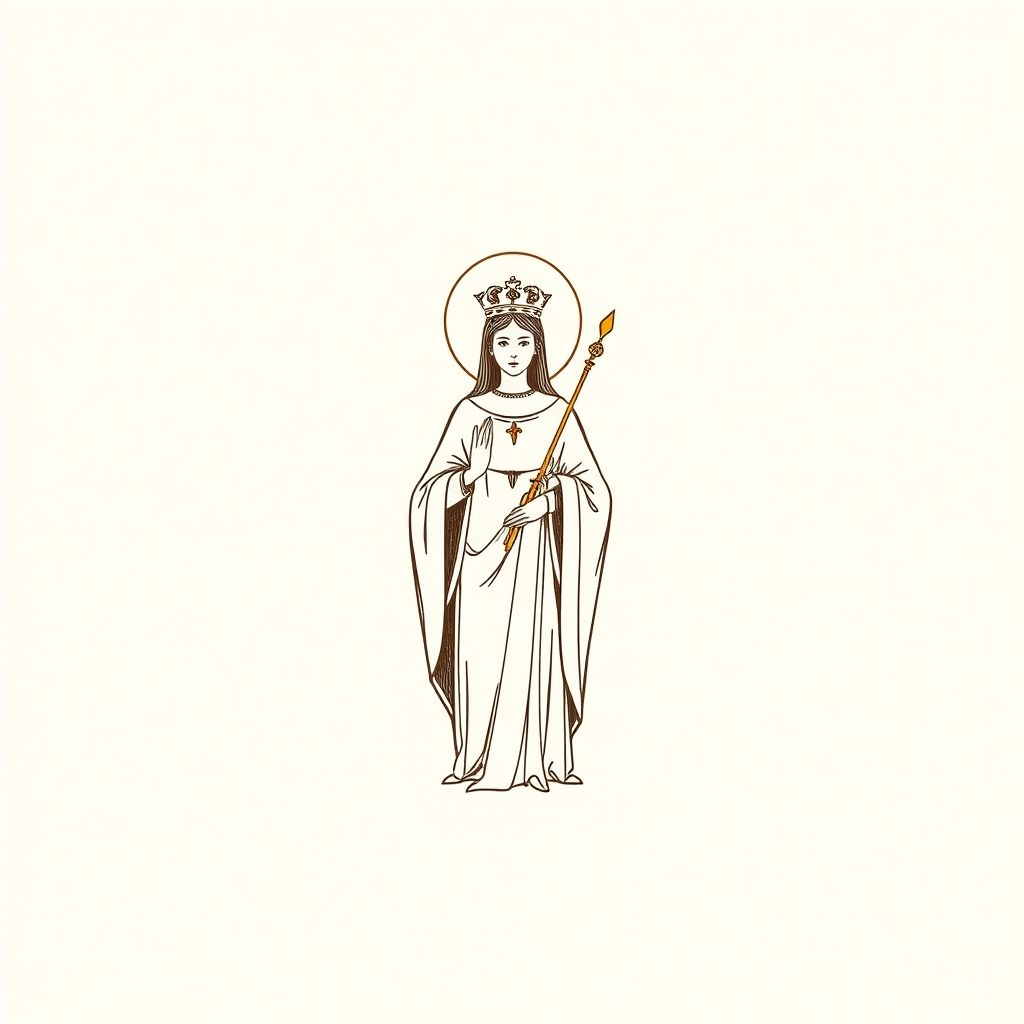
Saint Junien is depicted: 1st, having a fox return the hen it had stolen; 2nd, in a group with Saint Radegonde, to recall the pious relationship they had together.
Cult and peregrinations of the relics
The saint's body was transferred from Mairé to Nouaillé in 830 to protect it from wars, before being hidden during the Wars of Religion from the Huguenots.
[APPENDIX: CULT AND RELICS.]
The body of Saint Junien was carried from his hermitage in Chaunay to the church of Mairé, where he received burial, not without several sudden healings occurring among the sick whom pious confidence had led to accompany him. He was honored there for nearly three centuries.
In this interval, the priory of Nouaillé, dependent on Saint-Hilaire of Poitiers, had become in 799 an abbey protected by Charlemagne. That of Mairé, destroyed under Charles Martel during the war of which Aquitaine was the theater, had been united with the new foundation, and the remains of the Saint, which had been preserved through great precaution and vigilance by hiding their first burial place, were transported on November 6, 830, to the famous abbey church of which he later became the patron. Placed in a stone tomb behind the high altar, under the shelter of a walled space, they escaped the ravages of the Normans who pillaged the abbey in 863.
A council having been held at Charroux in 996 to remedy the disorders of the lay lords, the Fathers, in order to make their assembly more solemn and wishing to draw inspiration from the memories of one of the finest models of regular life, desired that the relics of Saint Junien should, in a way, preside over their deliberations: they were indeed transported there, but returned to Nouaillé immediately afterward to remain there forever, visited by the piety of the great and the small.
Five centuries passed in this way, and the monastery, respected even in the midst of the long wars that raged around it between the parties disputing France, was not to succumb later to its most cruel trials except under the blows of Frenchmen and Christians revolted against the Church. In 1569, the Huguenots, threatening the abbey with their fury, which they effectively exercised there soon after with a barbarity worthy of them, the monks had time to bury the holy body along with the sacred vessels and other precious objects: a few days later, the new barbarians set fire to the buildings, pillaged the church, and massacred the religious, whose remains were scattered by flight; and those who had secretly cooperated in the removal of the holy treasures having died or being unable to return, nothing could later indicate where they were hidden.
Some less considerable portions had fortunately been distributed to various churches: the nuns of the Trinity of Poitiers possessed some, which, after the restoration of the abbey, they shared with it. It is these remains which, saved from the profanations of the revolutionaries of '93, were returned by faithful hands to the competent authority, and Bishop Pie, having recognized their authenticity, permitted the continuation of the cult that they had never ceased to receive from the beginning.
Heritage and toponymy
The monastery of Mairé became a parish church under the name of Mairé-l'Évêque, and the cult of Saint Junien spread widely throughout Poitou.
Mairé, upon losing its title of monastery, took that of parish church, which it still bears under the name of Mairé-l'Évêque, because it has belonged since then, and for a very long time, to the bishops of Poitiers. As for Saint Junien, the patron of this parish, he became that of several others in the vicinity, and testifies, by the eagerness with which he was adopted from the beginning, to the filial confidence that the whole region placed in the Saint who had consoled it through his miracles and edified it by his virtues.
Taken from the Lives of the Saints of the Church of Poitiers, by Abbé Auber.
Additional passages recovered from the sources
These passages from Les Petits Bollandistes supplement the entry. The references identify their context in the original volume.
Read the supplementary notes and passages (1)
Source and Restoration of the Beginning of the Notice
The beginning of this notice had been omitted during extraction. The recovered page is reattached to the existing body, preserving the formulation and chronology of the historical source.
Paul Guérin, Les Petits Bollandistes, volume 9, p. 506, 507. Bibliothèque nationale de France: https://gallica.bnf.fr/ark:/12148/bpt6k30739j
Iconography
Signs and attributes

Entities
Narrative network
The names, places, and concepts most present in the entry, weighted by centrality in the text.
The supernatural in their life
The miracles of Saint Junien of Mairé
Frequently asked questions about Saint Junien of Mairé
Who was Saint Junien of Mairé?
A hermit at Chaunay and later the founding abbot of Mairé in the 6th century, Saint Junien was the spiritual friend of Saint Radegund. Under the protection of King Clotaire I, he established the Benedictine rule in his monastery. He died miraculously on the same day and at the same hour as Radegund in 587.
What is Saint Junien of Mairé the patron saint of?
Patronage of Saint Junien of Mairé: Mairé-l'Évêque and Nouaillé.
What is Saint Junien of Mairé invoked for?
Saint Junien of Mairé is invoked for: famine.
How is Saint Junien of Mairé depicted in Christian art?
In iconography, Saint Junien of Mairé is recognizable by: fox carrying a hen and depicted with Saint Radegund.
What miracles are attributed to Saint Junien of Mairé?
4 miracles are attributed to this saint, notably: Prophecy / infused knowledge, Protection / deliverance, Sign / wonder and Healing.
Which saints were contemporaries of Saint Junien of Mairé?
Contemporaries include: Saint Remigius (Apostle of the Franks), Saint Antide of Besançon, Saint Eugene of Carthage and Saint Nicaise of Reims.
When did Saint Junien of Mairé die?
Saint Junien of Mairé died around 600.
Annexes & related entities
Structured data for exploration: events, miracles, quotes, places, attributes, patronages, and important entities cited in the text.
Key Events
- Solitary retreat in the woods of Chaunay
- Establishment of a community of disciples and reception of the priesthood
- Foundation of the monastery of Mairé in 559 on land donated by Chlothar I
- Adoption of the Rule of Saint Benedict
- Died simultaneously with Saint Radegund on August 13, 587