
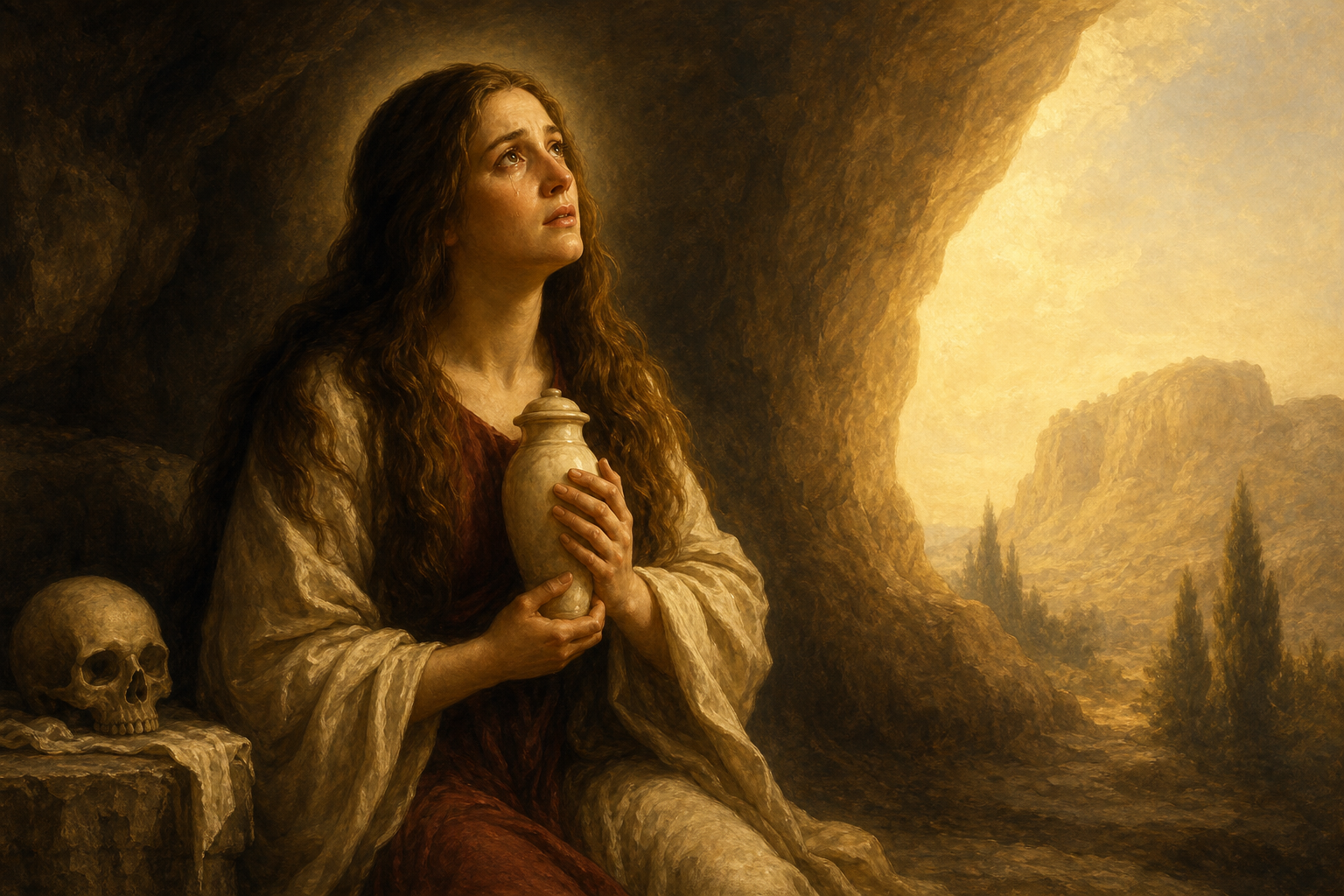
Saint Mary Magdalene
A disciple of Jesus Christ, Mary Magdalene is honored in Provence, particularly in Saint-Maximin and La Sainte-Baume. Her relics, hidden to protect them from the Saracens, were rediscovered in the 13th century and preserved through the centuries, despite the desecrations of the French Revolution. Her cult extends from the Orient to Paris, where a famous temple bears her name.
Contemporaries

Figures and markers around the normalized period for this entry.
Guided reading
6 reading sections
CULT AND RELICS.
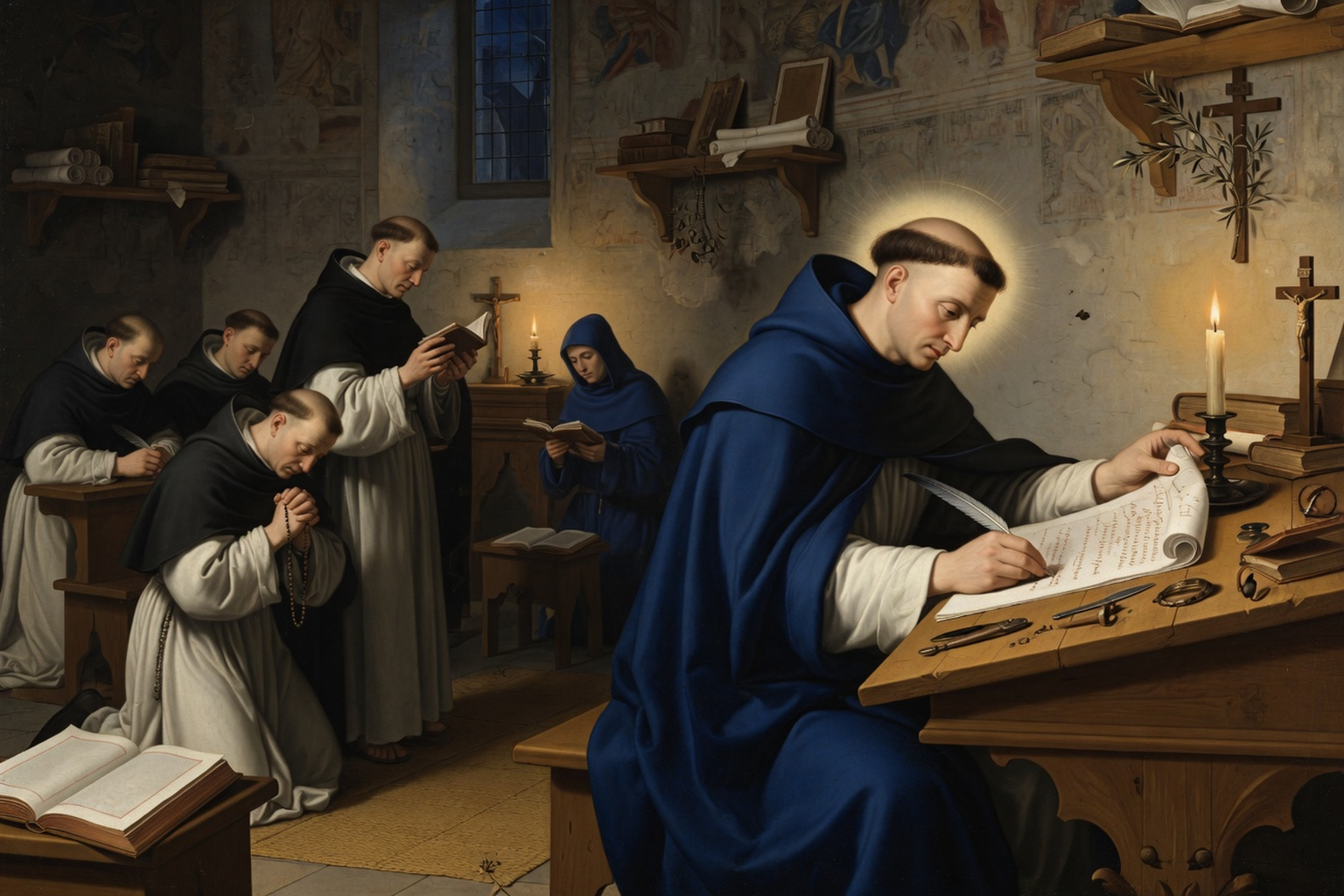
The Cult at Saint-Maximin
Description of the Dominican convent of Saint-Maximin and the saint's notable relics, particularly her head and a bone from her arm.
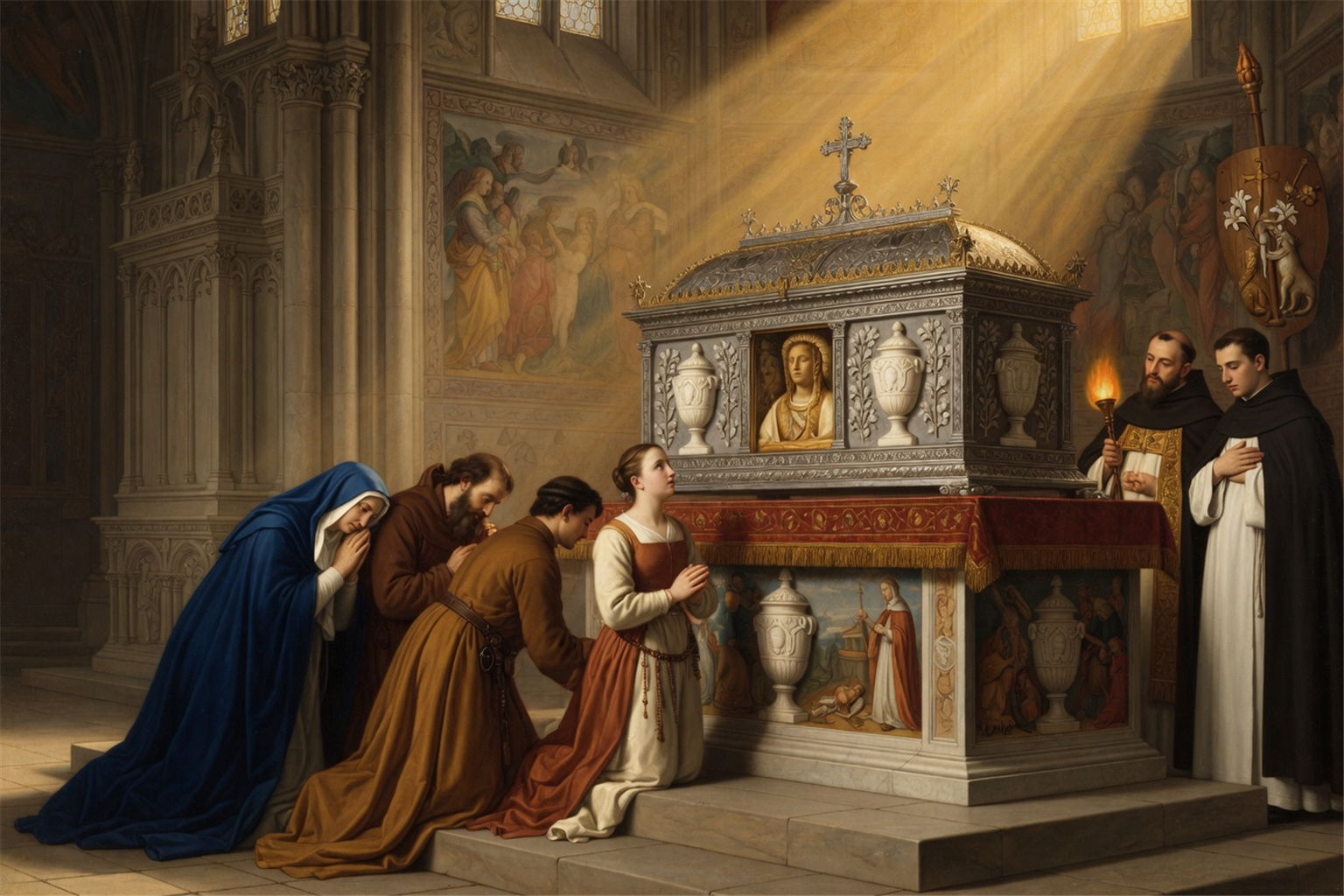
The precious remains of this holy lover and penitent have been honored at Saint-Maximin since time immemorial, but especially since Charles II, Prince of Salerno and later King of Naples, Sicily, Jerusalem, and Hungary, had the famous convent of the Order of Saint Dominic built there at the end of the 13th century, one of the most magnificent monasteries in France. Above the high altar, one can see a porphyry tomb, a gift from Pope Urban VIII, where, in the year 1660, the principal bones that were in the sepulcher were transferred in the presence of Louis XIV and his entire court by Jean-Baptiste de Marinis, Archbishop of Avignon, of the same Order of Saint Dominic; and, in a small vault in the nave, one can see the precious head of the Saint, on the forehead of which a little of her flesh still appears, at the spot where it is believed that Our Lord touched her after His resurrection, saying to her: Noli me tangere. There is, in the same place, a lock of her hair; and in her chapel, which is opposite, a bone from her arm which, without any natural cause, exhales a very sweet and very pleasant odor, much like the true wood of Saint Lucy.
Controversies regarding the translation of the relics
Analysis of the divergent traditions placing the relics in Ephesus, Constantinople, or Vézelay, and a defense of the Provençal tradition.
The Greeks, in their menology, as well as the historians Cedrenus, John Curopalates, and Zonaras, say that the relics of Saint Magdalene, being at Ephesus with those of Saint Lazarus, were transported to Constantinople in the year 886 by the command of Emperor Leo, which conforms to what Saint Gregory of Tours says in Book I of the Miracles, chapter 30, that in his time they were at Ephesus, having no covering above them; and further to what Richard de Vassebourg says, in Book II of the Antiquities of Gallia Belgica, that Saint Magdalveus, Bishop of Verdun, having gone to Ephesus on his pilgrimage to the Holy Land, was given two teeth and a little of the hair of Saint Magdalene. But this Magdalene, of whom the Greeks and those who followed them speak, is not our holy penitent, disciple of Jesus Christ, but some other of the same name, whom they have confused with her: this Magdalene, according to certain authors, was a virgin and martyr.
Sigebert, in his Chronicle for the year 745, says that the Saracens having sacked Provence, the body of Saint Magdalene was transported by Girault, Count of Burgundy, to the monastery of Vézelay, which he himself had built: which several other authors have written after him; but, while Sigebert speaks only with doubt, the tradition of the Churches of Provence is much more certain, since, in 1279, there was found at Saint-Maximin, in a very secret place, a marble tomb in which the body of Saint Mary Magdalene had been hidden for fear of the Saracens, with two very sacred inscriptions, one of which was even written on wax-coated tablets, which bore her name, with the reason that compelled the hiding of this great treasure. If Girault, Count of Burgundy, had a holy body transferred from Provence to Vézelay, which was not difficult for him, being lord of Avignon, it was not that of Saint Magdalene, but of some other saint whom they took for her.
The Revolution and the rescue of the remains
Account of the revolutionary profanations and the actions of Joseph Bastide and Lucien Bonaparte to preserve the relics and the church.
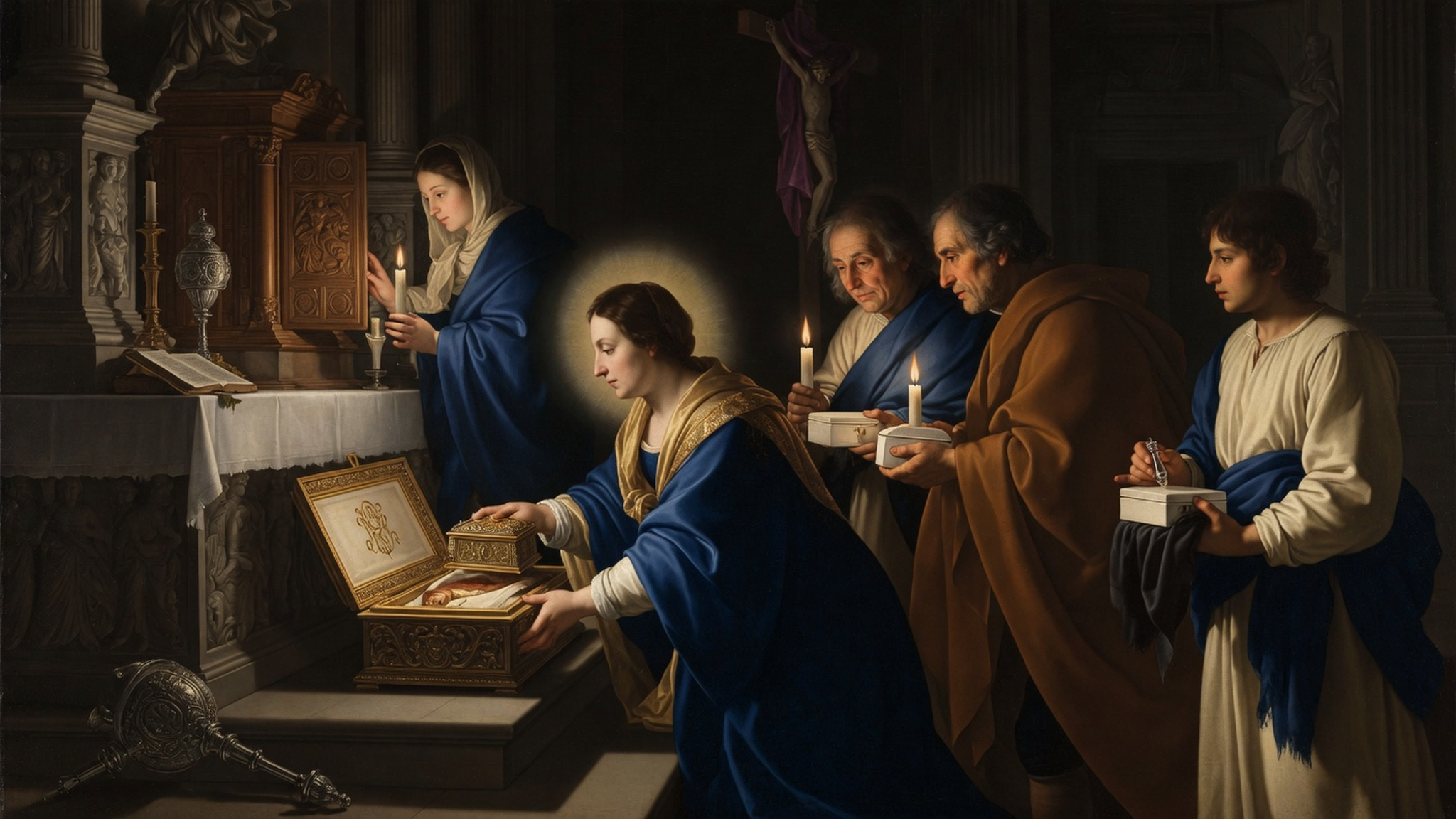
During the French Revolution, the church of Sainte-Baume was profaned and destroyed. The church of Saint-Maximin was also stripped of its treasure: the butcher Barras had the reliquary converted into currency, and the holy relics were thrown pell-mell. However, the former lay sacristan of the Dominicans, Joseph Bastide, secretly removed the head of Saint Mary Magdalene, the crystal vial known as the Holy Ampulla, the noli me tangere with its box, and a portion of the hair and arm bones. The church of Saint-Maximin was not burned and ruined like Sainte-Baume, thanks to the wise foresight of Lucien Bonaparte, who had the words 'Military Supplies' written on the door. As soon as calm began to be restored, Bastide returned the head of Saint Mary Magdalene to the church of Saint-Maximin; furthermore, the holy bodies thrown pell-mell were found in the sacristy, as we have said; it was only possible to distinguish two bones of Saint Maximin, the head of Saint Sidonius, and a few others, which were placed in wooden reliquaries. The two bones that were in the ancient reliquary called the Arm of Saint Mary Magdalene, which had been neglected by the looters, were enclosed in a gilded copper reliquary in the shape of an arm.
Restorations and pilgrimages in the 19th century
Reconstruction of the Sainte-Baume under the Restoration, papal favors from Pius VII, and the resumption of major pilgrimages.
Raised from its ruins in 1814, and visited on the 5th of the same month by twenty-five or thirty thousand pilgrims, the Sainte-Baume suffered new devastations during the Hundred Days. Marshal Brune, described, it is said, by Napoleon as an intrepid depredator, renewed the horrors and impieties of '93.
On the following August 22nd, he perished miserably in Avignon, a victim of the political fury of the people; his corpse, thrown into the water, wherever the Rhône carried it to its banks, was rejected back into its current; Divine Justice deprived him of a burial that is not refused even to strangers. Since then, the piety of the Provençals and the munificence of Louis XVIII restored this monument a second time. Pius VII once again granted a plenary indulgence to those who would visit the grotto of Saint Mary Magdalene on any of the surviving feast days: those of Pentecost, Saint Mary Magdalene, Saint Louis, Saint Maximin, and the Exaltation of the Holy Cross.
The Madeleine monument in Paris
The link between the relics of Parma, the will of Napoleon, and the erection of the Madeleine church in Paris as a center of devotion.
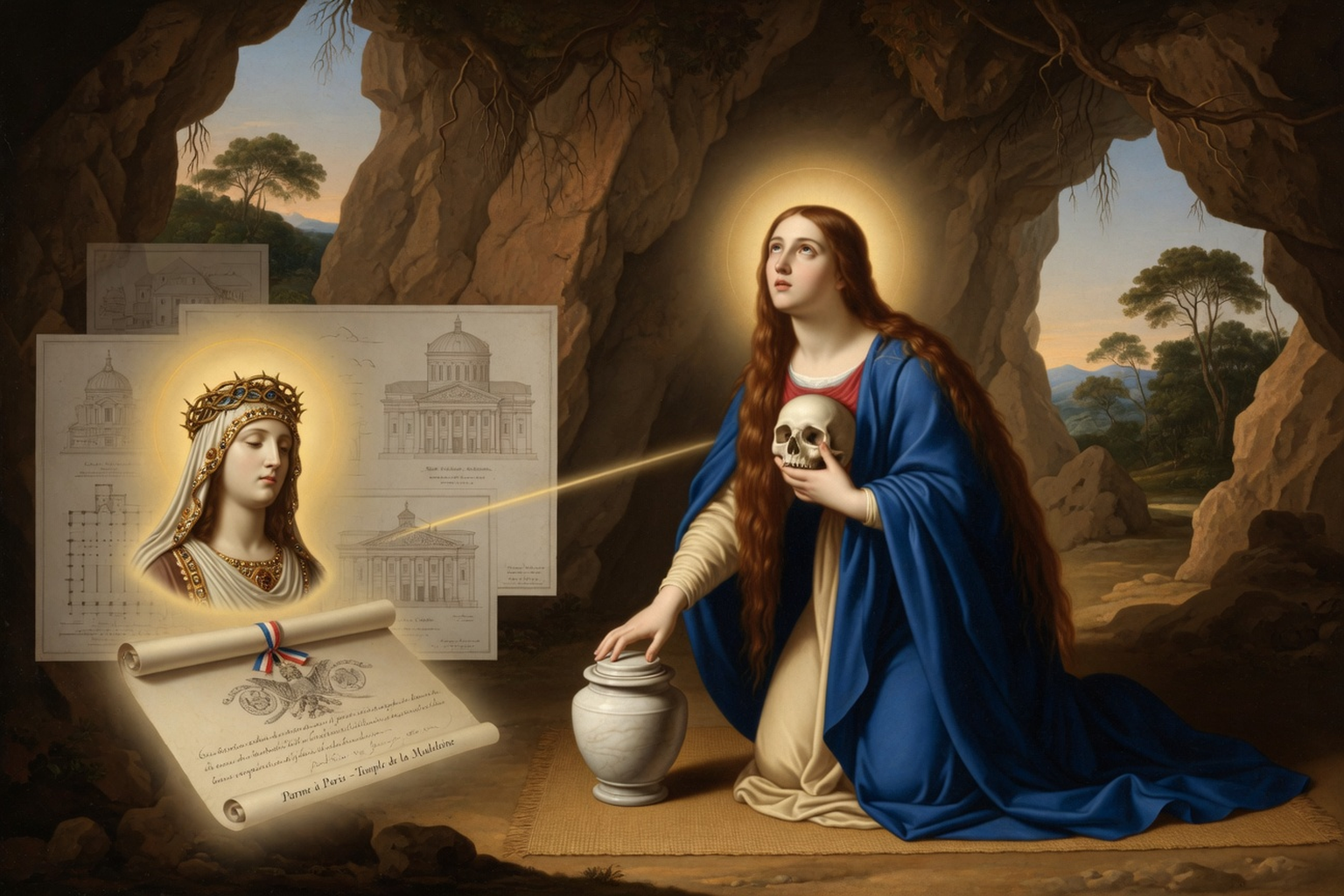
In the month of May 1822, all the works of art being completed, the altar of Saint Madeleine and that of the Blessed Virgin entirely refurbished, the Archbishop of Aix solemnly blessed the grotto; more than forty thousand pilgrims entered it successively. This was undoubtedly not enough for the fulfillment of that prediction which came from the mouth of the Savior, when Madeleine had poured her perfumes upon the Author of all gravity: "Amen, I say to you, wherever this Gospel shall be preached, in the whole world, that also which she hath done, shall be told for a memory of her." A prodigious edifice arose, which Napoleon wished to make the Temple of Glory; in effect, he publishes a glory proclaimed by the best Judge, by God Himself: this temple bears the name of the Madeleine. Thus, this humble woman shines in this very hearth of all celebrity, in this Paris from which renown radiates over the world. Such is the reliquary that Providence was preparing for the remains of Saint Madeleine.
In 1781, by the order of Louis XVI, the porphyry urn in which the body of Saint Madeleine was enclosed was opened for the first time, and an illustrious relic was detached from it, which was brought to Don Ferdinand, Duke of Parma. God took this measure in time. Twelve years later, everything that was in the urn was dispersed: there remained no other illustrious relic of Saint Madeleine than the portion sent to the Duke of Parma and the head honored in the church of Saint-Maximin, with two bones of an arm.
Providence willed that Napoleon should send to Paris, among the spoils of the Duke of Parma which were to be covered in currency, the very reliquary that contained this precious relic; after the Restoration, this treasure, ceded in full ownership by the former Queen of Etruria, was transferred to the monument that awaited it according to the eternal decrees.
Sources and literary authorities
A census of ancient and modern authors who have treated the life and penance of Mary Magdalene.
We have, in Origen, an excellent homily on her astonishment, which is believed, however, to be originally Latin and not Greek. Cardinal de Bérulle also gave to the public an admirable treatise on her excellences; and Coiffureau, Bishop of Marseille, with Godoux, Bishop of Vexau, have perfectly described her tears and her penance. Father Alexandre, a Jacobin, in the second volume of his Dissertations on the 1st Century, establishes very solidly what we have advanced in this life concerning the criticism of her history. — Cf. Unpublished Monuments of the Episcopate of Saint Magdalene, etc., by M. Faillou, of the Society of Saint-Sulpice, 2 vol. Migne; and Saint Mary Magdalene, by the Rev. Fr. Lacordaire.
Additional passages recovered from the sources
These passages from Les Petits Bollandistes supplement the entry. The references identify their context in the original volume.
Read the supplementary notes and passages (2)
Invention of the Body of Saint Mary Magdalene
Historical supplement to the Petits Bollandistes, transcribed from the images of the 19th-century edition. Traditions, assessments, and expressions describing a “current” situation are those of the source at its time; they do not constitute a contemporary verification.
3. In the year 1281, Prince Charles of Anjou, inspired by his religious zeal, convened a council at Saint-Maximin to proceed with the search for the body of Saint Mary Magdalene, which had disappeared at the time of the Barbarian invasions. This council was presided over by Guillaume de Longis, cardinal of the Holy Roman Church and chancellor to the king. It was composed of four archbishops, five bishops, ten abbots, a great number of doctors of theology, and pious persons. The various testimonies, writings, and monuments relating to the cause were attentively examined and discussed, and finally the council issued a solemn decree, which designated and recognized as true and authentic the relics of Saint Magdalene. This decree was confirmed by Boniface VIII and welcomed by the faithful with pious enthusiasm. Thus Magdalene, who formerly had sought with such solicitude the body of the risen Savior, had the glory, after her death, of seeing her body sought with the same care. All Provence rejoiced to have found again this body formerly offered in sacrifice to so long a penance, and which had lived by the life of the beloved Savior, far more than by the breath that still animated it. Christ restored her to us and illuminated the horror of the tomb with the radiance of glory, so that we might go toward Jesus, drawn by the perfumes of Magdalene, and that we might rediscover the spirit of penance with the body of the penitent Magdalene. In vain would we celebrate the invention of the body of Magdalene if we did not imitate her repentance. We must rejoice to have found Magdalene again, but we must also find ourselves again, we whom sin has lost, and while celebrating this feast, not neglect to draw from it fruits of salvation. Since the pearl of relics has been found, let us examine more closely the head of the blessed Magdalene. The aspect of this head, preserved intact, inspires penance. Exciting no horror such as the sight of human remains usually inspires, it inspires only love and veneration. Upon this head of Magdalene, a marvelous wonder shines forth: as if Magdalene had repeated to death the words that Christ had addressed to her: “Touch me not,” death did not dare touch the part that the Savior had consecrated with His finger. It seems still to retain the signs of life, which would suffice to prove the authenticity of her relics. Furthermore, there are found intact, and preserved in a reliquary, those blessed locks of hair which the holy lover of Jesus, inspired by a pious audacity, cast like a bond or a net around the feet of her Judge and her Savior. Thus, these relics of Magdalene can be regarded as a relic of the Savior Himself, because of the contact that consecrated them. May each of us imitate the sincere repentance of Magdalene, and the Savior say of us, as of her: “Many sins are forgiven her, because she loved much.” (Proper of the Diocese of Marseille.)
Paul Guérin, Les Petits Bollandistes, volume 5, p. 326. Bibliothèque nationale de France: https://gallica.bnf.fr/ark:/12148/bpt6k307355
Iconography of Saint Mary Magdalene
Historical supplement of the Petits Bollandistes, transcribed from the image of the 19th-century edition. The traditions, assessments and expressions describing a "current" situation are those of the source in its era; they do not constitute a contemporary verification.
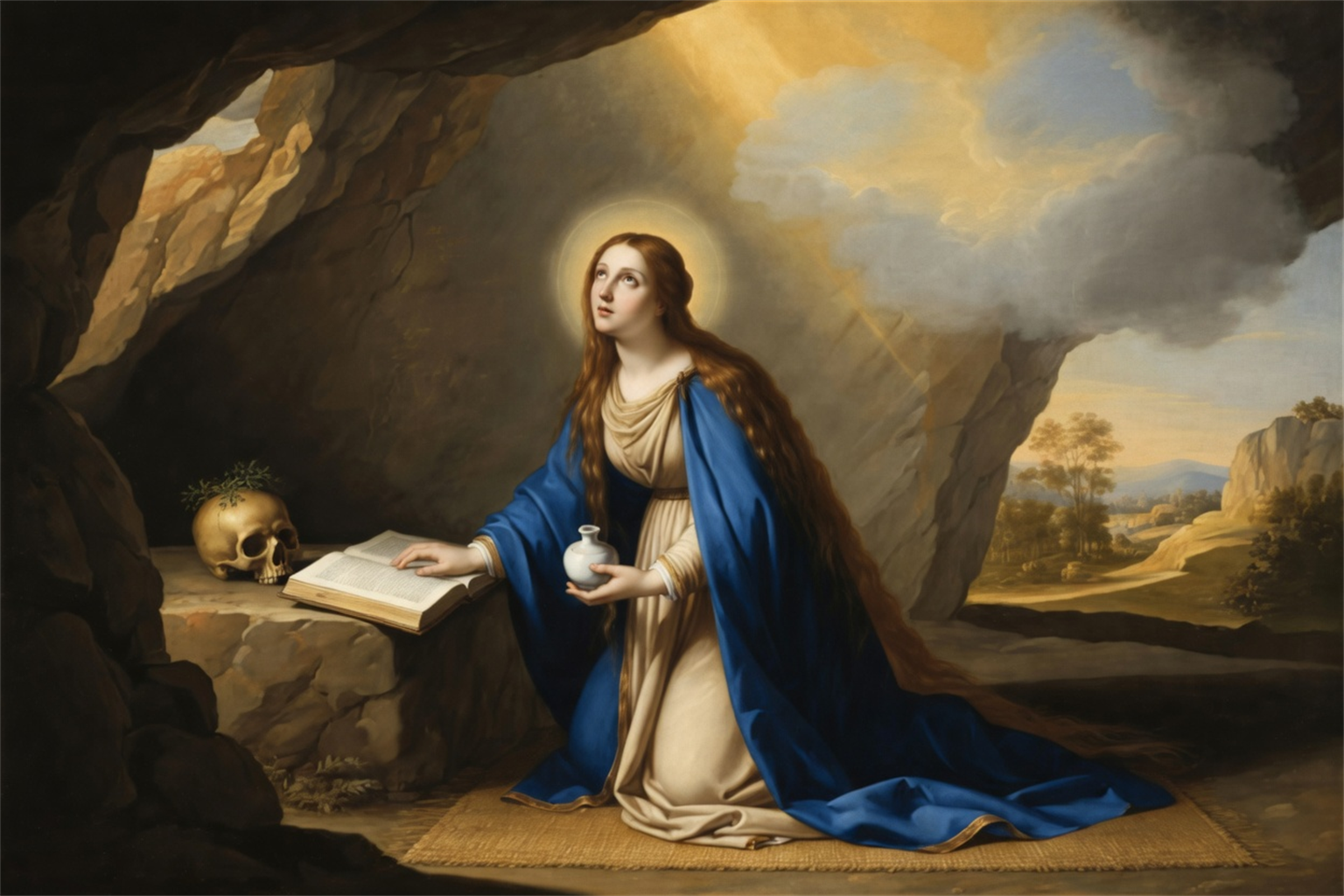
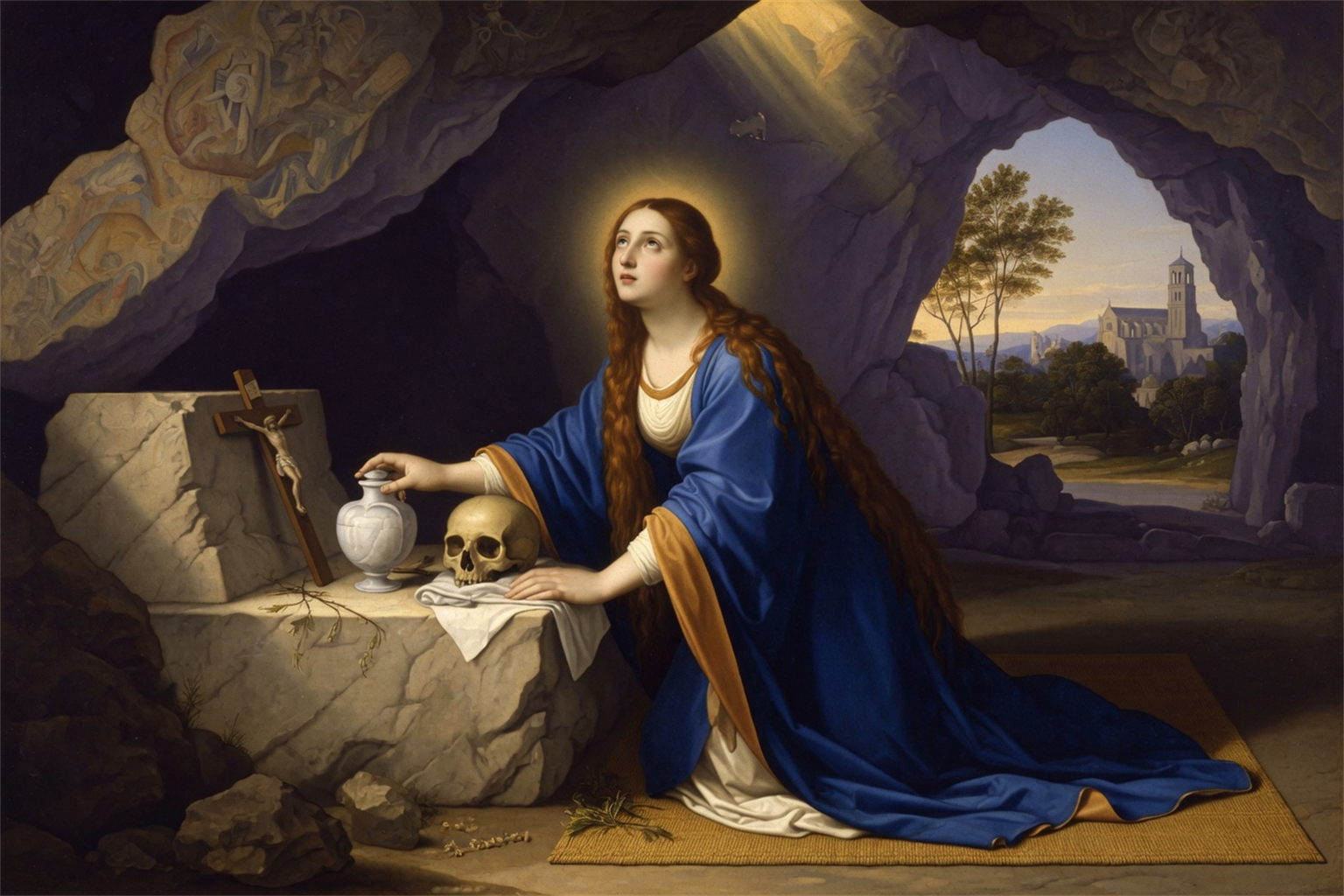
Saint Magdalene is ordinarily represented kneeling before a cross, at the foot of which is a skull. At other times she is standing, holding a vase of perfumes in her hand.
Paul Guérin, Les Petits Bollandistes, volume 8, p. 593. Bibliothèque nationale de France: https://gallica.bnf.fr/ark:/12148/bpt6k307386
Iconography
Signs and attributes





Entities
Narrative network
The names, places, and concepts most present in the entry, weighted by centrality in the text.
The supernatural in their life
The miracles of Saint Mary Magdalene
Frequently asked questions about Saint Mary Magdalene
Who was Saint Mary Magdalene?
A disciple of Jesus Christ, Mary Magdalene is honored in Provence, particularly in Saint-Maximin and La Sainte-Baume. Her relics, hidden to protect them from the Saracens, were rediscovered in the 13th century and preserved through the centuries, despite the desecrations of the French Revolution. Her cult extends from the Orient to Paris, where a famous temple bears her name.
What is Saint Mary Magdalene the patron saint of?
Patronage of Saint Mary Magdalene: Provence and Saint-Maximin.
What is Saint Mary Magdalene invoked for?
Saint Mary Magdalene is invoked for: penitence.
How is Saint Mary Magdalene depicted in Christian art?
In iconography, Saint Mary Magdalene is recognizable by: perfumes, long hair, head (skull), Holy Ampulla and noli me tangere.
What miracles are attributed to Saint Mary Magdalene?
2 miracles are attributed to this saint, notably: Sign / wonder and Incorruptibility.
Which saints were contemporaries of Saint Mary Magdalene?
Contemporaries include: Saint Martial, Apostle of Aquitaine, Saint James the Greater (Apostle), Saint George of Velay and Jesus Christ (Relics of the Passion).
When did Saint Mary Magdalene die?
Saint Mary Magdalene died around 100.
What are the other names of Saint Mary Magdalene?
Other forms of the name: Madeleine and Magdalène.
Who are the relatives of Saint Mary Magdalene?
Relatives of Saint Mary Magdalene: Saint Lazare (brother).
Annexes & related entities
Structured data for exploration: events, miracles, quotes, places, attributes, patronages, and important entities cited in the text.
Key Events
- Anointing the Savior with perfume
- Presence at the Resurrection (Noli me tangere)
- Supposed translation to Constantinople in 886
- Discovery of the hidden body at Saint-Maximin in 1279
- Rescue of the relics during the Revolution by Joseph Bastide
- Restoration of the cult at Sainte-Baume in 1814 and 1822
Quotes
Noli me tangere
Gospel (cited in the text)Truly I tell you, wherever this gospel is preached throughout the world, what she has done will also be told, in memory of her.
Words of the Savior