
Saint Menele
Born in Précigné, Ménélé fled a forced marriage to dedicate himself to God. After training for seven years under Saint Eudes in Velay, he restored the ancient abbey of Ménât in Auvergne. He also founded the monastery of Lisseuil for his mother, his sister, and his former fiancée, all three of whom had converted to religious life.
Contemporaries

Figures and markers around the normalized period for this entry.
Guided reading
8 reading sections
SAINT MÉNÉLÉ, ABBOT,
Historical Context
The life of Saint Ménélé takes place around the year 700, during the pontificate of Sergius I and the reign of King Childebert III.
Circa 700. — Popes: Sergius I. — King of France: Childebert III.
Hæ vera est sæculi fuga, abdicatio domesticorum, et quædam alienatio carissimorum.
The true flight from the world is the renunciation of family, with a certain distancing from those who are dearest to us.
S. Ambr., De fuga sæculi.
Youth and vocation
Born in Précigné to noble parents, Ménélé manifested great piety very early on and made a vow of perpetual virginity at the age of seven.
It is believed that Saint Ménélé wa s born i n Précigné, a small town in the Sarthe department, in the current diocese of Le Mans, the primitive diocese of Angers. His father was named Amanulfus and his mother Docula, of illustrious lineage. While still very young, our Saint showed what he would one day become: the purity, candor, and chastity that he displayed from his most tender years astonished all who knew him. At the age of seven, kneeling before the holy altars, he made a vow to the divine Jesus, whom his virgin heart already loved with such strong love, to keep a perpetual virginity.
Family conflict and forced marriage
His father attempts to force him to marry Sensa, daughter of Duke Barontus; after suffering violence, Menele pretends to agree before fleeing.
Alas! Virtue encounters so many and such great obstacles in this world! As soon as he was of an age to accept a position in the world, his father, jealous of perpetuating through his son the noble blood that flowed in his veins, wished to have him marry a young person of high birth: she was Sensa , daughter of Duke Barontus. To the first proposals made to him, Menele replied courageously that he had never dreamed of anything but the sublime delights of chaste souls, and that he would never consent to know any others.
The father, irritated by the failure of his approach, made his rebellious son bear the full weight of his indignation; he even forgot himself to the point of striking him, and subjecting him to the harshest treatment. The struggle lasted several days. Tired of such an unequal combat and desirous of putting an end to a position all the more false as it doomed him to inextricable difficulties, Menele finally acquiesced to his father's wishes.
Flight and monastic formation
Accompanied by his friends Savinien and Constance, he fled to Auvergne and joined the monastery of Calméry under the direction of Saint Eudes.
This act of condescension, which he reproached himself for as an act of unworthy weakness, troubled the peace of his heart. He consulted two of his in timate f riends, Savinien and Constance, and all three resolved to flee from the paternal castle. Guided by Providence, they left Précigné, and, after a few days of walking, they arrived near the ruins of an ancient monastery called M énât (Menatum, Bracum). It was an abbey of the Order of Saint Benedict, located between the Sioule and the Bouble, nine leagues from Clermont, founded during the reign of Clovis, before the year 500, and consecrated under the invocation of Saint Savior and Saint Martin.
Our young travelers had already established themselves forever in this solitude, when they were visited by a young mo nk named Théofride, known in Auvergne by the name of Saint Cha ffre, and n ephew of Saint Eudes, abbot of Calméry, in Velay (Calminiacum), a Benedictine monastery founded around 570 in honor of the prince of the Apostles, and later called Saint-Chaffre. Théofride proposed that they come and place themselves under the direction of his uncle: they accepted, and spent seven whole years with Saint Eudes in the fulfillment of all the duties of monastic life. However, on the faith of a vision, Ménélé and Savinien requested permission from Saint Eudes to return to Ménât: they cleared the land surrounding the ancient monastery, built an oratory where Savinien, who was a priest, could offer the holy sacrifice, and rebuilt a portion of the ruins of the old abbey.
Restoration of the Abbey of Menat
After seven years, Ménélé returns to the ruins of Menat to rebuild the Benedictine abbey and clear the surrounding lands.
However, the virtues of our young solitaries could not remain hidden for long: their fame spread far and wide, and Ménélé's mother, Docula, his sister Bocula, and his fiancée Sensa came to present themselves one day at the threshold of the monastery. Ménélé feared at first that they had come to tear him away from his solitude, but he was suddenly filled with joy when he learned from them that they had come to him to consecrate themselves to God. Ménélé hastened to build, at some distance from Ménât, cells and an oratory which he placed under the patronage of the Blessed Virgin, and which he abandoned to the three handmaidens of Jesus Christ. It is around this oratory that t he monastery of Lisse uil and the parish of that name were subsequently formed. It is today a humble village church in the shape of a Latin cross and of the simplest structure, with nothing to suggest that it replaced a more important edifice. Lisseuil was once very frequented as a place of pilgrimage: people came from several leagues around, especially on September 8, which is the patronal feast, and the influx, even today, is considerable. Pious people come there to ask Mary for their healing, drink water from the nearby fountain, or take some with them for their sick relatives.
Foundation of Lisseuil
Joined by his mother, his sister, and his former fiancée who had converted, he founded for them the oratory of Lisseuil, which became a place of pilgrimage.
Since this happy encounter, the days of Ménélé flowed by in peace; disciples in great numbers attached themselves to his footsteps; and, joining his efforts to theirs, he built on the ruins of the small monastery of Ménât th e immense abbey of that na me. Alas! a dreadful fire came to destroy in one day the fruit of long labors; however, at the mere name of Ménélé, all the peasants from the surrounding area rushed to help, and the new edifice rose even more splendid than the first. Our Saint had its church consecra ted by Saint Bonnet, Bishop of Clermont.
Trials, reconstruction, and death
Despite a devastating fire, the abbey was rebuilt with the help of the peasants and consecrated by Saint Bonnet before Ménélé's death.
Exhausted by the fatigues of a life so well spent, Saint Ménélé, feeling his end approaching, desi gnated Saint S avinien as his successor, and fell asleep gently in the Lord a few days later.
Posterity and relics
The cult of Saint Ménélé endures in Précigné and Menat, marked by a solemn translation of his relics in 1712.
There still exists, in the parish of Précigné, a chapel dedicated under the name of Saint Ménélé: on August 23, 1712, there was in this parish a solemn translation of a significant portion of his relics and those of Saint Savinien, obtained from the abbey of Ménât.
We have used, to compose this biography, the Acta Sanctorum; Notre-Dame de France; and the Saints d'Anjou, by the Rev. Fr. Dom François Chamard.
Iconography
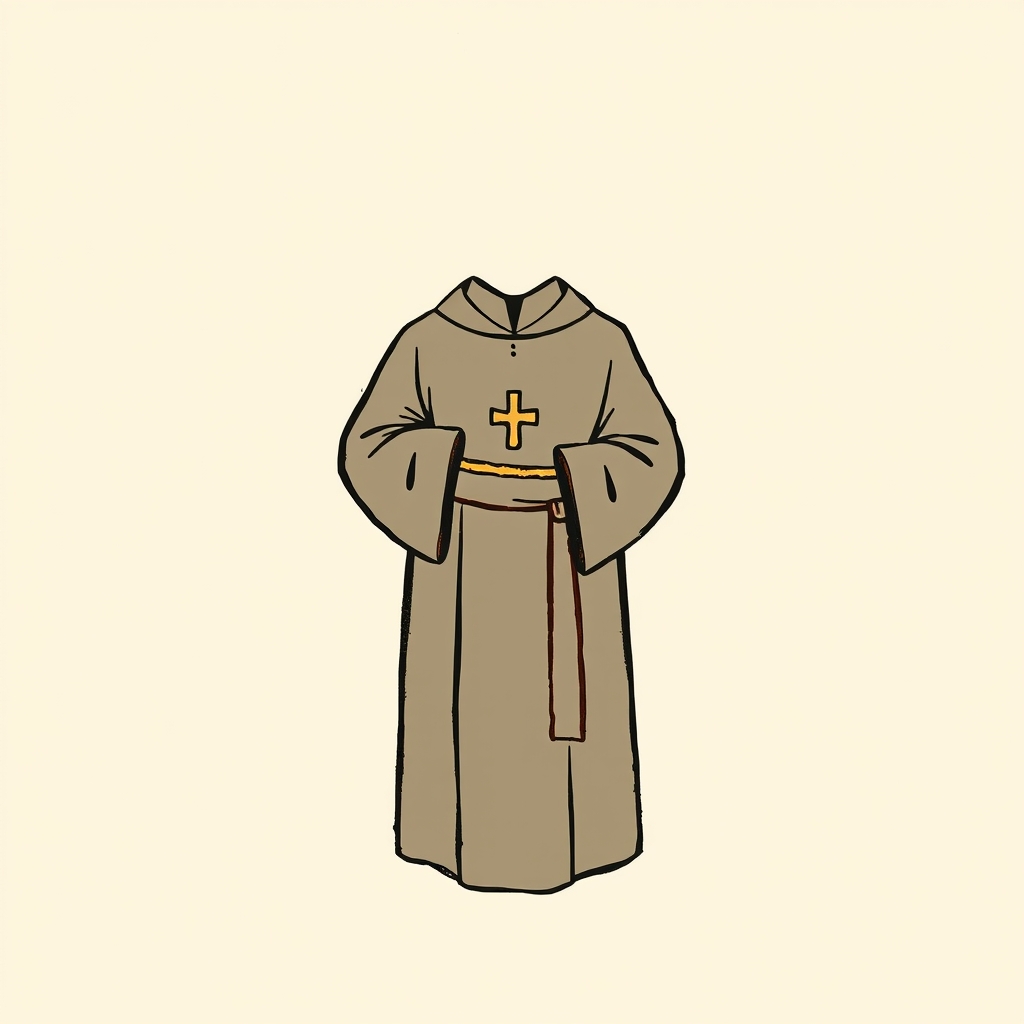
Signs and attributes


Entities
Narrative network
The names, places, and concepts most present in the entry, weighted by centrality in the text.
The supernatural in their life
The miracles of Saint Menele
Frequently asked questions about Saint Menele
Who was Saint Menele?
Born in Précigné, Ménélé fled a forced marriage to dedicate himself to God. After training for seven years under Saint Eudes in Velay, he restored the ancient abbey of Ménât in Auvergne. He also founded the monastery of Lisseuil for his mother, his sister, and his former fiancée, all three of whom had converted to religious life.
What is Saint Menele the patron saint of?
Patronage of Saint Menele: Ménât Abbey, Précigné and Lisseuil.
How is Saint Menele depicted in Christian art?
In iconography, Saint Menele is recognizable by: Benedictine habit, abbot's crosier and model of a church or abbey.
What miracles are attributed to Saint Menele?
2 miracles are attributed to this saint, notably: Vision / apparition and Sign / wonder.
Which saints were contemporaries of Saint Menele?
Contemporaries include: Saint Priest (Prix), Saint Gregory the Great (Pope and Doctor of the Church), Saint Die (Didier, Deodat) and Saint Augustine of Canterbury.
When did Saint Menele die?
Saint Menele died around 700.
What are the other names of Saint Menele?
Other forms of the name: Meneleus and Mauvier.
Who are the relatives of Saint Menele?
Relatives of Saint Menele: Amanulfus (father), Docula (mother), Bocula (sister) and Sensa (fiancée (later a nun)).
Annexes & related entities
Structured data for exploration: events, miracles, quotes, places, attributes, patronages, and important entities cited in the text.
Key Events
- Vow of virginity at the age of seven
- Refusal of marriage to Sensa and flight from the paternal home
- Seven-year stay at the monastery of Calméry under the direction of Saint Eudes
- Restoration of the Abbey of Ménât
- Foundation of the monastery of Lisseuil for his sister and his fiancée
- Reconstruction of the abbey after a fire
Quotes
-
Hæ vera est vœuli fuga, abdicatio domesticorum, et quædam alienatio carissimorum.
St. Ambr., De fuga vœuli (cited as an epigraph)