
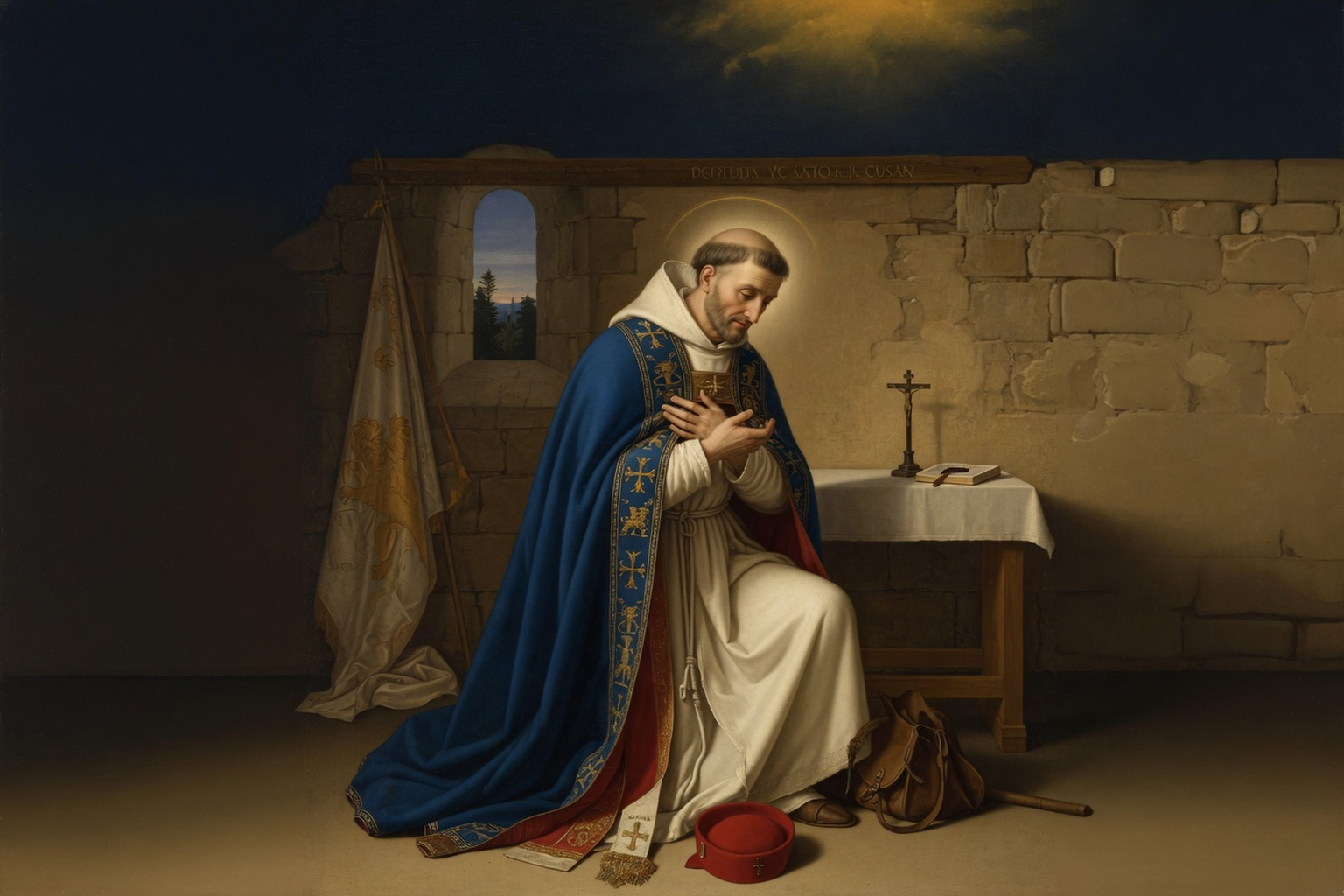
Doge of Venice elected in 976, Peter Urseolo governed with wisdom before renouncing power to embrace monastic life under the influence of Abbot Guarin. He fled secretly to France to the monastery of Saint-Michel de Cusan, where he ended his days in extreme penance and solitude. His relics are honored today in Venice and Prades.
Guided reading
4 reading sections
SAINT PETER URSEOLO, DOGE OF VENICE (997).
Election and governance in Venice
Pietro Orseolo was elected Doge of Venice in 976 after Pietro Candiano and distinguished himself by his piety and the reconstruction of St. Mark's Basilica.
Pietro, surnamed Orseolo, of the ancient family of the Orseoli of Rivo-Alto, born in Venice, shone with all the brilliance of Christian virtues; on the recommendation of these virtues, he was chosen by the unanimous suffrage of his fellow citizens to succeed as Doge, albeit against his will, to Pietro Candiano, in the year 976.
Raised to the height of power, he wished to inaugurate his public administration with good works. He therefore restored the church of Saint Mark the Evangelist, which, along with the Doge's Palace of Venice, had been consumed by a fire under his predecessor. He governed the republic with glory and wisdom, attributing everything to the common good of the fatherland. After the first child his wife gave him, he made a vow, in concert with her, of perpetual chastity.
The Call to Monastic Life
The meeting with Abbot Guarin of Saint-Michel de Cusan prompts the Doge to abandon the world to serve God in a monastery.
Divine Providence soon brought this pious resolution to its peak, through the means of Guarin, abbot of the monastery of Saint-Michel, of the Order of Saint Benedict of Cusan, in the county of Roussillon. Having stopped in Venice to venerate the relics of Saint Mark, this holy religious had the opportunity to observe and admire the piety of the Doge and his assiduity in his religious duties. He spoke with him of eternal glory, and determined him to embrace a more perfect way of life and to serve God far from the world, in a monastery.
Flight and asceticism in France
Peter fled secretly to France with companions to join the monastery of Cuxa, where he eventually lived as a hermit.
The Doge asked for some time to put his affairs in order; Guarin departed to continue his journey, and after completing it, returned to the one who already called him the savior of his soul. He remained Doge of Venice for another year, after which, leaving his homeland and family, he departed not only with Guarin, but also with Romuald and Marinus, John Morosini his son-in-law, and John Gradenigo. In order not to be recognized by spies, he disguised himself as a carriage driver, and it was in this way that he and his companions crossed Verona and all of Lombardy and arrived in France. Upon approaching the monastery of Cuxa, he took off his shoes and walked the rest of the way barefoot. His arrival excited universal admiration; he entered among the novices with Gradenigo and Morosini; the humblest occupations were those he preferred to seek. After two full years, he was named sacristan. But, driven by the desire for a stricter solitude, he requested and obtained permission to build, not far from the monastery, a cell barely large enough to sit and lie down in; fasting, prayer, and manual labor were his habitual occupations.
Death, cult, and translation of relics
After his death in 997, he was canonized by Clement XII; his relics were later divided between Venice and Prades after the French Revolution.
When his son Peter came to see him, he predicted that he would become Doge, and the event justified his prediction during his own lifetime. He further warned him never to depart from justice, and to preserve all their rights intact for the churches of the Lord. Finally, after nineteen years of monastic life, that is to say of exquisite piety and continual penance, in the sixty-ninth year of his age, warned by divine revelation that he would not delay in falling asleep in the sleep of death, lying on ashes and haircloth, on January 10 in the year of our salvation 997, he rendered his soul to God. Various miracles attested to his holiness; his body, preserved in the church under an altar dedicated in his honor, was visited and honored by the pious faithful. Clement XII canonized him and permitted his feast to be celebrated on January 14. Shortly thereafter, the solemn translation of a portion of his relics took place in Venice, in the church of Saint Mark. The entire city venerated its prince with extraordinary devotion.
At the end of the 18th century, after the revolution had broken out in France and the monastery of Cuxa had been destroyed from top to bottom, the other relics of Peter Orseolo were transported to the parish church of Prades, where they are still very religiously preserved today.
Breviary of Perpignan.
Additional passages recovered from the sources
These passages from Les Petits Bollandistes supplement the entry. The references identify their context in the original volume.
Read the supplementary notes and passages (1)
Note on the conversion and life of Saint Peter Orseolo
Historical complement of the Petits Bollandistes, transcribed from images of the 19th-century edition. Traditions, assessments, and expressions describing a "current" situation are those of the source at its time; they do not constitute contemporary verification.
1. On August 11, 1871, we wrote to Mr. Tolra de Bordas, a learned ecclesiastic of the diocese of Perpignan, concerning Saint Peter Orseolo: “Several biographers and historians, notably Cantù, do not agree with the Breviary of Perpignan on the decisive motives for his conversion and other details of his life. As a Breviary is a very great authority, before deciding to reject its version, I would not be sorry to have your opinion.” Mr. Tolra replied to us: “I do not have Cantù at hand (the History of the Italians is the only one of his works I lack); but I am not surprised that he followed several of the historians or biographers consulted on Saint Peter Orseolo, notably Saint Peter Damian, who, in his life of Saint Romuald, indeed presents our Saint as having risen to the dogeship only after taking an active part in the revolt in which his predecessor perished. Baronius, Baillet, and Fleury embraced the same sentiment without further examination. But, it must be said, the authority of Saint Peter Damian in this matter cannot be accepted as a final court of appeal; several historical errors are found in the life of Saint Romuald: thus this Father of the Church asserts that Saint Orseolo had succeeded not Peter Candiano, but Vitalis Candiano; whereas it is certain that the latter was, on the contrary, the successor of our Saint. As for the fact of Saint Orseolo's participation in the revolt that overturned his predecessor, the historians and chroniclers of Venice are almost unanimous in declaring that he was completely uninvolved in it. Dandolo, one of the most authoritative of these historians, calls Orseolo genere clarum, fide et moribus circumspectum; and further on, speaking of his elevation: A PUERILI ÆTATE nil aliud quam Deo placere studens, ad tantæ dignitatis provectum scandere contemnebat, timens ne sæcularis honoris ambitione propositum amitteret sanctitatis.... Sanuto (Vite de duchi di Venezia) says the same thing. Pietro Marcello (De vitâ, moribus et rebus gestis omnium ducum Venetorum) calls Saint Orseolo vir probitate et innocentiâ clarus..., qui aliquandiu MAGISTRATUM ASSUMERE RECUSAVIT; verum populi precibus fatigatus, ne Rempublicam eâ temporum novitate desereret, charitate patriæ motus, ægre administrationem assumpsit, et quamprimum omnes juramento adstrinxit, neminem passuros res novas aut seditionem aliquam adversus supremam dignitatem, nec aliquid quod non è Republicâ esset, moliri.... This explains and justifies the passage from the Proper of our diocese (... invitus tamen, suffectus est).”
Paul Guérin, Les Petits Bollandistes, volume 1, p. 265, 266. Bibliothèque nationale de France: https://gallica.bnf.fr/ark:/12148/bpt6k30731s
Entities
Narrative network
The names, places, and concepts most present in the entry, weighted by centrality in the text.
Frequently asked questions about Saint Peter Orseolo (Pietro Orseolo)
Who was Saint Peter Orseolo (Pietro Orseolo)?
Doge of Venice elected in 976, Peter Urseolo governed with wisdom before renouncing power to embrace monastic life under the influence of Abbot Guarin. He fled secretly to France to the monastery of Saint-Michel de Cusan, where he ended his days in extreme penance and solitude. His relics are honored today in Venice and Prades.