
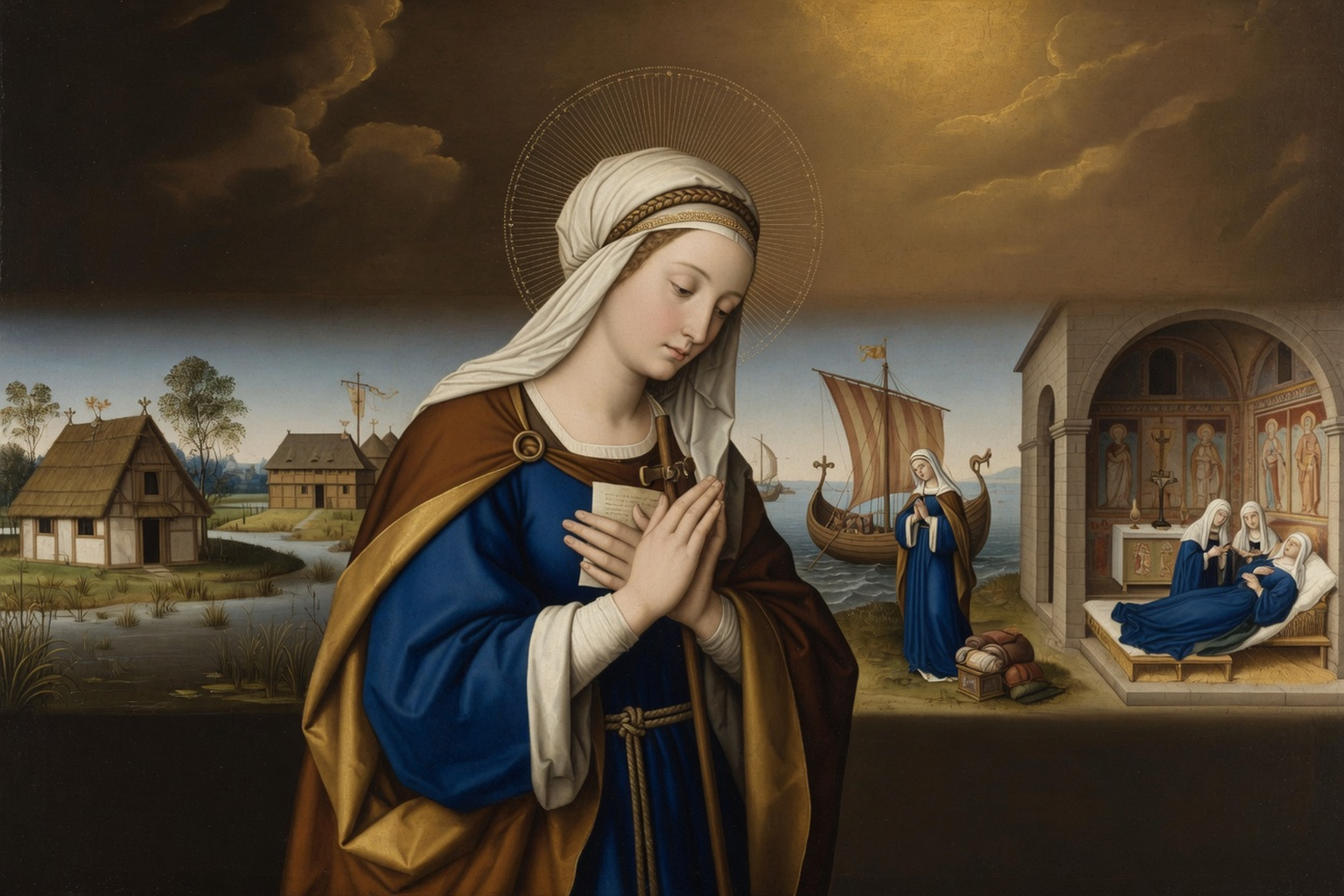
Saint Pega
Pée
Born of the royal blood of Mercia, Saint Pega lived as a recluse in England before dying in Rome around 719. Sister of the hermit Saint Guthlac, she is honored for her life of penance and the miracles performed by her relics preserved in Rome.
Contemporaries

Figures and markers around the normalized period for this entry.
Guided reading
4 reading sections
SAINT PEGA, VIRGIN IN ENGLAND (circa 719).
Origins and vocation
Sister of Saint Guthlac and of the royal blood of Mercia, Saint Pega chose a life of penance and withdrawal from the world.
This saint was the sister of Saint Guthlac, the famous hermit of Croyland. Although she was of the royal blood of Mercia, she left the world to lead a life of penance and withdrawal in the place that has since borne her name.
End of life in Rome
After the death of her brother, she went to Rome where she died around 719, her relics performing many miracles there.
She died in Rome, where she had gone after the death of her brother, around the year 719. Orderic Vital states that great miracles were performed through the virtue of her relics, which were kept in Rome in a church built in her honor.
Cult and toponymy
Her name survives in the toponymy of Northamptonshire and she was the patron saint of the abbey of Pegeland.
There is still a village in the county of Northampton that takes its name from that of our Saint. Saint Pega was also the patron saint of the abbey of Pegeland, which Saint Edward the Confessor united with Croyland. She is called Saint Pee in the county of Northampton, and Saint Fuge at Croyland.
Historical sources
The main historical testimonies come from Orderic Vital, Ingolf, and Harvécôt.
See Ingolf, Orderic Vital, bk. IV, Harvécôt, sect. VIII, ch. XIX, etc.
Additional passages recovered from the sources
These passages from Les Petits Bollandistes supplement the entry. The references identify their context in the original volume.
Read the supplementary notes and passages (2)
Note on the church of Saint Pega in Rome
Historical supplement from Les Petits Bollandistes, transcribed from the image of the 19th-century edition. Traditions, assessments and expressions describing a "current" situation are those of the source in its time; they do not constitute contemporary verification.
This church no longer seems to exist.
Paul Guérin, Les Petits Bollandistes, volume 1, p. 231. Bibliothèque nationale de France: https://gallica.bnf.fr/ark:/12148/bpt6k30731s
Note on the name of the village of Peakirk
Historical supplement to the Petits Bollandistes, transcribed from the image of the 19th-century edition. The traditions, assessments and expressions describing a "current" situation are those of the source in its time; they do not constitute a contemporary verification.
This village is called Peakirk or Pekirka, that is to say, church of Pega.
Paul Guérin, Les Petits Bollandistes, volume 1, p. 231. Bibliothèque nationale de France: https://gallica.bnf.fr/ark:/12148/bpt6k30731s
Entities
Narrative network
The names, places, and concepts most present in the entry, weighted by centrality in the text.
The supernatural in their life
The miracles of Saint Pega (Pée)
Frequently asked questions about Saint Pega (Pée)
Who was Saint Pega (Pée)?
Born of the royal blood of Mercia, Saint Pega lived as a recluse in England before dying in Rome around 719. Sister of the hermit Saint Guthlac, she is honored for her life of penance and the miracles performed by her relics preserved in Rome.
What is Saint Pega (Pée) the patron saint of?
Patronage of Saint Pega (Pée): Pegeland Abbey and Village in Northamptonshire.
What miracles are attributed to Saint Pega (Pée)?
1 miracle are attributed to this saint, notably: Sign / wonder.
Which saints were contemporaries of Saint Pega (Pée)?
Contemporaries include: Saint Hidulph of Trier, Saint Ghislain (Guillain), Saint Lambert (Landebert) and Saint Amand of Maastricht.
When did Saint Pega (Pée) die?
Saint Pega (Pée) died around 800.
What are the other names of Saint Pega (Pée)?
Other forms of the name: Pée, Füge and Pega.
Who are the relatives of Saint Pega (Pée)?
Relatives of Saint Pega (Pée): Saint Guthlac (brother).
Annexes & related entities
Structured data for exploration: events, miracles, quotes, places, attributes, patronages, and important entities cited in the text.
Key Events
- Leaves the world for a life of penance and seclusion
- Journey to Rome after her brother's death
- Died in Rome around 719