
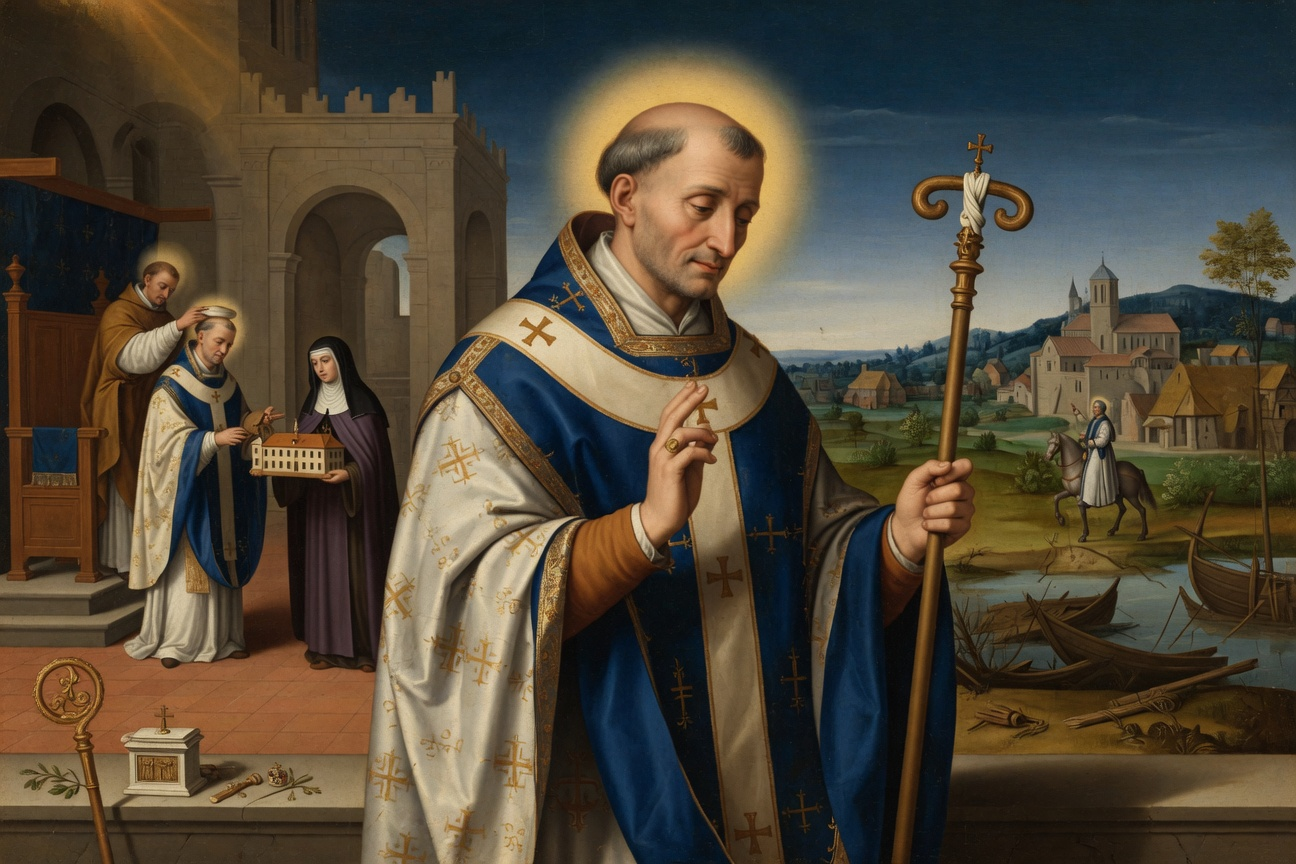
Bishop of Poitiers in the 6th century, Pient distinguished himself by his pastoral zeal and his support for Saint Radegund in the foundation of the Sainte-Croix monastery. After surviving a shipwreck near Maillezais, he died in Melle around 564. His cult remains active in Maillé, where he is invoked for hearing problems.
Contemporaries

Figures and markers around the normalized period for this entry.
Guided reading
4 reading sections
SAINT PIENT, BISHOP OF POITIERS (564).
Origins and accession to the episcopate
Of modest origin, Pient rose through his piety to the episcopal see of Poitiers, succeeding Daniel after the year 541.
Pientius or Pient , born in a humble condition, and whose father appears to have been attached to the churc h of Poi tiers in the capacity of a servant, rose, by his merit and his piety, to the first dignity of the diocese. It is not well known at what time he began to govern it, but it could only have been after the year 541, since, at that date, Daniel, his predecessor, was present at the fourth Council of O rleans.
Support for Saint Radegund
Pient's episcopate was marked by the foundation of the monastery of Sainte-Croix in Poitiers, a project he actively supported alongside Queen Radegund and the governor Eustropius.
A great event marked his episcopate, and he had the good fortune to play a major part in it. We speak of the establishment of the monastery of Sainte-Croix, which Sa int Radegund was founding in Poitiers. These houses of prayer bring too much glory to God and joy to priests for Saint Pient not to have given them his full devotion. Happily seconded by Eustropius, governor of Poitou for King Clotaire, he entered i nto the intentions of this prince, by hastening the completion of the holy dwelling over which the pious queen was watching, and which was favored by the royal generosity of her husband.
These cares of the prelate inspired in Radegund a gratitude that she showed him all her life, and Saint Grego ry of Tours, who wrote the history of this time, of which he was almost a contemporary, reports several traits that prove how much she always wished to remain towards him, with her sisters, in a filial dependence. She loved to entrust him with abundant alms for his poor and his churches. It was also she who provided him with the loaves of pure fine flour that she made for the service of the altar.
Pastoral Zeal and End of Life
Devoted to his vast diocese, Pient died in Melle around 564 during a pastoral tour, after having survived a shipwreck near Maillezais.
Everything that remains to us of the life of Saint Pient attests to his zeal for the regularity of episcopal life and the fulfillment of his duties. Constantly applied to the good of his flock, he visited it with solicitude, however vast the territory of the diocese of Poitiers may have been at that time, which extended from the Ocean to the borders of Touraine, Berry, and Limousin.
Once, while sailing toward the region of the island of Maillezais, he was shipwrecked with the sailors who were guiding his journey; several of them perished there. The Saint only escaped death in this circumstance to go and suc cumb at Melle, a small town in lower Poitou, which was receiving his visit perhaps during this same pastoral journey. It is believed that this was around the year 564. What is certain is that it must have been after 561, the date of the death of Clotaire I, since he died after this prince; and before 567, since Charibert, who succeeded the latter on the throne of France and reigned for only six years, placed Pascontius II after Saint Pient on the see of Poitiers.
Cult and popular devotions
Celebrated on March 13, his cult is particularly vibrant in Maillé, where a chapel commemorates his rescue from the waters and where he is invoked for hearing problems.
From time immemorial, the feast of Saint Pient has been celebrated on March 13, which is the day of his death. His name was placed between Saint Anthème and Saint Fortunat in the litanies of Poitiers, and the oldest liturgy of this diocese consecrates his memory. But his cult has nowhere retained as much celebr ity as in Maillé, the chief town of a parish near Maillezais. It is there that the Saint had been cast by the storm during the shipwreck of which we have spoken. Local tradition recounts that Pient had promised God in this peril to build a sacred monument at the very place where he would land, if His Providence deigned to save him. This vow was fulfilled, and it is this same chapel whose last traces have disappeared, but which, having long borne his name, was for more than ten centuries, on March 13 of each year, the meeting place of countless pilgrims. The small monument having been ruined, the devotion was transferred to the parish church of Maillé, and it is there that it still exists in its entirety in the confidence of the people who come there seeking the healing of ear ailments and deafness. Notes communicated to Canon Auber, historiographer of Poitiers, by Abbé Bourguy, professor at the major seminary of Luçon, and transmitted to the latter by the parish priest of Maillé.
Entities
Narrative network
The names, places, and concepts most present in the entry, weighted by centrality in the text.
The supernatural in their life
The miracles of Saint Pient (Pientius)
Frequently asked questions about Saint Pient (Pientius)
Who was Saint Pient (Pientius)?
Bishop of Poitiers in the 6th century, Pient distinguished himself by his pastoral zeal and his support for Saint Radegund in the foundation of the Sainte-Croix monastery. After surviving a shipwreck near Maillezais, he died in Melle around 564. His cult remains active in Maillé, where he is invoked for hearing problems.
What is Saint Pient (Pientius) the patron saint of?
Patronage of Saint Pient (Pientius): Maillé.
What is Saint Pient (Pientius) invoked for?
Saint Pient (Pientius) is invoked for: earaches and deafness.
What miracles are attributed to Saint Pient (Pientius)?
1 miracle are attributed to this saint, notably: Protection / deliverance.
Which saints were contemporaries of Saint Pient (Pientius)?
Contemporaries include: Saint Remigius (Apostle of the Franks), Saint Antide of Besançon, Saint Eugene of Carthage and Saint Nicaise of Reims.
When did Saint Pient (Pientius) die?
Saint Pient (Pientius) died around 600.
What are the other names of Saint Pient (Pientius)?
Other forms of the name: Pientius and Pient.
Who are the relatives of Saint Pient (Pientius)?
Relatives of Saint Pient (Pientius): Inconnu (father).
Annexes & related entities
Structured data for exploration: events, miracles, quotes, places, attributes, patronages, and important entities cited in the text.
Key Events
- Elevation to the episcopal dignity after 541
- Foundation of the Sainte-Croix monastery with Saint Radegund
- Pastoral visits in the vast diocese of Poitiers
- Shipwreck near the island of Maillezais
- Died in Melle during a pastoral visit