
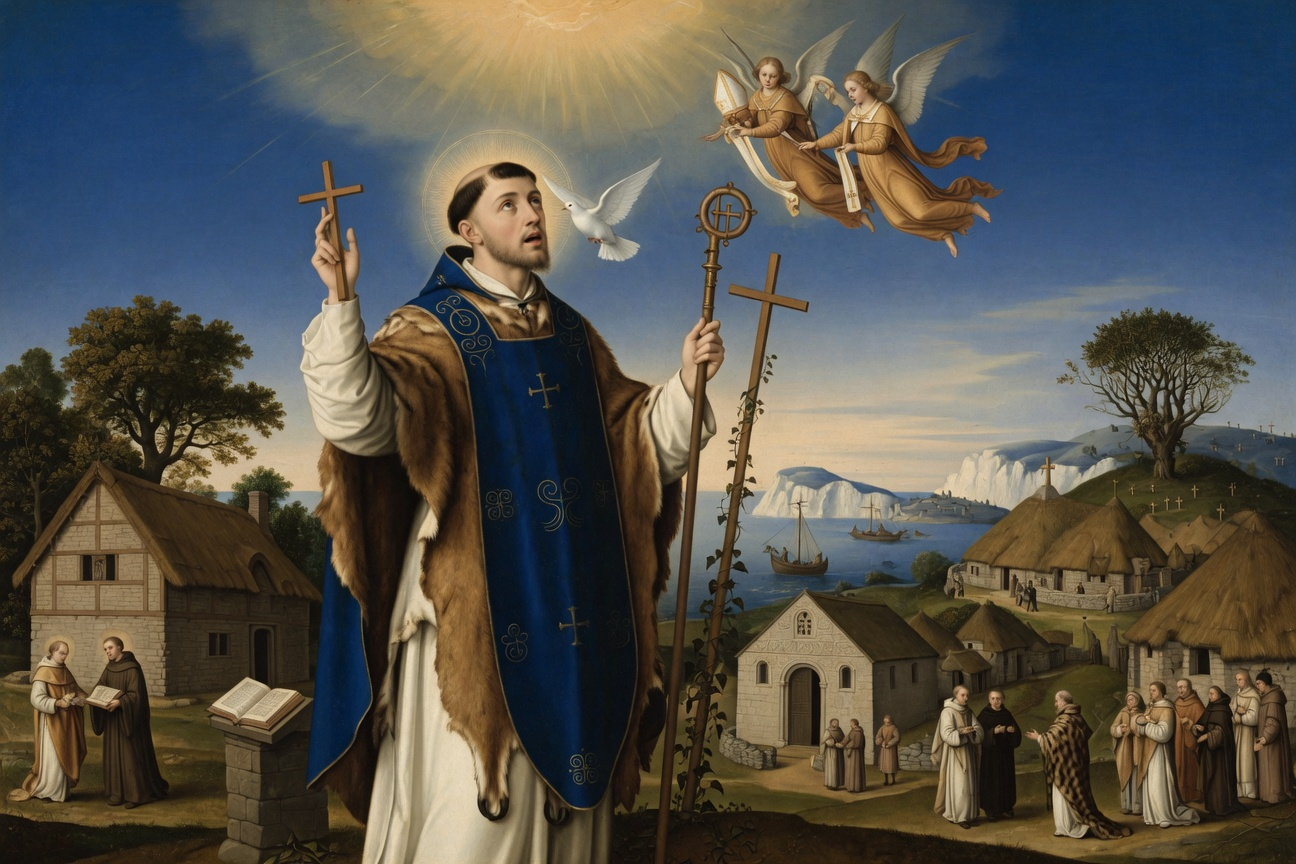
Saint David, son of a Welsh prince in the 6th century, was an austere monk and an influential archbishop. Founder of numerous monasteries and defender of orthodoxy against Pelagianism, he transferred his see to Menevia. He is the patron saint of Wales, renowned for his piety and miracles.
Contemporaries

Figures and markers around the normalized period for this entry.
Guided reading
4 reading sections
SAINT DAVID,
ARCHBISHOP AND PATRON SAINT OF WALES
Youth and monastic formation
Son of a Welsh prince, David received a Christian education and trained for religious life on the Isle of Wight under Paulinus, a disciple of Saint Germanus.
Circa 544. — Pope: Vigilius. Saint Davi d was the son o f Xant us, prince of C eredigion , today Cardiganshire. He received a very Christian education, which influenced the entire course of his life. After being ordained a priest, he withdrew to the Isle of Wight, w here he lived under the guidance of the pious and learne d Paulinus, who had been a d isciple of Saint German us of Auxerre. God rewarded David's eminent virtues with the gift of miracles. By making the sign of the cross, the saint restored sight to his master, who had become blind either through his great age or as a result of the abundant tears he shed in prayer. When he had well prepared himself for the functions of the holy ministry, he left his solitude, and like another John the Baptist emerging from the desert, he went to preach the word of eternal life to the Britons . He built a chapel at Glastonbury, a place that the first apostles of Great Britain had consecrated to the worship of the true God. He also founded twelve monasteries, the principal one of which was in the Ross valley near Menevia.
The austerity of David's rule
The saint imposed upon his monks a rigorous discipline based on manual labor without animals, silence, a frugal diet, and absolute obedience.
The rule that David gave to his monks was very austere. They worked continuously with their hands in a spirit of penance, never making use of animals suitable for plowing, and this so that their labor would be more arduous. Necessity alone could authorize them to break the silence. Uninterrupted prayer, at least mentally, sanctified all their external actions. Towards the end of the day, they returned to the monastery to attend to reading and vocal prayer. Bread and roots, of which salt was the only seasoning, made up all their food, and they had no other drink than water mixed with a little milk. After their meal, they spent three hours in orison; they then gave some time to sleep. They rose at the cock's crow, and returned to prayer until the moment for work had arrived. Their clothes were coarse and made of animal skins. When someone asked to be received into the monastery, he remained ten days at the door; and during that time he was tested by harsh words, by repeated refusals, and by arduous tasks, in order to accustom him to dying to himself. If he endured this trial with constancy and humility, he was admitted into the house. As for his possessions, he left them in the world, the rule of the monastery forbidding the receipt of anything for entry into the religious life. All the brothers were obliged to make their inner life known to the abbot and to reveal to him their most secret thoughts and temptations.
Struggle against Pelagianism and Episcopate
David distinguished himself at the Synod of Brefi against the Pelagian heresy and succeeded Saint Dubricius as archbishop, transferring the see to Menevia.
Pelagianism having appeared a second time in Great Britain, the bishops, in order to root it out entirely, assembled in 512, or rather in 519, at Brefi, in Cardiganshire. Saint David was invited to attend the synod. He appeared there with distinction, and confounded the heresy by the combined force of his knowledge, his eloquence, and his miracles. Saint Dubricius, Archbishop of Caerleon, took advantage of this circumstance to resign the government of his church to him. David, alarmed by the proposal made to him, burst into tears and protested that he would never take upon himself a burden that was far above his strength. In vain were the most pressing reasons alleged to determine him: he would never have yielded had the Fathers of the council not expressly ordered him to acquiesce in the choice of Dubricius. He obtained, however, the transfer of the see from Caerleon, then a very populous city, to Menevia, t oday Sa int Davids, a retired and solitary place.
Shortly after, he assembled a synod at Victoria, where the acts of the previous synod were confirmed. Several canons of discipline were also made there, to which the Roman Church later set the seal of its approval. It was from these two synods that the churches of Great Britain formerly drew their rules of conduct.
Death, Cult, and Relics
After a long life, David died around 544. His cult developed in Wales and his relics were later transferred to Glastonbury.
However, the reputation of our Saint increased day by day: he was at once the ornament and the model of the pastors of his century. He possessed the gift of speech to an eminent degree; but his eloquence had even less efficacy than the strength of his examples; thus he has always been regarded as one of the brightest lights of the British Church. By the foundation of his various monasteries, he was the spiritual father of a great number of Saints, who illustrated England and Ireland, their homeland. Finally, after a long and laborious episcopate, he died in peace, around the year 544, at a very advanced age. Saint Kentigern saw angels carrying his soul into heaven. His body was buried in the church of Saint Andrew, which has since taken the name of Saint David, as have the city and the diocese of Menevia. Near this church are several chapels where devotion attracted a great concourse of people in the Middle Ages. The principal one is that of Saint Non, mother of our Saint. Another is dedicated under the invocation of Saint Lily, surnamed Gwas-Dewy, that is to say, the man of Saint David, because he was one of his dearest disciples. He is honored there on the 3rd of March. As for Saint Non, who had trained several women withdrawn from the world to perfection, she is honored on the 2nd of the same month. Formerly, the southern Welsh celebrated the first three days of March in honor of Saint David, Saint Non, and Saint Lily; today, only the first is celebrated throughout Wales. In 962, the relics of our Saint were solemnly transferred to Glastonbury, along with a portion of those of Saint Stephen, th e first mar tyr.
Alban Rottier. — See in the martyrology, for this day, some marvelous facts that this author, following his habit, has passed over in silence.
Iconography
Signs and attributes

Entities
Narrative network
The names, places, and concepts most present in the entry, weighted by centrality in the text.
The supernatural in their life
The miracles of Saint David
Frequently asked questions about Saint David
Who was Saint David?
Saint David, son of a Welsh prince in the 6th century, was an austere monk and an influential archbishop. Founder of numerous monasteries and defender of orthodoxy against Pelagianism, he transferred his see to Menevia. He is the patron saint of Wales, renowned for his piety and miracles.
What is Saint David the patron saint of?
Patronage of Saint David: Wales.
How is Saint David depicted in Christian art?
In iconography, Saint David is recognizable by: animal skin clothing, sign of the cross, dove (implied by eloquence) and angels.
What miracles are attributed to Saint David?
2 miracles are attributed to this saint, notably: Healing and Vision / apparition.
Which saints were contemporaries of Saint David?
Contemporaries include: Saint Remigius (Apostle of the Franks), Saint Antide of Besançon, Saint Eugene of Carthage and Saint Nicaise of Reims.
When did Saint David die?
Saint David died around 544.
What are the other names of Saint David?
Other forms of the name: Dewi.
Who are the relatives of Saint David?
Relatives of Saint David: Xantus (father) and Sainte Nun (mother).
Annexes & related entities
Structured data for exploration: events, miracles, quotes, places, attributes, patronages, and important entities cited in the text.
Key Events
- Christian education and priestly ordination
- Retreat on the Isle of Wight with Paulinus
- Preaching to the Britons and foundation of twelve monasteries
- Participation in the Synod of Brefi against Pelagianism in 519
- Succeeded Saint Dubricius to the See of Caerleon
- Transfer of the episcopal see to Menevia
- Presidency of the Synod of Victoria
- Died at a very advanced age around 544