
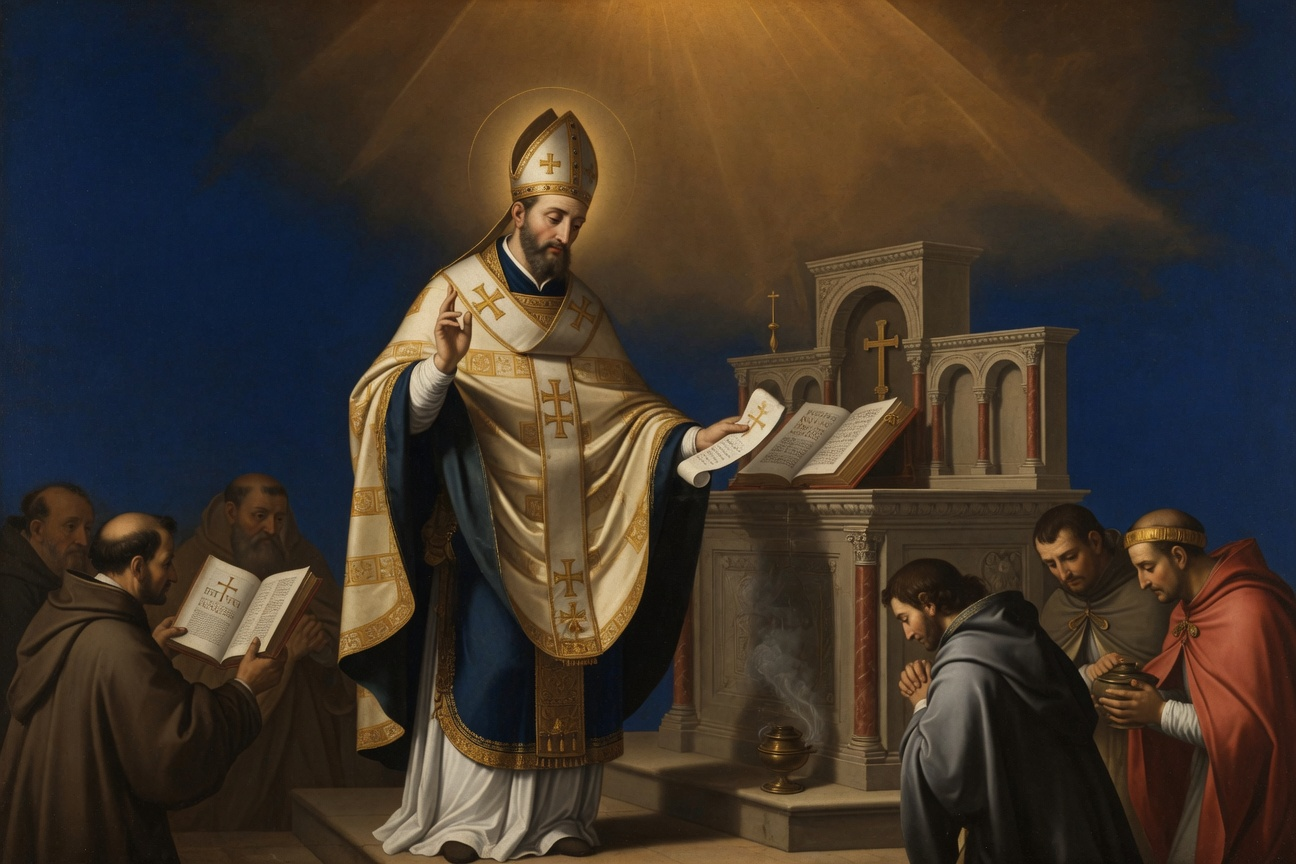
Saint Leander of Seville
Saint Leander was the architect of liturgical reform in Spain in the 6th century, introducing the Nicene Creed to counter Arianism. He played a key role in the conversion of the Goths and left major writings, including a rule for his sister Florentina and a speech at the Council of Toledo in 589.
Contemporaries

Figures and markers around the normalized period for this entry.
Guided reading
4 reading sections
LITURGY AND WRITINGS OF SAINT LEANDER.
Reform of the Spanish Liturgy
Saint Leander introduced the Nicene Creed into the Spanish Mass to counter Arianism, a practice later adopted by Rome.
We owe to Saint Leander a reform of the liturgy of the Church of Spain. This liturgy prescribed the recitation of the Nicene Creed at Mass, in accordance with what was already practiced in the East, to make an express declaration that one did not adhere to Arianism. Shortly after, this precious custom passed into the Church of Rome and the rest of the West.
Origins and evolution of the Mozarabic liturgy
The evolution of the liturgy in Spain, from the initial Roman influence to the contributions of Leander, Isidore, and Ildefonsus, up to its Mozarabic form.
Spain received the first lights of the faith from Rome, as we learn from the letter of Pope Innocent I to Decentius, and it is for this reason that Saint Isidore says, l. I., c. 15, Offec. ecc., that the office of the churches of Spain was instituted by Saint Peter. The ceremonies and discipline of these same churches had a Roman origin: this is a fact of which one can be convinced by reading their ancient councils. The Arian Goths substituted for the liturgy of Rome that which Ulfilas had composed based on the Eastern liturgies. It is believed that Saint Leander created a new one based on these first two and on that of the Gauls. Saint Isidore and Saint Ildefonsus subsequently gave it a new degree of perfection. Spain having passed under the domination of the Saracens or Arabs, the Christians of this kingdom were called mixti Arabes, that is to say soft Arabs, from which their liturgy took the name of Mozarabic. It gave way to that of Rome in the 11th and 12th centuries. Cardinal Ximenes re-established the Mozarabic liturgy in a chapel of the Cathedral of Toledo; it is also in use in seven churches of the same city, but only for the day of the patronal feast.
Debates and scholarly sources
Analysis of the works of historians and Jesuits regarding the authenticity and specificities of the liturgy of Saint Leander.
Father Florès believes that the liturgy of Saint Leander was not at all different from the Mozarabic, and that with the exception of a few rites of little importance, it had nothing in common with that of the Orientals. See his *Spagna sagrada*, vol. III, diss. de la Missa antiqua de Espagne, p. 187, 198, etc. But, although these liturgies had much conformity between them, they nevertheless had considerable differences on some points. We learn this from a letter that Father Durriel, a learned Jesuit, provided on the literary monuments found in Spain. One will draw great light on this article, as well as on several other particularities concerning the ecclesiastical antiquity of Spain, in the collection of Gothic manuscripts that Father Florès has given to the public. The curious will also consult with pleasure the new edition of the liturgies of the Christian churches, which the Messrs. Assemani provided in Rome in 15 vol. in-fol. The Mozarabic liturgy was printed in Rome, in-fol., under the care of Father Lesley, a Scottish Jesuit.
Writings and conciliar acts
Presentation of the preserved works of Leander, notably his letter to Florentina and his speech at the Third Council of Toledo.
Volume LXXV of M. Migne's *Patrologia Latina*, and the following one, include the Mozarabic liturgies. There remain of Saint Leander: 1° a letter to his sister Florentina, under the title: *On the Institution of Virgins and the Contempt of the World* (Volume LXXXII of M. Migne's *Patrologia*); 2° a *Speech on the Conversion of the Goths*: it is part of the Third Council of Toledo, in the year 589 (Volume LXXII of M. Migne's *Patrologia*).
Additional passages recovered from the sources
These passages from Les Petits Bollandistes supplement the entry. The references identify their context in the original volume.
Read the supplementary notes and passages (1)
Ways in which Saint Leander is depicted
Historical supplement of the Petits Bollandistes, transcribed from the images of the 19th-century edition. The traditions, assessments and expressions describing a "current" situation are those of the source at its time; they do not constitute a contemporary verification.
1° He is sometimes seen, but rarely, holding a flaming heart in his hand, a symbol no doubt of the zeal that led him to convert the Visigoths; 2° reunited with his brothers Saint Fulgentius and Saint Isidore and his sister Saint Florentina; 3° holding a pen in his hand: this attribute characterizes the Saints who particularly distinguished themselves by their writings; 4° instructing the young king Reccared the Catholic; 5° accompanied by some symbol representing the three persons of the Holy Trinity, to recall his struggle against Arianism; 6° on his knees before an image of the Holy Virgin, that of Our Lady of Guadalupe, no doubt, for it is believed in Spain, as we have already said, that Saint Gregory the Great made a gift to Saint Leander of the famous image of the Mother of God, made by the hands of Saint Luke, which is so venerated by the many pilgrims who go to Guadalupe (1. Cf. Moines d'Occident by M. de Montalembert.).
Paul Guérin, Les Petits Bollandistes, volume 3, p. 49, 50. Bibliothèque nationale de France: https://gallica.bnf.fr/ark:/12148/bpt6k30733g
Entities
Narrative network
The names, places, and concepts most present in the entry, weighted by centrality in the text.
Frequently asked questions about Saint Leander of Seville
Who was Saint Leander of Seville?
Saint Leander was the architect of liturgical reform in Spain in the 6th century, introducing the Nicene Creed to counter Arianism. He played a key role in the conversion of the Goths and left major writings, including a rule for his sister Florentina and a speech at the Council of Toledo in 589.
Which saints were contemporaries of Saint Leander of Seville?
Contemporaries include: Saint Remigius (Apostle of the Franks), Saint Antide of Besançon, Saint Eugene of Carthage and Saint Nicaise of Reims.
When did Saint Leander of Seville die?
Saint Leander of Seville died around 600.
Who are the relatives of Saint Leander of Seville?
Relatives of Saint Leander of Seville: Florentine (sister).
Annexes & related entities
Structured data for exploration: events, miracles, quotes, places, attributes, patronages, and important entities cited in the text.
Key Events
- Reformation of the liturgy of the Church of Spain
- Introduction of the recitation of the Nicene Creed at Mass
- Conversion of the Goths
- Participation in the Third Council of Toledo in 589
Quotes
On the Institution of Virgins and the Contempt of the World
Letter to his sister FlorentinaSpeech on the conversion of the Goths
Third Council of Toledo