
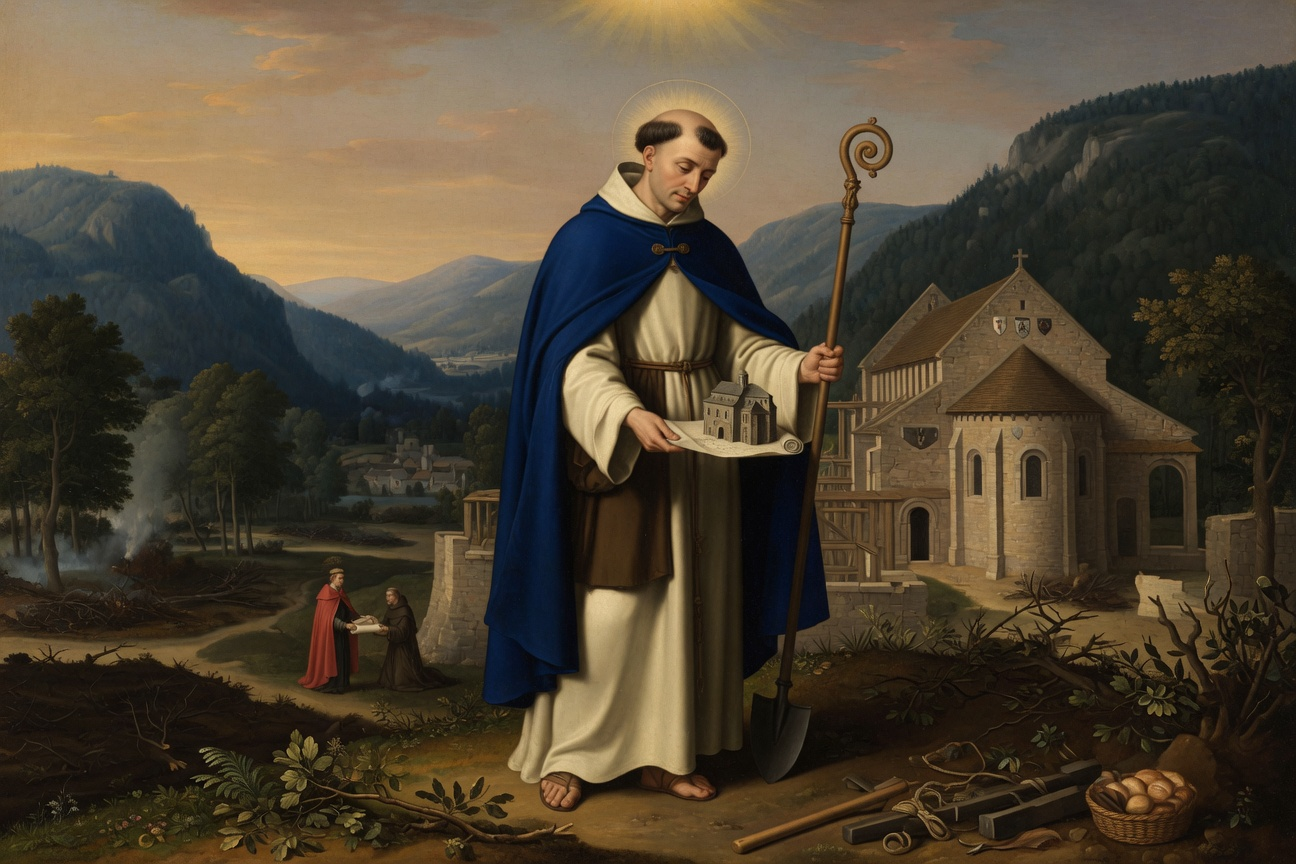
A disciple of Saint Columbanus, Leobard founded the Abbey of Marmoutier in Alsace in the early 7th century on a royal estate granted by Childebert II. A pioneer of land clearing at the foot of the Vosges, he established one of the oldest and most prosperous religious centers in the province.
Contemporaries

Figures and markers around the normalized period for this entry.
Guided reading
6 reading sections
SAINT LEOBARD OR LEUVART,
ABBOT, FOUNDER OF THE ABBEY OF MARMOUTIER, IN ALSACE (618).
The Monastic Rise in Alsace
In the 7th and 8th centuries, Alsace experienced a flourishing of religious foundations that transformed the wild lands of the Vosges into prosperous agricultural zones.
Nothing proves better how flourishing religion was in Alsace d uring the 7th and 8th centuries than the establishment of the numerous religious houses that were founded at that time in this province. Several pious solitaries, having flocked from foreign lands, settled at the foot of the Vosges, in uncultivated valleys covered with thick woods and stagnant waters, and bristling with rocks. The religious cleared the lands, drained the marshes, transformed into fertile gardens these fields hitherto struck with eternal sterility, and thereby they favored the progress of agriculture and the population. It is thus that they laid the foundations of this prosperity which developed later, and which makes Alsace one of the most beautiful regions of France today.
The foundation by Saint Leobard
Saint Leobard, a disciple of Saint Columbanus, founded the Abbey of Marmoutier under the protection of King Childebert II of Austrasia.
The Abbey of Marmoutier was the oldest in Alsace. It was located at the foot of the Vosges, seven leagues from Strasbourg, in a town of the same name, to which it gave birth. Historians agree in recognizing as its founder Saint Leobard, a dis ciple of Sain t Columbanus, who establishe d it in honor of the holy apostles Peter and Paul, and of Saint Martin, Bishop of Tours. Childebert I I, King of Austrasia, granted the founder, towards the end of the 6th century, the valley in which he had settled. This valley, as well as the surrounding area, was part of the royal domain, then known by the name of the March of Aquileia.
The territory of the abbey extended, in its origin, much further than in later times, and included a large number of villages and hamlets, but many of which were subsequently alienated.
Saint Maur and the reconstruction
After a devastating fire, Saint Maur completely rebuilt the abbey, becoming its second founder and giving it its definitive name.
He was replaced in the administration of the abbey by Anastasius, Godfrey, and Leobard II. Leobard II was suc ceed ed by Maur, who was also numbered among the Saints, and who must have been a disciple of Saint Firmin.
A fire had reduced to ashes, under Leobard II, the church and all the buildings of the cloister. Maur found the means to rebuild everything: the holiness of his life, joined to his zeal for the restoration of the monastery, earn ed him the title of second founder, and, since that time, the abbey was called by his name, Mauramünster, Maurmoutier, and by corruption Marmoutier.
The Carolingian Era and Drogo of Metz
Following a new fire in 827, Bishop Drogo of Metz restored the abbey with the support of Louis the Pious and transferred sacred relics there.
Studies were flourishing at that time in Marmoutier, and the religious followed the movement given to the renaissance of letters by Charlemagne, when a fire once again consumed, in 827, the abbey and all its archives. Celsus, who was its abbot, neglected nothing to re-establish the monastery, and he believed he should address Louis the Pious to obtain aid. The latter entrusted the restoration of the buildings to Drogo, Bishop o f Metz, and his natura l brother. This prelate discharged this duty with a zeal worthy of the highest praise, and the buildings were perfectly restored. It appears that the western facade of the church, as it is still seen today, is the one that was built by the orders of Drogo. On May 7, 833, Drogo solemnly transferred into the new church the bodies of two of his predecessors, Saint Caelestius and Saint Autarius, bishops of Metz. This church is built in very good taste and bears the traces of high antiquity. The nave appears to have undergone some changes in the 13th century; the choir, on the contrary, was rebuilt in the last century, but Gothic architecture was imitated to a certain point.
Since Drogo, the abbey of Marmoutier was subject, for its temporal affairs, to the bishopric of Metz. It was, until the days of our troubles, the home of knowledge and good studies.
Sindelsberg and the cult of Saint Vitus
The text details auxiliary foundations such as Sindelsberg and the importance of the pilgrimage to the grotto of Saint Vitus for the healing of 'Saint Vitus' dance'.
A quarter of a league from the abbey, one can see, on a hill, a pretty church, the remains of a convent for women called Sindelsberg, founded around 1120 by Richovin, abbot of Marmoutier, and later of Neuwiller. This church was consecrated in 1137 under the invocation of the Blessed Virgin and Saint Blaise. The nuns occupied it for nearly three hundred years, but they were removed in 1488 by the Bishop of Strasbourg, Albert of Bavaria. The Abbey of Marmoutier, which united the assets of Sindelsberg with its own domains, although heavily damaged, nevertheless committed to paying pensions to the nuns. The church of Sindelsberg was ruined during the Peasants' War in 1525, but Abbot Gisbert restored it. Another church, of equally remarkable architecture, located in the village of Zehnackern, near Reutenbourg, must also originate from an ancient convent of nuns that depended on the Abbey of Marmoutier. It is a frequented pilgrimage site in honor of the Blessed Virgin. We must not omit here the famous grotto of Saint Vitus or Saint Guy, located on a mountain in the Z orn valley, opposite Bob-Barr: it is more than sixty feet deep; art and nature appear to have contributed to making it interesting. It had long been inhabited by religious men. A chapel dedicated to Saint Vitus, located at the top of the plateau which this rock is surmounted by, was falling into ruins, and the faithful placed his image in the grotto, which was from then on enlarged and arranged as a chapel. The Saint who is venerated there is a young hero of Christianity, who suffered martyrdom under Diocletian at the beginning of the 4th century. The faithful invoke him for the healing of a disease called by his name, Saint Vitus' dance. This disease, which the credulity of the 15th century attributed to the demon, had become very common in Alsace, and especially in Strasbourg, to the point that the magistrates sent all the unfortunate people who were attacked by it to the chapel of Saint Vitus, and provided them with carriages and provisions.
This grotto continues to be frequented by numerous pilgrims, especially on the 1st of May. Iron toads are brought as an offering to the Saint, because it is claimed that the shape of this hideous animal resembles the part of the body where the ailment for which one implores healing is seated. There was also in the village of Obersteigen a monastery of regular canons of Saint Augustine, which was transferred to Savern e and erected into a collegiate church. This translation took place in 1308, and the secularization in 1482: this chapter consisted of eight canons, a provost, and a dean. The collegiate church, which was formerly the church of the castle that the bishops of Strasbourg had in this city, communicated with this castle by semi-underground chapels. It offers nothing remarkable, except for a very high square tower: the choir appears to be older than the nave. The parish church of Saint Margaret, located outside the walls, was united to this collegiate church.
Late developments in Saverne
The history concludes with the transfer of the canons of Obersteigen to Saverne and the installation of the Recollects until the Revolution.
The former monastery, built initially for the religious of Obersteigen in Saverne, was given under Bishop Albert, in 1486, to the Recollec ts, who inhabited it until the French Revolution. The church, which is in very good taste, and the cloister buildings, are presently assigned to the town's college.
Saints of Alsace, by Hunckler.
Entities
Narrative network
The names, places, and concepts most present in the entry, weighted by centrality in the text.
Frequently asked questions about Saint Leobard (Leuvart)
Who was Saint Leobard (Leuvart)?
A disciple of Saint Columbanus, Leobard founded the Abbey of Marmoutier in Alsace in the early 7th century on a royal estate granted by Childebert II. A pioneer of land clearing at the foot of the Vosges, he established one of the oldest and most prosperous religious centers in the province.
What is Saint Leobard (Leuvart) the patron saint of?
Patronage of Saint Leobard (Leuvart): Marmoutier Abbey.
Which saints were contemporaries of Saint Leobard (Leuvart)?
Contemporaries include: Saint Priest (Prix), Saint Gregory the Great (Pope and Doctor of the Church), Saint Die (Didier, Deodat) and Saint Augustine of Canterbury.
When did Saint Leobard (Leuvart) die?
Saint Leobard (Leuvart) died around 618.
What are the other names of Saint Leobard (Leuvart)?
Other forms of the name: Leuvart.
Annexes & related entities
Structured data for exploration: events, miracles, quotes, places, attributes, patronages, and important entities cited in the text.
Key Events
- Arrival in Alsace at the foot of the Vosges
- Foundation of the Abbey of Marmoutier in honor of Saint Peter, Saint Paul, and Saint Martin
- Obtained the valley of the Marche d'Aquilée from King Childebert II
- Land clearing and draining of marshes