
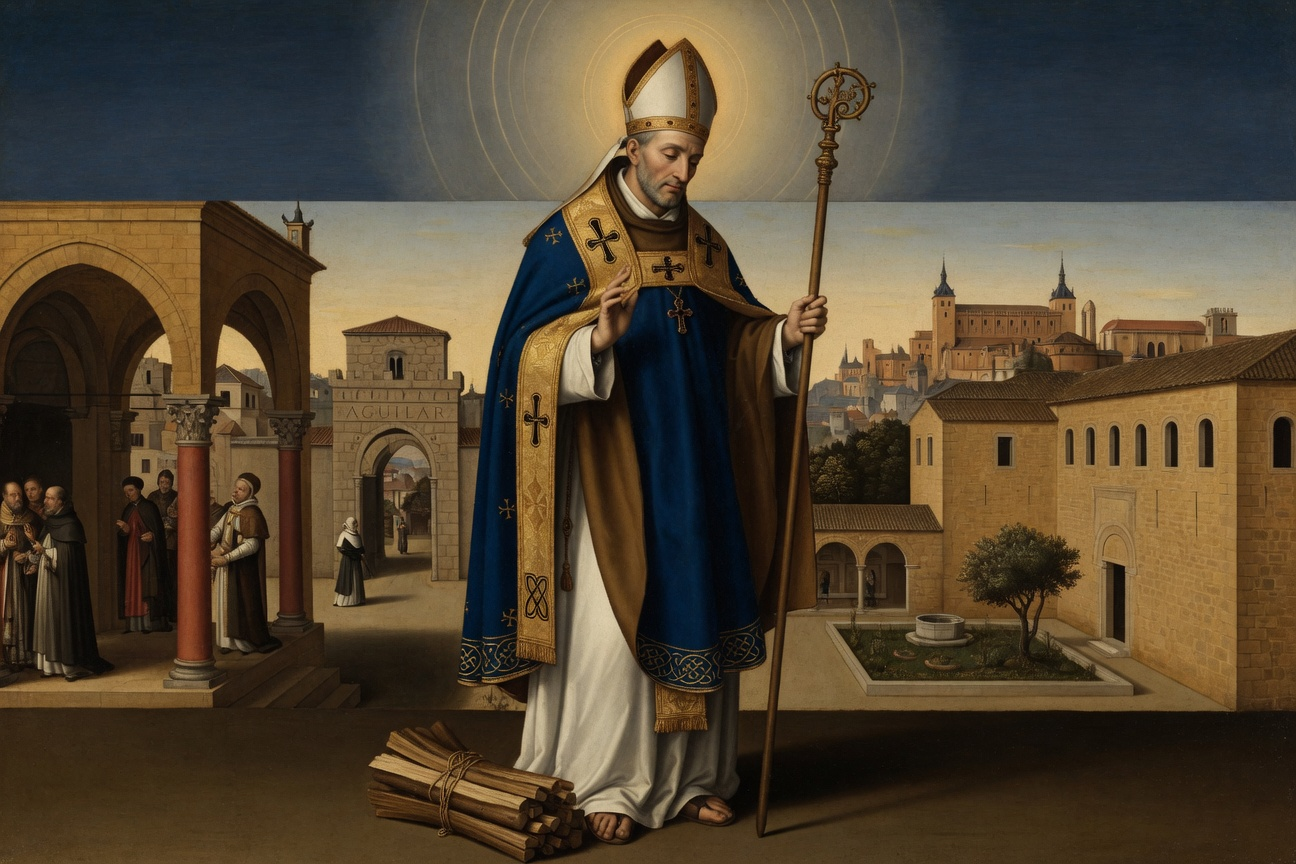
Saint Helladius of Toledo
A high dignitary at the court of Toledo, Helladius left his duties to become a monk at the monastery of Agali before being elected bishop of the city. He governed his church for eighteen years with immense charity toward the poor, under the reigns of Sisebut, Suintila, and Egica. He died in 632, leaving the memory of an exemplary pastor according to his successor Saint Ildefonsus.
Contemporaries

Figures and markers around the normalized period for this entry.
Guided reading
4 reading sections
SAINT HELLADIUS, BISHOP OF TOLEDO (632).
Public life and secret vocation
Helladius held high office at the court of Toledo while secretly leading a life of prayer and service at the monastery of Agali.
Helladius succeeded Avansius to th e episcopal see of Toledo . He held considerable rank at court and a high position in the government, which did not prevent him from fulfilling the vow and work of a religious under the habit of a secular. As soon as business left him some leisure, he would flee alone and without any pomp to the monaste ry of Agali, and th ere he would devote himself to all the occupations of the monks, even carrying wood to the oven with them and mingling with the crowd.
Monastic commitment and episcopate
After leaving the world to become a monk, he was called despite his old age to become Bishop of Toledo, where he distinguished himself by his wisdom.
As soon as it was possible, he left the world and came to shut himself up definitively in that same monastery, where he had already lived for so long in his desires. Having become a monk, he was a model for his brothers and he greatly enriched the monastery. When he was called to the episcopate, old age had already greatly weakened his body; nevertheless, in his new position, he gave even greater examples than he had done while a monk. He exercised as much discretion in governing the world as he had employed courage in despising it.
Virtues and charity
Recognized for his great mercy, he dedicated his resources to the poor, favoring exemplary action over writings.
He was so merciful toward the poor, his alms were so abundant, that his heart appeared as the source from which warmth and life flowed into the limbs and bowels of the poor to revive them. He did not write: he preferred to act.
End of life and historical context
His successor Saint Ildefonsus testifies to his death in 632 after eighteen years of governance under the reigns of the Visigothic kings.
It is Saint Ildefonsu s, his successor, who speaks thus, then he adds: Returning to the same monastery at the last moments of his life, he ordained me deacon; he died old, he held the government of his church for eighteen years, under the king s Siseb ut , Suintila , an d Egic a. He was considered blessed, and he entered into possession of heavenly glory, full of years and merits. 632. Annals of Baronius .
Iconography
Signs and attributes



Entities
Narrative network
The names, places, and concepts most present in the entry, weighted by centrality in the text.
Frequently asked questions about Saint Helladius of Toledo
Who was Saint Helladius of Toledo?
A high dignitary at the court of Toledo, Helladius left his duties to become a monk at the monastery of Agali before being elected bishop of the city. He governed his church for eighteen years with immense charity toward the poor, under the reigns of Sisebut, Suintila, and Egica. He died in 632, leaving the memory of an exemplary pastor according to his successor Saint Ildefonsus.
What is Saint Helladius of Toledo the patron saint of?
Patronage of Saint Helladius of Toledo: Toledo.
What is Saint Helladius of Toledo invoked for?
Saint Helladius of Toledo is invoked for: charity towards the poor.
How is Saint Helladius of Toledo depicted in Christian art?
In iconography, Saint Helladius of Toledo is recognizable by: monk's habit, episcopal insignia and firewood.
Which saints were contemporaries of Saint Helladius of Toledo?
Contemporaries include: Saint Priest (Prix), Saint Gregory the Great (Pope and Doctor of the Church), Saint Die (Didier, Deodat) and Saint Augustine of Canterbury.
When did Saint Helladius of Toledo die?
Saint Helladius of Toledo died around 700.
What are the other names of Saint Helladius of Toledo?
Other forms of the name: Héliade.
Annexes & related entities
Structured data for exploration: events, miracles, quotes, places, attributes, patronages, and important entities cited in the text.
Key Events
- High-ranking position in government and at court
- Frequent retreats at the monastery of Aguilar
- Definitive entry into the monastery as a monk
- Election to the episcopal see of Toledo
- Governed the Church for eighteen years
- Ordination of Saint Ildefonsus as deacon
Quotes
-
He did not write: if he had acted better.
Saint Ildefonsus