
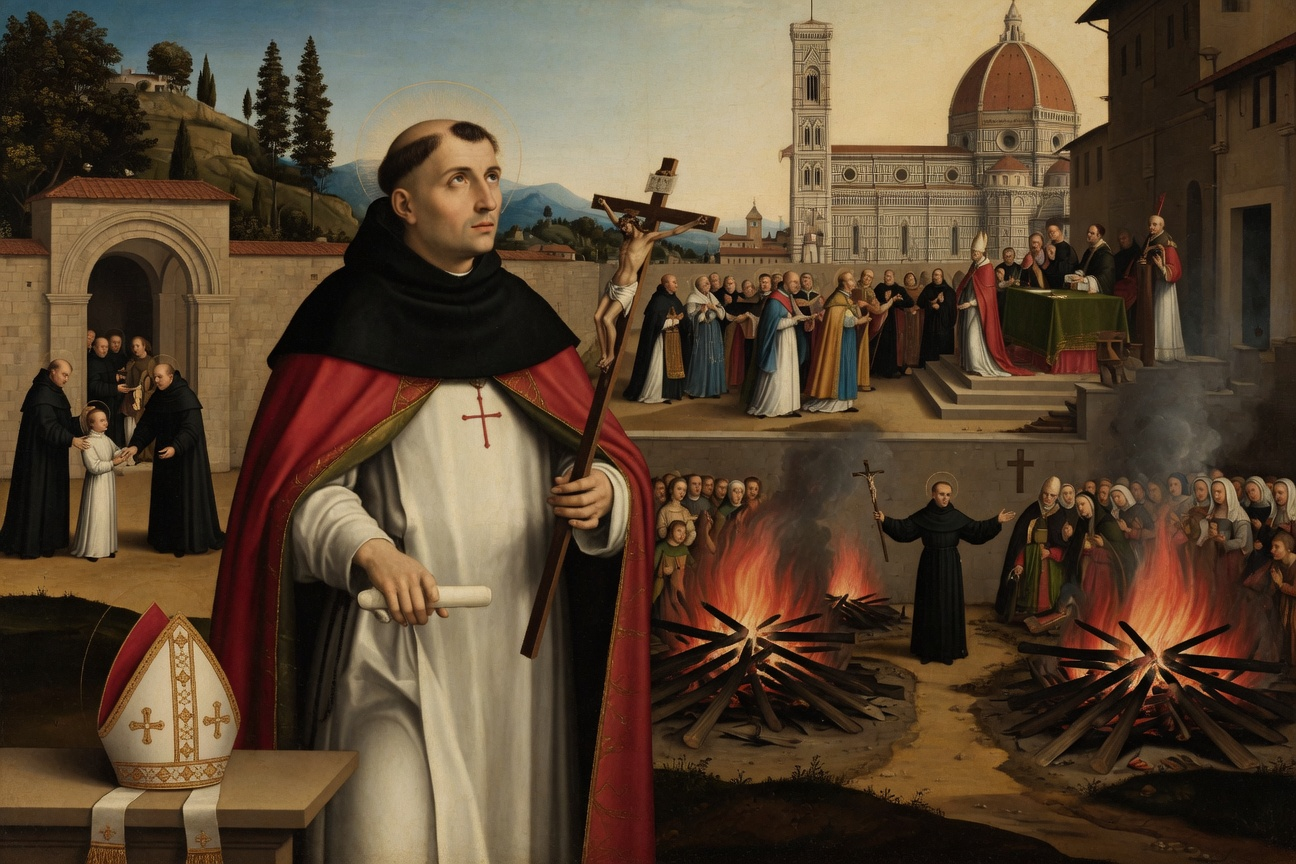
Blessed Peter Aldobrandini
A Vallombrosan monk in the 11th century, Peter Aldobrandini was tasked with proving the accusations of simony against the Archbishop of Florence through the ordeal by fire. He walked unharmed through a double blazing pyre before a vast crowd, which earned him the nickname 'Peter Igneus'. He ended his life honored with the titles of bishop and cardinal.
Contemporaries

Figures and markers around the normalized period for this entry.
Guided reading
6 reading sections
BLESSED PETER ALDOBRANDINI (1089).
Origins and monastic vocation
Pierre Aldobrandini, from an illustrious family, joined the monastery of Vallombrosa founded by Saint John Gualbert.
He came from the illustrious Aldobrandini family. He became a religious in the monastery of Vallombrosa, which Saint John Gualber t had just founded.
The accusation against the archbishop
In 1063, the monks of Vallombrosa accused the Archbishop of Florence of simony and proposed the ordeal by fire to prove their claims.
The religious of this monastery having accused Peter of Pavia, A rchbishop of Fl orence, of simon y in 106 3, Peter Aldobrandini was chosen by his brothers to support this accusation through the ordeal by fire.
"Neither th e Pope (Alex ander II) nor the council (of Rome) had permitted the monks to justify themsel ves by the ord eal by fire, as they had offered. It was not the same for the people of Florence, who forced the religious to demonstrate the truth of their accusation by this means. A day was therefore set for this purpose, and, as soon as it arrived, an immense crowd of laypeople and priests, of men and women of every age and condition, gathered near the convent of Saint-Sauveur. There, two pyres, built by the people, rose up, ten feet long, five wide, and four high. They were separated by a path, strewn with dry and highly flammable wood."
Preparation for the ordeal by fire
Despite the initial lack of papal authorization, the people of Florence impose the ordeal; Peter is chosen to walk through the pyres after a solemn mass.
In the church, hymns were sung and fervent prayers were addressed to heaven to know who, according to the abbot's orders, was to pass through the flames; the choice fell upon Peter, a monk of Vallombrosa, a m an of irrepr oachable conduct. Peter went to the altar to celebrate mass; all hearts were moved. Four monks then headed toward the pyres: the first carried the image of Christ, the second holy water, the third twelve blessed candles, and the fourth a vessel full of incense to light the fire. All raised their hearts to God for the success of this perilous undertaking.
As soon as the priest had finished the sacrifice, he took the Savior's cross and solemnly walked around the pyres, accompanied by the abbot and the monks; when he had approached the flames, the purpose of the ceremony was explained to the people. The fire was already lit, the flame crackled with ardor; the priest knelt before God, and begged Jesus Christ to allow him to pass through the flame safe and sound, if Bishop Peter was guilty. The people answered: Amen.
The miracle and the triumph
Peter passes through the flames unharmed before the eyes of the crowd, confirming by this miracle the veracity of the accusation.
Finally, the monk made the sign of the cross over this burning furnace, grasped the crucifix, and, with a serene countenance, he passed through the flames without being touched: God and his faith protected him. When he reappeared at the other end, the people rushed toward him, fell to their knees, kissed his feet, considering themselves fortunate to be able to tear off a shred of his robe. It was with great difficulty that his brethren managed to free him from this crowd.
Ecclesiastical consequences
The guilty archbishop is deposed by the Pope and Peter, henceforth nicknamed 'Igneus', is raised to the dignities of bishop and cardinal.
As soon as the Holy Father had learned of this event, he deposed the accused as having been convict ed. The monk Peter, who was n icknamed Igneus, attained great honors: he was bishop and cardinal.
Sources of the narrative
The text relies on the works of the Protestant historian Voigt, translated by Abbé Jager.
We borrow this narrative from the History of Gregory VII, by the Prot estan t Voigt, transla tion by M. l'ab bé Jager.
Iconography
Signs and attributes


Entities
Narrative network
The names, places, and concepts most present in the entry, weighted by centrality in the text.
The supernatural in their life
The miracles of Blessed Peter Aldobrandini
Frequently asked questions about Blessed Peter Aldobrandini
Who was Blessed Peter Aldobrandini?
A Vallombrosan monk in the 11th century, Peter Aldobrandini was tasked with proving the accusations of simony against the Archbishop of Florence through the ordeal by fire. He walked unharmed through a double blazing pyre before a vast crowd, which earned him the nickname 'Peter Igneus'. He ended his life honored with the titles of bishop and cardinal.
How is Blessed Peter Aldobrandini depicted in Christian art?
In iconography, Blessed Peter Aldobrandini is recognizable by: crucifix, pyre, flames and Vallombrosan monk habit.
What miracles are attributed to Blessed Peter Aldobrandini?
1 miracle are attributed to this saint, notably: Mastery of the elements and Protection / deliverance.
Which saints were contemporaries of Blessed Peter Aldobrandini?
Contemporaries include: Saint Bernard of Menthon (Apostle of the Alps), Saint Stephen of Hungary, Saint Norbert of Magdeburg and Saint Bernard of Clairvaux.
When did Blessed Peter Aldobrandini die?
Blessed Peter Aldobrandini died around 1100.
What are the other names of Blessed Peter Aldobrandini?
Other forms of the name: Pierre Igné and Petrus Igneus.
Who are the relatives of Blessed Peter Aldobrandini?
Relatives of Blessed Peter Aldobrandini: Famille Aldobrandini (family of origin).
Annexes & related entities
Structured data for exploration: events, miracles, quotes, places, attributes, patronages, and important entities cited in the text.
Key Events
- Entered the monastery of Vallombrosa
- Accusation of simony against the Archbishop of Florence in 1063
- Victorious ordeal by fire near the Saint-Sauveur convent
- Elevation to the dignities of bishop and cardinal