
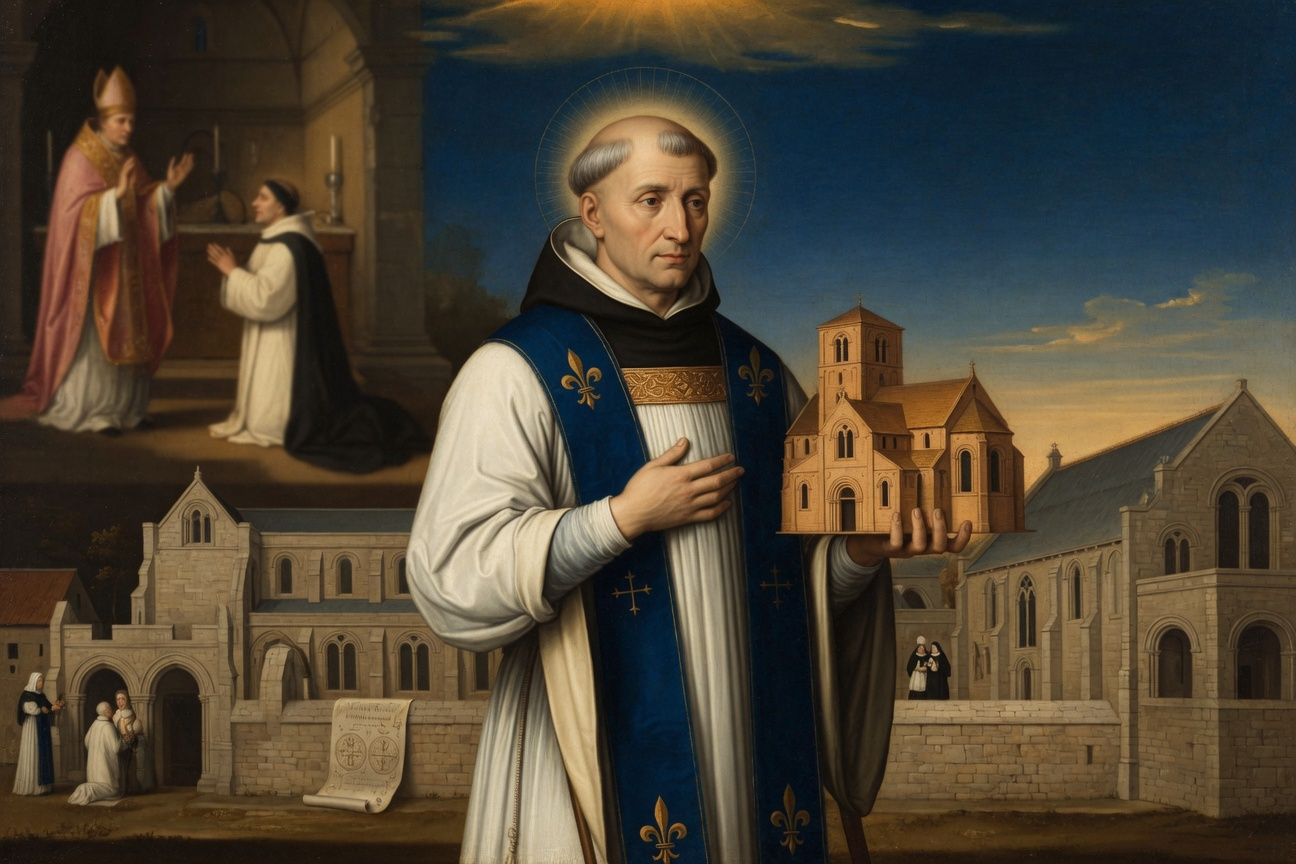
Saint Gilbert of Sempringham
An English priest of the 12th century, Gilbert founded the Gilbertine Order at Sempringham, uniting communities of men and women under rules inspired by Saint Benedict and the canons regular. Despite political persecutions linked to Thomas Becket, he lived to the age of 106 in great austerity. He was canonized in 1202 following numerous miracles reported at his tomb.
Contemporaries

Figures and markers around the normalized period for this entry.
Guided reading
7 reading sections
SAINT GILBERT, FOUNDER OF THE GILBERTINES (1190).
Youth and formation
Born in Sempringham in England, Gilbert received a clerical education before becoming a priest and opening a school for the youth.
This Saint was bor n in Sempri ngham, in the province of Lin coln, in England. Having been trained in the practice of all clerical virtues, he was raised to holy orders, and then received the priesthood from the Bishop of Lincoln. He opened a school where he taught the youth for some time the principles of the sciences and even more so the great maxims of piety.
Ministry and Charity
Appointed pastor of Sempringham and Tirington in 1123, he distinguished himself by his extreme personal poverty and his total dedication to the instruction of his parishioners.
In 1123, he was appointed to the cu re of Sempr ingham and that of Tirington. These two parishes, of which his father was lord, had been united, and could consequently be served by the same priest. The Saint reserved for himself from the income of these two benefices only what was absolutely necessary for him to live; all the rest was distributed to the poor. He gave himself entirely to the instruction of his parishioners, and it was with extraordinary success. They lived indeed in their homes like religious in their cloisters, and it was enough to see them to know who their pastor was.
Foundation of the Order of Gilbertines
He founded a double community for women and men, inspired by the rules of Saint Benedict and the canons regular, which was approved by Pope Eugene III.
Seven virgins having consecrated themselves to God in a house near the parish church of Sempringham, Gilbert took particular care of them and gave them a rule which they observed exactly in their retreat; he also gave one to a community of men who asked to live under his guidance. He had drawn the first of these rules from that of Saint Benedict, and the se cond from th at of the canons regular; but he added to both some new constitutions. Such was the origin of the Order of Gilbertines, which Pope Eugene III approved.
Ascetic life and piety
Gilbert led a life of extreme mortifications, nourishing himself on very little and practicing charity through the 'dish of the Lord Jesus'.
Our Saint himself entered this Order and took on its governance, from which he nevertheless resigned some time before his death. He nourished himself only on roots and vegetables; and even then, he ate so little that one could not conceive how he could survive. He always had at his table a dish that he called the dish of the Lord Jesus. He would place in it the best of what was served to him, then have it given to the poor. His love for mortifications was insatiable. He habitually wore a hair shirt, slept very little and only while seated, spending a great part of the night in prayer. It was in this holy exercise that his soul found those spiritual wings by means of which it rose to the throne of the divine Majesty.
The Trial of Persecution
Falsely accused of having supported Thomas of Canterbury in exile, he accepts imprisonment out of moral solidarity rather than justifying himself.
God wished to test His servant by allowing men to persecute him. Saint Thomas of Canterbury having been exiled, Gilbert and the other superiors of his Order were accused of having sent him aid. The accusation was false; but the holy abbot preferred to be put in prison, and to run the risk of seeing his Order suppressed, rather than to justify himself, for fear of appearing to condemn an action that would have been just and good in itself.
End of life and recognition
He died at 106 years old in 1190. Following numerous miracles, he was canonized by Pope Innocent III in 1202.
Finally, after having completed a career as long as it was holy, he died on February 4, 1190. He was one hundred and six years old. The miracles that occurred at his tomb having been verified by Hubert, Archbishop of Canterbury, and by the commission ers whom Inn ocent III appointed in 1201, he was canonized the following year by that Pope. The statutes of the Gilbertines and the exhortations to his brothers are attributed to this holy abbot.
Legacy of the Order
The order developed extensively before being suppressed under Henry VIII, although a presence remains in Ireland.
At his death, Gilbert had seen his family reach the number of seven hundred members, distributed among thirteen houses of men and nine of wome n. The Order counted twenty-one monasteries at the time of its suppression under Henr y VIII: there is still one house in Baltim ore, in West Cork, Ireland.
A church is placed in the hand of Saint Gilbert as a symbol of his foundation.
Godeseard.
Iconography
Signs and attributes

Entities
Narrative network
The names, places, and concepts most present in the entry, weighted by centrality in the text.
The supernatural in their life
The miracles of Saint Gilbert of Sempringham
Frequently asked questions about Saint Gilbert of Sempringham
Who was Saint Gilbert of Sempringham?
An English priest of the 12th century, Gilbert founded the Gilbertine Order at Sempringham, uniting communities of men and women under rules inspired by Saint Benedict and the canons regular. Despite political persecutions linked to Thomas Becket, he lived to the age of 106 in great austerity. He was canonized in 1202 following numerous miracles reported at his tomb.
What is Saint Gilbert of Sempringham the patron saint of?
Patronage of Saint Gilbert of Sempringham: Gilbertine Order.
How is Saint Gilbert of Sempringham depicted in Christian art?
In iconography, Saint Gilbert of Sempringham is recognizable by: a church held in hand.
What miracles are attributed to Saint Gilbert of Sempringham?
1 miracle are attributed to this saint, notably: Sign / wonder.
Which saints were contemporaries of Saint Gilbert of Sempringham?
Contemporaries include: Saint Bernard of Clairvaux, Saint Norbert of Magdeburg, Saint Arthaud of Belley and Saint Stephen of Hungary.
When did Saint Gilbert of Sempringham die?
Saint Gilbert of Sempringham died around 1190.
Who are the relatives of Saint Gilbert of Sempringham?
Relatives of Saint Gilbert of Sempringham: Seigneur de Sempringham (father).
Annexes & related entities
Structured data for exploration: events, miracles, quotes, places, attributes, patronages, and important entities cited in the text.
Key Events
- Ordination to the priesthood by the Bishop of Lincoln
- Appointed rector of Sempringham and Tirington in 1123
- Foundation of the Gilbertine Order approved by Pope Eugene III
- False accusation of having helped Saint Thomas Becket in exile
- Voluntary imprisonment for refusing to condemn a just action
- Died at the age of one hundred and six
- Canonization in 1202 by Pope Innocent III