
Sister of the martyrs Simplicius and Faustinus, Beatrice was strangled in prison around 303 by order of the greedy Lucretius who coveted her property. After burying her brothers, she suffered martyrdom before her persecutor was struck by divine justice. Her relics rest at Saint Mary Major in Rome.
Contemporaries

Figures and markers around the normalized period for this entry.
Guided reading
4 reading sections
SAINT SIMPLICIUS, SAINT FAUSTINUS AND SAINT BEATRICE, THEIR SISTER, MARTYRS IN ROME.
JULY 29.
Martyrdom and first burial
Saint Beatrix is imprisoned for her faith and then strangled on the order of Lucretius. She is buried by Saint Lucina near her brothers on the road to Porto.
303. — Pope: Saint Marcellinus. — Roman emperors: Diocletian and Maximian. Contemne vivens, quæ post mortem habere non potes. Despise during life that which you can no longer possess after death. S. Isidorius Hispal.
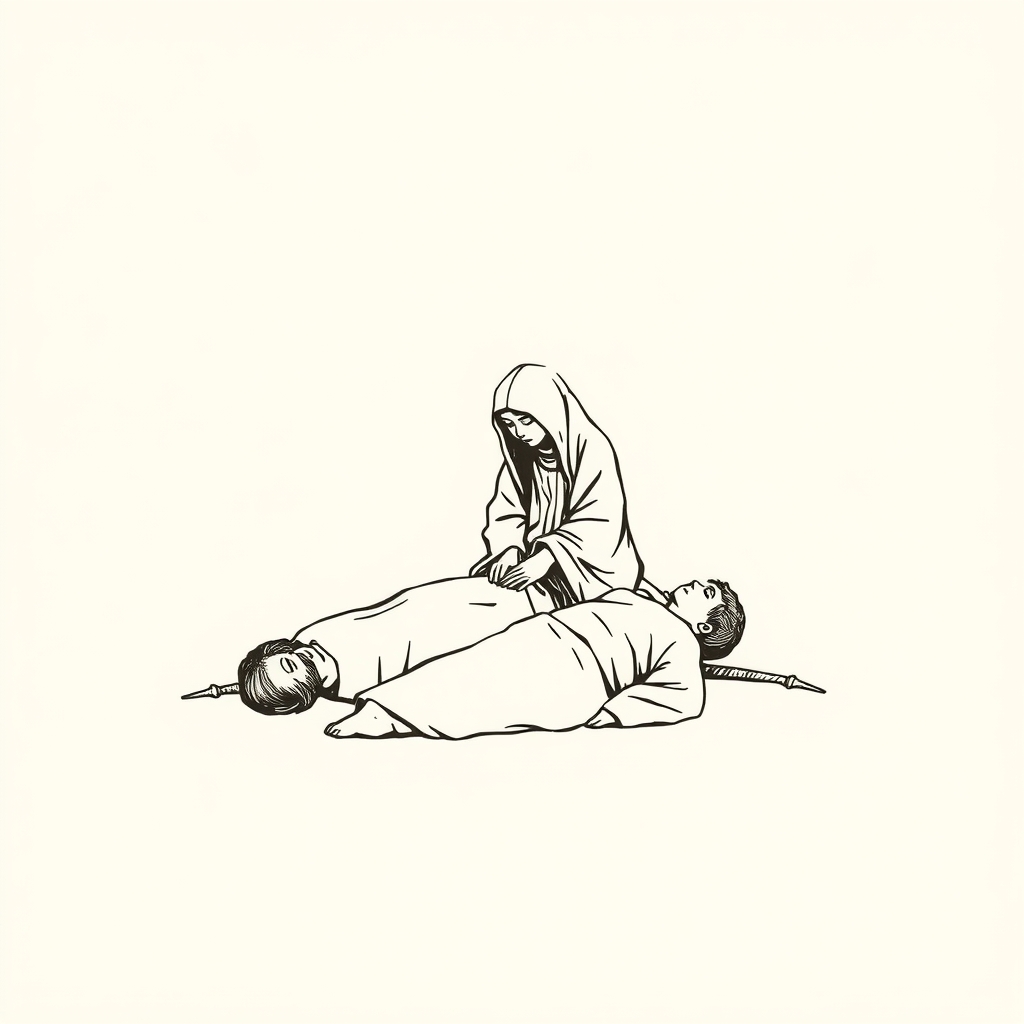
The holy martyrs Simplicius, Faustinus, and Saint Beatrix, their sister, all three died in Rome for the profession of the Christian religion, in the cruel persecution of Diocletian and Maximian. Simplicius and Faustinus were taken; and, as they bore witness with invincible constancy, the judge, after many torments, had their heads cut off. Their bodies were thrown into the Tiber, to be carried away into the sea; but Saint Beatrix, their sister, took care to have them pulled from the water and to give them burial. Afterwards, this holy maiden retired to the house of the famous Saint Lucina, who spent the day and a great part of the night in prayer and in works of charity. She remained seven months in peace in such happy company, with a great desire to shed her blood for Jesus Christ, just as her brothers had shed theirs. She finally obtained the happiness she desired; for Lucretius, vicar of the emperor, a cruel and avaricious man, wishing to possess an inheritance that belonged to her, in order to join it to the large estates belonging to him, had her arrested as a Christian. He offered her a choice between two things: either to sacrifice to the gods of the empire, or to lose all her property, and even to be put to death. The Saint replied that she had nothing more precious than her faith and her salvation, and that, for all the things in the world, she would not sacrifice to demons nor to gods of wood and stone. Upon this confession, she was led to prison; and the following night, this infamous miser had her strangled. Saint Lucina, her dear mistress, buried her body near those of her two brothers, by the side of the main road to Porto, in the cemetery called ad Ursum Pileatum. This happened around the year 303. Since then, Pope Leo II built a church in Rome in honor of these Martyrs, where he had their bodies brought; they are today in that of Saint Mary Major.
The punishment of Lucretius
After seizing the saint's property, the miser Lucretius is confounded by the prophecy of an infant and dies possessed by the demon.
Divine justice soon made it appear that it is a rod that has eyes, and which watches for the vengeance of the just and for the punishment of the wicked, as it is said in Jeremiah. Lucretius, after the death of Beatrix, took possession of her inheritance which he had confiscated, and, on the very day of this criminal invasion, he gave a great feast for his friends, where he showed extraordinary joy and even often mocked the Saint whom he had caused to die and whose pursuit he did not fear. But, while he was mocking and blaspheming against the Christian religion, an infant in swaddling clothes, who was in his mother's arms, cried out, in the company, in a clear and intelligent voice: "You have killed, Lucretius, and stolen her goods, but you are going to be punished." Indeed, this wretch having remained completely stunned by this threat, the demon seized his body at that very hour, and, after making him suffer horrible torments for three hours, he strangled him to carry his soul into hell. This terrible punishment should serve as an example to show us that there is a reward for virtue and a punishment for crime; that God finally uncovers the deceits of the wicked, and that, if he sometimes seems to leave the impious without punishment, it is only a temporal delay which serves only for their greater condemnation, if they do not take advantage of it to do penance.
Translation of relics
Pope Leo II transferred the bodies of the martyrs to a church in Rome; relics are also reported in France, notably in Amiens.
There are relics of Saint Beatrice with the Religious of Louvencourt in Amiens, and at the convent of Davenescourt.
Artistic representations
The saint is traditionally depicted watching over the burial of her brothers or carrying a rope, a symbol of her own martyrdom.
Saint Beatrice is depicted finding the two corpses of her brothers and caring for their burial; sometimes with a rope, to indicate that she was strangled in prison.
Cf. Acta Sanctorum.
Additional passages recovered from the sources
These passages from Les Petits Bollandistes supplement the entry. The references identify their context in the original volume.
Read the supplementary notes and passages (1)
Source and restoration of the beginning of the entry
The beginning of this entry had been omitted during extraction. The recovered page is joined to the existing body, preserving the phrasing and chronology of the historical source.
Paul Guérin, Les Petits Bollandistes, volume 9, p. 105, 106. Bibliothèque nationale de France: https://gallica.bnf.fr/ark:/12148/bpt6k30739j
Iconography
Signs and attributes

Entities
Narrative network
The names, places, and concepts most present in the entry, weighted by centrality in the text.
The supernatural in their life
The miracles of Saint Beatrice (Beatrix)
Frequently asked questions about Saint Beatrice (Beatrix)
Who was Saint Beatrice (Beatrix)?
Sister of the martyrs Simplicius and Faustinus, Beatrice was strangled in prison around 303 by order of the greedy Lucretius who coveted her property. After burying her brothers, she suffered martyrdom before her persecutor was struck by divine justice. Her relics rest at Saint Mary Major in Rome.
How is Saint Beatrice (Beatrix) depicted in Christian art?
In iconography, Saint Beatrice (Beatrix) is recognizable by: rope and recovering the bodies of her brothers.
How did Saint Beatrice (Beatrix) die?
Saint Beatrice (Beatrix) suffered martyrdom for the Christian faith (4th century).
What miracles are attributed to Saint Beatrice (Beatrix)?
2 miracles are attributed to this saint, notably: Prophecy / infused knowledge, Sign / wonder and Exorcism.
Which saints were contemporaries of Saint Beatrice (Beatrix)?
Contemporaries include: Saint Blaise, Saint Hilary of Poitiers, Saint Basil the Great (Archbishop of Caesarea) and Saint Baudilus.
What are the other names of Saint Beatrice (Beatrix)?
Other forms of the name: Béatrice.
Who are the relatives of Saint Beatrice (Beatrix)?
Relatives of Saint Beatrice (Beatrix): Saint Simplice (brother) and Saint Faustin (brother).
Annexes & related entities
Structured data for exploration: events, miracles, quotes, places, attributes, patronages, and important entities cited in the text.
Key Events
- Confession of faith before the idols
- Imprisonment in Rome
- Died by strangulation on the orders of Lucretia
- Burial by Saint Lucina
- Translation of relics by Pope Leo II
Quotes
You have killed, Lucretia, and stolen her goods, but you will be punished
A child in the swaddling clothes