
Humbert of Romans was the fifth Master General of the Order of Preachers in the 13th century. Renowned for his scholarship in theology and law, he was a close advisor to Saint Louis and played a major role in the organization of his order and its missions. He refused supreme ecclesiastical dignities to spend the end of his life in prayer and study in Valence.
Contemporaries

Figures and markers around the normalized period for this entry.
Guided reading
8 reading sections
BLESSED HUMBERT OF ROMANS,
MASTER GENERAL OF THE DOMINICANS
Youth and intellectual formation
Born in Romans into a noble family, Humbert received a rigorous Christian education before distinguishing himself through his studies in theology and canon law in Paris.
Humbert, praised by all our historians as one of the holiest religious of the Order of Saint Dominic, was born in R omans, on the Isère , near Valence, at the beginning of the 13th century, to a noble, wealthy, and pious family. Nothing proves the religious sentiments of his parents better than the eminently Christian education they gave him themselves, and which they subsequently had him receive from the masters most capable of enlightening his mind and forming his heart to virtue.
The young Humbert was soon sent to the sc hools of Paris, frequented by a great number of students who had come from all parts of Europe, and who were given over to all the impulses of the passions. Their dangerous examples had no effect on his heart; he knew how to triumph over them through the firmness of his faith, as much as by his assiduity in work and prayer. Thus, he made astonishing progress in the humanities and in the higher sciences, especially in theology and canon law.
Vocation and entry into the Order
Initially drawn to the Carthusians, he finally joined the Friars Preachers at the convent of Saint-Jacques in 1224.
He had first vowed to enter the Order of the Carthusians; but, by a secret inspiration of Providence, he decided upon that of the Friars Preach ers, and receive d the habit in the convent of Saint-Jacques, on the feast of Saint Andrew, in 1224.
Provincial Responsibilities and Diplomacy
After a journey to Palestine, he directed the Roman and then the French provinces, narrowly missing being elected pope after Gregory IX.
Shortly after his religious profession, he distinguished himself in Lyon and Paris by his high virtues, his profound knowledge of the Divine Scriptures, and his eloquence as a preacher. Around the same time, he made a journey to Palestine, visited the Holy Places, and upon his return, he was given the government of the Roman province, where he displayed such prudence and knowledge that, according to several historians, after the death of Gregory IX, some cardinals cast their eyes upon him to elevate him to the papacy. The new pope, Innoce nt IV, havi ng given the Roman purple to Hugh of Saint-Cher, Humbert succeeded him in the government of the province of France, which he held for ten years, until he was named General of his Order in the year 1254. "The votes," says a historian, "were not divided: Father Humbert had them all, and he alone was surprised by it."
Generalate and expansion of the Order
Elected Master General in 1254, he traveled across Europe on foot, visited Hungary, and presided over numerous general chapters focused on missions.
Hungary was the first province he visited, and, however vast it may have been, he traveled through it on foot, announcing the word of God to the people everywhere. King Béla IV was not content to honor him with his affection; he also gave him a great mark of his trust and esteem by asking him to remain for some time in his states to receive the vows of the young Princess Margaret of Hungary, his daughter.
From Hungary, Humbert went to Italy, where he received letters from Alexander IV, which prove the high esteem in which this Pope held his learning and virtue. He presided over a general chapter in Milan, where the work of the missions was the primary focus; he returned to Paris, where Saint Louis, wish ing to give him a great mark of his affection, chose him to hold at the baptismal font one of his sons, Prince Robert, Count of Clermont and the first of the House of Bourbon.
Doctrinal struggle and royal counsel
He collaborated with Thomas Aquinas against subversive writings and served as a legal and political advisor to King Saint Louis.
Saint Thomas Aquinas, called to Italy around the same time, worked successfully by order of Father Humbert on the refutation of a dangerous book entitled: *On the Perils of the Last Times*, while our tireless General presided over the chapter of Florence and that of Toulouse, from where he addressed a very remarkable letter in Latin to all the religious of his Order.
In the year 1258, Sain t Louis, knowing that Father Humbert was no less a skilled jurisconsult than a learned theologian, admitted him to his council to make him judge of certain disputes that had arisen between the Count of Clermont and the Counts of Anjou and Poitiers.
Geopolitical and ecclesial crises
He opposed the incursions of the Tartars and tried in vain to dissuade Albert the Great from accepting the bishopric of Regensburg.
The following year, he went to hold a chapter in Valenciennes, in Hainaut. There, seconded by the zea l of Albert the Great, Saint Thomas Aquinas, and Peter of Tarentaise, he concerned himself with the means of preserving the Christians of those regions from the fury of the Tartars, who were beginning their incursions and ravages once again. He dissuaded the King of Hungary from any treaty of alliance with these peoples who were enemies of the name of Jesus Christ, and thus saved the faith, which was threatened with imminent ruin. In the meantime, Humbert learned that the Sovereign Pontiff had just chosen Albert the Great for the see of Regensburg. He was deeply afflicted by this, and in his sorrow, he wrote a letter to the blessed Albert that is a true masterpiece, in order to dissuade him from accepting the episcopate. He begged him to consider first the embarrassments that are encountered in the government of the churches of Germany, and how difficult it is, in such high dignities, not to offend God and men. He asked him how, after having loved the Holy Books and the purity of conscience so much, he could see himself engaged in the tumult of temporal affairs, always exposed to continual perils of sin. Finally, he pointed out to him that the good to be done in the episcopate is quite uncertain, while, by his change of state, he would lose the great fruits he was already producing, not only in Germany but in the whole Church, through his reputation, his examples, and his writings. He concluded this vivid and pathetic exhortation by protesting that he would rather see one of his religious carried to the coffin than to an episcopal chair.
However, the desires of the holy General, his prayers, his warnings, and all his remonstrances were then without effect. Albert the Great, it is true, did not think otherwise than Father Humbert, and he feared as much as he did the peril that he saw more closely. But he was not left the freedom to refuse the burden; the Vicar of Jesus Christ wished to be obeyed, and Albert accepted, trembling, a dignity that he would have reproached himself for having desired. The consequences made his true feelings known.
Resignation and end of life in Valence
He resigned from his office in 1263, refused the patriarchate of Jerusalem, and retired to the convent of Valence to devote himself to writing.
Three years later, having succeeded in having his resignation accepted by P ope Urban IV, the holy doctor returned to his convent in Cologne at the same time as Father Humbert, through the voluntary cession of his office, and resumed his former state as a simple religious. Humbert had held his eighth general chapter in Barcelona and the ninth in Bologna. It was only in the one in London, in the year 1263, that he obtained from the definitors the permission to resign from an office that only obedience could have made him accept, and whose duties he had saintly fulfilled for nine years. Vainly did Pope Urban IV wis h to tear him away from the sweetness of solitude to elevate him to the dignity of Patriarch of Jerusalem. Nothing was capable of making him consent to his elevation. Always firm in refusing this dignity, he retired to the convent of Va lence, where he li ved for another fourteen years, occupied solely with his salvation and the numerous works he composed. It was in these praiseworthy occupations and in the exercise of the ministry of the word that Father Humbert saw his final hour arrive gently; he died in Valence on July 14, 1277. His body rested for a long time in the church of the Preaching Friars of Valence, with his epitaph, his eulogy, and the date of his death.
Works and Posterity
A prolific author, he left numerous treatises on religious life, the Rule of Saint Augustine, and the history of his Order.
## WRITINGS OF BLESSED HUMBERT OF ROMANS.
Ecclesiastical writers have spoken with praise of the works of Father Humbert, and they have provided the following catalogue:
1° A treatise concerning the three religious vows; 2° A commentary on the Rule of Saint Augustine, and another on the prologue of the constitution of the Order of Preachers; 3° A treatise on the seven degrees of contemplation; 4° An abridged history of the life of Saint Dominic; 5° A short chronicle of his Order from 1203 to 1254; 6° An excellent manuscript, preserved in the Vatican Library, where the author, among other things, discusses the means to retake the Holy Places and to preserve them against the efforts of the infidels; 7° The Religious Mirror; 8° A treatise on true and false virtues, etc.
Taken from the Hagiological History of the Diocese of Valence, by Abbé Nadal.
Iconography
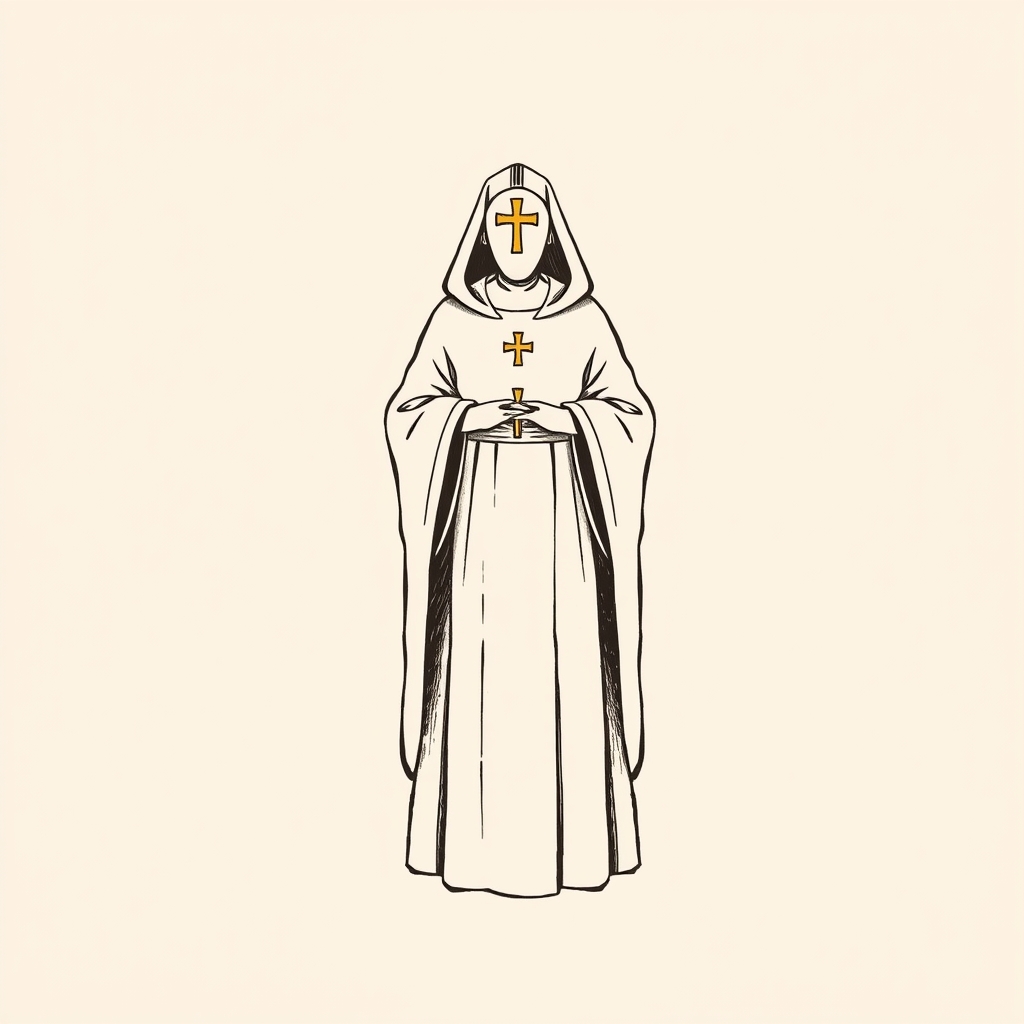
Signs and attributes

Entities
Narrative network
The names, places, and concepts most present in the entry, weighted by centrality in the text.
Frequently asked questions about Blessed Humbert of Romans
Who was Blessed Humbert of Romans?
Humbert of Romans was the fifth Master General of the Order of Preachers in the 13th century. Renowned for his scholarship in theology and law, he was a close advisor to Saint Louis and played a major role in the organization of his order and its missions. He refused supreme ecclesiastical dignities to spend the end of his life in prayer and study in Valence.
How is Blessed Humbert of Romans depicted in Christian art?
In iconography, Blessed Humbert of Romans is recognizable by: Dominican habit and books/writings.
Which saints were contemporaries of Blessed Humbert of Romans?
Contemporaries include: Saint Anthony of Padua (Ferdinand), Saint Thomas Aquinas, Saint Arthaud of Belley and Saint Peregrinus of Auxerre.
When did Blessed Humbert of Romans die?
Blessed Humbert of Romans died around 1277.
What are the other names of Blessed Humbert of Romans?
Other forms of the name: Père Humbert.
Annexes & related entities
Structured data for exploration: events, miracles, quotes, places, attributes, patronages, and important entities cited in the text.
Key Events
- Born in Romans at the beginning of the 13th century
- Theology and canon law studies in Paris
- Entered the Order of Preachers in 1224
- Government of the Roman province
- Governed the province of France for ten years
- Elected Master General of the Order in 1254
- Visit to Hungary and meeting with King Béla IV
- Participation in the council of Saint Louis in 1258
- Resignation from his office as Master General at the London Chapter in 1263
- Retreat at the Valence convent for fourteen years
Quotes
-
He would rather see one of his friars carried to the grave than to an episcopal chair.
Letter to Albert the Great