
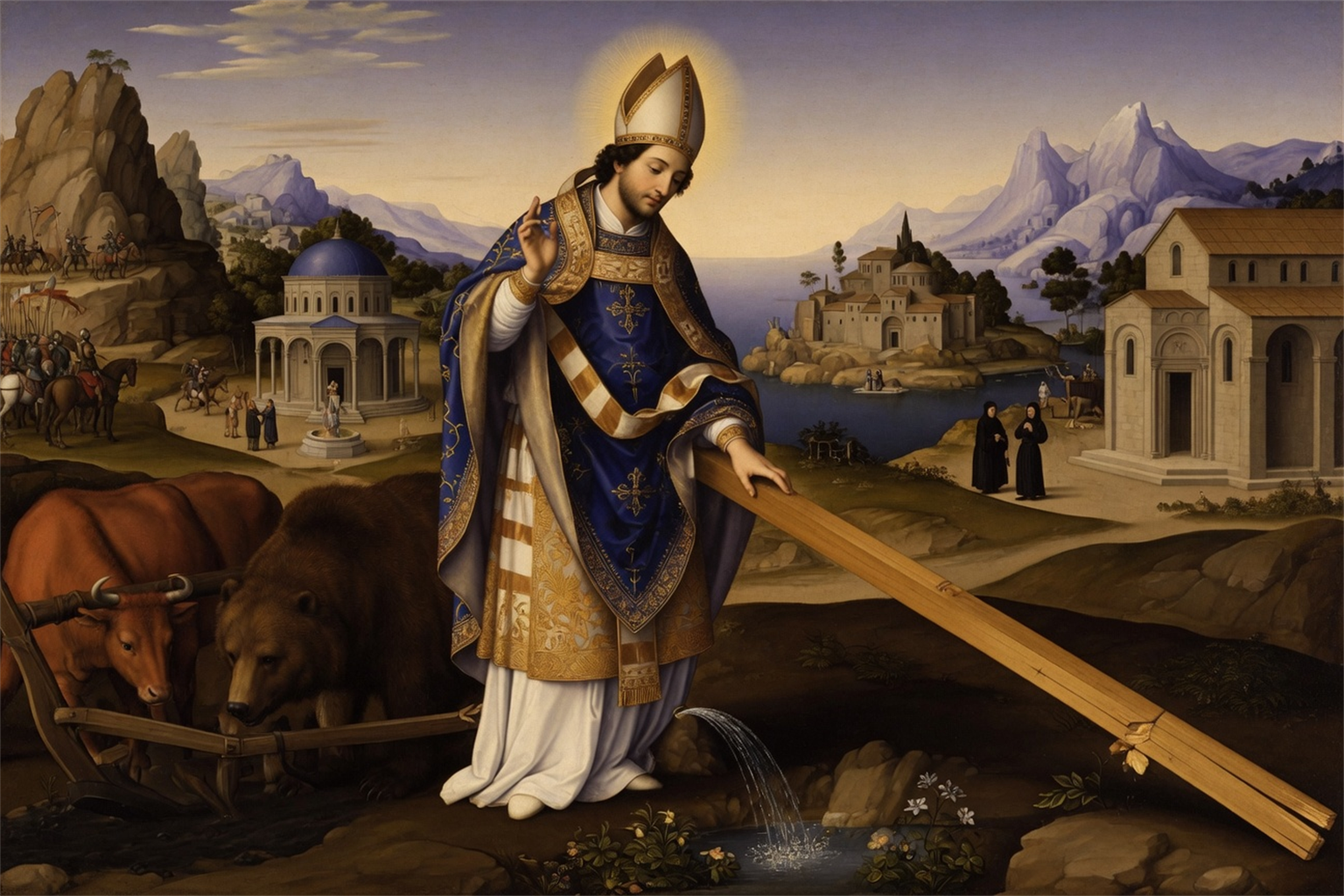
A former Persian officer who converted, Jacques became the first bishop of Tarentaise in the 5th century after training at Lérins. He evangelized the tribes of the Graian Alps, performing many miracles such as taming a wild bear for plowing. He died in Arles in 429, leaving his successor Marcel to organize the diocese.
Contemporaries

Figures and markers around the normalized period for this entry.
Guided reading
8 reading sections
SAINTS JACQUES AND MARCEL,
BISHOPS OF TARENTAISE
Origins and conversion
Jacques, from an illustrious family of Assyria and an officer in the Persian army, converted to Christianity during the persecutions and set out to seek the faith in the East.
Vos et consens præmia, Infracta quondam prætore, Morum fidei arbitres Noctræ coronam gloriæ. Hymn of the Lenières of the holy Pontiffs and Brothers of the Church of Comminges.
The Church of Tarentaise celebrates on the same day the feas t of Saint Jacques, the first known bishop of the diocese, of which he is regarde d as the fou nder, and of Saint Marcel, his first successor.
From an illustrious family of Assyria, Jacques served with honor in the armies of Persia, when the persecution against the Catholics revealed to him the sublimity of their religion. He abandoned everything, his rank, his family, his riches, his homeland, and came to seek the Christian light in the Eastern Empire, where the Church was then so flourishing.
Meeting with Honoratus and Monastic Life
In Nicomedia, he meets Honoratus and Venantius, Gallic pilgrims, whom he follows to the monastery of Lérins under the direction of Saint Leontius.
Two brothers, Honora tus and Venantius, from a consular family of the great Sequania, in Gaul, had embraced Christianity despite their parents, had placed themselves under the direction of a holy hermit named Caprasius, and had undertaken a pilgrimage to the East. They sought above all to imbue themselves with the religious spirit that reigned in the solitudes of the Thebaid. James had just received baptism and was looking for a friend, a guide in the ways of salvation. He had the good fortune to meet our two pilgrims in Nicomedia and became especially attached to Honoratus. Venantius died in Methone, in Achaia. The other three returned to Transalpine Gaul, placed themselves under the direction of Saint Leontius, Bishop of Fréjus, and retired to the island o f Lérins.
First mission among the Centrones
Jacques accompanies Honoratus into the Graian Alps to evangelize the Centrones, but must withdraw in the face of resistance from the local Serpent cult and Burgundian invasions.
Saint Honorat us often left his retreat to evangelize the countryside and initiate his disciples into the apostolate; he sometimes traveled up the Rhône and the Saône as far as his homeland, to win souls for God there. It was in this way that he converted Saint Hilary, his successor at Lérins. It was during one of these excursions that he took on Jacques and Maximus, the latter born in Château-Redon, near Digne, and led them into the province of the Graian Alps, inh abited b y the Centrones (420). Already the first glimmers of Christianity had penetrated there. Missionaries who had set out from Rome and were heading for Geneva via the Graian Alps and Mount Mercury (the Little Saint Bernard and the Bonhomme), had evangelized these high valleys, among others that of the glaciers on the Chappieu. The monks of Lérins developed and extended these precious seeds. But they had to struggle against a type of idolatry somewhat analogous to the obstacles they had first encountered on their island. The Romans had indeed introduced their Olympus into the city of Tarentaise; Jupiter, Hercules, Venus, Mercury, and Silvanus were honored in various places in the province. The cult of Mithras and the Mothers, introduced to Rome under Pompey, had penetrated as far as the Alps. But these terrible mountaineers, who had fought with such energy against the legions of Julius Caesar, had preserved their national cult, that of the Serpent, and were not disposed to abandon it. The title of Saint Stephen, proto-martyr, given to the first church that was established there, is a witness to the resistance and threats that tried to prevent the work of God. After some rather brilliant successes, the missionaries, pursued by the most hardened, escaped through the mountains of the Luce valley, today Beaufort, where they were able to form a small nucleus of Christians. But their preaching was again hindered by the wars of the Empire against the irruption of the Barbarians. The Burgundians had invaded the Viennese province (413) and were then penetrating into that of the Graian and Pennine Alps (423). Their semi-Christianity still compromised the entirely peaceful character of our missionaries. They had to return to their solitude of Lérins, and reported the result of their mission to Saint Honoratus, who had left them in the first year to resume the direction of his monastery. The unanimous wishes of the clergy and the people then called him to the see of Arles, to replace Patroclus, who had died (426). His first care was to take his faithful Jacques with him, to have him share in the cares of the administration of his church, and to initiate him into the pastoral functions for which he destined him.
Episcopate and founding miracles
Ordained Bishop of Tarentaise in 426, he converted the populations and performed famous miracles, notably that of the bear subjected to the yoke.
Following the invasions, Arles had succeeded Trier as the capital of the Praetorian Prefecture of the Gauls. By becoming the center of the seven provinces, it had greatly harmed Vienne, its former civil and ecclesiastical metropolis. The bishops of Arles had become metropolitans, and Pope Zosimus, for reasons that do not fall within our scope to examine here, had attributed to Patroclus the ordinations of the entire province, to the exclusion of the metropolitan of Vienne. It is for this reason that his successor Honoratus organized the new diocese of Tarentaise (426). Aventicum, a city annexed to the province of the Graian and Pennine Alps by Constantine, had been reunited with the great Sequania. The other two cities, Octodurus and Tarentaise, were attributed, in ecclesiastical terms, the former to Milan, the latter to Arles, then to Vienne, during the division of the Viennensis by Pope Saint Leo (450). James, ordained Bishop of Tarentaise, left with several priests whom Saint Honoratus assigned to him (426). Remembering the dangers and struggles of his first apostolate, he thought it an act of prudence to arrive without fanfare and almost clandestinely. But the grace of God had changed minds: the first seeds of the divine word had germinated. The reputation of his holiness had spread since his first departure. The servant of God was sought out, he had to perform his episcopal functions solemnly, and there was a great turnout for his preaching. Pagan temples became deserted and fell into ruins when they were not transformed into churches or chapels. One would have said that God wished to reward in the bishop the first labors of the priest. When the eloquence and virtues of the Saint were not enough to win hearts, God added miracles. It was a question of building the main church. The neophytes gathered from all parts to bring the necessary materials. A team of oxen was hauling wood to this destination. A bear suddenly lunged from a forest, killed one of the oxen, and began to devour it. Informed, the holy bishop rushed over, ordered the bear to take its place in the team to replace the ox, and attached it himself to the yoke. The work finished, the hunters prepared to kill the bear. But the good shepherd stopped them and sent the bear away, which never reappeared. This prodigy and those that follow are recounted not only in the charters of the ancient diocese of Tarentaise, but in all the supplements of the breviary and in the life of Saint James of Tarentaise, by Guy of Burgundy, Archbishop of Vienne, who became pope under the name of Callixtus II. His homeland, his learning, the numerous c ouncils he held, the pacification of the struggles between the priesthood and the empire which he happily concluded at Worms, all contribute to making the veracity of his account of events that took place in the confines of his ecclesiastical province accepted. They are in the domain of local tradition and are still found in the old paintings of the churches.
Another day, a beam intended for the roof of a church was found to be five feet too short; the holy bishop sprinkled it with holy water and it suddenly acquired the desired length.
Confrontation with King Gundahar
To protect Catholics in the face of Burgundian Arianism, James traveled to Geneva where he healed the son of King Gundahar, thereby obtaining recognition for his diocese.
However, the Burgundians had maintained their position in the Viennensis and half of the Graian Alps, despite the Roman legions. Honorius, unable to drive them out (420), had accepted them as allies and auxiliaries against new invasions, and Theodosius had confirmed all their conquests in the Alps (423). But, having barely attached themselves to Christianity, these peoples had become Arians. Free and even protected in the upper Isère valley under the Roman leaders, the Catholic religion suffered in the other valleys occupied by the heretics. The holy bishop of Tarentaise was distressed to see the exercise of his zeal hindered in more than half of his diocese.
He resolved to approach the leader of the Burgundians. He set out with one of his neophytes, also named James, and a beast of burden to carry their luggage and a few gifts. They crossed the Jovet and Mercure mountains (the Col du Bonhomme). The Saint evangelized while passing through the Sallanches valley, which touched the borders of the ancient Centrones and where the god Mars was worshipped. Two accidents that occurred during this journey gave our bishop the opportunity to perform several miracles which, along with the brilliance of his virtues, manifested his holiness throughout t he diocese of Geneva. Nevertheless, Gundahar received him very poorly, and the Saint was returning, shaking the dust from his shoes against the palace of Geneva, when the sudden illness of the king's son and the prayers of the nobles caused him to be recalled in great haste. He healed the prince and obtained from the father several important concessions regarding material and moral matters; for they constituted an official recognition of the diocesan organization in the new kingdom of Burgundy, while at the same time ensuring a suitable existence for the see. They were maintained by the emperors of Germany and were still preserved in the thirteenth century during the feudal struggles of the archbishops of Tarentaise with the counts of Geneva over the Luce valley. William of Geneva acknowledged, in 1225, that the entire valley of Luce or Beaufort had been given to Saint James at the foundation of the diocese.
Expansion of the diocese and end of life
After founding numerous churches, Jacques died in Arles in 429, on the same day as his friend Saint Honoratus.
God permitted the Saint's return to be marked by a striking testimony of the graces of which he was the dispenser. During his journey, one of his most devoted friends had died. Jacques wished to see his tomb; he shed abundant tears, like the Savior over his friend Lazarus, and death could not resist the voice of him who had performed so many wonders. From then on, his apostolate encountered no more obstacles. The episcopal house was built on the Puppim rock, one of the donations of Gunderic, with a chapel in honor of Saint Peter, prince of the Apostles. As at the voice of Moses, a spring gushed forth for the service of the village which bore the name of Saint-Jacquemoz and which a landslide destroyed a few centuries later. Several other churches had been built, among others those of Aime, Granier, Saint-Maxime, Saint-Jacques de Luce, Tignes, Les Glaciers, Villaroger and Saint-Jacques-sur-Macot, Longefoy, Centron, Les Allues, Les Bellevilles, Gemilly, and Thénésol. His zeal even extended into the Aosta Valley, where he founded the chapel of Saint-Jacquême.
Only three years had passed since Saint Jacques had received episcopal consecration, and already the country was completely transformed. One could say of him what Scripture says of the just: "He lived a long time in a short space of time." The Lord did not make him wait for his reward. He even added a consolation that we would call human if it were not linked to the death of the Saints. Saint Honoratus and Saint Jacques had bonded, as we have seen, in a purely spiritual intimacy. Both had displayed before the people the virtues practiced in a mutual emulation of everything that could be most pleasing to the divine Master. He did not wish to separate them in death. Saint Jacques, divinely enlightened about his approaching end and that of his holy friend, designated his successor to his people, and left for Arles, where he had the happiness of rend ering to God his soul full of merits, on the same day as the holy archbishop of that city, the eighth or ninth day after the Epiphany of the year 429.
Saint Jacques of Tarentaise is represented ordering a bear to take the place of an ox in a yoke that it had just devoured.
The work of Saint Marcel
Saint Marcel, successor to Jacques, organizes the clergy, founds the monastery of Moûtiers, and erects the cathedral of Tarentaise.
The city of Aime, which had been the most eager to listen to the holy word, deserved to give the Apostle of the Centrones his first successor. It was indeed to the priest MARCE L, from this city, a man of proven virtue, says the legend of the ancient breviary, that Saint Jacques resigned his pastoral charge before leaving for Arles. Saint Jacques had completed the career of the Apostle and the Thaumaturge; he had shaken the populations, he had overthrown paganism; the missionary's task was well advanced. There remained that of definitive organization. The masses were Christian, but there was not yet a center for this diocese. There were evangelical workers, but there was not yet a hierarchically constituted clergy. This was the work of Saint Marcel. Formed in the school of his dear master, identified, so to speak, with his principles which were those of the monastery of Lérins, he raised in the ruins of the city of Tarentaise, on the right bank of the Isère, a central house where the priests were to live in community under the inspection of the bishop, *monasterium*, where the Levites of the sanctuary would be raised, where those who had "borne the burden of the day and the heat" in their apostolic journeys would come to be refreshed in silence and prayer.
It is thus that at the same period, Saint Augustine, who had founded a monastery in Hippo when he was only a priest, later transported it into his episcopal house, as a seminary and a retreat house for students, veterans of the priesthood, and the city clergy.
Next to this monastery rose the cathedral church in honor of the Assumption of the most holy Virgin and the apostles Saint Peter and Saint Paul (434). And to facilitate the exercise of the priestly ministry, without harming the recollection necessary for this central house, he established on the left bank of the Isère and along the Roman road of Agrippa a religious edifice intended to contain the baptismal fonts, which he dedicated to Saint John the Baptist. It was not rare, at that time, to see the baptistery outside the main church. This usage finds its reason in the penitential system of the Church in the first centuries. Baptism and penance were mainly administered there. As it was separated from the church by a river that often flooded, it was not long before the holy sacrifice was offered there, to give the faithful, through communion, the complement and the source of all sacramental graces. Thus this chapel grew greatly, like the baptisteries of Aix-en-Provence, Pisa in Italy, etc., and all those that did not form a single body with the main church.
However, war had begun again between the Burgundians and the Romans. The inhabitants had taken refuge around the monastery, far from the passage of armed troops, as in a safe asylum. This quarter, where two other religious houses were later built, took on such importance over time that it definitively left its name, *Munsterium*, Moûtiers, to the rest of the city, and the ancient name of Tarentaise, no longer able to serve to designate a city whose ruins were giving way to new buildings, preserved in the episcopal title, has nevertheless remained until today, in the usage of the Church, the name of the diocese.
Following the struggles mentioned above, the fortified house of Saint Jacques, on the Puppim rock, also became a refuge for several families who formed a village there. Saint Marcel established a church there in honor of Saint Marcel, Pope. The churches of Bellecombe, Saint-Marcel in Belleville, Bozel, Conflans, Bourg-Saint-Maurice, etc., are also attributed to him. It is remarkable that the churches to which the first two bishops gave their patrons, Saint Jacques the Apostle and Saint Marcel the Pope, later chose as patrons their holy bishops of the same name, Jacques or Marcel. These two saints are rightly regarded as the founders of the diocese, and the piety of the people has never separated them in the worship it has rendered them for fourteen centuries.
Critique of sources and antiquity of the see
The text discusses the antiquity of the diocese of Tarentaise, refuting late theses to affirm an origin dating back to the 5th century.
## ORIGINS OF THE CHURCH OF TARENTAISE.
The hypercritical school of the 18th century found supporters in Savoy. According to Besson, in his *Mémoires* on the four dioceses of Savoy; Grillet, in his *Dictionnaire historique*; and also according to the *Benedictines* of Saint-Maur, Tarentaise was not enlightened by the lights of faith until the 7th century. These authors based their opinion, on one hand, on the legend of Saint Jacques, who is regarded as the first apostle of the Centrones; and on the other, on the brief of Leo III, who supposedly first conferred the title of archbishop upon the pontiffs of Tarentaise.
As for the time when Christianity penetrated Tarentaise, it seems unlikely that it was only upon the arrival of Saint Jacques in 420, and that until then the land of the Centrones remained enveloped in the darkness of paganism; for all the regions with which it was most directly in contact had been evangelized, some from the end of the 1st century, others from the 11th, the 11th, or finally the 12th century. The cities of Vienne, Lyon, Arles, Grenoble, Geneva, and Saint-Jean de Maurienne had their bishops. It is not to be presumed that Centronia, one of the prominent provinces of the same Roman Empire, crossed by the main road that communicated from Gaul to Italy, remained the only one foreign to the religious movement that was taking place everywhere in these times of fervor when Christianity was spreading with such effusion, brilliance, and zeal. Thus, the same historian Besson records, according to Gaudeau and Dupin, the presence of Domitian, bishop at *Forum Claudii* (Aime, capital of the Conmonte), at the Council held in Rome in 313: but, because there may have been another place called Forum Clavili, or because he could not complete the series of pontiffs who would have succeeded one another in this see until 420, the time of the arrival of Saint Jacques, this author infers from that that the latter is its apostle and first bishop. It would have been more just to say that the names of the successors of Domitian are not known, than to affirm that he had none: especially if one pays attention to the fact that more or less considerable gaps are also seen elsewhere, and that, in these remote times, one had neither the same ease nor the same attention that one had later to record the facts or the names of the people in power.
It is, moreover, precisely the time of the decadence of the Roman Empire and the invasion of the Barbarians from the north; the latter will have destroyed the few historical monuments that could have been collected: finally, it is quite possible that because of the troubles the see was vacant for a more or less long time. This is what one is led to conclude from the legend: Saint Jacques having arrived in the midst of the Centrones, it is said, brought this people, who were moreover of a great facility, to the knowledge of the true God, and turned them away from the worship of idols (*Ubi perveniens Jacobus ad Centronem, jura... hominum indecis, a semitiscerum in cultu, ad veram Dei et Salvatoris I. C. religionem transtulit*. Legenda S. Jac., die 10 januari). The legend will lose nothing of its venerable character, and history will preserve that of truth by saying that this country, which the Romans had taken so much interest in conquering, where they had formed a praetorium, a capital, and implanted their customs and their gods, retained strong traces of paganism even after it had been evangelized a first time, but in a manner still not very stable and perhaps not general enough. All this is only to explain the legend literally, and it is known that these accounts must be understood according to the rigorous acceptance of the words. This has just been indicated only, for this first question will be clarified by what follows on the antiquity of this metropolitan see, and here it is something more than probability.
Since the dignity of ecclesiastical metropolis was conferred on cities that were already so in the civil order, it must first be shown how Tarentaise (Barantasia) took its distinguished rank and acquired this signal title. The historians Strabo, Pliny, Ptolemy, Caesar, and Titus Livy take it upon themselves to teach us. They tell us how the values of the Centrones have always given importance to their country. Depositories, so to speak, of the key to the Alps, they guard it carefully or defend it with energy, never yielding it except to force and after having signaled their courage, making the proudest conquerors pay dearly for the passage. The famous Roman generals Vescros, Messala-Corniens, and Terentius-Verro experienced in turn the bravery of this warlike people; as Hannibal had already experienced it long before them. It was only given to Caesar to finally submit them to a foreign domination (Caesar's Commentaries: *de Bello gallico. lib. I*), in the year of Rome 748, and it was by that that he himself put an end to his exploits. "Thus," says Canon Chait (Mémoires de l'Académie de Savoie, vol. IV), "the conquest of the world ended in some way in this valley of the Alps. To stride over this nation, it took an Augustus, and an Augustus raised to the highest point of glory and fortune."
To testify to this people his esteem and the value he placed on their valor, this very competent judge (Augustus) added the Centrones to the privileges of the inhabitants of Latium (*Sunt Livio dati loci Centrones*. Pliny, vol. IV, p. 29, Paris edition, 1824): which gave, according to Sigenius, the signal power to nominate or be nominated to the magistracies and offices of the republic. After this conquest, Augustus immediately occupied himself with organizing his immense States, and, among other things, he divided the Gauls into four parts, where four provinces were then established, each of which had its metropolis; the fourth took the name of metropolis of the Graian and Pennine Alps, and was Tarentaise (*Le Père de Saint-Aubin*, Histoire ecclésiastique de Lyon, 3rd part, p. 133; Strabo, Ptolemy, Pliny, cited by Grillet, vol. III, p. 497). This is a historical fact solidly established and not contested; but to understand it and have a just idea of the province of which Tarentaise was the metropolis, one must remember that these regions, separated by mountains, and which today seem to have almost no relations between them, then formed the union of the peoples inhabiting the Alps, namely: to the west, the Centrones (The Centrones extended from the Aosta Valley to the limits of the Lower Valais, occupying, from the Little Saint-Bernard to Martigny, the valleys of Tarentaise, Beaufort, and Upper Faucigny.); to the east, the Solassi, or Aosta Valley; to the north, the Nontunis, the Ortoduranes, and the Veragri, that is to say, the Lower Valais and the Great Saint-Bernard valley; finally, to the south, the Geracelles and the Meitelli, the Maurienne, who all, by a general confederation, had united their fate and their temporal interests. They provided mutual aid each time they were attacked, which made them formidable and almost always victorious. But the most prominent among them were the Centrones, which earned them the honor of exercising jurisdiction and possessing the metropolis of the Alpine peoples in the civil order.
For this same reason, the Centrones obtained the metropolis in the ecclesiastical order: for, "the Church established in Rome and recognized in the empire," says Father de Saint-Aubin in the place already cited, "as soon as it had gained a foothold, it had the discretion to accommodate itself to the divisions that had been made there by state maxims; it wanted to conform to them and add its own, instituting in these four provinces metropolises of idolaters, as many metropolitan prelates, or archbishops, to hold their provincial councils there and to consecrate the bishops, their suffragans." Monsieur de Mares further observes that, since this distribution, the Church also judged that it was to its advantage to add three other provinces to the four oldest of which we have just spoken: these three were those of Sens, Tours, and Aix-en-Provence; it established as many archbishops there, so that in the 6th century, the Church had seventeen provinces (of which that of Tarentaise was the fourth), which made as many metropolises in the Gauls. Chorier (*État politique du Dauphiné*, vol. IV, p. 126 et seq.) and Father Fulani (*Description des couvents de l'icône de Saint-François*, p. 274-248) are here perfectly in agreement with Father de Saint-Aubin, a Jesuit. From all this one is already sufficiently authorized to conclude that the Church of Tarentaise, as a metropolitan, dates back to the 6th century: this is even demonstrated, notwithstanding the briefs and authorities cited by Messrs. Grillet and Rosson according to which this metropolis would only have been erected in the 8th or 9th century. This is the place to briefly refute these authors, or to show how they should be understood.
Grillet first (*Dictionnaire historique*, vol. III, p. 134) formally says that this metropolis was erected in the course of the 8th century and that its suffragans are designated in canon VIII of the Council of Frankfurt, those of 794: this canon saying something else entirely and not speaking of the suffragans of the metropolitan of Tarentaise (See Father Labbe, or also Messrs. de Sainte-Marthe, vol. III, p. 1059), the allegations of this author are therefore faulty in this regard. As he says himself, he had too little time to write on such varied subjects. He could not verify all his citations.
Besson, then, invokes and cites in part the brief of Pope Leo addressed to the archbishop of Vienne, the date of which refers, without a doubt, to the beginning of the 12th century, or to the end of the 8th (Besson, p. 150. We did not have to follow this historian in his long dissertation, based on that of Father Sirmond. What we say regarding the brief of Pope Leo will suffice to explain or interpret everything else.) "Although the bishop of Tarentaise has jurisdiction over some cities," it is said there, "nevertheless the province of the Graian Alps will always remain subject to the province of Vienne, as it has been ordered more than once by our predecessors; and the bishop of Tarentaise must not, although raised to a new dignity, imagine that he can derogate from it by submitting to the authority of a greater dignity; since, if he sees bishops below him today, it is only by pure grace and he only holds from our liberality this new rank which draws him from among his equals." If one had to, with Besson, take the last part of this brief literally, it would really follow that the bishop of Tarentaise had just received the title of metropolitan for the first time; but then how to explain what the same author says a little further on (page 192), where one reads that Possessor, archbishop of Tarentaise, accompanied Stephen III in 774, which precedes by a quarter of a century the accession of Leo III to the sovereign pontificate; it is therefore not from him that the bishops of Tarentaise received the title of archbishop or metropolitan. Moreover, the cited brief explains itself; it is titled: confirmation of the privileges granted to the primate of Vienne, and Pope Leo only recalls previous ordinances. One sees in fact, in the history of the Church of Vienne (*Chorier*, *État politique du Dauphiné*, vol. III, p. 200 et seq.), that Adrian I, immediate predecessor of Pope Leo, had written to Berterie to restore the rights and privileges of primate which this see had almost not enjoyed for seventy years following the troubles and the invasion of the Moors. Saint Gregory III, in 731, had already recalled the same rights; as also later Elias I and finally Callixtus II, around 1119, do so in similar or equivalent terms.
It was therefore a question in all this of privileges and they were those that had been regulated by Saint Leo around 450 between the Church of Vienne and that of Arles. The archbishop of Vienne, because of the preeminence of his see, bore the title of primate of primates: in this capacity he was to have as suffragans not only bishops, but also archbishops. This same Pope Saint Leo detached from the province of Arles, around 455, the Church of Tarentaise, erected it into a metropolis of the Graian and Pennine Alps, and submitted it to the archbishop of Vienne, as primate (*Le Père de Saint-Aubin* and the other authors already cited, Chorier and Fedoré), and in this same capacity he also submitted to him Embrun, metropolis of the Maritime Alps. The jurisdiction of the primate was rather honorary: the metropolitans declined it in what it could have of real, because of the distance of the places, or the times when it had been given, or else because of political troubles: this is what caused complaints on the part of the archbishops of Vienne. Canon VIII of the Council of Frankfurt, which has already been spoken of, refers precisely to these kinds of disputes. It is therefore in this sense that one must understand what Besson reports on the dependence of the Church of Tarentaise, that is to say, that it remains subject to that of Vienne, as primatial; although it was itself really already metropolitan from the middle of the 5th century.
If one objects that Sanctius subscribed to the Council of Epaone, in 517, as bishop, although according to what has just been said he was already archbishop of Tarentaise, it is easy to answer, with Pisterius and Lullprand, that: "although the bishops were archbishops by jurisdiction, they were only bishops by title, and it is only towards the middle of the 8th century that the title of archbishop was given to metropolitans."
Thus, the series of metropolitans of Tarentaise would begin, not as Besson says, with Possessor, but indeed with Saint Marcel, who is the second bishop of Tarentaise in the chronology drawn up by the same author, or, at the very least, with Puscharias, his successor. This see first had as suffragan the bishop of Sion, and towards the middle of the 6th century, that of Aosta; finally, a little later, that of Maurienne. One sees, from then on, the archbishops of Tarentaise appearing in the Councils, in the transactions and charters, in the concessions of the kings or emperors who succeed one another. Charlemagne (*Grillet*, vol. III, p. 135) gives by testament his immense furniture to the twenty-one metropolises of his States, and he names that of Tarentaise the seventeenth. Like most of the bishops of those times, the archbishops of Tarentaise exercised, with ecclesiastical jurisdiction, civil jurisdiction at the pleasure of the sovereigns, until towards the end of the 10th century, when they united this double power in their person and exercise it, as temporal sovereigns, by the concession in full ownership of the county of Tarentaise made, in 996, to Archbishop Anton, for him and his successors, by Rudolph III, King of Burgundy. (Count de Vignet, in a learned dissertation on the origin of the House of Savoy, informs this title: *Mémoires de l'Académie de Savoie*, vol. III, p. 294). The lawyer Ménahola, in his interesting and profound historical studies (*Mémoires de the same Academy*, vol. IX, p. 309), says: "Mr. de Vignet, not being able to reconcile this charter with his system, has cast doubt on its authenticity, for reasons that do not seem to me entirely beyond criticism," and he examines them. Thus, after having read these two distinguished academies, we will keep our primitive historical faith on this charter reported by Besson, no. 1 of the *Preces*, the original of which is found in the court archives in Turin, and reproduced recently in the large and beautiful collection *Monuments hist. Pat.*, vol. 1 *Chartorum*, p. 304.) — Cf. *Saint Pierre de Tarentaise*, by Abbé Chevray. Baume-les-Dames, 1841.
Iconography
Signs and attributes



Entities
Narrative network
The names, places, and concepts most present in the entry, weighted by centrality in the text.
The supernatural in their life
The miracles of Saint James of Tarentaise
Frequently asked questions about Saint James of Tarentaise
Who was Saint James of Tarentaise?
A former Persian officer who converted, Jacques became the first bishop of Tarentaise in the 5th century after training at Lérins. He evangelized the tribes of the Graian Alps, performing many miracles such as taming a wild bear for plowing. He died in Arles in 429, leaving his successor Marcel to organize the diocese.
What is Saint James of Tarentaise the patron saint of?
Patronage of Saint James of Tarentaise: Diocese of Tarentaise, Saint-Jacquemoz and Beaufort.
How is Saint James of Tarentaise depicted in Christian art?
In iconography, Saint James of Tarentaise is recognizable by: bear yoked to an ox, miraculously lengthened beam and gushing spring.
What miracles are attributed to Saint James of Tarentaise?
5 miracles are attributed to this saint, notably: Sign / wonder, Healing, Resurrection and Mastery of the elements.
Which saints were contemporaries of Saint James of Tarentaise?
Contemporaries include: Saint Augustine of Hippo, Saint Honoratus of Arles, Saint Jerome of Stridon and Saint Epiphanius of Salamis.
When did Saint James of Tarentaise die?
Saint James of Tarentaise died around 429.
What are the other names of Saint James of Tarentaise?
Other forms of the name: Jacobus and Saint-Jacquême.
Annexes & related entities
Structured data for exploration: events, miracles, quotes, places, attributes, patronages, and important entities cited in the text.
Key Events
- Service in the Persian armies
- Baptism in Nicomedia
- Retreat to the island of Lérins under Saint Leontius
- First mission in Tarentaise (420) and flight to Beaufort
- Episcopal ordination by Saint Honoratus in Arles (426)
- Definitive evangelization of Tarentaise and miracles of the bear
- Journey to Geneva to visit King Gundaharius
- Died in Arles on the same day as Saint Honoratus (429)
Quotes
-
Ubi perveniens Jacobus ad Centronem, jura... hominum indecis, a semitiscerum in cultu, ad veram Dei et Salvatoris I. C. religionem transtulit
Legenda S. Jac., January 10