
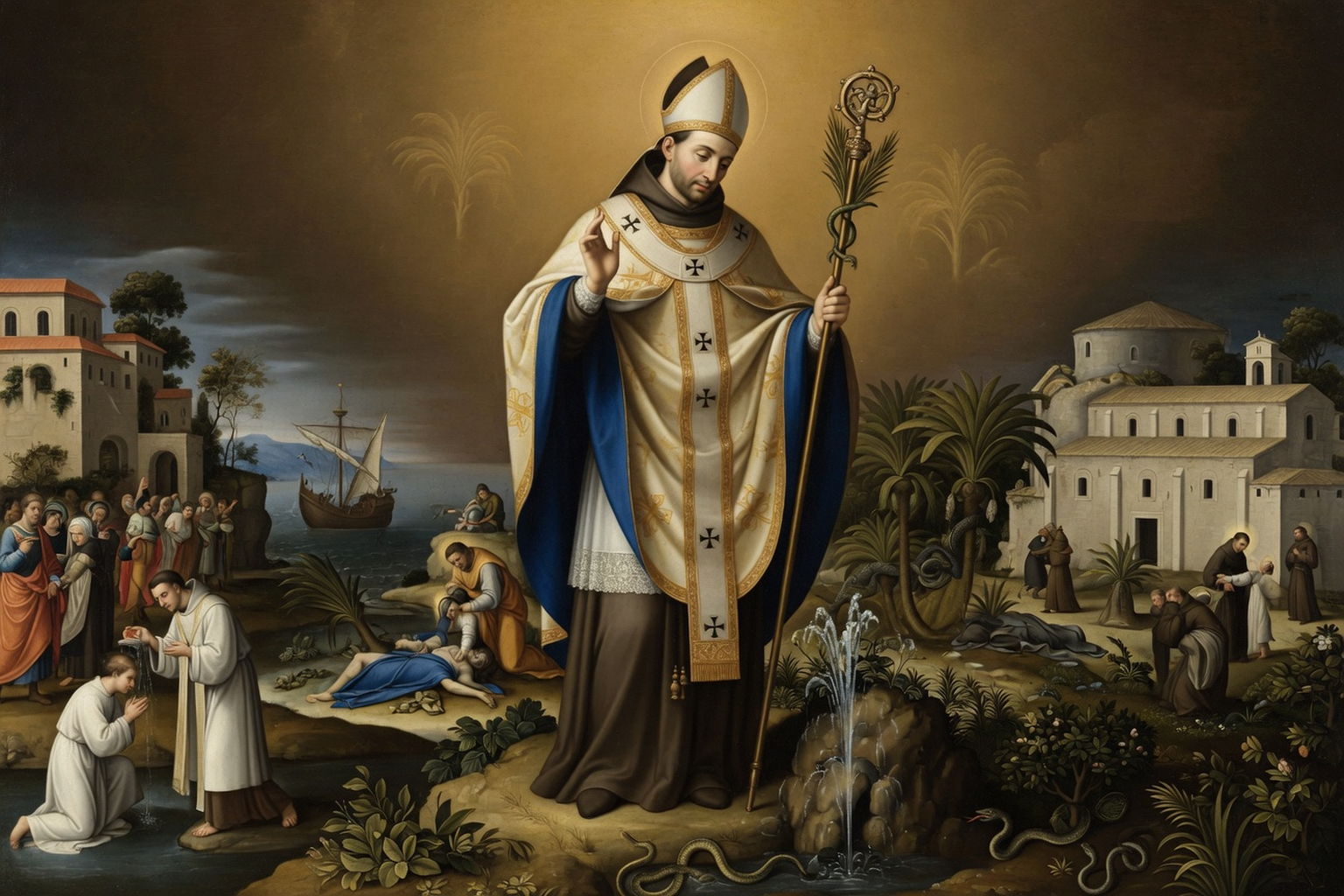
Born into a Gallic consular family, Honoratus renounced his nobility for Christ. After a journey to the East marked by the death of his brother Venantius, he founded the famous monastery of Lérins, transforming an island infested with snakes into a spiritual paradise. Becoming Bishop of Arles in 426, he distinguished himself by his inexhaustible charity and discipline before passing away in 429.
Contemporaries

Figures and markers around the normalized period for this entry.
Guided reading
8 reading sections
SAINT HONORATUS, BISHOP OF ARLES,
FOUNDER OF THE MONASTERY OF LÉRINS
Origins and early vocation
Coming from a Gallic consular family, Honoratus turned to Christianity from his childhood despite the opposition of his father, who tried to distract him with worldly pleasures.
When he finds nothing or little to praise in the life of his hero, the panegyrist places before our eyes the glory of his ancestors; he exalts the nobility of his blood. But we, who have received the same birth in Jesus Christ, and who are more or less noble, according to whether we are more or less children of God, see a source of greatness in the brilliance of earthly origin only insofar as one tramples it underfoot. We shall therefore content ourselves with reca lling that Sa int Honoratus was from a consular family; he came into the world towards the end of the reign of Constantius.
It is known that he was a Gaul by birth, and that he was neither from Aquitaine, nor from the Viennese or Narbonnese Gaul, but it cannot be asserted in what other part of the Gauls he came into the world; it is on simple conjectures that some scholars have brought him from that part of ancient Belgica, which later formed Champagne and Lorraine. God placed early in this child the desire for baptism; and to see how he prepared for it, gentle in his childhood, modest in his adolescence, grave in his youth, always ahead in grace and virtue at every stage of life he traversed, always greater than himself, it was easy to guess that heaven itself had taken charge of his education. No one trained him in piety; no one excited him to receive baptism; everyone, on the contrary, opposed it; his parents, his friends, his country, fearing to lose in him their richest ornament, made the greatest efforts to turn him away from a religion they considered a tomb. But the love of Our Lord Jesus Christ prevailed, and the father of Honoratus could not tear from his heart the desire for baptism for which the child was preparing, especially by distributing his small income to the poor. When he had received this sacrament, his father used a very powerful weapon against him: he procured for him every possible entertainment to make him love the world. He went so far as to become a child himself, in order to draw him into all the pleasures of young people; he hunted with him, he played with him, but the holy young man, in the midst of all the delights of the century, fortified himself inwardly with these words which he addressed to himself: "This life pleases; but it deceives."
Conversion and Ascetic Life
Honorat adopts a life of deprivation, leading his brother Venance in his quest for spiritual perfection and charity toward the poor.
And he added: "I hear in the world precepts entirely different from those of the Church; one must choose between the two. On one side, I am preached modesty, restraint, and the life of the soul; on the other, unbridled enjoyment and the life of the body. Here, Jesus calls me to reign in heaven; there, the demon calls me to reign on earth. Everything in the world is vain and flatters the eyes, but the world and what flatters the eyes pass away; only he who does the will of God remains forever. Let us hasten, then, to pull ourselves from these traps while we are not yet firmly caught. When bonds are fully formed, it is difficult to break them; when weak, they are easier to undo than they are to cut when strong. Save your soul on the heights, far from the earthly thoughts that soil it and prevent it from breathing freely. Those who possess gold are possessed by gold; those who are rich in slaves are themselves slaves to this wealth; those who take pleasure in dignities lower the dignity of their soul, which is the image of God. My slaves are my evil passions; my joy, the salvation of my soul; my spouse, wisdom; my pleasure, virtue; my treasure, Christ, who, in exchange for perishable goods, will give me imperishable ones: to serve him on earth and reign with him in heaven." He soon realizes these noble thoughts. He cuts his long hair. He renounces the magnificence of the garments that cover the body to occupy himself only with the adornment of the soul. The beauty of his neck, white as milk, fades under a rough garment. No more foolish joy on his face, but a gentle serenity; the vigor of his limbs passes into his spirit. Fasting has made pale his face, which, previously full of health, now breathes only gravity. In a word, he is entirely other than he was, and his father weeps absolutely as if he had lost his son. Honorat was undoubtedly touched by his father's tears, but he knew that "well-ordered love must begin with God!" He was docile to the voice of God, who told him to leave the world. His elder brother, Venance, followed him in this holy enterprise. A celestial emulation soon established itself be tween t hem, the only one that should exist between brothers: who would advance the fastest on the path of perfection, who would have a more delicate piety, coarser food, a gentler conversation, a harsher garment; who would speak the least and pray the most; sleep the least and read the most; offend the least and forgive the most; who would have Christ most often on their lips, and the world more rarely.
By distributing large alms to the poor, they seasoned them with the tears of the tenderest compassion; in the stranger they received at their table, they saw first Jesus Christ to be loved before seeing a guest to be fed. Although they had for resting their limbs only a hairshirt spread on the ground and a stone for a pillow, they fulfilled the duties of hospitality with such charity that the bishops who received it at the homes of these two young Christians learned how to give it. Humility could not hide the brilliance of so many virtues; the whole country, amazed, pursued them with its love, its praises, and its honors. In vain did each of them put the other forward to be eclipsed by him; they only reflected each other's brilliance, and a more shining glory radiated from both. To strip themselves of it, for they feared succumbing to the dangers of vanity and receiving their reward here below, they resolved to abandon their country to go and hide far away in some desert. God, in giving them this desire to emigrate, wanted to lead these stars to various places to spread light there. They give to the poor what remained of their wealth. They leave, following the example of Abraham, their house, their kin, and their homeland, which weep; and so that their conduct might offer nothing that smells of the lightness of youth, they take with them a holy old man of consummate gravity and angelic life, named Capraise; they submit to him as to their guide, their master, and their father in Jesus Christ. When they pass through Marseille, Procule, bishop of that city, makes every effort to attach them to his church. They are at first close to yielding to the prelate's requests because of his holiness, but the initial resolution prevails.
Exile and Mourning in the East
Accompanied by the elder Caprasius, the two brothers set sail for the East; Venantius dies in Greece, at Methone, leaving Honoratus to continue his journey alone.
They set sail to find a shore where the customs of Gaul and the Latin language they speak would be foreign. Happy are the lands, happy are the ports that will receive these citizens of heaven who are sailing toward their homeland! Others travel to the East and to places inhabited by Saints, to benefit from their examples; but God brings these men to provide the good example themselves, to leave seeds of holiness everywhere. It would be too long to follow them; let us only recall that, for the love of Jesus Christ, our two young travelers intrepidly endured all the inconveniences of a crossing that was bound to be very painful for persons raised so delicately. But the strength of Venantius was unequal to his c ourage: he fell ill and died in Greece, in the city of Methone. A magnificent funeral was held for him , which all the inhabitants of the city, Latins, Greeks, and Jews, attended with eagerness.
The foundation of the monastery of Lérins
Returning to Provence, Honoratus settled on the deserted island of Lérins, which he purified of snakes and transformed into a major monastic and intellectual center.
After the death of his brother, Honoratus resumed his journey to the West, led by the invisible hand of Providence, which saved him from all perils. The lands he touched on his passage received spiritual lights. Italy, where he landed, regarded his presence as a blessing; Tuscany embraced him with veneration and, through the engaging prayers of its priests, compelled him to prolong his stay. Finally, Our Lord broke all these bonds and brought him back to us. Our hermit landed in Provence, and there, having formed a close friendship with Saint Leontius, Bishop of Fréjus, in order not to distance himself from this man of God, he sought a desert in the vicinity where he could speak to God rather than to men. "The sailor, the soldier, the traveler who leaves the roadstead of Toulon to sail toward Italy or the Orient, passes between two or three rocky, arid islets, topped here and there by a sparse cluster of pines. He looks at them with indifference and moves on, and yet there is one of these islets that has been for the soul, for the spirit, for the moral progress of humanity, a hearth more fertile and purer than any famous island of the Hellenic Archipelag o. It is Lérins, formerly covered by a city already ruined in the time of Pliny, and where, at the beginning of the 5th century, one saw only a deserted beach made inaccessible by the quantity of snakes that swarmed there."
It is this place, considered by the surrounding peoples as cursed by heaven, that Honoratus chose. He was not at all frightened by the descriptions given to him. What frightened everyone else pleased him, because he hoped to flee the commerce of everyone there. Armed with these words, which he had in his heart and on his lips, which he repeated to himself and to his disciples: "You shall tread upon the asp and the basilisk, and you shall trample underfoot the lion and the dragon," and with these others: "Behold, I have given you the power to tread upon serpents and scorpions," he entered this desert intrepidly; his assurance dissipated the fear of his companions; the horror of the solitude fled; the snakes withdrew in droves. "And since then ," says Saint Hilary, "has it ever been heard that a single one of these reptiles has ever caused not only peril, but fear to anyone?" Soon this desert, empty of men, became populated with visible angels; it became like a camp of the Lord. Honoratus, who commanded it, had until then avoided the priestly dignity, but his friend Leontius finally compelled him to receive it. His merit raised the priesthood so high that it appeared in him equal to the episcopate. Saint Hilary says more: "Never has a bishop presumed enough of himself to dare to consider himself the colleague of this priest." But he preserved in the priesthood the humility of the monk, just as fully as as a monk he possessed the merits of the priesthood. Through his care, a temple suitable for all the ceremonies of the Church arose, as well as buildings capable of housing his numerous disciples; renewing the miracles of the Old Testament, he caused fresh water to flow for the use of his community from a rock where there had been none until then.
"The island changed its face, the desert became a paradise. A countryside bordered by deep shade, watered by beneficial streams, rich in greenery, enameled with flowers, perfumed by their scent, revealed there the fertile presence of a new race. Honoratus, whose beautiful face radiated a sweet and attractive majesty, opened there the arms of his love to the sons of all countries who wished to love Christ; disciples from all nations arrived in crowds. The West no longer had anything to envy the Orient, and soon this retreat, intended in the mind of its founder to renew on the coasts of Provence the austerities of the Thebaid, became a famous school of theology and Christian philosophy, a citadel inaccessible to the waves of barbarian invasion, an asylum for the letters and sciences that were fleeing Italy invaded by the Goths, and finally a nursery of bishops and saints who spread the science of the Gospel and the glory of Lérins throughout all of Gaul. There is perhaps nothing more touching than the picture drawn by one of the most illustrious sons of Lérins of the paternal tenderness of Honoratus for the numerous family of monks he had gathered around him."
Spiritual direction and miracles
Honorat leads his community with paternal tenderness, writes a rule, and performs miracles, notably by causing a spring of fresh water to gush forth.
Let us try to reproduce something of this portrait, drawn by Saint Hilary:
Honorat knew how to soften the most barbaric hearts: in his hands, ferocious beasts became gentle doves. He made those he converted taste the savor of goodness so strongly that they could not help but hate more and more the evil they had done: he placed them in such a light that they considered their past as a dark dungeon from which they were happy to have escaped. He had words to heal all the maladies of the soul: bitter, harsh, and angry spirits were restored to peace, to the freedom of Christ. Who would not have been swayed by this lively and pressing word? What stones would not have been changed into sons of Abraham? When he could obtain nothing through his exhortations, he had recourse to God. His charity transformed itself into as many ways as he had disciples: he suffered everything they suffered; their goods and their evils were his own, knowing how to rejoice with those who rejoiced, to weep with those who wept; he made the vices and virtues of all serve the increase of his charity and his merits. His prudence was diversified according to the different needs of his brothers. He spoke to some in secret, to others in public; he approached one with severity, another with gentleness; as much as the repression of offenses was certain, the form of the repression varied according to the offenders: a conduct that gave birth in all hearts to two sentiments that are rarely found together, love and fear. One cannot believe how he took care that sadness afflicted no one, that no one was tormented by the thought of the world. To see how he discovered the sorrows of each one, one would have said that he carried all hearts within his own.
God made him know the state of each person's body and spirit. It is miraculous that he could exercise so many functions alone at once with continuous vigilance. Although subject to various bodily infirmities, he seemed to surpass in strength and vigor the most robust persons, and those whom the novelty of conversion made more fervent in fasts, vigils, and austerities. He visited the sick, sometimes being more ill than they, thinking only of distributing spiritual and bodily relief; always full of solicitude, he said to himself incessantly inwardly: "Is this one not cold? Is that one not suffering? Is this work perhaps too heavy? Is this food perhaps not suitable? This monk has been offended by that other; one must ensure that the one who received the injury forgives it and regards it as light or as nothing, and that the one who committed it regards it as very grave and groans before God." His desire, his continuous application, was to take upon himself all the weight of the yoke of Jesus Christ to make it lighter for others, to dissipate the clouds of sin, to recall the serenity of innocence, to spread, by loving first, the love of God and neighbor, to make the joys and fervor experienced on the first day of conversion reborn.
Thus, this assembly of men who came from all points of the universe, at the sound of his name, although so different in customs and language, was unanimous in one sentiment, that of gratitude. They bore him a love more than filial. All called him their master, all their father; in him they found their homeland, their relatives, everything.
He had a particular care for the strangers who came in great numbers to ask him for hospitality. Who passed near his island without landing? Who did not interrupt the happiest navigation and neglect all advantages out of the desire to see such a great man? One groaned at the winds that were too favorable and carried one far from these fortunate rocks; one would have preferred the most violent storm. One hastened to come there, one did not notice the time one spent there, one left it tranquil, accompanied by the tenderness, the help, and the prayers of Honorat: he said goodbye to those he saw for the first time as if they were his children. He lavished everything on this immense concourse of strangers, reserving only what was necessary for the needs of his community for the present day, without thinking of the morrow. If provisions ran out, faith never failed, and faith, by its wonders, soon brought back provisions. One day when he had emptied the monastery's treasury in his ordinary generosity, he had only one gold coin left; it was his only resource for the maintenance of his community. A poor man happened to pass by; Honorat, full of confidence in God, gave him this last treasure, and said, in the presence of a large number of witnesses and myself, recounts Saint Hilary: "If our charity has nothing more to give, He who must repay us is not far away." Indeed, after three or four hours, his promise was realized. As his hands would not have sufficed for his munificence, he had in many places instruments of charity, trusted persons who received and gave in his name. When one could not see him or speak to him, one wanted at least to open one's heart to him in writing and one received answers composed entirely of grave, amiable, and sweet sentiments. Saint Eucher, after having received one of his letters, written according to the custom of the time on wax tablets, replied to him: "You have returned its honey to the wax," to mark what was the sweetness of his style and the pleasure that the reading of his amiable letter had made him experience.
Our Saint also gave in writing to his solitaries an excellent rule which was lost in the passage of time, since the rule of Saint Benedict was substituted for it. Thanks to his examples and his instructions, this monastery was, for several centuries, like a nursery of bishops for Provence and several other provinces of France and Italy; one saw coming out of it, not to name the others: Saint Faustus and Saint Maximus of Riez, Saint Hilary of Arles, Saint Lupus of Troyes, Saint James of Tarentaise, Saint Valerian of Cimiez, Saint Veranus of Cavaillon, Saint Eucher of Lyon who wrote a eulogy of this blessed island and those who inhabited it; in this work he does not forget the holy old man Caprasius who was always the principal advisor to Honorat in the spiritual government of his community.
Election to the See of Arles
Called against his will to succeed Patroclus, Honoratus became Bishop of Arles, where he restored ecclesiastical discipline and charity.
Although the intention of our Saint in retiring to Lérins had been to isolate himself from the world and bury himself in solitude, God used the guests who came in such great numbers to benefit from his lessons as so many heralds to publish the virtues of His servant everywhere. Many churches wished to have such a great Saint as their pastor. This happiness was reserved for the city of Arles, after the death of Patroclus (426), whose tyrannical and simoniacal episcopate had become the horror of all good people. This church, by a visible effect of Providence, cast its eyes upon our Saint and chose him as bishop, without ever having seen him, and despite all sorts of contentions and intrigues that had formed for others. He tried to resist as he had done formerly when he had been raised to the priesthood; but he did not succeed any better. He had to obey the voice of God, who spoke to him so sensibly. He left Maximus in his place to govern the monastery of Lérins, which he had directed for nearly thirty-five years according to some, or only for sixteen years according to others, and went where God called him, accompanied by Saint Hilary, his other disciple. The latter, having later become the immediate successor of his spiritual father, and delivering his eulogy in the church of Arles, appealed to the memory of his listeners regarding the episcopate of our Saint, and said: "You have seen, my dearest, this vigilant solicitude, this zeal for discipline, these tears of piety, this perpetual serenity of the soul, of which his face was the invariable testimony. If one wished to represent charity in a human figure, one would have to paint the portrait of Honoratus. Also, who could ever be satisfied with seeing him, that amiable face where sweetness tempered severity so well?... Each day he seemed to have reached the summit of perfection, and the next day one noticed that he had climbed higher... His first care was to appease the discord that had preceded his election and to unite all hearts by the bonds of a holy fraternity. He sought to give birth in his children to affection rather than terror; he won them to duty rather than obliging them to it. Soon the church of Arles was as flourishing as the monastery of Lérins: it grew in spiritual graces as it decreased in temporal goods; discipline, entering this house of the Lord, banished from it the money of iniquity amassed by Patroclus, who had sold the sacraments; justice and piety made worthy use of these riches, which until then had been unproductive for heaven. This holy bishop thus sent their treasures to the deceased; those who had given them to the Church received in the other world all the relief they expected from them. He reserved only what was necessary for the subsistence of the ministers of the altars. As for him, he was detached not only from riches and honors, but from his own blood, if I may speak thus. Several of his relatives having come to see him in Arles, when they learned that he was bishop, he received them with kindness, but as strangers, professing to recognize no one according to the flesh, and he would not relax the ecclesiastical rules in any way out of consideration for them."
Honoratus showed himself full of zeal for the maintenance of discipline, and one may believe that it was he who brought his complaints to Pope Celestine I regarding several abuses that had crept into the c hurches of Narbonensis. This holy Pontiff had succeeded Saint Boniface on September 12, 422. He wrote on this subject, on July 25, 428, a pastoral instruction to the bishops of Viennensis and Narbonensis. He told them first that he would wish to be able to congratulate them on the exact discipline of their churches, but that he could not hide the disorders that reigned there because he must extend his solicitude wherever the name of the Lord is announced. Consequently, he drew up wise regulations in eight articles against the abuses that had come to his knowledge; but Saint Honoratus could not long give his care to their exact observation in his province. His episcopate was of short duration, that is to say, of about two years. He did not die of a violent and sudden illness, but exhausted by his excessive austerities. As long as he could stand, he continued his labors and discharged the duties of his office; but the efforts he made to preach once more in his church on the day of the Epiphany, January 6 of the year 429, finished consuming him. This stainless soul kept an incredible vigor until the end while the body dissolved. God having preserved for him the use of his tongue, when almost all his limbs were losing their movement, he did not cease to exhort and console those who visited him; but the more he wiped away the tears around him, the more they flowed. It is impossible to bear the harsh grips of death with more courage; he did not fear it any more than he desired it; for he had so often and for so long contemplated this necessity of our nature, this threshold of a better life, that upon approaching it, it offered him nothing new, nothing frightening. "Also, before leaving, before bidding us farewell," said Saint Hilary, "so as to leave nothing unfinished, to settle everything as he had proposed, he questioned each of us, begging us, if he forgot something, to remind him of it. He signed all his arrangements, and forced us, despite our desire to spare him any fatigue, to help him continue his work; he forced us, I say, by that sweet command which was habitual to him... Once, trying to mix with our last conversations some words interrupted by sobs, I told him that I no longer wept to see myself separated from him, because, far from abandoning me by ascending to heaven, he would become for me a more powerful protector; what afflicts me, I added, are your pains, it is this supreme struggle that you must sustain. — What are," he replied, "the sufferings of the least of all the servants of God, compared to the tortures that so many Saints have endured in their final moments?" Then, after reminding me of some of these martyrdoms, he added: "Great men suffer much, in order to teach others to suffer; they are born to serve as examples."
Death and final exhortations
Exhausted by his austerities, Honoratus died in 429 after addressing a pathetic discourse on the fragility of life to the city's magistrates.
The Prefect of the Gauls, the magistrates, and the leading men of the city having come to visit him, he addressed to them exhortations all burning, beneath the cold of death that already enveloped him, and his state provided him for his discourse the most pathetic exordium: "You see," he said to them, "how fragile this bodily dwelling is! To whatever rank we may have risen, death soon makes us descend from it. Nothing tears us away from this necessity, neither honors nor riches; it is common to the just and the wicked, to the great and the small. We owe great thanks to Christ who, by his own death and by his resurrection, has animated our death with the hope of resurrection, offering us an eternal life, and delivering us from the fear of an eternal death. Live therefore in such a way that you do not fear the end of life, which we call death; await it as a passage to another life. Death is not a punishment when it does not lead to torments. Doubtless, it is a hard thing, the separation of the soul and the body; but a much harder thing will be the reunion of the soul and the body of the damned... If the spirit, not forgetting its nobility, knows how to declare a salutary war upon the body, the body, far from defiling the spirit, will be purified by the spirit, and these two substances will form in heaven a happy society; there the Saints will be exalted in glory and will rejoice in their dwellings; that is to say, in their bodies, dwellings of the souls. Follow these counsels, my dear children, it is the inheritance that your father and bishop Honoratus leaves you; with his last breath he invites you to the heavenly kingdom. Do not let yourselves be seduced by the love of the world; it is good to voluntarily despise what necessity will one day force us to leave. Let none of you be a slave to money, let the vain glitter of riches corrupt no one. Everything that God offers us on earth must serve our salvation; it would be a crime to make it serve our ruin."
While he spoke thus, his face, his eyes, all his senses directed toward heaven said even more. As his limbs refused him their ministry, heaven flooded his soul with new graces. He traversed in his thoughts his friends arranged around his funeral couch, and greeted them one after the other; he said into the ear of Saint Hilary, tenderly leaning toward him: "Excuse me, I cannot say all that I would like." He continued thus to console, to edify his own, with a sweet serenity, a gracious smile, and even with an agreeable playfulness, until at last he fell asleep in the Lord, without a tremor, without any agony, on the eighth or ninth day after the Epiphany, in the year 429. Many people saw this holy soul, generous, pure from all contact with the world, enter into the glorious choirs of the angels, and by a miracle no less admirable, several having awakened in the middle of the night when he expired, ran to the church to venerate his mortal remains. Everyone wanted to see him; one could not tire of contemplating his face which had preserved all its radiance and its pleasant air. They kissed his mouth and the other parts of his body; each vied to carry away everything they could tear from his garments; a shred, a fringe, were considered as precious treasures.
Posterity and translation of the relics
Initially buried at the Aliscamps, his body was transferred to Lérins in the 14th century before his relics were dispersed between Grasse, Cannes, and Auribeau during the Revolution.
His holy remains were carried with great pomp to the Aliscamps cemetery, near the remains of Saint Trophimus, in the chapel which, in the course of time, bore the name of Notre-Dame des Champs or Notre-Dame de Grâce. Towards the end of the 14th century, they were transferred to the island of Lérins, which, since that time, seems to have borne no other name than that of Saint-Honorat. This translation took place on January 20, 1392, and it was commemorated on that day; but the principal feast was celebrated on May 15, the day on which all the saints of the island of Lérins were solemnized at once.
Upon the suppression of the abbey of Lérins in 1788, the relics of Saint Honoratus were given by the Bishop of Grasse to the neighboring parishes, namely: to Grasse, his bust; to Auribeau, one of his jaws; to Cannes, the reliquary of 1491 containing a notable part of his bones. One can still read on one of the sides of this reliquary the following inscription: Corpus Smi P. Honorati Lerinensis, episcopi Arelatensis in hoc reconditur locello; quem si quis operire praesumpserit anni finem non videbit; that is to say: In this reliquary are enclosed the remains of our most holy father Honoratus of Lérins, Bishop of Arles; whoever has the boldness to open it will not see the end of the year.
Saint Honoratus is the patron of the parish church of Grasse. The church of Lérins, repurchased by Mrs. Jordany, Bishop of Fréjus, was returned to worship on February 9, 1859.
The Roman Martyrology indicates the feast of Saint Honoratus on January 16, and it is on this day that it is celebrated, under the double rite, in the archdiocese of Aix, Arles, and Embrun.
As for the chapel of Notre-Dame de Grâce, the first place where these holy relics had been deposited, it was given in 1616 to the Minim Fathers of Saint Francis of Paola, and they had a beautiful and large church built not far from there which bore the name of Saint Honoratus, in order to renew the memory of the illustrious prelate at the site of his first burial.
The number of miracles that Saint Honoratus performed was so great that he even performed them without his knowledge. Thus, he prayed to God to withdraw this gift from him. We recalled above those of the fountain he caused to spring forth and the snakes he drove from the island of Lérins. It is claimed that one can still see today the palm tree upon which he took refuge while the reptiles were moving out. It is these two wonders that artists have associated with the reproduction of his true or supposed features.
The life of Saint Honoratus was written above all by Saint Hilary, his disciple, his friend, his successor as abbot of Lérins and bishop of Arles (Sermo de vita sancti Honorati). Not having found that Father Gtry had sufficiently benefited from this beautiful panegyric, we believed we would please the reader by rewriting the history of this life. See, in vol. IV of the Patrologia Latina by M. Migne, the sermon of Saint Hilary on Saint Honoratus, p. 1249, and Saint Eucherius, Bishop of Lyons (De laude Eremi), same volume, p. 702. We speak further on of these two saints and their works, on May 5 and November 16.
Iconography
Signs and attributes



Entities
Narrative network
The names, places, and concepts most present in the entry, weighted by centrality in the text.
The supernatural in their life
The miracles of Saint Honoratus of Arles
Frequently asked questions about Saint Honoratus of Arles
Who was Saint Honoratus of Arles?
Born into a Gallic consular family, Honoratus renounced his nobility for Christ. After a journey to the East marked by the death of his brother Venantius, he founded the famous monastery of Lérins, transforming an island infested with snakes into a spiritual paradise. Becoming Bishop of Arles in 426, he distinguished himself by his inexhaustible charity and discipline before passing away in 429.
What is Saint Honoratus of Arles the patron saint of?
Patronage of Saint Honoratus of Arles: Grasse and Saint-Honorat Island.
How is Saint Honoratus of Arles depicted in Christian art?
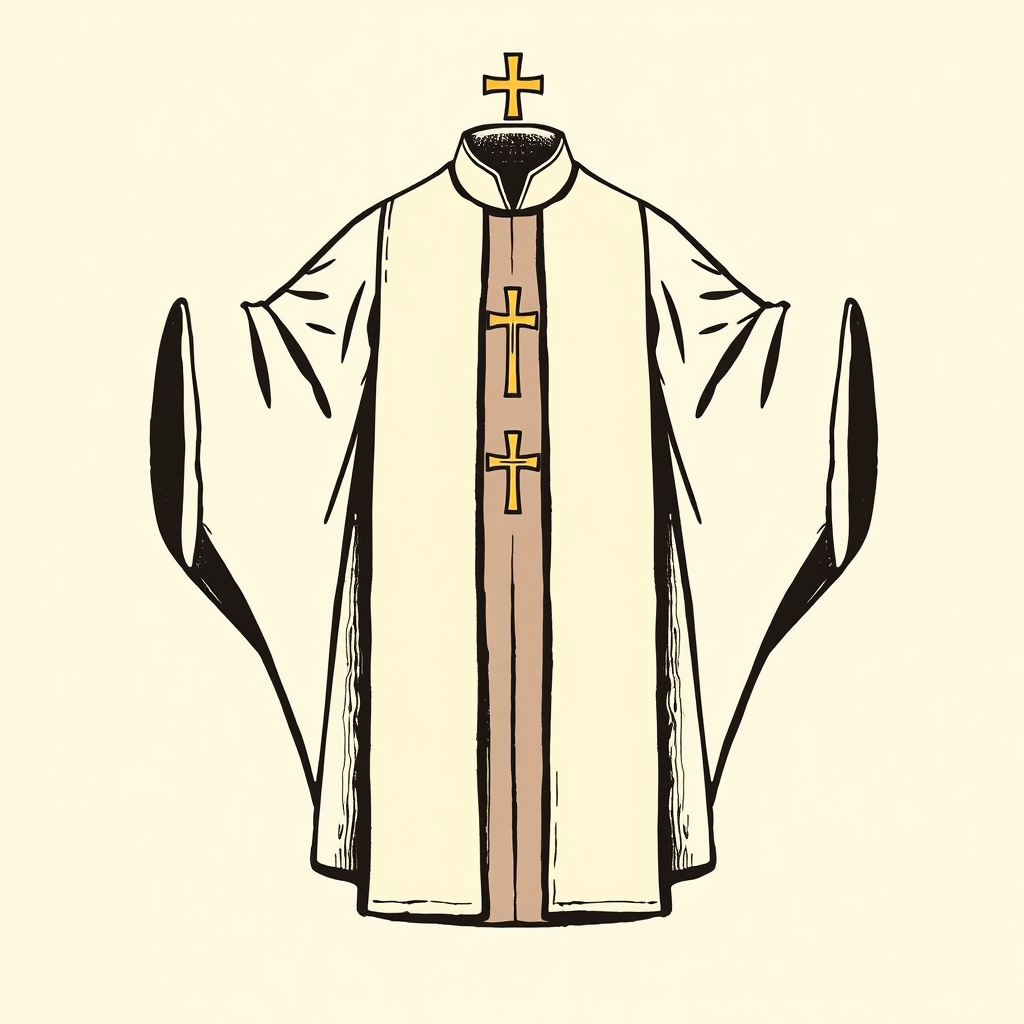
In iconography, Saint Honoratus of Arles is recognizable by: snakes, palm tree, gushing fountain and episcopal vestments.
What miracles are attributed to Saint Honoratus of Arles?
4 miracles are attributed to this saint, notably: Sign / wonder, Mastery of the elements, Multiplication / provision and Healing.
Which saints were contemporaries of Saint Honoratus of Arles?
Contemporaries include: Saint Augustine of Hippo, Saint James of Tarentaise, Saint Jerome of Stridon and Saint Epiphanius of Salamis.
When did Saint Honoratus of Arles die?
Saint Honoratus of Arles died around 429.
What are the other names of Saint Honoratus of Arles?
Other forms of the name: Honoratus.
Who are the relatives of Saint Honoratus of Arles?
Relatives of Saint Honoratus of Arles: Venance (brother).
Annexes & related entities
Structured data for exploration: events, miracles, quotes, places, attributes, patronages, and important entities cited in the text.
Key Events
- Born towards the end of the reign of Constantius
- Baptism despite his family's opposition
- Journey to the East and death of his brother Venantius in Methoni
- Foundation of the Lérins Monastery
- Election to the episcopal see of Arles in 426
- Died January 14 or 15, 429 (8th or 9th day after Epiphany)
Quotes
-
This life is pleasing; but it deceives.
Saint Honoratus (words reported by Saint Hilary) -
If one wished to represent charity in a human figure, one would have to paint the portrait of Honoratus.
Saint Hilary of Arles