
Saint Vincent of Lérins
A former soldier born in Toul, Vincent retired to the monastery of Lérins to dedicate himself to God. He is famous for his Commonitorium written in 434, where he defines the rule of the Catholic faith as what has been believed "everywhere, always, and by all." He died around 450, leaving a major work on tradition and the development of dogma.
Contemporaries

Figures and markers around the normalized period for this entry.
Guided reading
8 reading sections
SAINT VINCENT OF LÉRINS
Origins and conversion
Brother of Saint Lupus of Troyes, Vincent left a military career to retire to the monastery of Lérins in order to devote himself to his salvation.
Vincent , own brother of Sa int Lupus, Bishop of Troyes, was born in Toul. He had first embraced the profession of arms and shone in the world. Touched by grace, and perhaps drawn by the example of his virtuous brother, he went to shut himself aw ay in the monastery of Lérins to think only of the work of his salvation.
The Commonitorium and the rule of faith
In 434, he wrote under a pseudonym his major work defining the rule of universality, antiquity, and consent for the Catholic faith.
Painfully affected to see the Church torn apart by heretics and wishing to contribute, for his part, to protecting the simple faithful against the sophistries of error, he composed, around the year 434, three years after the Council of Ephesus which proscribed Nestorianism, a book he titled Commonitorium or warning against heretics, and which, out of humility, he published under the name Per egrinus (t he Traveler or the stranger). It is in this beautiful and solid work that he traces this rule to which, more strictly than ever, it is important to conform: "In the Catholic Church itself, we must take the greatest care to hold what has been believed everywhere, always, and by all." In ipsa Catholica Ecclesia magnopere curandum est ut id teneamus quod ubique, quod semper, quod ab omnibus creditum est.
This book, which Father Labbé qualifies as a golden book, and which Bellarmine, because of its brevity, calls small in its extent, immense in its value, aims to preserve the faithful from novelties in matters of faith.
This treatise was originally divided into two parts, the second of which had as its object the Council of Ephesus, and to which was attached a recapitulation of the entire work. The second part having been stolen from Vincent, he contented himself with reporting this recapitulation at the end of the first part, and making the whole into only one book; it is in this state that we have it today.
The author establishes an infallible rule for distinguishing truth from error, namely, the authority of the Scriptures explained according to the tradition of the Catholic Church.
Warning against the teachers of heresy
The author warns the faithful that even great men like Origen or Tertullian can go astray, and that one must follow the Church rather than the teachers.
Vincent of Lérins applies himself above all to cautioning the faithful against one of the most dangerous temptations to which their faith is exposed, which occurs when God permits great men, men esteemed for their talents and in reputation for holiness, to become teachers of heresy. He brings forward as examples Valentinus, Donatus, Photinus, Apollinaris, Nestorius, Tertullian , and abov e all Origen, two Fa thers whom he praises most magnificently, to conclude that "all true Catholics must receive the Doctors with the Church, but not abandon the faith of the Church with the Doctors."
Literary and Theological Value
Analysis of the quality of Vincent's Ciceronian style and a comparison of his work with Tertullian's Prescriptions as a foundation for controversy.
The Commonitorium is one of those writings that one cannot read too often; there are few in antiquity that contain so many admirable things in so few words. Its style is pleasant, clear, gentle, and flowing; the phrasing of Vincent of Lérins, always pure and harmonious, modulates and balances itself like the Ciceronian period. In terms of style, the author of the Commonitorium seems to us far superior to Salvian, who lived in the same century.
As a controversialist, Vincent of Lérins has been very well judged by Mgr Gerbet. After showing that the division of heretics into two main classes also determined a double controversy regarding them, he adds:
"We do not have to concern ourselves here with that which consisted of showing, through the monuments of tradition and dogmatic decisions, what the faith of the Church was; but that which had as its object to prove the necessity of believing in the Church merits particular attention.
Christian antiquity produced two fundamental works on this subject, one towards the beginning of the 3rd century, and the other in the 5th: the Prescriptions of Tertu llian, and the Commonitoriu m of Vincent of Lérins. We call them fundamental because, effectively, the considerations developed therein strike equally at all sects, whatever their particular doctrines may be: and just as, in algebra, one obtains general formulas applicable to any kind of quantity by eliminating the special conditions of a particular problem; in the same way, by setting aside in the reading of these two writings the names of contemporary heretics and the accessory reflections attached to them, one sees emerging, in its logical purity, the general principle of controversy with all those who create or choose their faith, according to the proper meaning of this name of heretics."
Definition and humility of the author
Explanation of the term 'Commonitorium' as a collection of notes for memory and presentation of Vincent's humility as he describes himself as a pilgrim.
Here is the humble beginning of this beautiful book: "It seems to me, a pilgrim, the least of all the servants of God, that it would not be, with the help of the Lord, a thing of mediocre utility to commit to writing what I have faithfully received from the holy Fathers, a precaution which is undoubtedly very necessary for my own weakness, since I will have at hand the means to compensate, through assiduous reading, for my poor memory!"
These lines well explain the meaning of the title chosen by the author. At that time, the name *Commonitorium* was given to a collection of notes intended to aid the memory: it is in this way that Emperor Theodosius gave a commonitorium to Count Elpidius as he left for the Council of Ephesus , and that Pope Zosimus gave one to Faustinus whom he was sending to Africa.
The Theology of Dogmatic Progress
A famous development on the progress of religion, compared to the organic growth of the human body: an increase without a change in essence.
One of the most admirable pages of the *Commonitorium* is that which treats of progress, this great question of all times and of our own in particular. "Someone will perhaps say: Can there then be no progress for religion in the Church of Christ?" "Let there be, and let there be much. For who would be so malevolent to men, so cursed by God, as to prevent this progress? But it must nevertheless be truly a progress, and not a change. What constitutes the progress of a thing is that it takes on increase, without changing its essence; what constitutes change, on the contrary, is that it passes from one nature to another. It is therefore necessary that the intelligence, the science, the wisdom of each as well as of all, of a single man as well as of the entire Church, according to age and century, grow and increase much, but always in their own kind, that is to say, in preserving the same doctrine, the same sense, the same thought.
"Let the religion of souls imitate the state of the body, which, while developing and growing with the years, does not cease to be the same.
"There is indeed a difference between the flower of youth and the maturity of old age; but he who is today an old man is not someone other than he who was once an adolescent; so that one and the same individual, though he may change in state and disposition, nevertheless changes neither in nature nor in person. The limbs are small in a nursing infant, large in a young man; they are however the same in both. As many limbs as children have, so many have men; and if there are parts that develop at a more mature age, they existed nevertheless in the principle of their origin, so that nothing new appears in an old man that was not hidden in him when he was a child.
"Thus, therefore, there is no doubt that the right and legitimate rule of a beautiful development, the perfect and invariable order of a beautiful growth, is when the number of years comes to reveal in a young man the parts and forms that the wisdom of the Creator had first hidden in a child. But if man, with time, changes into a figure that is not his own; if the number of his limbs increases or decreases, it must be, in that case, that the whole body either perishes, or becomes monstrous, or at the very least is weakened.
"Likewise, the doctrine of the Christian religion must follow these laws of perfection, consolidate itself with the years, extend with time, rise with age, but remain however pure and intact, show itself full and entire in all the measures of its parts, as in its senses and limbs in a way, admit no change, lose nothing of what is proper to it, and undergo no variation in the defined points.
"As for the Church of Christ, the careful and prudent guardian of the dogmas entrusted to her, she never changes anything in them, diminishes nothing, adds nothing; she does not cut off what is necessary, she introduces nothing superfluous, she lets nothing be lost of what belongs to her, she usurps nothing foreign; but she puts all her industry, all her understanding into treating faithfully and wisely the ancient things, into shaping and polishing what may have been begun or sketched out in the past; into consolidating and strengthening what was expressed and developed; into keeping what was confirmed and defined.
"Finally, what other goal has she ever proposed in the decrees of councils, if not to make that which was believed with more simplicity be believed with a more lively faith; to make that which was preached with more weakness be preached with more force; to make that which was already adored with certainty be adored with more zeal?"
Death and posterity
Vincent died around 450 under Theodosius II. His relics are kept at Lérins, although fragments exist elsewhere.
Saint Vincent of Lérins died before the end of 450, under the reign of the emper ors Theodos ius II and Valentinian III. His relics, it is said, are respectfully kept at Lérins; we believe, however, to have seen fragments of them somewhere else.
Spiritual reflection and cult
Meditation on the brevity of life and indications regarding the dates of his liturgical feast in Fréjus and Nancy.
Saint Vincent of Lérins saw in the wave of a stream moving away from its source, to which it must never return, the image of the fleeting moments of life, which flow away never to return again! Alas! What mouth has not sometimes said, while thinking of the brevity of our days: What is life?
By recalling our happy childhood, by treading again in thought upon that lawn where we frolicked with such gaiety, by seeing again in spirit those countrysides where we wandered in our carefree youth, does it not seem that we are still touching moments that have nevertheless passed many years ago? Now, it will be the same when, on our deathbed, we can contemplate our entire life at a single glance: what will it be for us then, if not a frivolous dream, a light and fleeting shadow? What is your life, says the apostle Saint James? It is a vapor that appears for a little time and will soon be dissipated. Are you not then fools, you who say: Today or tomorrow, we will go into such a city, we will trade there for a year, and we will make a considerable gain: do you even know what will happen tomorrow?
Many people think quite often about the brevity of life; but this thought, which God intended to bear so much fruit, is sterile for them. Far from benefiting from it, indeed, they hasten to chase it away as soon as it presents itself, and strive to replace it with cheerful and frivolous thoughts. In truth, is this not a madness similar to that of the fools who would dance above a volcano opened beneath their feet to devour them?
The propers of Fréjus and Nancy mark the feast of Saint Vincent of Lérins on May 28.
Annales hagiologiques, Godescard, Lille ed.; local notes provided by Abbé Guillaume, canon, chaplain of the ducal chapel, in Nancy.
Iconography
Signs and attributes

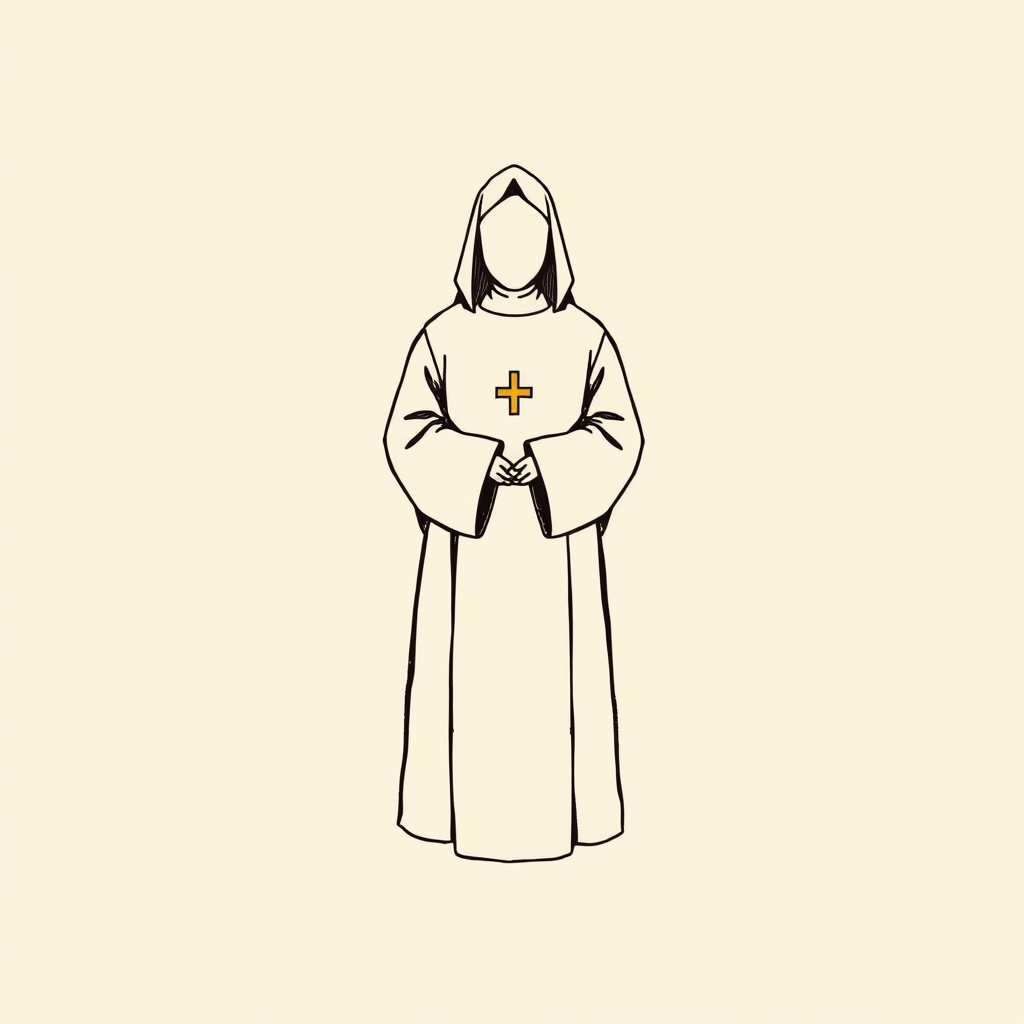
Entities
Narrative network
The names, places, and concepts most present in the entry, weighted by centrality in the text.
Frequently asked questions about Saint Vincent of Lérins
Who was Saint Vincent of Lérins?
A former soldier born in Toul, Vincent retired to the monastery of Lérins to dedicate himself to God. He is famous for his Commonitorium written in 434, where he defines the rule of the Catholic faith as what has been believed "everywhere, always, and by all." He died around 450, leaving a major work on tradition and the development of dogma.
How is Saint Vincent of Lérins depicted in Christian art?
In iconography, Saint Vincent of Lérins is recognizable by: book and monastic habit.
Which saints were contemporaries of Saint Vincent of Lérins?
Contemporaries include: Saint Augustine of Hippo, Saint Honoratus of Arles, Saint James of Tarentaise and Saint Jerome of Stridon.
When did Saint Vincent of Lérins die?
Saint Vincent of Lérins died around 450.
What are the other names of Saint Vincent of Lérins?
Other forms of the name: Peregrinus, Le Voyageur and L'Inconnu.
Who are the relatives of Saint Vincent of Lérins?
Relatives of Saint Vincent of Lérins: Saint Loup (full brother).
Annexes & related entities
Structured data for exploration: events, miracles, quotes, places, attributes, patronages, and important entities cited in the text.
Key Events
- Born in Toul
- Military career
- Entered the monastery of Lérins
- Composition of the Commonitorium around 434
- Died during the reign of Theodosius II and Valentinian III
Quotes
-
In the Catholic Church itself, every care must be taken that we hold what has been believed everywhere, always, and by all.
Commonitorium -
It must be a true progress, and not a change.
Commonitorium