
Saint Cletus
The fourth pope of the Church, Cletus succeeded Saint Linus in 77. He organized the twenty-five parishes of Rome and founded the first Christian hospital to care for victims of the plague. He died a martyr in 83 during the persecution of Emperor Domitian.
Contemporaries

Figures and markers around the normalized period for this entry.
Guided reading
6 reading sections
SAINT CLETUS, FOURTH POPE
Origins and beginning of the pontificate
Cletus, of Roman origin and son of Emilianus, succeeded Peter and Linus, reigning during the empires of Vespasian and Titus.
« Roman by origin, C letu s was the son of Emilianus. He was born in the Patricius district, which was part of the Esquiline region, not far from the senatorial residence of Pudens, where Saint Peter had resided. He sat for six years, one month, and eleven days, during the reigns of Vespasian and Titus, from the eighth consulship of Vespasian and the sixth of Domitian, until the ninth of Domitian and that of Rufus, when he received the crown of martyrdom.
« In accordance with the rules laid down by the blessed Peter, Cletus ordained, during the month of December, twenty-five priests for the city of Rome. He was buried on the 6th of the Kalends of May, near the body of Saint Peter, at the Vatican. After him, the see remained vacant for twenty days ».
Such is the notice that the * Liber Pontificalis* devotes to Saint Cletus.
A pontificate marked by catastrophes
His election in 77 coincides with the exile of Saint Clement and a period of natural disasters, including the eruption of Vesuvius and the plague.
We may add, by way of commentary, that the date of Saint Clet's election in 77 coincides with the departure of Saint Clement, his predecessor, into exile.
The pontificate of Saint Clet was marked by the inauguration of the Colosseum, from which so many martyrs were to ascend to heaven; by that famous eruption of Vesuv ius which engulfed the two cities of Pompeii and Herculaneum; by a formidable fire that broke out in Rome and lasted for three days and three nights; and finally by a terrible plague that depopulated several provinces of Italy.
Organization of parishes and charity
He structured the twenty-five parishes of Rome and founded the first Christian hospital in his own home to care for plague victims.
This invasion of the plague made the organization, or at the very least the reorganization, of the twenty-five parish titles all the more opportune. According to the instructions of Saint Peter, these were to divide Rome among themselves and form as many distinct dioceses for the administration of baptism and penance, for the benefit of pagans converted to the faith. The Popes have always advanced spiritual aid and temporal aid, demanded by the miseries and infirmities of our poor humanity, side by side. Barely a few years after the death of Saint Peter, Clet transformed the house where he was born into a church and added to it a hospice where the victims of the plague were received. Such was the origin of the first Christian hospital: it dates back far, as one can see.
Martyrdom under Domitian
The first victim of the persecution of Domitian, he was martyred in 83 and buried at the Vatican near Saint Peter.
However, Titus, the delight of the human race, who did not shed a drop of Christian blood, had been succeeded by Domitian, the second Nero. He was worthy, says Eusebius, to sign the edict of the second general persecution against the Christia ns: Saint Clet was its first victim. He was martyred in Rome on April 26, 83, and his precious remains were deposited in the Vatican, near those of Saint Peter, where they still rest.
Liturgical and Institutional Heritage
His model of priestly organization, inspired by Jerusalem, and his hospital foundations endured for several centuries.
The tenure of Saint Clet on the pontifical chair left a luminous and deep furrow in the history of the Roman Church. This did not prevent French historians and hagiographers from barely mentioning his name and leaving his works in the shadows—works that survived until the last century. Indeed, the church and hospital founded by him in the year 79, after having been ruined and rebuilt several times, were only definitively suppressed in the 18th century. And the memory of his charity had been preserved so faithfully in the minds of the Romans that the Institute of the Cruci fers or Cross-Bearers a ttached to this hospice traced its origin back to this holy Pontiff.
That is not all: the various Popes who had to reconstitute the parishes of Rome or establishments intended for the administration of baptism and penance constantly showed themselves faithful to the apostolic tradition of Saint Clet; they maintained the number of twenty-five: thus did Saint Marcellus in 308, and Pius V, fifteen hundred years later. Was this number, determined by Saint Peter himself, not a reminder of the twenty-four priestly series which, in Jerusalem, shared the sacred ministry of the te mple under the direction of the high priest? Was this not an indication that the Roman pontificate succeeded the destroyed pontificate of Aaron?
It is known, moreover, that until the destruction of the temple, or the year 70, Christians converted from Judaism went to sacrifice in Jerusalem. Saint Paul himself offered a bloody sacrifice at the temple during one of his visits to the holy city: it was so as long as the prophecy of Jesus Christ was not fulfilled and the abomination had not entered the Holy of Holies. Now, Saint Peter, not having seen the destruction of the temple, would have ordered his successors to await it and, when it had taken place, to adopt for Rome the priestly organization of Jerusalem.
This is what the *Liber Pontificalis* seems to indicate when it traces back to Saint Peter himself the idea of dividing Rome into twenty-five parochial titles.
Coadjutor and patron of Ruvo
Honored as the first bishop of Ruvo, he is said to have served as coadjutor to Saint Peter for the external affairs of Rome.
Saint Clet was, it is said, the first to use these words in his letters: "Salutation and apostolic blessing"; but this detail is contested and we record it only for the record.
He is one of the patrons of Ruvo in the kin gdom of Naples. The tradition of this locality holds that he was its first bishop: this could very well be reconciled with the fact, established in history, that Saint Peter named him his coadjutor, outside of Rome, just as Saint Linus was within.
*Liber Pontificalis et Histoire de l'Église*, by Darrus.
Iconography
Signs and attributes

Entities
Narrative network
The names, places, and concepts most present in the entry, weighted by centrality in the text.
Frequently asked questions about Saint Cletus
Who was Saint Cletus?
The fourth pope of the Church, Cletus succeeded Saint Linus in 77. He organized the twenty-five parishes of Rome and founded the first Christian hospital to care for victims of the plague. He died a martyr in 83 during the persecution of Emperor Domitian.
What is Saint Cletus the patron saint of?
Patronage of Saint Cletus: Ruvo.
What is Saint Cletus invoked for?
Saint Cletus is invoked for: plague victims.
How is Saint Cletus depicted in Christian art?
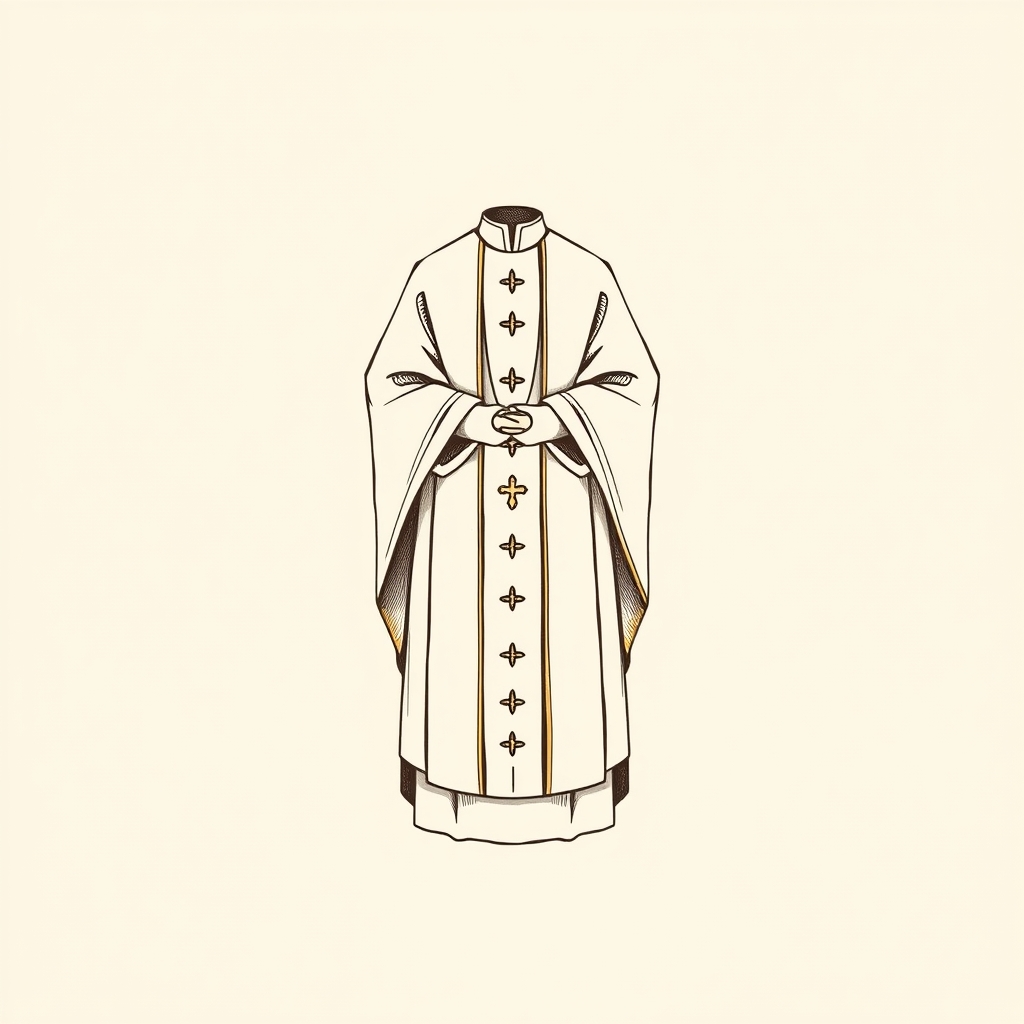
In iconography, Saint Cletus is recognizable by: cross, crown of martyrdom and pontifical vestments.
How did Saint Cletus die?
Saint Cletus suffered martyrdom for the Christian faith (1st century).
Which saints were contemporaries of Saint Cletus?
Contemporaries include: Saint Martial, Apostle of Aquitaine, Saint James the Greater (Apostle), Saint George of Velay and Jesus Christ (Relics of the Passion).
What are the other names of Saint Cletus?
Other forms of the name: Anaclet.
Who are the relatives of Saint Cletus?
Relatives of Saint Cletus: Emilien (father).
Annexes & related entities
Structured data for exploration: events, miracles, quotes, places, attributes, patronages, and important entities cited in the text.
Key Events
- Election to the pontificate in 77
- Ordination of twenty-five priests for the city of Rome
- Transformation of his birthplace into a church and hospice in 79
- Organization of the Roman titular churches
- Martyrdom during the reign of Domitian
Quotes
-
Greetings and apostolic blessing
Attributed by tradition (disputed)