
Blessed Jeanne-Marie de Maillé
Born into the high nobility of Touraine, Jeanne-Marie de Maillé lived a virginal marriage with Robert de Sillé before dedicating herself entirely to the poor after her widowhood. A Franciscan tertiary and mystic, she ended her life in absolute poverty in Tours, after having been an advisor to kings and princes. Her cult, which has remained alive through the centuries, was officially recognized by Pius IX in 1871.
Contemporaries

Figures and markers around the normalized period for this entry.
Guided reading
8 reading sections
BLESSED JEANNE-MARIE DE MAILLÉ
Origins and early devotions
Jeanne-Marie was born in 1332 into an illustrious family of Touraine and manifested from a very early age an exceptional piety and an attraction to poverty.
Jeanne Marie de Maillé was born on April 14, 1332, at the Château des Roches, in the village of Saint-Quentin, near Loches, to a noble and illustrious family. Her father, Hardouin VI de Maillé, was a knight, baron, and lord of the land of Maillé, known today as Luynes. Through her mother, Jeanne de Montbazon, who was the daughter of Barthélemy Savary, lord of Montbazon, and Marie de Dreux, she was connected to the royal blood of France. These names suffice to highlight the rank her family occupied in the society of that era. At baptism, she received the name Jeanne; that of Marie was given to her at confirmation.
From her earliest youth, she testified to a great love and devotion for the Blessed Virgin, and one of the first prayers she recited was the Angelic Salutation. At six years old, she was already noted for her gravity and devotion: she loved to weave crowns with flowers from the garden to adorn the statues of the Blessed Virgin and those of the saints; she avoided everything that might distinguish her: by preference, she kept company with the poor little girls of the countryside, with whom she delighted in exchanging her rich clothing.
Her governess, having noticed her dispositions and her very pronounced inclination for mortification, predicted that the earth would never have the privilege of conquering her heart. The young Marie's parents viewed with distress what they called pious exaggerations, and resolved to combat and destroy them. But their efforts were useless; grace had already taken hold of this young heart, and the obstacles contributed more powerfully to cementing her union with God.
She was eleven years old when, for the first time, on the day of the Nativity of Our Lord, she was caught up in ecstasy. These extraordinary graces were renewed more than once thereafter. The Virgin Mary then appeared to her, carrying her divine son on her left arm: she held in her right hand a censer filled with drops of the blood of Jesus Christ, and she seemed to sprinkle them upon the young girl. From that day on, she felt keenly inclined to meditate on the mystery of the cross and the sufferings of Jesus Christ, and she placed upon her heart an image of the crucifix painted on parchment, which she often watered with her tears.
God visited her with a cruel illness that soon led her to the gates of the tomb. The doctors, despairing of curing her, had abandoned her; but her mother vowed her to Saint James. Scarcely had she been commended to the Apostle than she immediately recovered her health, and the doctors themselves declared that this healing, so unforeseen and so sudden, was miraculous. Marie took advantage of this new grace to detach herself more and more from earthly affections and to draw closer to God. A Franciscan friar, who usually resided at the château, directed her in this path of renunciation and virtue.
A marriage in chastity
Married to Robert de Sillé, she convinced her husband to live a virginal union consecrated to charity and the service of the poor for sixteen years.
While she thought only of forgetting the world, her parents had other thoughts for her: they wanted to commit her to marriage. At this news, Marie was dismayed; but, far from showing resistance, she chose heaven as the sole confidant of her pain. Her prayer became continuous; she begged with tears the Virgin Mary and all the holy virgins not to allow her to be forever deprived of one day taking her place in their rank in heaven. Her prayers, her fasts, and her numerous penances were heard by God, and He revealed to her that she should fear nothing, but follow the will of her parents, that she would not lose her virginity through her marriage, and even that she would inspire the love of it in her future husband.
At that time, Marie was fatherless. Her grandfather Barthélemy Savary, Lord of Montbazon, chose for her as a husband a young Lord of great devotion, Robert de Sillé. Marie knew him; he had been raised with her and e ven "she had saved his life by a beautiful miracle." Still a child and playing with children of his age, Robert fell one day into a pond; his companions, unable to rescue him, cried out loudly: Marie, still very young, knelt down and prayed with such fervor that he suffered no harm. Robert always retained a great gratitude for this, and to be pleasing to her, he had striven to imitate her in her devotions. All these reasons had inclined the heart of Marie's grandfather toward this choice. The marriage was therefore decided, but the wedding day was to be covered with a funeral veil and changed into a day of mourning, for, on that very day, the old Lord of Montbazon died.
Once united with young Robert, Marie shared her vow with him. The young husband was at first surprised and overwhelmed, but his chaste wife, as pure and as eloquent as the virgin Cecilia, spoke with such grace and unction to this new Valerian that he yielded to her will: both committed themselves to keeping their virginity, and, during the sixteen years they were united, nothing ever came to alter their angelic purity.
The two spouses began by choosing their servants with great care, and they took the commandments of God as the rule for their conduct in the government of their house. Games of chance, so frequent then, and blasphemies were forever banished from their castle, and those who, after several warnings, still dared to hold irreligious discourse or utter improper words were shamefully chased away. Their seigneurial dwelling had become a Hôtel-Dieu: open to all the poor, they came every day in such great numbers that the bread that had been prepared seemed more than once insufficient, and one does not know how, without the intervention of a miracle, they could have all been satisfied. God often renewed, in favor of these pious chatelains, what He did so many times to make the virtue and holiness of His friends shine forth: He multiplied the loaves in the hands of Marie; all the poor left after having eaten well and there still remained enough bread to feed the inhabitants of the castle. Not content with assisting the poor in this way, they went to visit them, entered the hospitals, and everywhere they left the sweet and suave impression of an angelic virtue and a tender and inexhaustible charity. One day, the Lord of Sillé, walking alone, met three small children, abandoned by their parents; he took them by the hand and led them to his wife: "Madame," he said to her, "we shall have no children, here are nevertheless three that I present to you." Marie gave them a maternal welcome, adopted them, and kept them near her as if they had been her own children.
Trials visited the young spouses. Marie fell gravely ill; but suffering could not disturb the serenity of her soul: she always maintained calm and peace, and she still found the means, through her entirely heavenly conversations, to soften the affliction of her husband. This was, however, only the beginning of the adversities that were soon to descend upon this elite soul.
The torments of the Hundred Years' War
After the defeat at Poitiers in 1356, her husband was wounded and then captured by the English; he was miraculously freed thanks to Jeanne's prayers.
We remember the sad and famous day of P oitiers, in which K ing John was taken prisoner by the English. Robert, as intrepid a warrior as he was a fervent Christian, was in this battle at the side of his prince; he fought with valor and was so severely wounded that he had been left among the dead. It was soon noticed, however, that he was still breathing; he was taken back to his castle, placed in the hands of his pious wife, who, despite all her care, could not obtain a complete recovery: this lord remained lame for three years. The defeat of the king, which occurred in the year 1356, and especially his captivity, plunged France into a deplorable situation. Our two spouses had to suffer from it in particular. The land of Sillé was pillaged, the castle was taken by storm, a large number of vassals were put to death, and the brave lord himself fell into the hands of the enemies, who held him prisoner in a fortress and demanded for his ransom the sum, enormous at the time, of three thousand florins. Marie, in the midst of all these disasters, took pleasure in blessing the good pleasure of God and carried, with joy, to her lips, thirsty for sacrifice, this bitter cup of humiliations and poverty. The greatest suffering for her heart was the captivity of her husband. Her alms had exhausted her coffers, the enemies had taken away all her wealth, so she resolved to resort to borrowing to pay Robert's ransom. But she could not raise the required sum, and the English threatened to put the prisoner to death. He was watched more severely than ever, and for nine days he was refused all food. Marie, who knew all the sufferings of her husband, poured herself out in tears and prayers, and invoked above all with strength the assistance of the Virgin Mary. The sufferings and prayers exhaling continuously from this virginal heart touched the Queen of Heaven, who appeared to the prisoner in his prison, broke his chains, and restored his freedom. It was a great joy for Marie to see her dear husband again in perfect health. Both of them took advantage of this grace to practice virtue more perfectly, and to all their good works they added that of working for the deliverance of prisoners.
Widowhood and Total Renunciation
Upon the death of Robert in 1362, Jeanne was driven out by her in-laws and chose a life of absolute poverty, renouncing all her possessions in favor of the Carthusians.
But God seemed to have reunited the two spouses only to make the separation more cruel. One day, Our Lord appeared to Marie during her prayer: it seemed to her that He had just been attached to the cross; the Savior looked upon her with a favorable eye and assured her that she must resemble Him through suffering, contempt, and poverty; then, having detached His right hand from the cross, He touched her left eye and imprinted very strongly in her spirit a profound aversion for the grandeurs of the earth and a great thirst for humiliations and trials. This vision was promptly followed by a profound sorrow: some time later, Robert fell ill and died the death of the just. This event occurred in 1362. They had been united for sixteen years, exhorting one another to the practice of good and loving each other with a love all the more strong for being more chaste.
This death was very painful to her, and, far from calming her grief, her husband's family increased it by the conduct they held toward her. Robert was barely in the grave when they overwhelmed his widow with insults and bitterly reproached her for the alms that her husband had so abundantly distributed at her instigation. They went further: they shamefully drove her from the castle, without leaving her the slightest dowry; so that she felt, in all its truth and in all its rigor, the fulfillment of the word that the Savior had addressed to her a short time before: she was becoming conformed to Him, rejected, poor, and having not a stone on which to rest her head.
In this extremity, Marie went to knock at the door of a poor woman she had once had in her service. She stayed there for some time; but as she possessed absolutely nothing, her hostess treated her with bitterness, and the Blessed one resolved to return to Luynes, to her mother, who received her in her castle. Her piety then took a new flight, and, more than ever, she sought solitude and prayer: the church of Saint-Pierre, located at the foot of the castle, had become her favorite retreat, and she conversed there at length and familiarly with God, who flooded her with His sweetest consolations.
Saint Yves appeared to her one day, clothed in his Third Order of Saint Francis robe, and said to her: "Marie, if you now wish to leave the world, you will possess a heavenly joy." Taking her then by the arm, he raised her into the air, and the heart of the Saint experienced something of the joys of heaven.
Marie was still young; her virtue and nobility caused her to be sought in marriage by several gentlemen, but she resisted with energy the urgings of her mother and brother, and, entirely decided to live far from the world, she left the maternal home and retired to Tours. Lodged in a small house near Saint-Martin, she at tende d there in the chapel of Sainte-Anne at all the hours of the canonical office of the day and night. When she went to church or returned from it, one saw her sometimes preceded by a heavenly light that walked before her to trace her path in the midst of the darkness of the night.
The private homes of the poor and the hospitals were continually visited by her: all the time she did not employ in prayer, she devoted to the care of the sick; she dressed their wounds with her own hands; she invited the beggars to sit at her table, she served them, and she herself fed on their leftovers. Among the indigents who entered her dwelling, she noticed one day a tall and venerable old man with a majestic air; fearing an illusion, she said to him: "If you are a Christian, make the sign of the cross." He obeyed immediately and disappeared in a moment: those present believed that it was an angel who had come to honor with his presence the servant of the Lord.
She took particular pleasure with the lepers. It is said that one of them, abandoned by all because of the foul odor that exhaled from his wounds, was the object of her privileged care and that she restored his health.
The Blessed Virgin, in an apparition, having ordered her to put on the habit of the Third Order of Saint Francis, Marie obeyed immediately. She always wore this garment, even in the streets, which drew upon her the contempt and i nsults of libertines, who, in mockery, called her the Hermit. Her fervor increased even more, and, finding herself one day at Saint-Martin, in the chapel of Sainte-Anne, she begged Our Lord to give her the grace to correspond to His love and to communicate to her a spark of the sacred fire with which the Apostles were filled on the day of Pentecost. Her prayer was barely finished when a globe of fire surrounded her and she was as if set ablaze with such love that one noticed externally the wonders that were operating in her soul.
Filled with respect for the word of God, she heard it assiduously, seated on the ground at the foot of the pulpit. She encouraged the preachers, helped them in their laborious and difficult ministry; she lent them books and often repeated to them: "Strive to edify the public with solid and moral truths, without seeking the grace of discourse or vain science."
She prayed constantly that the anointing of the Holy Spirit would inspire them and render their word effective. It is said that a religious, still young and inexperienced in this difficult art of preaching, obliged to preach before a large assembly in the abbey of Sainte-Croix de Poitiers, had only one day to prepare his discourse; he came to ask for advice from the Blessed one and to recommend himself to her prayers: "Fear nothing," she said to him, "trust in Jesus Christ, who promised his disciples to inspire them with what they must declare to the people: I will pray for you." This assurance gave courage to the good religious; his preaching had great success, earned him the reputation of an eloquent and skillful man, and, what is even better, he had the joy of converting several of his listeners. And he passed in the following time "into the habit of invoking Marie de Maillé as the supreme resource for speakers in distress, for preachers delayed in the preparation of their discourses!"
The zeal for the salvation of souls devoured her, and she often spent the nights in prayer to ask for their conversion. She was deeply afflicted at the sight of those unfortunate women who do not fear to sacrifice their virtue, their honor, and their tranquility in infamous debauchery. She had the joy of bringing several back into the paths of virtue; she helped them to rise again, led them herself to the feet of a confessor, and, when she saw them seriously returned to their duties, she did everything in the world to procure for them a suitable establishment.
One of these unfortunate women is cited, named Isabeau, whom she withdrew from vice and who, married in Bourges, returned each year to Tours to thank the Blessed one for the care she had taken of her soul. Another, following her criminal life, fell ill: covered with hideous wounds, exhaling a fetid odor from afar, she was abandoned by all and lay alone in a frightful attic, awaiting death. The Blessed one learned of it, she ran in all haste to her, approached her bed, took her in her arms to put her in the bath, reminded her of her duties, excited her to contrition, and finally received her last breath after having contributed to reconciling her with God.
Marie de Maillé spent entire days in the church of Saint-Martin, and there, absorbed in prayer, she forgot everything that surrounded her. One day, when she was prostrated before the altar of the cross, a madwoman threw a huge stone at her back. The blow was so violent that the Blessed one fell face to the ground, and for an hour she was thought dead. Marie of Brittany, Queen of Sicily, sent her a skillful surgeon, who, judging the wound incurable, did not want to undertake her healing. God was Himself her physician, and He restored her so well that nothing in her gait ever betrayed the blow she had received and of which she nevertheless kept the mark as long as she lived.
Her austerities are incredible; she gave herself to them with an ardor of which it is difficult to have an idea. She wore continually a serrated iron circle, and the sharp points with which it was armed above and below penetrated very deeply into her flesh. A rough hair shirt served as her chemise. She fasted on Monday, Wednesday, Friday, and Saturday of each week, and for all food she took a piece of black bread and cold water in very small quantity. Besides the fasts prescribed by the Church, she observed Advent from Saint-Martin until Christmas, and one can say that her year was divided into several Lents: one in honor of the Blessed Virgin, another to the glory of Saint Michael and all the angels, a third of thirty days before All Saints' Day, and a fourth of eleven days before Pentecost, to prepare herself for the coming of the Holy Spirit. As one can see, her life was a continuous fast of extreme rigor.
She slept on the ground and very frequently gave herself the discipline.
Similar austerities compromised her health; she fell gravely ill and soon she was thought to be at the gates of the tomb. Marie did not despair of it; long detached from the things of the world, she saw with joy the hour of deliverance arrive. However, she had one deep regret remaining: she would not have wanted to die before having entirely stripped herself of the lands and domains that had been restored to her. She still desired to live to realize this pious design. Returned to health, she went immediately to find the Archbishop of Tours, Simon Renoul, and made the vow of chastity in his hands. She then went to her castle of Les Roches, at Saint-Quentin, where she made an authentic donation of all her lands and lordships to the Carthusians of the monastery of Le Liget. She even renounced all the goods that could come to her in the future, because a relative who was present at the act of cession pointed out that she could hope for beautiful inheritances. Needless to say, this step was very poorly receiv ed by her family, who made bitt er reproaches to her for it. But, without being troubled, the Blessed one replied: "God who gave me the grace to leave the goods I possessed will well give me that of living without desire and without attachment for future riches." It is undoubtedly around this time, in the octave of Pentecost, that she drove into her head a long and strong thorn, which remained there until the end of the following Lent, the time at which it fell out by itself.
She returned to Tours blessing God. Harsh trials awaited her there. No one wanted to lodge her anymore; rejected by the rich who called her a spendthrift and insane, begging her bread from door to door, she spent the day in the churches, and in the evening she retired "to some place that had formerly served as a stable for dogs and pigs" to spend the night there.
Mystical Life and Hospital Service in Tours
She settled in Tours, entered the Third Order of Saint Francis, and devoted herself to the care of lepers and the sick at the Saint-Martin hospital.
Providence, while allowing its servant to be thus drenched in humiliations and sufferings, wished to make her holiness shine forth. One of those who had refused her shelter in his house was suddenly seized with great despair and was heard crying out continually: "I am damned, VIES DES SAINTS. — TOME IV. 3 the demons torment me horribly, and I will never be delivered from their tyranny if Madame de Sillé does not assist me."
Marie, as soon as she learned of this man's state, ran to him, and her presence restored his calm. She had him approach the sacraments of Penance and the Eucharist, and he died in a very Christian manner.
Following these events, a dwelling was offered to the Blessed by a nun of the monastery of Beaumont, named Sister Jeanne, who came, with the permission of her superior, to live with her. This consolation was not of long duration, for a prompt death came to take this companion from her, and Marie found herself alone again and without resources.
It was then that she was admitted among the servants of the Saint-Martin hospital. This duty of caring for the poor, which she had previously performed voluntarily with such grace, now became mandatory for her: but it was also the occasion to make her humility and renunciation shine with a brighter light. The most arduous and humiliating tasks were given to her by preference: she kept watch at night, worked during the day, and ran to the market to buy provisions. One day, her brother, the Duke of Maillé, met her and turned his head so as not to see "the one who dishonored his house." She rejoiced in this contempt, with the thought that it brought her closer to the divine crucified one. Her virtue even became the occasion for insulting and hurtful words, which were lavished upon her by the servants of the hospital, her companions, jealous of her qualities, and their mistreatment went so far that she was forced to leave the hospital.
Far from becoming discouraged, Marie accepted all these trials as a just punishment for her faults.
She allowed herself to be locked in churches at night, particularly in that of Saint-Simple, where she applied herself to meditation and to reading the lives of the Saints and the Bible, which the Queen of Sicily had given her.
The favors of heaven did not fail her, and one Holy Thursday evening, as she began to read the Passion of the Savior, she was caught up in ecstasy until the following morning. God transported her to the earthly Paradise, and made her understand all the greatness of Adam's fault. It seemed to her that she was a witness to his dismissal from Paradise, and God gave her a perfect and clear knowledge of all the events of the Old and New Testament, up to the point of the Passion where she had stopped.
The Blessed Virgin appeared to her often and several times forbade her from associating with certain people. One of her historians affirms that Saint Gatien, Saint Martin, and all the holy bishops of Tours appeared to her and consoled her with their sweet conversations. Despite her virtue and prudence, several people stirred up a true persecution against her; she was forced to leave the city and take refuge in the monastery of Beaumont.
In this pious asylum, God did not abandon her, and more than ever she was filled with his favors. He gave her knowledge of the mystery of the Incarnation, revealed to her the ineffable virtues of Mary and the merits of the Archangel Gabriel. She had such an intimate knowledge of this mystery that she melted into tears, and her heart overflowed with an inexpressible and divine joy.
The abbess and the nuns, witnesses to these wonders, surrounded the Blessed with respectful admiration full of tenderness. However, this affection was not powerful enough to shelter her from persecutions: her enemies pursued her even into the cloister, and she was forced to leave the abbey. It was then that she retired near the chapel of Saint-Valérien, in a place called Champchevrier, which belonged to her family. There again, she wished to live on alms, and she accepted with gratitude what the servants of her mother consented to give her.
The Hermitage of Planche-de-Vaux
She retired to the solitude of Planche-de-Vaux, where she restored a chapel and performed numerous miracles linked to a spring and to nature.
Shortly after, Marie de Maillé retired permanently near the hermitage o f Planche-de-Vaux, located at an equal distance from Ambillou, Cléré, and the Château de Champchevrier. There was in this place a small, very ancient chapel, dedicated to the Blessed Virgin, which was falling into ruin. Marie had no greater priority than to have it rebuilt, and she took joy in helping the laborers with their work. It was undoubtedly when it was completed that she begged a virtuous person to carry there an image of the Virgin that she had had made.
They both walked barefoot during this translation, singing the praises of God with such fervor "that the encounter with paths covered in mud and thorns, or ditches full of water, did not inconvenience or slow them down any more than if they had flown like birds."
She had already had a statue of the Virgin placed at the top of the choir of the Canons of Saint-Martin, and another at the altar of the Three Marys.
Marie hid for a long time in the solitude of Planche-de-Vaux; she nourished herself with a little barley and some wild herbs. Her drink consisted of stagnant and foul water, but her conversation was with the angels. Such a mortified life weakened her considerably; she then resolved to return to Tours and to establish her dwelling near Notre-Dame-la-Riche.
Her weakness was such that she could not have undertaken this journey if God had not given the water she usually drank the flavor and strength of a generous wine.
The chapel of Planche-de-Vaux is called today the chapel of the good Hermitess by the people, who come there to make numerous and frequent pilgrimages. The statue of the Virgin, placed by the Blessed one, is still there; but it is not because of her that they come. It is Marie de Maillé herself who is the object of their pilgrimage; it is she whom they invoke, and it is to her intercession that they attribute the healing of headaches and fevers.
What is called today the garden of the Hermitess is a wooded space of about twelve square meters, entirely enclosed by a wide ditch, filled with water for a large part of the year. In summer, the part of the garden that borders the chapel is accessible to pilgrims, who piously gather some flowers that they deposit on the window of the small oratory. It is said that the garden of the Hermitess produces flowers in all seasons of the year.
It is especially on Good Friday that the great pilgrimage of the Hermitess takes place. On that day, the inhabitants of the neighboring parishes go there in crowds: they enter the chapel, burn candles there, and always leave some offering proportionate to their fortune. They then go to a well, located a few steps from the chapel, to draw water to which they attribute a miraculous virtue. This fountain, similar to the wells seen near poor country dwellings, was dug by the Blessed one. Although stagnant and subject to decomposition because of the leaves and animals of all kinds that fall into it through the opening at ground level, the water is always abundant and retains its clarity and a pleasant taste at all times. Thus, the pilgrims are keen to take some of this water to their homes; there is always on the edge of this well a wooden hook and a small pitcher for the use of the pilgrims.
One recounts that he was cured of a violent sore throat; another assures that very tenacious intermittent fevers yielded to the use of the water of the Hermitess.
Facts of this nature are recounted daily in the parishes of Cléré and Ambillou, and they undoubtedly weigh heavily in the memory and the trust that the inhabitants of this region have kept for the Blessed one.
The pilgrims of the Hermitess are accustomed, before leaving, to throw a few coins on the pavement of the holy place, and to deposit outside fragments of bread accompanied by some flowers, a small sprig of hawthorn or flowering broom, a violet picked in the bush, etc.
Where does this custom come from? Tradition explains it through a graceful and naive legend. One of the lords of Maillé or Champchevrier, a close relative of the pious recluse, had one day, in the middle of the woods, lost the trail of his hunting companions. After having wandered for a long time, exhausted by hunger and fatigue, he happened to pass near the hermitage of Marie, whom he found in her garden. He explained his distress to her and asked her if she might have a little bread to calm his hunger. "Messire knight," she said to him, "bread, I have none at all, but may it please you to accept this little flower that I place in your hand, and pray to the most sweet Notre-Dame, whom no knight in distress ever implored in vain." What to do with a flower to appease his hunger? The knight, touched no doubt by the gravity and the supernatural aspect of the pious woman, accepted it nonetheless, and it served him well. He placed it on his hat, then, spurring his steed again, he took the path to the manor of Champchevrier that Marie had indicated to him. He was moving away rapidly when he felt a considerable weight that made his hat tilt to the side where he had placed the flower. He uncovered his head and could not help but let out a cry of surprise upon seeing three very appetizing small loaves hanging from the cluster of this flower. After having satisfied his hunger, he thanked Notre-Dame, and upon arriving at the Château de Champchevrier, he told his story and then learned the name of the unknown old woman who had so marvelously helped him.
Counselor to Kings and Sinners
Recognized for her holiness, she advised King Charles VI in Paris and worked for the conversion of many sinners and prisoners.
Upon arriving in Tours, Marie de Maillé took refuge in the church of Notre-Dame, where, for forty days, she spent her days and nights in prayer and meditation; yielding, despite herself, to the force of sleep, she sometimes took a little rest on the pavement or on a bench.
But the churchwardens of this church did not allow her to stay there any longer, and as she complained lovingly to Our Lord, she heard a voice that said to her: "Come to the place where Jesus Christ rests." She therefore went immediately to prostrate herself before the high altar, and God visited her twice in the last night she spent at Notre-Dame-la-Riche, with consolations so intimate and so sweet that she was promptly comforted.
The next day, Marie de Maillé, aged fifty-seven, went to lodge in a small and poor room in the vicinity of the convent of the Friars Minor Cordeliers.
She finally began to find some tranquility in this asylum; but she did not diminish any of her austerities and always continued to beg for her bread. If sometimes she received food that was a little more succulent, she distributed it to the poor and kept only black bread and some raw herbs for herself.
She attended all the offices of the Cordeliers' convent: she spent every night in the church, her head covered with dust, prostrate with her face against the ground, and remaining on her knees for so long that a historian recounts that calluses had formed on the skin of her knees.
Her devotion and respect toward the Holy Eucharist were such that she only approached it trembling, and after communion her face seemed transfigured and all on fire. Her heart gave way to all the impulses of love and gratitude, and she expressed her feelings in admirable canticles, which were found after her death, written entirely in her own hand, but which, unfortunately, have not come down to us.
The world understands nothing of the things of God: this appears in the judgments it passes on the saints. The very extraordinary life of Marie was bound to attract mockery and even slander: she was looked upon as a madwoman, some even treated her as a witch and a sorceress. Jeanne de Maillé had sought silence and self-effacement; but fame came to her, attracted by works whose brilliance radiated far and wide. Souls who had a sense of noble and great things honored her as a saint. Louis, Duke of Anjou, and Marie of Brittany, his wife, were of this number, and they chose her to present their son, the prince, at the baptismal font. Marie de Maillé took this dignity seriously and prayed much for her godson. It is even said that she often approached his cradle, and, although the child did not have the use of reason, she spoke pious and touching discourses to him, as if he could have understood her. But her goal, says her historian, was rather to instruct and edify the people present. Nevertheless, one evening, after supper, the little child seemed, by his childish cries, to testify that he took great joy in her discourses, and one was quite astonished to hear him speak to express his satisfaction "with the devout conversation" of the Blessed.
In the end, her holiness shone so brightly in the eyes of the inhabitants of Tours that when she passed through the streets, one saw children running to her, kneeling, and joining their little hands to say this prayer: "Praised be Jesus Christ Our Lord and the good God."
Marie had a great devotion to Saint John the Baptist, and, shortly before his feast day, she received the order to go to Notre-Dame de la Planche-de-Vaux. She left immediately, staff in hand and accompanied by two Friars Minor. Arrived at this place, God revealed several future events to her. She announced the journey of the King of France, Charles VI, to Tours, and she even designated the gate by which he would enter this city. The sequel verified this prophecy: a few years later, the king, having come to Tours, was preparing to enter this city by th e eastern gate, where the ecclesiastics and religious were waiting for him, when he suddenly changed his mind and "took his path by another way that the Blessed had indicated."
She revealed to the king, through the intermediary of the Duke of Orleans, several secrets that she had learned from God. Three years later, she had several interviews with this monarch in Paris in the church of the Celestines and at the Hôtel de Saint-Paul. She then presented him with the cup from which Saint Martin drank; this holy relic was deposited in the royal chapel to be honored there with the insignia relics that were already kept there.
The king wanted her to be presented to the queen, Isabeau of Bavaria, but one of the guards, seeing her so poorly dressed, pushed her away with contempt and even went so far as to strike her. The Blessed did not complain about it at all and, on the contrary, used all her strength to spare this wretch the punishment he deserved. The queen was so happy to see her that she kept her at court for seven days: she never tired of hearing her, and Marie's discourses had so much charm and strength that they converted several courtiers. Everyone hastened to be agreeable to her; thus she obtained beautiful reliquaries for several churches, and the ladies of the court joyfully gave her their most magnificent clothes, from which she had altar hangings and ornaments made for poor parishes. She gave the convent of Saint-François of Tours a very precious monstrance of beautiful workmanship.
Returned to Tours, Marie continued her works of devotion and charity, and more than ever she strove to win souls to Jesus Christ. Her fervor made her especially eloquent in rebuking blasphemers, and very few resisted her touching supplications. Once, however, a young man from Tours uttered a horrible blasphemy at the moment the Blessed was passing in the street; she stopped and implored him to cease. But, for all answer, he threw her to the ground and trampled her underfoot with such brutality that he left her half dead. Transported to her room and having come to herself, she was strongly urged to prosecute this wretch before the courts: "I will do nothing of the sort," she replied, "for vengeance is equally harmful to those who suffer it and to those who exercise it, and we serve our neighbor more usefully by patience than by any other good work."
A woman of the city, having become jealous to the point of losing her reason, uttered blasphemies against God and the sacraments with such rage that the neighbors were frightened. She spat on the crucifix when it was presented to her, and she screamed like one possessed. Marie is warned: she runs immediately, enters the dwelling of this unfortunate woman, saying these words: "May peace be in this house." Then she kneels to obtain her healing. The unhappy woman calms down immediately, listens quietly to this sweet word which exhorts her to penance and disposes her to the reception of the sacraments. Marie had the joy of seeing her die reconciled with God and in the best Christian dispositions.
Thévenin, a bourgeois of Tours, pursued by a violent despair that he could not master, had resolved to let himself die of hunger. He invoked the demon and prayed to him to rid him of life. Marie approaches him and her discourses calm him; but no sooner has she abandoned him than the crises become more furious and more formidable. Learning this, she ordered him to be led to the church of Notre-Dame-la-Riche, where she went herself and prayed with such fervor that this man was finally delivered from the demon, who did not abandon him until after having uttered horrible blasphemies.
This wretch, feeling himself finally delivered, cried out in a loud voice: "The Mother of God deigns to visit me. Let my parish priest approach to hear my confession: the mercy of my Savior is admirable!"
He did, in fact, confess all his faults, which he wept over bitterly, and he departed from this world after having received all the sacraments.
The Blessed had no greater joy than to work for the conversion of sinners: she disposed them to penance and facilitated all the means for them to confess. She herself asked Rome several times for more extensive powers for the priests to whom she addressed these unfortunates.
Two young religious of the Cordeliers' convent had the misfortune to apostatize, to leave their convent, and to seek by flight to evade their sacred engagements. As soon as she learned of it, Marie immediately began to pray, and at the moment these two foolish men were preparing to cross a stream, they suddenly felt themselves stopped by an invincible force, which obliged them to return to themselves. The Blessed went to meet them, excited them to repentance, and brought them back to the convent, where their superior welcomed them with kindness.
Her zeal shone again in the city of Tours regarding an old witch, named Philomène, whose reputation was immense among the poor and simple people of the populace. She went to find her and spoke to her of God without any success. She then called to her aid a Cordelier father, a lecturer in theology. This good Father used all his science and all his skill in vain to convince this unfortunate woman of her error and the danger that her profession made her run for her salvation. In the presence of such obstinacy, Marie said to the religious: "If we can decide her to enter the church, we will succeed, and she will not leave it without being confessed." That was the difficult part; she was able to obtain it, however, and Philomène had barely taken the first step into the church when the sight of the crucifix touched her and abundant tears escaped from her eyes. This rebellious heart was finally touched, the grace of absolution purified it, and she retired to Angers to do penance there. She gave, in fact, the example of all virtues there, and following the example of the Blessed, she begged from door to door.
The prisoners could not escape the tender solicitude of Marie de Maillé; she visited them, consoled them by citing the example of the saints who had suffered the same punishments without having deserved them, and it is said that several miraculously recovered their freedom through her intercession. During the king's stay in Tours, she solicited the pardon of all the condemned. The king promised; but, as happens too often, the courtiers prevented this promise from obtaining its effect, and shortly after, the Blessed, returning from a trip, found the prisons fuller than before her departure. Having been able to obtain nothing from the king of the earth, she addressed herself to the King of kings: the prison doors opened of their own accord, the chains of the prisoners broke, and they were able to go away without anyone thinking of disturbing them. The miracle was so evident that one of these prisoners, having forgotten to take his "Hours of the Virgin," returned to look for them: he was allowed to come and go, and the king, having learned of it, immediately granted the pardon he had promised.
It was enough for her to speak to the condemned to bring back peace and resignation to their hearts. Once, it was the Saturday of the Passion, she was leaving Notre-Dame-la-Riche, when one of these unfortunates who was being led to the place of execution called her and said to her: "Madame de Sillé, pray for me." Touched with compassion and melting into tears, she returned to the church and begged Our Lord to be favorable to this poor condemned man. The criminal could not be executed that same evening, because all the ladders that were needed were found to be too short or broke as soon as one wanted to use them; he was therefore led back to prison, and the Blessed was able to obtain his release the next day.
She obtained by her prayers the deliverance of several women whose condition inspired serious fears for the lives of their children. One of the first gentlemen of Tours had asked her to attend the baptism of one of his children. At the moment of the ceremony, it was noticed that the child had been suffocated by the linens and lace with which he had been adorned. At this sight, Marie shuddered and immediately began to pray. He who had made Lazarus come out of the tomb restored life to this child through the intermediary of his faithful servant: he was baptized and lived for several more years.
The innocence of young children attracted and charmed her. She delighted in their company, taught them to bless God, and often repeated with them: "Praised be Our Lord Jesus Christ!" In her hermitage of the Planche-de-Vaux, she had a magpie that she had trained to repeat these words, and she had no greater joy than to hear the name of God resound a thousand times a day in the midst of the solitude of the forest.
We cannot omit what the Blessed did, nor what she predicted regarding the extinction of the Great Western Schism. "This," says the Bishop of Poitiers, "deserves to be mentioned in the annals of the Church. In reward for all the movement she had made, for so many processions and public prayers that she had had instituted, she had a revelation of the coming peace of the Church, which would be brought about by the election of a pope of the Order of Saint Francis. And in fact, Alexander V, by the indiction of the Ecumenical Council, had the glory of preparing the definitive return to unity." But the hour of her death was soon to sound, and Marie prepared for it by a greater love of suffering. She hungered and thirsted for martyrdom: finding herself one day in the church of Saint-Jacques of Châtellerault, s he thought of the sufferings of Saint Stephen and she regretted not having been able to share them, when, suddenly, men she had never seen appeared to her and stoned her with such fury that she was thrown to the ground, endured horrible pains, and it was with great difficulty that she dragged herself to her home.
Death and recognition of the cult
She died in 1414 in Tours. Her cult, interrupted by the Revolution, was officially confirmed by Pope Pius IX in 1871.
It was shortly thereafter, in her meager dwelling near the Cordeliers convent in Tours, that she died on March 28, 1414, between one and two o'clock in the afternoon, on the Wednesday of the Passion. Around her waist was found a small cord adorned with knots, still reddened with her blood. Her body, emaciated by fasts and years, became fresh and rosy, and the people flocked in crowds to honor and see her who had edified them during her life.
Her funeral resembled a triumph, and the crowd was so considerable that it had to be postponed for a few days to restore order. She was laid in the ground on a Monday afternoon; she was dressed in the habit of Saint Clare, and she was given a burial in the choir of the Cordelier friars, in the very place where she had spent almost every night in prayer since the age of fifty.
## CULT AND RELICS OF B. JEANNE-MARIE DE MAILLÉ.
Marie de Maillé had performed thirty-nine miracles during her life, and she performed thirteen new ones after her death. The healings obtained at her tomb were so extraordinary and numerous that the ecclesiastical authority was moved. By order of the Archbishop of Tours, Ameil Dubreuil, a canonical inquiry was begun on April 11, 1414, fifteen days after the death of the Blessed. This information process ended on May 20, 1415. It was immediately sent, in due form, to Avignon, where Pierre de Lune, known as Benedict XIII, then resided. The Bollandists have published it in its entirety, and the library of Tours possesses a manuscript copy on parchment of this trial, signed by Pierre La Bruyère, apostolic notary. We read in this interesting procedure that Marie de Maillé healed lepers, restored hearing to the deaf, speech to the mute, the use of their legs to the lame, and health to many other sick people suffering from various infirmities.
One reads there the depositions of the Cordeliers, who attest that her tomb is constantly visited by numerous pilgrims, some of whom come from very far away, and that every day countless miracles occur there. The obituary book of the religious mentioned her memory in these terms: *Noble lady, Saint Marie de Maillé, buried with the habit*.
They had a painting where she was represented with the halo of holiness, and, in certain circumstances, they exposed it on the high altar.
Jacques II de Bourbon, Count of La Marche, husband of Jeanne de Duras, and King of Sicily, Jerusalem, and Hungary, used all his credit to have the Blessed canonized, and he obtained the appointment of an apostolic commission for this subject; but the unfortunate circumstances of the schism prevented this trial from succeeding.
Fr. Martin de Boisgaultier, born in Amboise, guardian of the Cordeliers convent and confessor of the Blessed, wrote her life. More than anyone else, he was able to satisfy public devotion by offering it an edifying picture of the virtues of his holy penitent.
the people did not wait for the canonical judgment of the Church; they came with love to pray to the Saint, and her prayers, usually answered, only increased their devotion.
In 1562, the tomb of Marie de Maillé was no more respected by the Huguenots than those of our most illustrious Saints: they profaned it, violently tore out the body of the Blessed, and scattered all her bones. In 1643, times having become better, the Father guardian of the Cordeliers convent wanted to collect the bones of the Blessed to render them more honor. He had her tomb opened and the earth removed, but he found only a few vertebrae and small bones that had escaped the rage of the heretics. He left some minimal particles in the tomb on which the faithful came to pray, and placed the others in a wooden box that he had painted red and enriched with gilded rods. He also removed the cap that had covered the head of the Blessed and which was perfectly preserved, although it had been buried in the earth for two centuries. The faithful had a great devotion to this relic and they had it placed on their heads to obtain healing from fever and migraine.
A contemporary writer of this translation of the relics of the Blessed, Ollivier Cherreau, in his history, in verse, of the archbishops of Tours, attests that he was healed, by the imposition of this cap, of a violent headache from which he had suffered for forty years. He adds that they found in the tomb of Marie de Maillé her ring finger entirely, "with the ring with which her dear and chaste spouse had married her".
The serious historian of the archbishops of Tours, Canon Maan, writing in 1647, provides us with an irreversible testimony of the veneration with which the memory of the Blessed was surrounded. He sketches the main features of her life and virtues. He represents the holy widow "dressed coarsely, emaciated, disfigured by fasting, living in the midst of the poor and the sick, begging from door to door for meager food which she often shared with the needy. She, however," he adds, "whom the great and the princes visited with respect, even in the midst of her poor and her dear sick...; she to whom kings addressed ambassadors or letters to consult her in their difficulties and doubts, resorting with full confidence to her advice, and regarding her as an advocate and a protector before God...; she finally whom God glorified, either during her life or after her death, by miraculous healings and even by the resurrection of a dead person". He does not fear to say that she was the miracle of her century.
The cult of Jeanne de Maillé continued in Tours until the bloody era of the French Revolution. The Cordeliers church was always the center of this popular devotion, and the religious were accustomed to expose to the veneration of the faithful a painting representing the Blessed with the halo of holiness. But during those days when it was given to the beast to make war on the Saints, and in a certain sense, to overcome them, the name of Jeanne de Maillé seemed destined to disappear from the memory and affection of the people.
By a decree of the municipality, of November 5, 1791, the Cordeliers church was granted to non-juring Catholic priests to celebrate mass and administer the sacraments there. When they wanted to take possession of it, an insurrection broke out, and in the space of a morning, the church was devastated with such rapidity that only the main walls remained: which explains the disappearance of the relics and the painting that was still venerated there. This insurrection was a true event; the looting extended to neighboring houses, the troops and the national guard were able to restore order with great difficulty. The municipality then had the convent and the church closed, and the bell tower, which threatened to collapse as a result of the looting, was torn down. A few years later, the Cordeliers church was transformed into a theater. This is how violence and force interrupted the cult of the Blessed Jeanne-Marie de Maillé in the city of Tours.
Her memory was no longer preserved there except by a small number of pious and educated people. But she was still honored in the parishes of Aubillon and Cléré, and the pilgrimage that took place every year, at the chapel of the Ermitière, on Good Friday, had never been interrupted. During the year, the sick and the afflicted still came to pray in this humble and poor sanctuary.
Providence permitted a very simple event in itself to revive the name and memory of our Blessed in Tours. On November 9, 1868, the workers who were working on the construction of the new theater, on the very ruins of the Cordeliers church, which, since 1792, had lost even its name, encountered the stones of a tomb that was judged, at first glance, to be the tomb of the Blessed Jeanne-Marie de Maillé. A fairly well-preserved body and some fragments of a coarse wool dress seemed to confirm this presumption. A considerable crowd immediately went to the place of the discovery, and the name of the Blessed was on everyone's lips. But soon a more in-depth study and the documents provided by historians did not allow these remains to be recognized as those of Jeanne-Marie de Maillé. Her tomb, already profaned in 1562, contained no more, according to the testimony of an eyewitness, in 1645, than a few vertebrae and some bones that the Father guardian of the convent had almost entirely removed to place them in a more suitable place, in the church itself. The tomb and relics of the Blessed had therefore not been found; but her cult had awakened in all hearts, and in a few days Marie de Maillé had become popular again in Tours as in the early days. Her memory was not to perish. Mgr Guibert, Archbishop of Tours, thought so. According to the rules laid down by Pope Urban VIII, all servants of God, who died before the year 1534, and honored by an immemorial and continuous cult, possess by that very fact a title to receive the honors rendered to the Blessed and the Saints. His Grace therefore appointed a commission to verify the antiquity and continuity of this cult.
This commission began its work on July 30, 1869; it pursued it with zeal and in accordance with the formalities prescribed by the court of Rome. The minutes were sent to Rome and nineteen French archbishops and bishops joined the Archbishop of Tours to request the recognition of the cult of the Blessed.
On April 27, 1871, the sovereign pontiff Pius IX sanctioned the decree rendered by the congregation of cardinals to confirm the cult rendered from time immemorial to the Blessed Jeanne-Marie de Maillé in the diocese of Tours, and he permitted her feast to be celebrated on March 28, the glorious anniversary of the day when, 458 years earlier, she fell asleep in the Lord.
On September 8, 1871, an apostolic decree approved the office of the Blessed, under the double rite, with a proper prayer and three lessons also proper, at the second nocturn of Matins. T he dio ceses of Bourges, Le Mans, Angers, Laval, and that of Poitiers for the monastery of Sainte-Croix, in which Marie de Maillé left memories of her piety and virtues, were also authorized by special rescripts to celebrate her feast and recite her office.
Finally, by a special favor and on the report of the secretary of the sacred Congregation of Rites, dated September 14, 1871, the Pope permitted the insertion into the Roman martyrology, for the use of the diocese of Tours, the eulogy of the Blessed, conceived in these terms:
"In Tours, the 5th of the kalends of April (March 28), commemoration of the Blessed Jeanne-Marie de Maillé; born of an illustrious family and having become a widow after the death of her husband, with whom, as it is reported, she had remained a virgin, she had herself received into the Third Order of Saint Francis, and after having shone with the brilliance of all virtues and the glory of miracles, she took her flight toward God, in the eighty-second year of her age".
The church of Tours could not remain indifferent to this new glory, and it wanted to inaugurate, or, to speak more exactly, solemnly sanction the cult rendered by our fathers to their holy and illustrious compatriot. One of the last acts of the administration of Mgr Guibert had been to communicate to the clergy the various decrees of the Holy See relating to Jeanne-Marie de Maillé, and he had announced a solemn triduum. His successor, Mgr Fruchard, wanted to worthily fulfill this legacy, and he ordered that a triduum be celebrated on April 7, 8, and 9, 1872, on the occasion of the feast of the Blessed, transferred to April 9, because March 28 fell during Holy Week. The Archbishops of Paris, Bourges, the Bishops of Laval, Poitiers, Le Mans, Angers, Nantes, and Basilite enhanced by their presence the brilliance of this solemnity, which was incomparable. The piety of the faithful, their eagerness to surround the Christian pulpit, where the bishops of Poitiers, Nantes, and Angers were heard, the splendid decorations of the cathedral and Notre-Dame-la-Niche, the beauty of the procession that traveled through almost the entire city, in the midst of an immense and respectful crowd, all this made the three days of the triduum forever memorable and blessed.
During these three days, the only relic of the Blessed Jeanne-Marie de Maillé that has reached us was exposed to the veneration of the faithful, on a brilliantly decorated altar. The Carmelites of the city had kept it for a long time with secret and religious veneration. It consisted of two small bones of a very brown color, one of which was obviously the longest phalanx of a finger; the shape of the second bone was less distinct. They were enclosed in a small bag of silver fabric embroidered with flowers, and surrounded by a strip of paper where one could read this inscription: *Here lies in this small silver cloth base the ring finger of the Blessed Marie de Maillé*. Upon opening the bag, one found the relics wrapped in another paper, on which was written: *This relic was given to me by the RR. PP. Cordeliers of Tours, in the year 1645. — H. de Maillé*.
This date of 1645 is precisely the year indicated by Ollivier Cherreau, and in which the relics of the Blessed were raised, and her ring finger found.
The Carmelites did not reveal their secret until the moment of the legal proceedings relating to the recognition of the cult. Mgr Guibert himself made a serious examination of these relics, he rec ognized their authenticity, and he detached the main bone from them, to donate it to the metropolitan church.
The judicial inquiry revealed another subject of consolation: Christian art can compensate us for the regrettable loss of the painting from the Cordeliers church. We learned, in fact, that there existed in the world of antiquities of Angers an impression on copper representing the figure of the Blessed, and at the bottom of which one reads these words: "True portrait of the Blessed Marie de Maillé, for the very religious Simeone de Maillé, venerable abbess of Le Ronceray d'Angers, by Baugin, her most humble servant".
This copper plate was intended to adorn the book of Claude Ménard, which is still in manuscript state at the library of Angers, and entitled: *Pandectæ rerum Andegavensium*; collection of short notices on the main figures of Anjou.
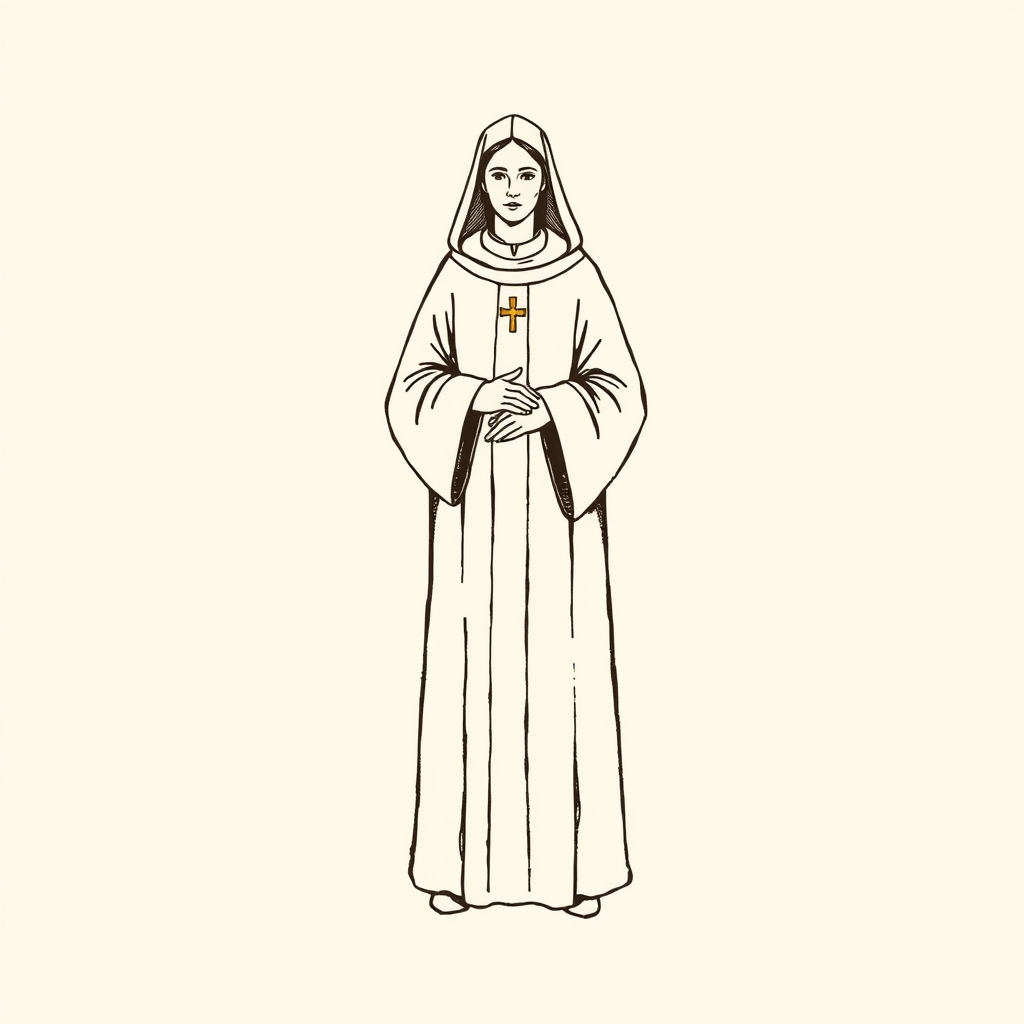
Around the noble and sweet figure of the Blessed, one sees the traditional halo; in her right hand she holds a double-branched cross, which is quite generally regarded as an allusion to Simon de Maillé, her grand-nephew, who died in 1597, Archbishop of Tours, in the odor of sanctity. Above the left hand, on the mantle of the Tertiary, they did not fail to show the patched piece, a distinctive sign of the Franciscan habit to recall that of the holy patriarch, the poor man of Assisi.
Some impressions of this true portrait of the Blessed were taken and it was photographed, but Mgr Guibert ordered a reproduction from M. Emile Lafon, history painter. This painting, intended to adorn the altar that will be erected, in honor of Marie de Maillé, in the future basilica of Saint-Martin, is very remarkable. The Blessed, dressed in the habit of the Tertiaries of Saint Francis, is represented in the attitude of prayer, at the foot of the crucifix; rays escape from Christ and come to illuminate her face with celestial light. Nothing seems as sweet to us as this figure on which are painted all the characters of goodness, asceticism, and ecstasy, which are like the main features, one could say the entire physiognomy of this admirable woman.
This figure, emaciated by fasts and vigils, aged by the years, is nevertheless full of freshness and youth; one sees in a way the beauty of her soul reflected there with incomparable brilliance. Her hands are crossed on her chest, her eyes fixed on Christ, and already she seems to taste the ineffable joys of the "beatific vision". It is a true figure of a Saint, and it seems to us that the artist has almost reached the ideal.
This beautiful painting is placed today in the temporary chapel of Saint-Martin.
The life of the Blessed Saint Maillé was written, as we have already said, by Father de Boisgautier, her confessor. Published in Latin, a translation into French appeared immediately. This short and substantial account is nevertheless of a simplicity, grace, and unction that delight and edify the reader. The Bollandists published it in full on March 29.
Father de Vermas, a penitent of the Third Order, published in 1667, a Life of our Blessed, under this title: *Life of the Blessed Jeanne-Marie de Maillé, recluse*. It is part of a work by the author entitled: *Collection of the Lives of illustrious persons who lived in the 15th, 16th, and 17th centuries*. This life is hardly more than an abridgment of the one published by Father de Boisgautier; written in good 18th-century French style, it is full of touching unction and naive grace.
Another abridgment of the Life of the Blessed, also full of charm, was published around the middle of the 18th century. It is part of a collection entitled: *Abridgment of the most illustrious Lives of the Saints of the Third Order of Saint Francis*, by a soldier, 1640.
But most of these biographies are hardly more than a reproduction of the work of Father de Boisgautier. There were, however, precious elements for hagiography in the Acts of the information process drawn up for the beatification of the Blessed, and until now no one had thought of putting them to use. Today we have nothing more to describe in this regard: M. l'Abbé Jauvier, canon of the metropolitan church, was tasked with completing this gap, and, on the occasion of the feast of Jeanne-Marie de Maillé, he published a very remarkable book. M. l'Abbé Bourassé had done a first work that illness prevented him from finishing. It was entrusted to M. Jauvier, and the work of the learned and venerable canons appeared in the last days of March 1872. This Life, "learned and piously written", testifies Mgr Pie, Bishop of Poitiers, was published by the Mame house, and in a few days the first edition was almost exhausted. The Archbishops of Tours and Paris addressed to the authors letters of approval which find their place at the head of this charming and pious work (*Life of the Blessed Jeanne-Marie de Maillé*, by M. E. Bourassé and Jauvier, canons of the metropolitan church of Tours, 1 vol. in-8°. Alfred Mame, Tours, 1872).
And now, in finishing this short notice, it only remains for us to turn our eyes toward our new protector and offer her our homage:
- Lord Jesus Christ, you who love humility and charity, and who, after having inflamed the Blessed Jeanne-Marie with the flames of your love, filled her with your graces and taught her to despise the prosperities of this world, grant us the grace to imitate the humility, charity, and contempt for the things of the earth of her whom we honor by a solemn feast; you who live and reign with God the Father, in the unity of the Holy Spirit for ever and ever. Amen.
This biography is from the pen of M. l'Abbé Belland, *honorary canon, chaplain of the Boarding School of the Brothers of the Christian Schools of Tours*.
Iconography
Signs and attributes

Entities
Narrative network
The names, places, and concepts most present in the entry, weighted by centrality in the text.
The supernatural in their life
The miracles of Blessed Jeanne-Marie de Maillé
Frequently asked questions about Blessed Jeanne-Marie de Maillé
Who was Blessed Jeanne-Marie de Maillé?
Born into the high nobility of Touraine, Jeanne-Marie de Maillé lived a virginal marriage with Robert de Sillé before dedicating herself entirely to the poor after her widowhood. A Franciscan tertiary and mystic, she ended her life in absolute poverty in Tours, after having been an advisor to kings and princes. Her cult, which has remained alive through the centuries, was officially recognized by Pius IX in 1871.
What is Blessed Jeanne-Marie de Maillé the patron saint of?
Patronage of Blessed Jeanne-Marie de Maillé: Tours, Ambillou and Cléré.
What is Blessed Jeanne-Marie de Maillé invoked for?
Blessed Jeanne-Marie de Maillé is invoked for: headaches, fevers, deliverance of prisoners and success of preachers.
How is Blessed Jeanne-Marie de Maillé depicted in Christian art?
In iconography, Blessed Jeanne-Marie de Maillé is recognizable by: Franciscan tertiary habit, double-barred cross, patched piece on the cloak and crucifix.
What miracles are attributed to Blessed Jeanne-Marie de Maillé?
5 miracles are attributed to this saint, notably: Multiplication / provision, Protection / deliverance, Resurrection and Healing.
Which saints were contemporaries of Blessed Jeanne-Marie de Maillé?
Contemporaries include: Saint Peregrinus of Auxerre, Saint Francis of Assisi (Confessor), Saint Colette (Nicole) and Saint Andrew Corsini.
When did Blessed Jeanne-Marie de Maillé die?
Blessed Jeanne-Marie de Maillé died around 1414.
What are the other names of Blessed Jeanne-Marie de Maillé?
Other forms of the name: Jeanne de Maillé, Marie de Maillé, Madame de Sillé and L'Ermite.
Who are the relatives of Blessed Jeanne-Marie de Maillé?
Relatives of Blessed Jeanne-Marie de Maillé: Hardouin VI de Maillé (father), Jeanne de Montbazon (mother), Barthélemy Savary (maternal grandfather), Robert de Sillé (spouse) and Simon de Maillé (great-nephew).
Annexes & related entities
Structured data for exploration: events, miracles, quotes, places, attributes, patronages, and important entities cited in the text.
Key Events
- Born at the Château des Roches in 1332
- Miraculous healing through the intercession of Saint James
- Virgin marriage to Robert de Sillé in 1347
- Captivity of her husband after the Battle of Poitiers (1356)
- Widowhood and dispossession by her in-laws in 1362
- Joined the Third Order of Saint Francis
- Hermit life at Planche-de-Vaux
- Meeting with King Charles VI in Paris
- Died in Tours at the age of 82
Quotes
-
Strive to edify the public with solid and moral truths, without seeking the grace of discourse or vain science.
Advice to preachers -
God, who gave me the grace to leave the goods I possessed, will surely give me the grace to live without desire or attachment to future riches.
Response to her family