
Saint Zachary, Pope
A pope of Syrian origin in the 8th century, Zachary was a great peacemaker who saved Rome from Lombard invasions through his diplomacy. He actively supported Saint Boniface in the evangelization of Germany and played a decisive role in the rise of the Carolingian dynasty in France. Known for his gentleness and charity, he redeemed slaves and converted several sovereigns to monastic life.
Contemporaries

Figures and markers around the normalized period for this entry.
Guided reading
8 reading sections
SAINT ZACHARY, POPE
Origins and character
Zachary, a native of Syria and a Benedictine monk, ascended to the papacy in a context of tensions with the Lombards, distinguishing himself by his gentleness and charity.
"Blessed are the peacemakers, for they shall be called the children of God!" Following the example of Saint Zachary, we must fulfill the office of peacemakers whenever the opportunity arises, even if only between two people.
Zachar y, a nat ive of Syria, a canon regular, then a Benedictine monk, created cardinal-priest by Gregory II, was the son of Polychronius. Gifted with the rarest qualities of mind and heart, raised with great care in piety and the sciences, he moved to Italy in the 8th century and was admitted into the Roman clergy at a time when the city of Rome was very subject to the alarms of the Lombards . Liutpra nd, who had long reigned over these barbarians in Italy, having already advanced once with his army to besiege Rome, had been turned away by Pope Gregory II; he had even reconciled so well that, as a pledge of his good understanding, he had offered a silver cross and a gold crown to the tomb of Saint Peter. But, ten years later, this prince, dissatisfied with the protection that Pope Gregory III gave to Thrasimund, Duke of Spoleto, came to lay siege to Rome, and only withdrew after his troops had pillaged the church of Saint Peter, which the Goths had once respected. Things were in this state when Gregory, after having asked for help from Charles Martel, in France, against Liutprand, who had since ravaged the lands of the Church again, left the See vacant upon his death. There was not much to deliberate on the choice of the successor to be given to him. A man was needed who had the prudence and moderation necessary to restore the affairs of the Church and State in Italy. This was found in the priest Zachary, whose virtue and capacity were known. The innocence of his life and the integrity of his morals were accompanied by a natural kindness and a gentleness that charmed everyone. He was never caught in the slightest outburst: always full of charity for everyone, he was seen disposed to return good for evil at every encounter, and, when he became pope, far from taking revenge on those who had persecuted him, he wished to overcome them only by benefits.
Diplomacy with Liutprand
Upon his election in 741, Zachary negotiated with King Liutprand at Terni, obtaining the restitution of cities and the release of prisoners through the sheer force of his persuasion.
He was consecrated on November 19, in the year 741, nine days after the death of his predecessor and nine days before his burial. The disorder in which he found public affairs upon his accession led him to judge that he must begin by remedying them, in order to then be able to settle those of the Church with greater ease. Resolved to expose himself to anything for the salvation of his people, he first sent a nuncio with letters full of civility to King Liutprand, who was so touched by them that, having conceived much esteem and respect for this new Pontiff, he appeared softened and entirely inclined to acquiesce to everything that would be proposed on his part. Zachary knew how to take advantage of these happy dispositions. He went himself, accompanied b y the principals of his clergy, to meet the king at Terni, in Umbria. This prince, having been notified, sent the leading lords and officers of his court to meet him, and received him with all imaginable honors. He made with him a peace treaty as advantageous as one could wish: he released all his prisoners and returned to the Holy See the cities he had taken in the Duchy of Rome and on the lands of the Church. The next day, which was a Sunday, the king wished to attend, with his court and his officers, the consecration of a bishop that the Pope was to perform in the church of Saint Valentine of Terni. The holiness of the ceremony, and much more so that of the prayers he offered there, touched the Lombards so deeply that most could not hear them without shedding tears; and the piety he displayed throughout this action excited in the hearts of many sentiments of devotion to God and respect for the Church. The Pope, upon leaving this ceremony, invited the king to dinner, where he received his blessing, and who testified that he had never found himself at a better meal. He then had him honorably escorted by the Duke of Chiusi, his nephew, and other notable lords: the treaty having then been faithfully executed, Zachary ordered public prayers in Rome to give thanks to God for the success of this whole affair.
Intervention for Ravenna
The Pope travels to Pavia to protect Ravenna from Lombard oppression, a journey marked by miraculous signs and a major diplomatic success.
The peoples of Italy, seeing the great credit he had acquired over the mind of Liutprand, eagerly sought his mediation and favor with that prince. Zachary always endeavored to employ it in a manner that could turn the success to the glory of God and the advantage of the Church. With this view, he undertook to extinguish the war that had ignited between the inhabitants of Ravenna and this king, and to reconci le them with him. Seeing the violent oppression in which Liutprand held them, he did not fear to expose himself to the fatigues of a long journey and to go find him at Pavia, to obtain by his presence what he had not been able to obtain from him by his nuncio and his letters.
Having therefore left the government of Rome to the patrician Stephen, he ran, like the good shepherd, to redeem those of his sheep who were about to perish. It was at the height of summer. It was observed that from Rome to Ravenna a cloud shielded him from the heat of the sun during the day, and that from Ravenna to Pavia, this cloud appeared preceded by armed battalions. The Exarch (this was the name given to the prefect who governed Ravenna in the name of the Emperor of Constantinople) came to meet the holy Pontiff up to seventeen leagues from the city, where he escorted him. All the people of Ravenna, men, women, children, went to meet him and received him amidst tears and thanksgivings, crying: "Blessed be our shepherd who has left his flock and has come to deliver us, we who were about to perish!"
From Ravenna, the Pope sent two deputies to Liutprand to announce his imminent arrival. But the king, determined to grant nothing, even refused to give them an audience. "Must it be," cried the Lombard, "that the importunities of a priest, of an old man, always come to disturb my triumphs?" This obstinacy, of which he was informed at night, did not discourage the holy Pontiff; despising the peril and trusting in Christ, he boldly left Ravenna, entered the lands of the Lombards, and arrived on the banks of the Po on June 28. The king sent his nobles to receive him and bring him to Pavia. But as it was the eve of Saint Peter, the Pope went to the church of this Saint, which was outside the city, and celebrated the prayer of None there, with the Holy Mass. The next day, the very day of the feast, he celebrated solemn Mass there at the king's request. There, having greeted one another, they ate together and returned to the city. The day after the feast, invited by the king to come to the palace, where he was received with the greatest honors, the holy man begged him no longer to send his troops into the province of Ravenna, but on the contrary, to return to him the cities he had taken, particularly Cesena. The king resisted for a long time; but finally, he agreed to return to Ravenna all the territory it had previously held, and two-thirds of the territory of Cesena, keeping, for his security, the other third and the city until July 1 of the following year, so that his ambassadors would have time to return from Constantinople. Upon the Pope's departure, the king accompanied him to the Po and left several lords with him, with orders to follow him to Ravenna and to have the Lombard garrisons leave the places he was restoring.
In all these circumstances, we see the peoples of Italy, with their magistrates, whether imperial or otherwise, resorting to the Roman Pontiff as their sole salvation, and this Pontiff not failing their trust. Alone and unarmed, he disarms princes and kings by word and persuasion. Certainly, if there is a way to become the legitimate sovereign of a country, it is this way. At the very least, this is how common sense and the gratitude of the saved peoples judge it.
Reform and mission in Germany
Zachary actively supported Saint Boniface in the organization of the Church in Germany, resolving theological questions regarding baptism and doctrinal errors.
Having returned to Rome in the month of July, he celebrated there once again the great feast of Saint Peter and Saint Paul, although he had already solemnized it on June 28 and 29 in Pavia, in the presence of the king and his court. He mingled with it public prayers for the deliverance of the people of Ravenna, upon the news he received of the infidelity with which Liutprand seemed to be breaking his word. A few days later, the death of this prince was learned, whose successor Hildebrand, who was his nephew, was driven out seven months later by the Lombards themselves, because he was as ill-intentioned as his uncle toward the peace of Italy. They raised to the throne in his place Ratchis, Duke of Friuli, to whom Zachary immediately sent a nuncio to congratulate him and to try to lead him into paths of pacification. The new king deferred entirely to these remonstrances, and made a twenty-year peace with all of Italy.
It served the holy Pope to restore the ancient face of the Church, to remedy the disorders that had crept in with the war and public calamities, to reform the morals of the clergy and the people, and to make discipline flourish again. He rebuilt or adorned various churches and other pious edifices in Rome, and he made other establishments useful to religion, which were fruits of the peace he had procured for the people. His solicitude and care extended at the same time into the most distant provinces of Christendom. In the West, he powerfully seconded the zeal of Saint Boniface , the apostle of Germany, and sent him the decision on several points upon which he had consulted him, with various regulations on the conduct he should maintain in his apostolate.
Among other things, he confirmed the erection of three bishoprics established by Saint Boniface; he then confirmed the erection of the archbishopric of Mainz, to which the same Saint Boniface gave as suffragans the bishops of Tongeren, Cologne, Worms, Speyer, and Strasbourg. Boniface consulted Zachary with the most complete submission; sometimes, in Germany, poorly instructed priests administered baptism in incorrect terms, and he cited examples of it. Zachary replied that one must regard as valid a baptism in which the priest might even have pronounced words devoid of meaning and clarity: the intention to do what the Church does is sufficient.
Saint Boniface, in his intimate correspondence with the Pope, complained that a priest named Virgil was working to sow division between him and Odilo, Duke of Bavaria, and that, besides this, he was teaching several errors, the principal ones being that there was another world, other men under the earth; another sun, another moon. Zachary replied that he must be deposed if he persisted in teaching such errors. But one would be wrong to conclude from this response, as some modern writers have done, that the holy Pontiff condemned the sentiment of those who admitted the existence of antipodes; he had in view certain heretics who maintained the existence of a race of men who did not descend from Adam, and who had not been redeemed by Jesus Christ. Moreover, he did not pronounce judgment on this occasion, since he ordered Virgil to come to Rome, so that his doctrine could be examined. There is every appearance that Virgil justified himself, since he was elected shortly after as Bishop of Salzburg.
Charity and Eastern Relations
The Pope distinguished himself by redeeming slaves in Venice and maintained diplomatic relations with the iconoclast emperor Constantine Copronymus.
The holy Pope had a tender charity for the unfortunate. Having learned that Venetian merchants had bought slaves in Rome to resell them to the Moors of Africa, he first reproached them for a traffic so injurious to humanity and religion, and then paid the sum demanded of him to restore freedom to all these slaves. He adorned the city of Rome with several magnificent churches, made a great number of foundations for the benefit of the poor and pilgrims, and assigned a very considerable annual income for the maintenance of the lamps of St. Peter's Church.
In the East, he worked, through his gentleness, to manage, in favor of the Church, the difficult spirit of the Emperor Constantine Copronymus, who had made himself an enemy of the holy images. This prince, although obstinate in his impiety, showed much consideration for Zachary, and willingly granted him what he had requested in particular for the Roman Church. The Pope held various synods in Rome from the beginning of his pontificate: working ceaselessly on the affairs of the Church with tireless application, sometimes with his neighboring bishops, sometimes with the clergy of Rome, so as to do nothing without full knowledge and much maturity. In the one he assembled of several bishops in the year 745, he cut off from the body of the Church two inventors of new heresies, named Adalbert and Clement, whom Saint Boniface had already condemned; and in the year 748, he did the same with regard to a third, called Samson, from Ireland. Although he watched equally over all the churches of the earth, he seemed to do so even more particularly over those that Saint Boniface and other evangelical workers had newly founded in Germany: and one sees that there are no affairs more spoken of in most of the letters of his that have remained to us. Among so many occupations, he still found the leisure to translate into Greek the Dialogues of Saint Gregory the Great.
Conversions of princes
Zachary receives the renunciation of the world from Carloman of Austrasia and the Lombard king Ratchis, both of whom embrace the monastic life at Monte Cassino.
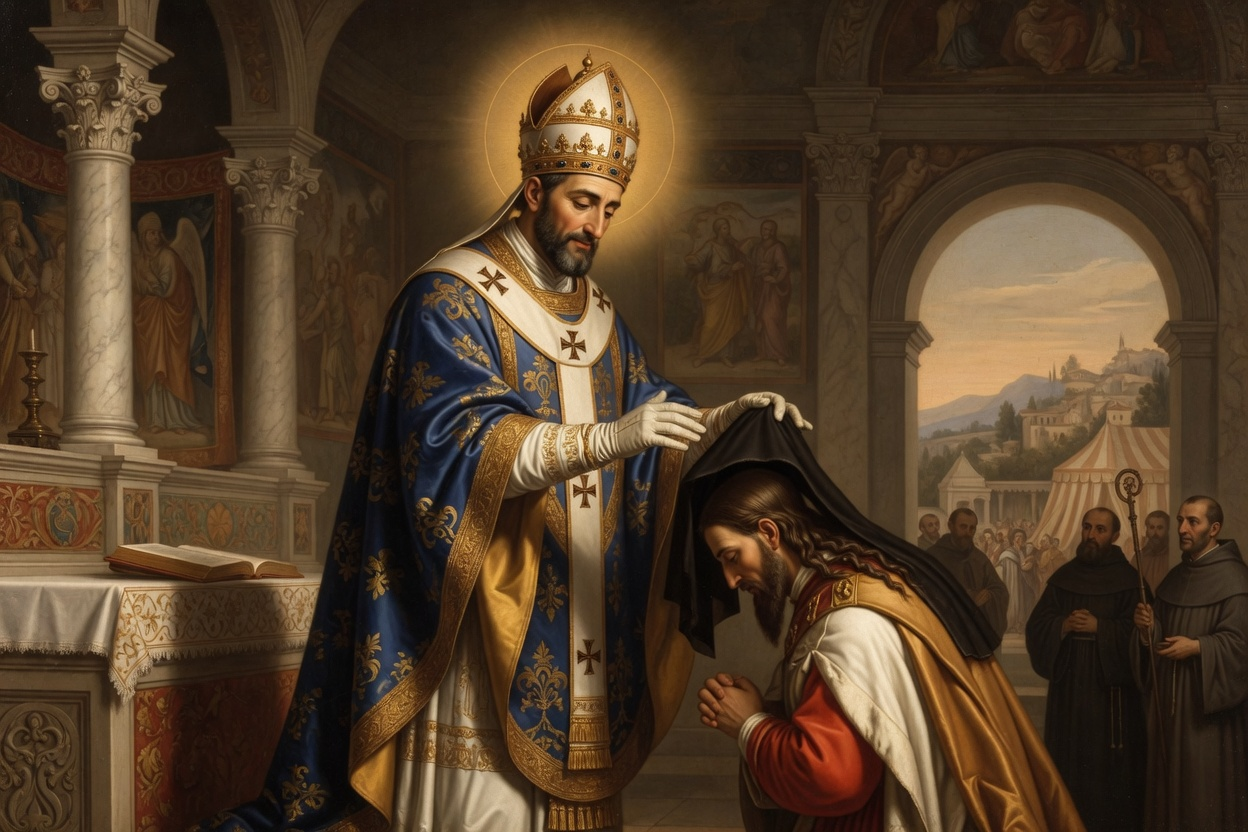
It is customary to count, among the most glorious circumstances of the pontificate of Saint Zachary, the striking conversion of two princes, a conversion of which he was the instrument and the minister. The first was Carloman, Mayor of the Palace of Austrasia, son of Charles Martel and elder brother of Pepin, who was, shortly thereafter, elected King of France. This prince, who bore the title of Duke of the Franks and who shared with his brother all the royal power, after having maintained the State by his valor, and the discipline of the Church by his zeal, renounced the world all at once, came to Rome to receive the tonsure from the hands of the holy Pope, then retired to Mount Soracte, where he built a monastery in honor of Saint Sylvester, a nd passed f rom there to Monte Cassino, where he embraced the institute and the rule of Saint Benedict. The other prince was Ratchis, King of the Lombards, who, after having broken the peace and laid siege to Perugia, was not only turned from his design by Pope Zachary, but also so sincerely converted to God that, upon his advice, he descended from the throne and voluntarily reduced himself to the state of a private life to serve God. The impression that the remonstrances of the Saint made upon his mind then completed the work of a conversion so rare and of such great example. Ratchis wished to leave everything to follow Jesus Christ; but his wife, Tasia, and his daughter, Ratrude, touched like him by the contempt of the world, could not leave him. They therefore came together to Rome, where Zachary gave the tonsure to Ratchis with the monastic habit, which his wife and daughter also took from his hand, and he sent them all three to the monastery of Monte Cassino.
The Frankish Succession
Consulted by Pepin the Short, Zachary legitimized the change of dynasty among the Franks, favoring the one who held effective power over the nominal title.
It was at this same time tha t Pep in, Mayor of the Palace, who was the master of France under the shadow and name of Childeric III, sent to Rome Burchard, Bishop of Würzburg in Franconia, and his chaplain Fulrad, Abbot of Saint-Denis, to consult the holy Pope on the design the Franks had to place the crown upon his head. Zachary, thinking of procuring a powerful protection for the Holy See against the Lombards, with whom the Romans could not be safe, was not content merely to approve the choice of the Franks; but he also secretly exhorted Pepin not to refuse a crown that Providence so visibly destined for him. The response he gave to the consultation of the Frankish lords on this subject, although in general terms, served much to determine them. For, without speaking of deposing Childeric or electing Pepin, he sent word to them that "it was better that he who held all the power should be king." It took no more than this for Pepin, who knew well how to make use of this response from the holy Pope. Everyone took it for an approval, or at least for a consent; the election of Pepin was viewed as the work of heaven; he had himself crowned the following year at Soissons by Saint Boniface, Archbishop of Mainz. This royal anointing did not take place until the first day of May; and our holy Pope had already died on the 3rd of March preceding, after ten years, three months, and fourteen days of pontificate. The day of his burial, which took place on March 15th in the church of Saint Peter, is the day on which the Church honors his memory.
He is represented clothing Rachis, King of the Lombards, in the religious habit. The Bollandists have provided his portrait in their supplementary volume, named "Him, who is a priest of my clergy. He has secret matters to communicate on my behalf to Your Piety alone, both by word of mouth and in writing."
Among these secret things on which Saint "Him" was charged by Saint Boniface to consult Pope Zachary by word of mouth, and on which the Pope gave his response also by word of mouth, one conjectures with sufficient foundation that it was a question of validating and concluding a political revolution that had been preparing for many years among the Franks, namely: a change of dynasty. In the beginning, the crown of the Franks was elective rather than hereditary. Childeric, father of Clovis, having made himself odious by his debaucheries, the Franks drove him from the throne and the kingdom, and unanimously chose as king the Roman Egidius, who reigned alone for eight years. Then, having learned that Childeric had become wiser, they begged him to return from Thuringia, where he had fled, and restored him to royalty; so that he and Egidius reigned together (Greg. Tur., l. II, c. 12). This fact, attested by Saint Gregory of Tours, shows us that, in the beginning, the Franks could choose for themselves kings not only from another family, but even from another nation. Since Clovis, who had taken the precaution of having all his other relatives put to death, they were chosen from among his descendants. These having quickly degenerated and become entirely null, could the Franks not do a second time what they had done a first, give themselves a king from another family, or even another nation? Bring forth a king who was already one in fact, and to whom only the name was lacking? It is to be believed that Saint Boniface consulted Pope Saint Zachary confidentially on this important question before it was proposed to him officially.
"In the year 751, Burchard, Bishop of Würzburg, and the priest Feitret, chaplain, were sent to Rome to Pope Zachary, to consult the Pontiff on the kings who existed then in France, and who had only the name of kings, without any royal power. Through them, the Pontiff sent word that it was better that he be king who had the sovereign power; and having given his authorization, he ordered that Pepin be established as king. The year after, following the sanction of the Roman Pontiff, Pepin was called King of the Franks, crowned for this purpose by the hand of the holy Martyr, Archbishop Boniface, and, according to the custom of the Franks, raised upon the throne in the city of Soissons. As for Childeric, who bore the vain title of king, he had his hair cut and was relegated to a monastery." This is what Eginhard, fellow student and then secretary to Pepin's son, Charlemagne, recounts of the matter in his Annals of the Franks (Eginh., Annal. ad an. 749 and 750). A contemporary author, the continuator of Fredegar, reports it in these terms: "Then, by the counsel and with the consent of all the Franks, and with the authorization of the Apostolic See, the illustrious Pepin, by the election of all France, the consecration of the bishops, and the submission of the princes, was raised to royalty, with Queen Bertrada, according to ancient customs (Fredeq., Contis. anex 132)." The other annals and chronicles report the same thing as these two writers, and often in the same terms. The annals of Xanten, a city on the Rhine below Cologne, say more briefly: "Pepin, elected king according to the custom of the Franks, is crowned by Saint Boniface, Bishop of Mainz (Pertz., Monumenta Germania, t. II, p. 221)."
Now, what to think of the conduct of the Franks and the decision of Pope Zachary? We shall cite the opinion of three competent men. Here is how Bossuet summarizes this fact: "In a word, the Pontiff is consulted, as in an important and doubtful question, whether it is permitted to give the title of king to one who already has the royal power. He answers that it is permitted. This response, coming from the greatest authority that exists in the world, is regarded as a just and legitimate decision. By virtue of this authority, the nation itself takes the kingdom from Childeric and transfers it to Pepin. For one did not address the Pontiff so that he might take away or give the kingdom, but that he might declare that the kingdom should be taken away or given by those whom he judged to have the right (Defensio, t. II, c. 34)."
Fénelon applies himself in the same sense. He formally recognizes that temporal power comes from the nation; he supposes that the nation has the right to elect and depose its kings; for he observes that, in the Middle Ages, the bishops had become the first lords, the heads of the body of each nation to elect and depose sovereigns (Oeuvr. comp. de Fénelon. Versailles, t. XIII, p. 384). He recognizes that, to act with a safe conscience, Christian nations consulted in this case the head of the Church, and that the Pope was bound to resolve these cases of conscience, for the reason that he is the supreme doctor and pastor. "Pope Zachary," he says, "answered only to the consultation of the Franks, as the principal doctor and pastor, who is bound to resolve particular cases of conscience, to put souls in safety (Ibid., t. II, p. 382)." — "Thus the Church neither destined nor instituted legitimate princes; it answered only to the nations that consulted it on what touches the conscience, regarding the contract and the oath. This is not a juridical and civil power; but only directive and ordinative, such as Gerson approves (Ibid., t. II, p. 384)."
This is what Chateaubriand says, following Bossuet and Fénelon: "To treat the advancement of Pepin to the crown as an usurpation is one of those old historical lies that become truths by dint of being repeated. There is no usurpation where the monarchy is elective, as has already been remarked; it is heredity which, in this case, is an usurpation. Pepin was elected by the advice and consent of all the Franks: these are the words of the first continuator of Fredegar. Pope Zachary, consulted by Pepin, was right to answer: It seems to me good and useful that he who is king without having the name, or who has the power, be preferred to him who, bearing the name of king, does not keep the authority." (Etudes histor., t. III, p. 213).
Death and Cult
Zachary died in March 752 after a ten-year pontificate and was buried in Saint Peter's; he is traditionally depicted with King Ratchis.
May's secretary, and Ciaconius in his *Life of the Roman Pontiffs*. The engraving adopted by the former is preferred to that given by the latter. See the letters of Saint Zachary, vol. VI, *Conc.* and the Pontificals. See also Fleury, vol. IX, bk. XIII, p. 349.
Iconography
Signs and attributes
Entities
Narrative network
The names, places, and concepts most present in the entry, weighted by centrality in the text.
The supernatural in their life
The miracles of Saint Zachary, Pope
Frequently asked questions about Saint Zachary, Pope
Who was Saint Zachary, Pope?
A pope of Syrian origin in the 8th century, Zachary was a great peacemaker who saved Rome from Lombard invasions through his diplomacy. He actively supported Saint Boniface in the evangelization of Germany and played a decisive role in the rise of the Carolingian dynasty in France. Known for his gentleness and charity, he redeemed slaves and converted several sovereigns to monastic life.
What is Saint Zachary, Pope invoked for?
Saint Zachary, Pope is invoked for: pacification and restoration of ecclesiastical discipline.
How is Saint Zachary, Pope depicted in Christian art?
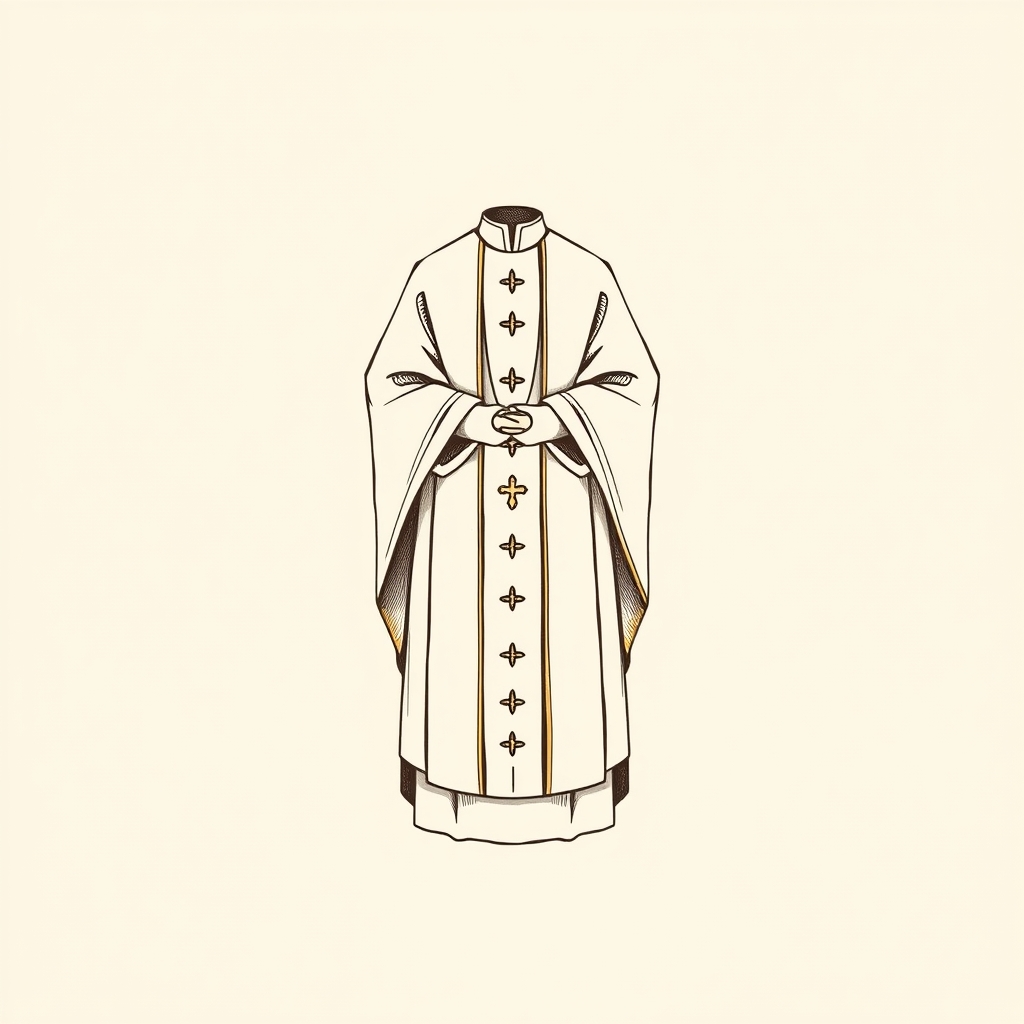
In iconography, Saint Zachary, Pope is recognizable by: Pontifical vestments and Depicted giving the religious habit to King Ratchis.
What miracles are attributed to Saint Zachary, Pope?
2 miracles are attributed to this saint, notably: Sign / wonder and Vision / apparition.
Which saints were contemporaries of Saint Zachary, Pope?
Contemporaries include: Saint Hidulph of Trier, Saint Ghislain (Guillain), Saint Lambert (Landebert) and Saint Amand of Maastricht.
When did Saint Zachary, Pope die?
Saint Zachary, Pope died around 800.
Who are the relatives of Saint Zachary, Pope?
Relatives of Saint Zachary, Pope: Polychronius (father).
Annexes & related entities
Structured data for exploration: events, miracles, quotes, places, attributes, patronages, and important entities cited in the text.
Key Events
- Election to the pontificate on November 19, 741
- Peace negotiation with the Lombard King Liutprand in Terni
- Diplomatic intervention in Ravenna and Pavia
- Support for the apostolate of Saint Boniface in Germany
- Redemption of Christian slaves sold to the Moors
- Authorization of the change of dynasty in France in favor of Pepin the Short
- Conversion of princes Carloman and Ratchis to monastic life
Quotes
-
Blessed are the peacemakers, for they shall be called children of God!
Gospel (cited in introduction) -
It was better that he who held all the power should be king.
Response to the Frankish lords