
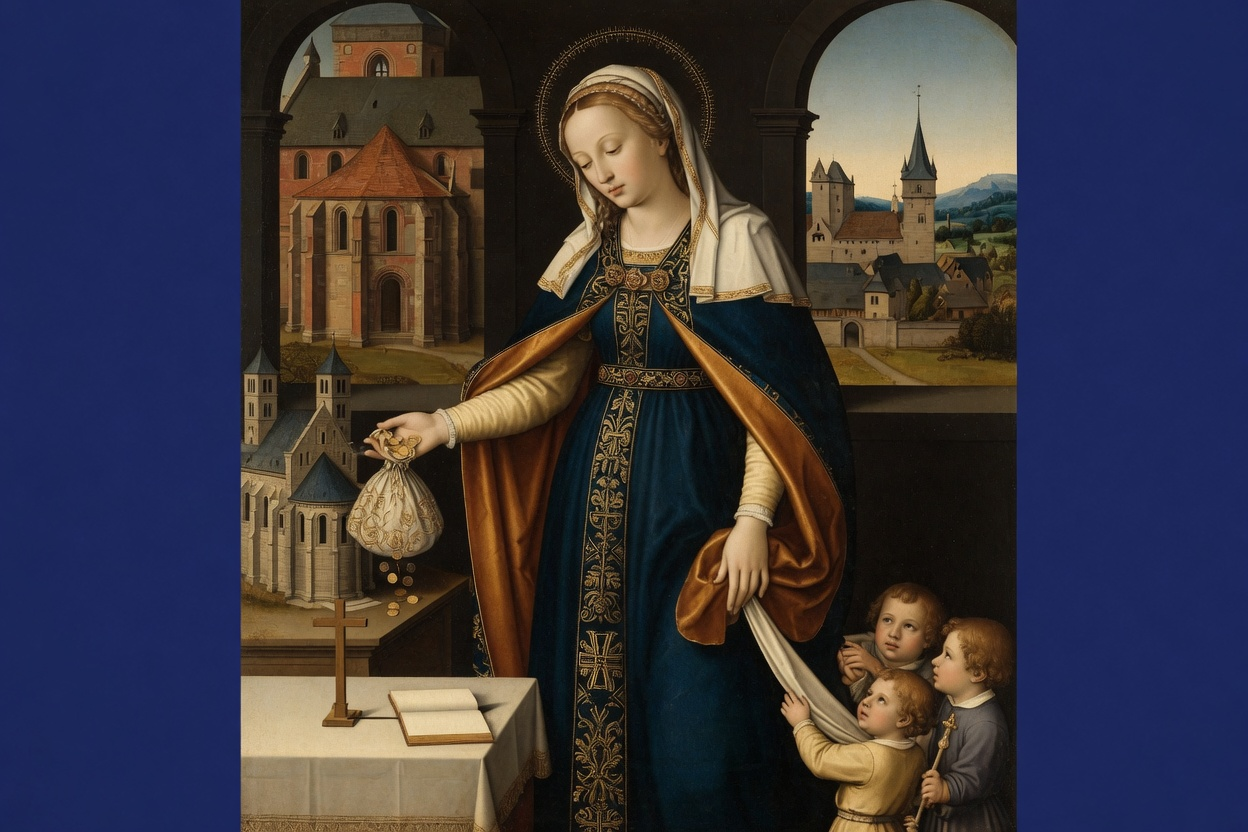
Wife of Henry I and mother of Otto the Great, Saint Matilda was an Empress of Germany exemplary for her humility and charity towards the poor. After enduring the ingratitude of her sons, she dedicated herself to the founding of monasteries and to prayer. She died in 968 in Quedlinburg, after a life of penance and devotion to the needy.
Contemporaries

Figures and markers around the normalized period for this entry.
Guided reading
7 reading sections
SAINT MATILDA, EMPRESS
Origins and education
Coming from the high Saxon nobility, Matilda was raised in piety at the monastery of Erfurt under the guidance of her grandmother, the abbess.
Love is stronger than death, says the Holy Scripture. Indeed, death cannot dissolve the bonds that unite men together in a Christian manner, nor exempt us from doing good through prayer, almsgiving, and attendance at the holy sacrifice, for those who were our father, our mother, our brothers, or our children.
Although the most pious and most illustrious Princess whose merit we are about to discover recognizes many famous heroes and many great saints as ancestors and descendants, as can be seen in history and in the chronological tables drawn up for the glory of her family, we shall nevertheless content ourselves with saying here, in a few words, that she draws her origin from one of the noblest races of Germany; that she was the wife of a great king, Henry I, mother of Otto I , called the Great, Emperor of t he West, and the noble stem of several other great monarchs who governed their states with much glory and success.
The father of this blessed Princess was Count Thierry, or Dietrich of Saxony , a descendant of the famous Widuk ind, leader of the Saxons, who waged war against Charlemagne for a long time; her mother was Countess Reinhilde, of the blood of the princes of Denmark and Frisia. Thierry had no less regard for her rare virtues than for her illustrious birth when he chose her as his wife. From such a beautiful alliance was born a fruit that appeared very pleasing to everyone: I mean the little Matilda or Mahault, who was the greatest glory of her family.
She was still a child when the mother of Count Thierry, who was a widow, and who, after having left the world, had become abbess of the famous monastery of Erfurt, asked for her to raise her in pi ety and have her learn what children of her birth should ordinarily know. She profited in every way under the guidance of such a wise mistress: she appeared to have happy inclinations for virtue from her tenderest youth, and much capacity was even noted for the sciences and for all kinds of work suitable for persons of her sex.
Marriage to Henry the Fowler
She marries Henry, son of the Duke of Saxony, and becomes Queen and then Empress of Germany, combining royal dignity with profound humility.
Otto, Duke of Saxony, who was a lord highly commendable for his birth and his positions in the armies of Conrad, had a son, among several others, named Henry, for whom he sought a wife worthy of his merit: he was a young prince endowed with great perfections of body and mind. Divine Providence, which guides all things with wisdom, made known to Otto the match that was most suitable for his son. In effect, the reputation of young Matilda, who had reached marriageable age and possessed very rare qualities, flew so high everywhere that Duke Otto resolved to give her as a wife to his son Henry, and sent him to recognize for himself the one he destined for him. When he had arrived at the monastery of Erfurt, the abbess of the monastery, having regard for the birth and other qualities of the young lord who came to make the request for Matilda, did not refuse to listen to his proposals; the families agreed and the marriage was concluded. Henry, at the head of the troops he then commanded, led his wife to Saxony, and the wedding was celebrated in the city of Wallhausen, with all the pomp one could wish for and the applause of the people, who conceived a particular joy to see such a beautiful alliance. Otto looked upon Matilda as his own daughter; he favored her as much as he could, admiring the great virtues that shone in her person; but finally, God, who counts and ends our days when it pleases Him, withdrew this wise father from this world, and Henry, his son, became the sole master of the duchy. This new dignity, which was then very considerable, did not swell Henry's heart; he acted with such humanity toward his subjects that everyone, recognizing moreover in his person entirely royal qualities, wished him nothing less than the crown of the empire. Heaven seemed to want to answer the desires of the people: Conrad, Emperor of Germany, came to die, and Henry was carried to the throne which he occupied very worthily (919). Matilda, his wife, although raised to the imperial dignity, did not diminish anything of that profound humility she had acquired beforehand, and she made herself more illustrious by the brilliance of the Christian virtues she practiced than by the royal pomp she was obliged to maintain in the state in which she found herself; she knew how to despise glory in the most honorable condition to which a person of her sex could be raised. She showed such kindness to her subjects, without diminishing anything of the brilliance of her majesty, that she became equally the object of both the love and the respect of all her people.
Devotion and works of mercy
Despite her rank, she dedicated herself to nocturnal prayer, systematic almsgiving, and the liberation of prisoners.
Her most ordinary exercise was prayer. Not content with spending several hours at it during the day, she practiced it for a good part of the night as well. She found ways to skillfully withdraw from the nuptial bed of the King, her husband, to go and enjoy the sweet embraces of the heavenly Spouse in the sweetness of contemplation; she gave alms to the poor every day, and no afflicted person ever appeared before her without receiving some remedy for their pain; she obtained the release of prisoners, either by satisfying their debts or by soliciting their pardon from the King, her husband, if it concerned criminal matters. The excellent virtues of this illustrious Princess drew great blessings upon the royal family; God did not wish to deprive such a beautiful union of the consolation of having children who could become the heirs and successors of the kingdom. Five are usually named: Otto the Great, who was Emperor of Germany; Henry, who was Duke of Bavaria; Saint Bruno, Archbishop of Cologne; and two daughters, one of whom married Louis d'Out remer, King of France, and the othe r Hugh Capet, head of the third race of our kings. Never was a marriage seen more accomplished than that which was contracted by these two illustrious persons; they had but one will, and all the desires of one were the desires of the other. Sacred love was the principal bond that united them; they were animated by the same spirit, which was that of God; they tended toward the same end, which was to conquer heaven and overcome their passions, rather than to subdue cities and provinces. God, nevertheless, caused them to subjugate an infinity of different nations, to give them the opportunity to make the Gospel reign there. They concerted together laws full of justice to establish in their States; they confirmed and caused to be observed inviolably the ancient ones that seemed good to them, and universally supported all those that tended to the good and happiness of their peoples.
Widowhood and the trial of her sons
After the death of Henry I, she suffered persecution from her sons Otto and Henry, who accused her of squandering the royal treasury on alms.
They gave great proofs of their piety and liberality by building many hospitals and monasteries, which could be occupied by religious who would praise God in perpetuity, and who would continually offer vows to heaven for their royal persons; but when King Henry was thus occupied with his holy spouse in ex tending t he reign of God on earth, it pleased the divine Goodness to call him to another kingdom, which was that of heaven. Being on his deathbed, he had several holy conferences with his spouse regarding this great passage; he thanked the Princess for all the good advice she had given him, and for having so often moderated his great zeal in the judgments he planned to render against rebels and the impious; he praised this august Queen before the whole court, and gave great testimony of the esteem he held for her person and her virtue, inasmuch as he knew that he alone truly understood all her merit. Finally, as the illness increased, the holy Princess learned, at the feet of the expiring Jesus Christ, the sad news of the king's death: she immediately prostrated herself on the ground, and annihilating herself thus before God, she adored the decrees of His Providence and gave testimony of her perfect conformity to all the orders of heaven.
After having granted to the just sentiments of nature what grace does not forbid on such occasions, she rose from the humbled posture in which she had placed herself, and went, with her three children, to throw herself at the feet of the deceased king; she addressed a very edifying exhortation to them, reflecting on the vanity of earthly grandeur, and representing to them that, if they had some right to ascend their father's throne, they must also remember that they would one day descend into his tomb. Then, forgetting her own pain to think only of the spiritual interests of the dear departed, she began to pray again to recommend her husband's soul to God. She asked if there was still a priest who was fasting, in order to say the holy mass. An ecclesiastic named Adelzac having presented himself, she experienced such consolation that she took off her gold bracelets and gave them to him, saying: "Take this and say a mass for the repose of the emperor's soul." As long as she lived, she had numerous commemorative masses celebrated each year for the same intention.
She knew how to take advantage of the perfect freedom in which she found herself; she devoted herself to all the exercises of piety that Saint Paul requires of a true widow: prayer, fasting, almsgiving, mortification of the senses, retreat, and the reading of holy books were the ordinary practices to which she occupied herself tirelessly; the day not seeming long enough to satisfy her piety, she would rise in the middle of the night to attend to prayer and exercise herself with more freedom in acts of penance; she never went to church without bringing gifts, obeying in this the letter of the Holy Spirit, who says that one should never appear empty-handed before God.
It was her custom to recite the entire psalter before the first cockcrow. She was so attentive to the needs of the poor that as soon as she heard their voice, she presented herself to answer them: she herself distributed to them sometimes money, sometimes clothing; to some, enough to pay their debts, to others, food to feed their families, and to all, enough to provide for their needs. She was very sober in her meals, peaceful and quiet in conversation, prompt only to do good to everyone and to fulfill all that was her duty; she undertook nothing without counsel and after having consulted God Himself in prayer. But, although she was irreproachable in her conduct, she did not fail to have enemies who gave rise to occasions for great patience, and God permitted that it be suggested to King Otto, her son, that she was hiding great treasures and that she was making herself mistress of the crown's revenues. This was enough to lead this monarch to make the queen his mother account for the royal funds she had handled; he even deprived her of her own revenues. He inquired about the gi fts she h ad made; he sent spies everywhere to recognize the conduct she was keeping; he posted guards in the places where she had her alms carried in secret; but what seemed most sensitive to her was to see that her son Henry, Duke of Bavaria, whom she had always loved preferably to the others, joined in this encounter with his brother to persecute her and force her to leave the court.
It was in this harsh persecution that God wished to make the virtue of this incomparable Princess shine more highly. Indeed, she bore the injustice of her childr en with invincible pa tience. She could not suffer that one spoke ill of their conduct; she published that she deserved it for several faults she had committed: "Is it not, moreover, a subject of great consolation for me," said this Princess, "to see that my children, who were in disunion, are now united on the subject of the persecution they are inflicting upon me? Would to God," she continued, "that they could, without sinning, not cease to persecute me, provided that they always preserved the peace that is now between them." And she did not fail, nevertheless, to profit very advantageously for herself from the persecution that her children inflicted upon her; she withdrew very willingly from the court, she even abandoned to them the goods that the late king, her husband, had left her, and took refuge in the town of Engern , in the county of Ravensberg, in Westphalia. The more she saw herself deprived of the favor of men, the more she received help and blessings from heaven.
Reconciliation and Great Foundations
Recalled to court after political troubles, she reconciled with her sons and founded important monasteries, notably at Nordhausen.
This illustrious Princess was enjoying a very profound peace in her retreat, when God, to avenge the cause of her innocence, and in punishment for the injustice and ingratitude of her own children, permitted troubles and wars to arise which brought a thousand misfortunes upon their States. Henry was also struck by a very dangerous illness, and everyone easily understood that the absence of the pious Princess was drawing the wrath of God upon the kingdom, and that by losing her, the State would be deprived of an inestimable blessing. Indeed, the evils increased to such a point that the great men and ministers of the State felt compelled to solicit Queen Edith, wife of Otto, to ask for the return of the queen mother. Indeed, Edith represented to Otto the fault he had committed in sending away the queen, his mother; this prince opened his eyes, recognized his wrongs, and, on the spot, he appointed lords of the highest rank to go and express to this illustrious Princess the sorrow in which he was plunged for the conduct he had held toward her, and the ardent desire he had to see her again at court. He even wrote her a letter full of submission and respect, in which he humbly asked her pardon for his fault. The Princess, who was incapable of resentment, and who was not unaware of the usefulness of her return to her children, was willing to leave the sweetness of her retreat and the delights of contemplation, with which God favored her in solitude, to respond to the eager designs of the king, her son; as soon as she appeared, this monarch confessed to her that he recognized no other cause for all the misfortunes that had happened to his State than her absence from court.
It is known that generally women have more difficulty in forgiving sincerely and entirely than men; and yet the following fact proves how sincere and entire Saint Matilda's reconciliation was.
Her eldest son, Otto, Emperor of Germany, came to visit her and spent eight days with her.
At the moment of parting, the mother and son went together to attend Mass. At the end of the office, the empress accompanied her son to the door of the church, and there they parted while shedding tears; their farewells were so touching that those present wept as well. Then, while her son was mounting his horse, Matilda returned to the church, sought the place where he had knelt, and kissed the trace of his footsteps while weeping. Count Witigon, having noticed this, returned to the emperor and told him what the empress had done. The prince immediately dismounted, re-entered the church, and found his mother still kneeling in the same place, praying and weeping. Deeply moved, he threw himself at her feet, saying:
« O my venerable mother, how can I show you my gratitude for these tears?... »
Henry, Duke of Bavaria, her second son, having participated in his brother's fault, also joined him to obtain his mother's pardon, and made the same apologies to her as his brother Otto: from that time on, there was a perfect understanding between this worthy mother and her children. She was even asked to take care of the kingdom: nothing was done without her advice; she had full liberty to give alms, and she worked in concert with the king to build churches, hospitals, and other such houses consecrated to the glory of God. It was at this time that she had a famous monastery built, in which she assembled three thousand ecclesiastics to continually proclaim the praises of God, and to which she left sufficient funds to sustain them. Our illustrious princess was then enjoying great peace: but it was soon changed into sadness when she learned of the death of her dear son Henry, Duke of Bavaria. This news was very painful to her, and recognizing thereby, more than ever, the vanity of all things and the fragility of all human support, she valued only virtue; she gave up games, even the most innocent ones, and she observed to no longer grant her senses anything that could satisfy them: she substituted, by a happy exchange, the simple recitation of psalms for the most melodious concerts of the churches; silence and prayer for the most pleasant entertainments, and the exercises of penance for the pleasures one tastes at the court of the great.
She withdrew from ordinary conversations to converse with the poor, who recognized her as their mother; she gave them delicious food to eat twice a day: when she was traveling, she ordered a nun, who accompanied her everywhere, to observe all the poor who appeared, and not to let any pass who had not shared in her benefits. She had large fires lit in public squares during the harsh seasons for those who needed them. The day of her most abundant charities was Saturday: from the break of day, she was occupied in preparing what she was to distribute; she even made baths for the relief of the sick, the poor, and the pilgrims. She did not judge it an action unworthy of her person to apply her royal hands to the ulcers and wounds of the sick, and to dress their ailments. She made herself so familiar with the poor that she often introduced them into her room to have them explain their needs and to understand the point of their necessities at more leisure.
Not being able to go herself to visit the hospitals, she sent people from her household who had orders to distribute alms in her name.
Divine Providence, to reward Otto for the justice he had rendered to his mother, willed that, shortly after having restored her to the possession of all her rights, he be called to Rome by the Sovereign Pontiff to be crowned emperor. During this time of the king's journey to Italy, the queen his mother redoubled her alms and prayers: she had the holy sacrifice offered every day for the happy return of her son, and, with the consent of her grandson Otto, she had built, in the city of Nordhausen, one of the most considerable monasteries for women that have ever been in the world, with foundations for the maintenance of three thousand virgins who offered their tears, their penances, and their prayers to God day and night, to thank Him for the blessings He poured upon the empire, and to draw new graces upon the royal family.
Emperor Otto, full of glory and happiness, left Rome after having been crown ed, and ca me to the city of Cologne to see his venerable mother, who received him with a consolation that cannot be expressed: he confirmed everything she had done in his absence, declared publicly that he held from her the empire that heaven had just restored to his power, and gave her a thousand blessings. The whole court then went to the city of Nordhausen to admire the queen's masterpiece in the construction of the monastery she had had built for the three thousand virgins. Having brought them into his presence, the emperor declared his intentions to them, which were in conformity with those of the queen his mother; he exhorted them to fulfill the duties of their vocation, assuring them that he would protect them in all things.
Final Retreat and Passing
She ended her days at the monastery of Quedlinburg in extreme austerity, dying on haircloth and ashes in 968.
The return of Emperor Otto gave Saint Matilda, who foresaw her end, the opportunity to ask the monarch for permission to take refuge in the convent she had founded, in order to better prepare for death. The emperor could not resist the prayers she made to him on this subject; she therefore left the court to go and shut herself away in this solitude. It was a thing worthy of admiration to see with what fervor she attended all the regular acts of the community; she even entered into the details of the needs, both spiritual and temporal, of all the sisters; she inquired, not out of curiosity, but in a spirit of zeal, into the situation in which they found themselves, in order to console some in their sorrows, to profit from the virtue of others to advance herself in perfection, and to animate them all to fulfill the duties of their state.
Scarcely had this pious princess enjoyed the happiness she had found in the house where she was, when divine Providence stirred up pressing affairs, which obliged her to leave this place of peace and holiness to go to the city of Quedlinburg. After she had settled the affairs that had br ought her there, divine Providence, which wished to end her course and crown so many good works that she had done during her life, permitted a slow fever, from which she had already been suffering for several months, to increase notably: doubting not at all of her departure for eternity, she distributed the rest of her goods to the bishops and other ecclesiastics who were then present, so that they might make largesse and alms to those they judged to be in need. She did not wish to delay making her confession; she made it into the hands of the Archbishop of Mainz, who was one of her grandsons; then she wished to give some testimony of her benevolence to this prelate, for whom she had much esteem: but a nun who was with her having represented to her that everything that belonged to her had been distributed according to her orders, and that there remained in her apartment only the sheets she had reserved for her burial, she ordered that they be given to the archbishop, saying that he would need them before she did, to make the journey for which she was preparing. This was a prediction that had its effect, because this prelate, returning to his diocese, died on the way before the passing of the princess.
Some time later, knowing that her hour was approaching to depart from this world, she had some prelates come to settle what was to be done for her funeral; she gave lessons of piety and wisdom to all those who were in her apartment, and especially to her granddaughter Matilda, daughter of Emperor Otto, who was abbess of a monastery: she made her reflect seriously on the advantages of the path she had taken and on the vanity of the grandeurs of the earth; she placed in her hands a memoir where the names of all her illustrious deceased ancestors were written, so that she might remember to pray to God for the rest of their souls, and that she might also understand that the high qualities and great titles of honor with which these illustrious heroes had been favored could not exempt them from death.
Finally, having finished her pious exhortations and received all the sacraments of the Church, she prayed that several psalms be recited in her presence, and that the Holy Gospel be read to her until she had breathed her last. She had previously taken the precaution of having the rough haircloth she usually used spread on the floor; she asked to be taken from her bed to lie on this instrument of penance, and taking ashes, she put them on her head, saying to the assembly that any person who prided themselves on being a Christian should not expire otherwise than on haircloth and in ashes. Scarcely had this worthy princess completed this heroic act of piety, when, making the sign of the cross over herself, she rendered her blessed soul to Him from whom she had received it: which happened on March 14, 968. She was given a funeral befitting her dignity: she was buried in the church of Saint-Gervais, in Quedlinburg, in the Duchy of Saxony, near the sepulcher of King Henry her husband. Thus died this most pious princess, even more illustrious for the brilliance of he r virtues than for the status of empress and mother of the emperor. Thus ended the life of her who was the mother of the poor, the protectress of the people, the advocate of prisoners and captives, the joy of the empire, the founder of so many churches, hospitals, and monasteries; in a word, the most accomplished, the most Christian, and the most virtuous princess of her century.
Posterity and sources
Her life is documented by contemporary authors and her iconography often depicts her with a purse or a model of a church.
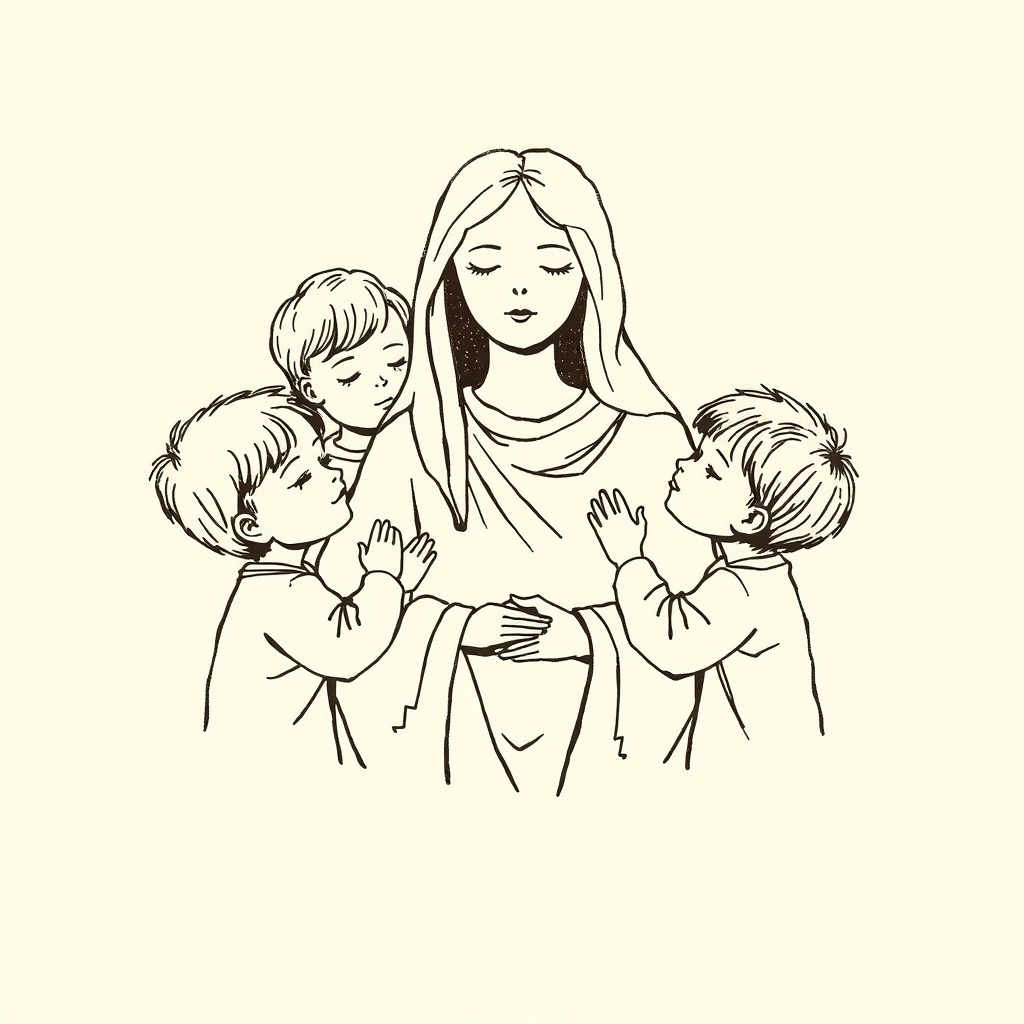
Artists have in turn recalled the generosity of our princess distributing alms; her assiduity before the altars of the Lord; her zeal for the decoration of churches, her love for the little ones and children, to whom she often distributed the bread of religious instruction. Hence a purse in her hands; an altar before which she is devoutly kneeling; a small sacred edifice placed on her hand, children surrounding her like a crown are all attributes by which she may be recognized.
We have composed this life based on the one that was made by the order of the Emperor Saint Henry, her grandson, which is reported with beautiful notes in Bellandus. Dom Mabillon also provided extracts taken from the chronicle of a contemporary author, and published in the 15th century by a Benedictine.
Iconography
Signs and attributes



Entities
Narrative network
The names, places, and concepts most present in the entry, weighted by centrality in the text.
The supernatural in their life
The miracles of Saint Matilda (Mahault)
Frequently asked questions about Saint Matilda (Mahault)
Who was Saint Matilda (Mahault)?
Wife of Henry I and mother of Otto the Great, Saint Matilda was an Empress of Germany exemplary for her humility and charity towards the poor. After enduring the ingratitude of her sons, she dedicated herself to the founding of monasteries and to prayer. She died in 968 in Quedlinburg, after a life of penance and devotion to the needy.
What is Saint Matilda (Mahault) the patron saint of?
Patronage of Saint Matilda (Mahault): the poor, prisoners and captives.
What is Saint Matilda (Mahault) invoked for?
Saint Matilda (Mahault) is invoked for: religious instruction of children and relief for the sick.
How is Saint Matilda (Mahault) depicted in Christian art?
In iconography, Saint Matilda (Mahault) is recognizable by: purse, altar, church model and children surrounding her.
What miracles are attributed to Saint Matilda (Mahault)?
1 miracle are attributed to this saint, notably: Prophecy / infused knowledge.
Which saints were contemporaries of Saint Matilda (Mahault)?
Contemporaries include: Saint Ansgar (Apostle of the North), Saint Bernard of Menthon (Apostle of the Alps), Saint Stephen of Hungary and Saint Solange of Berry.
When did Saint Matilda (Mahault) die?
Saint Matilda (Mahault) died around 968.
What are the other names of Saint Matilda (Mahault)?
Other forms of the name: Mahault and Mathilda.
Who are the relatives of Saint Matilda (Mahault)?
Relatives of Saint Matilda (Mahault): Thierry (Dietrich) de Saxe (father), Reinhilde (mother), Henri Ier (spouse), Othon Ier le Grand (son), Henri (son), Saint Brunon (son), Gerberge (daughter) and Hedwige (daughter).
Annexes & related entities
Structured data for exploration: events, miracles, quotes, places, attributes, patronages, and important entities cited in the text.
Key Events
- Marriage to Henry I at Waldhausen
- Accession to the imperial throne in 919
- Widowhood and persecution by her sons Otto and Henry
- Retirement to Engern followed by reconciliation with her family
- Foundation of the monasteries of Nordhausen and Quedlinburg
- Died on a hairshirt and ashes in Quedlinburg
Quotes
-
Is it not, moreover, a subject of great consolation for me to see that my children, who were in disunion, are now united in the subject of the persecution they are inflicting upon me?
Source text