
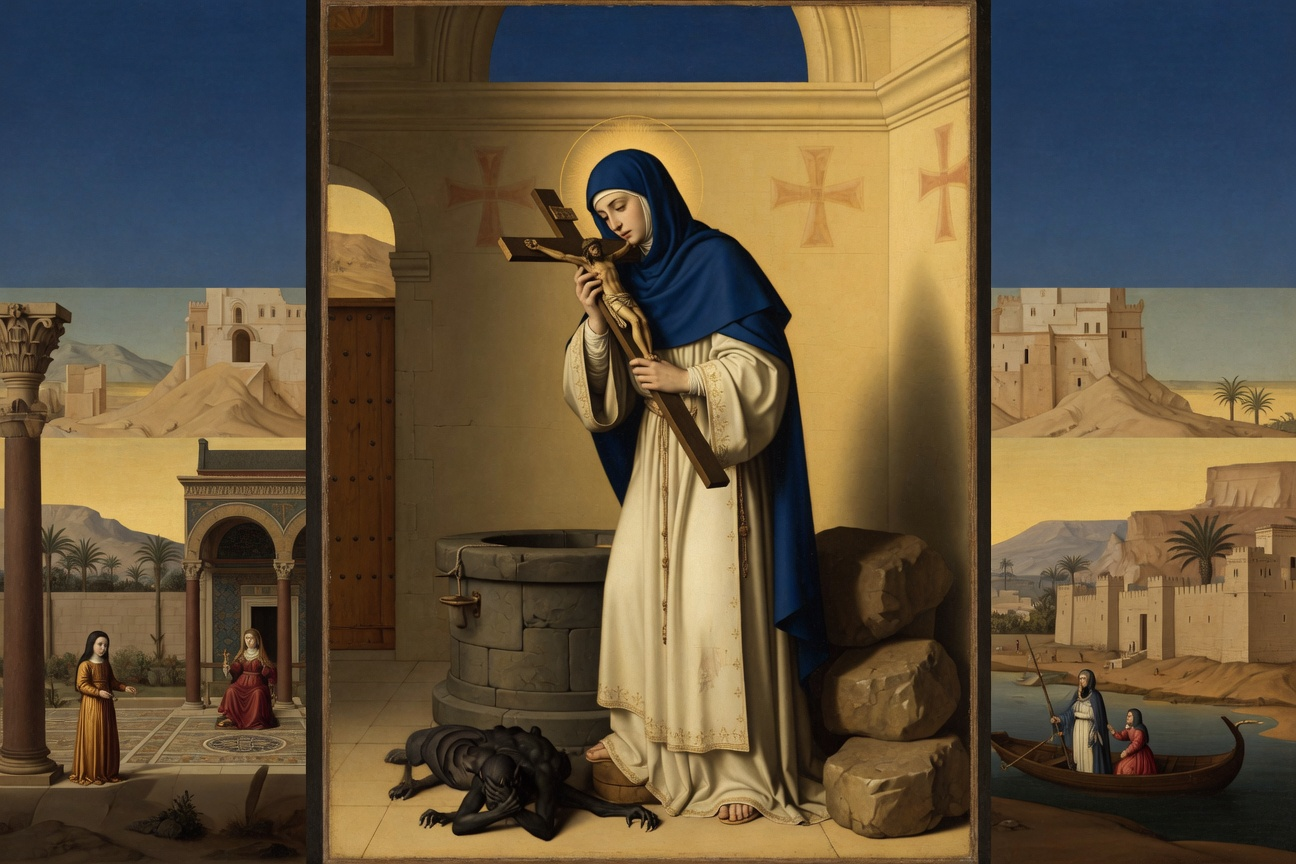
The daughter of a senator of Constantinople, Euphrasia dedicated herself to God from childhood in a monastery in the Thebaid in Egypt. She refused an imperial marriage to lead a life of extreme austerities, triumphing over the persecutions of the demon and performing miracles. She died at the age of thirty, leaving an example of holiness celebrated by both the Greeks and the Roman Church.
Contemporaries

Figures and markers around the normalized period for this entry.
Guided reading
6 reading sections
SAINT EUPHRASIA OR EUPRAXIA, VIRGIN
IN THE THEBAID
Origins and parental vows
Euphrasia was born in Constantinople to a senator allied with Emperor Theodosius; her parents decided to live in continence after her birth.
Euphrasia , whose life we present here, had as her father a senator of Constantinople named A ntigonus , and as her mother a noble woman named Euphrasia. Antigonus was allied to the Empe ror Theodosius th e Younger, and was one of those most employed in public affairs and most capable of handling them; Euphrasia, his wife, yielded to him neither in nobility nor in virtue. Both were very attached to religion and the service of God, and worthily fulfilled all the duties entrusted to their prudence. Some time after their marriage, they received from the hand of God a daughter, who was named Euphrasia like her mother. They were content with this child: Antigonus, who was strongly persuaded of the vanity of this life, proposed to his wife that they spend the rest of their days in perpetual continence, since it had pleased God to give them a daughter, the heir to their house.
Euphrasia, blessing God in her heart for having brought forth this good desire in her husband's soul, testified to him that she asked for nothing better, knowing well, according to the words of Saint Paul: "That the time is short, and that those who are married should live as though they were not, because the shadow and figure of this world pass away in a moment." She then begged him to distribute a portion of his wealth to the poor, so that they might carry it for them to heaven, where it would profit them a hundredfold. Antigonus did so with a good heart, and both of them, from that time on, being united only by the bond of charity, applied their minds only to serving Jesus Christ perfectly; but Antigonus did not live long in this holy exercise: he died at the end of the year, and left, by his death, the capital of the empire full of regrets, as well as the sweet odor of his virtues. His widow, in her affliction, had recourse to the emperor, threw herself at his feet, and begged him to treat little Euphrasia as his daughter, since she had the honor of belonging to him. Theodosius promised her this, and, as proof of his good will, he had her betrothed to one of the principal senators when she was only five years old.
Retreat to Egypt and vocation
Having become a widow, Euphrasia's mother retreats to Egypt to flee a suitor and settles near an austere monastery where her seven-year-old daughter chooses to remain.
The contract was made and the rings given, but the wedding was deferred until she was of age. While the young widow thought only of securing her child's future, she found herself sought after by another senator; he employed every means that came to his mind, even interposing the authority of the empress, so that she might persuade Euphrasia. Nevertheless, his industry served very little, because the virtuous widow would not listen to him at all: that is why, fearing to be constantly importuned, she withdrew with her daughter and her household to Egypt, where she had gre at est ates. She did not stay long in one place, but went from city to city, in order to leave everywhere marks of her charity, through the great alms she gave to the poor. She visited the lower Thebaid, and it was an ineffable consolation for h er to see the holy hermits who dwelt there. Finally, she fixed her residence very close to a monastery of one hundred and thirty nuns, whose life was so austere that some ate only once a day, towards sunset, a little bread and vegetables; others ate only every other day, and others every three days, to say nothing more of their other mortifications and penances.
The mother of Euphrasia, touched by these examples of virtue, wished to give a large sum of money to this holy house, in order to have a share in the prayers that were offered there; but the abbess refused this alms, saying that her nuns had no need of it, since they had renounced the goods of the world to enjoy eternal goods, and she accepted only wax, oil, and incense, to serve the church. The holy widow often visited this monastery with her daughter, who was still only seven years old, and the abbess took pleasure in entertaining this innocent Virgin with the sweetness experienced by those who were consecrated to God, and how delicious a thing it is to give oneself entirely to Him, while despising the vain grandeurs of the earth. Little Euphrasia was deeply touched by these discourses; evening having come, as her mother wished to withdraw to her lodging and take her with her, she told her that she did not want to leave the monastery. The abbess replied that no one could remain there without being consecrated to Jesus Christ by a perpetual vow. Then the holy girl, approaching a crucifix that was present there, embraced it with much tenderness, and, kissing it lovingly, she cried out: "Let that be no obstacle; I offer myself to Jesus Christ by a perpetual vow to be a nun of this convent." She pronounced these words with great fervor; in vain did the superior try to frighten her with the austerities of the house, she could never shake her courage, nor oblige her to return with her mother. The latter, far from opposing her daughter's resolution, prayed to God to grant her constancy. She therefore left her in the hands of the abbess, and returned with her eyes bathed in tears. She continued to lead the holy life she had begun, traveling through all the places where she knew there were poor and unfortunate people, to assist them in their needs. However, the abbess had a revelation that this excellent woman was not to live long: she warned her of it, so that she might prepare herself for death. The holy widow was not at all astonished by this news, since she asked God every day to be pleased to withdraw her from the world; after having thanked Him for it, she sent for her daughter, exhorted her to perseverance, and, having left her all her riches to be employed in works of piety, she rendered her soul to God at the end of three days, and was buried in that same monastery.
Definitive Renunciation of the World
Euphrasia refuses to return to Constantinople to marry the senator to whom she was betrothed, preferring to dedicate her life and possessions to God and the poor.
The emperor, informed of this death and of what had transpired, wrote to the young Euphrasia at the solicitation of the senator to whom she had been betrothed; he commanded her, since she was of marriageable age, to come to Constantinople to celebrate her nuptials. Euphrasia replied that she would leave it to him to judge whether it was reasonable for her to abandon her spouse Jesus Christ, who was an immortal God, to marry a man destined to be food for worms; as for her, she was resolved to die a thousand times rather than leave the religious state she had embraced; she also requested that her goods be distributed to the poor, her slaves set free, and her farmers discharged of what they might have owed since the death of her father, so that, being entirely delivered from earthly cares, she might think only of serving Jesus Christ, to whom she had entirely consecrated herself. The emperor received this letter and had it read in the presence of the entire court; and, approving of Euphrasia's course of action, he faithfully fulfilled everything she asked of him.
Ascetic Life and Trials
The young nun devotes herself to extreme fasts and the humblest tasks, enduring the jealousy of Sister Germaine and the physical attacks of the demon.
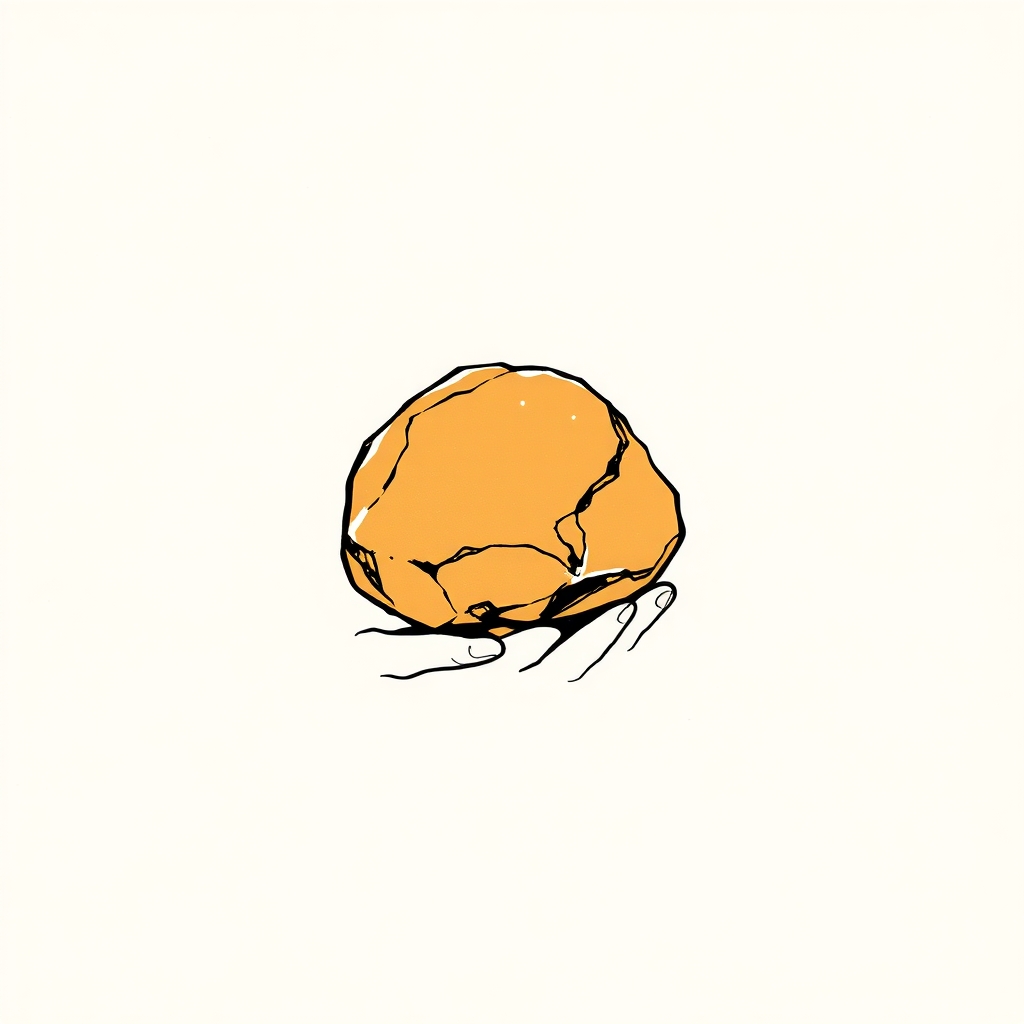
This young nun, seeing herself thus free from the entanglements of the world, undertook to work toward her perfection with a courage worthy of a bride of Jesus Christ. As soon as she reached her twelfth year, she began to practice the fasts of the monastery and to eat only once a day; and, some time later, she would go for two or three days without taking any food. She would sweep the convent, make the beds of the other sisters, draw water for the kitchen, engage in the lowliest ministries of the house, and perform all these things with incredible joy. The spirit of darkness, foreseeing the fruits that her fervor would produce, first waged cruel war against her through strong interior temptations; but she overcame them by redoubling her fasts and austerities and by declaring her troubles to her superior, an effective means to triumph over all the artifices of the demon. The abbess, to test her, would sometimes order her to carry heavy stones from one place to another, then to carry them back to their original spot, and our Saint executed this as punctually as if she had seen the utility of it. She also had her make the convent bread; our Saint obeyed with pleasure, without concern for her nobility and birth.
The demon, outraged with spite to see with what ease Euphrasia received the command of her superior and accomplished everything regarding the observance, did not leave her in peace: he launched new assaults against her, tormenting her with evil representations that he excited in her imagination, and with troublesome dreams and dangerous phantoms; but the holy girl, knowing that this proceeded from the evil spirit, was not at all troubled by it; on the contrary, wishing to mortify her exterior senses more and more through fasts longer than the ordinary ones, she asked permission to fast for a week without eating anything, an austerity that not one nun had yet been able to practice, except for the abbess, who was very zealous and fervent. This holy superior, seeing the courage of Euphrasia, permitted her to do in this what she pleased; so that she remained seven days without eating. There was, in the monastery, a nun of low birth named Germaine, the daughter of a slave; instead of admiring the favors and graces that Euphrasia r eceived from the goodness of God, and working to imitate her virtues, she conceived such jealousy because she had fasted all week without taking anything, that interpreting this miraculous action in a bad light, she told her, in a tone of reproach, that it was only ambition and hypocrisy to become abbess after the death of the other; but that she hoped God would never suffer it. Euphrasia, instead of becoming angry at these bitter words, profited from them as an occasion for virtue; and, throwing herself at the feet of Germaine, she asked her for forgiveness, confessing that she was a sinner, and did her best to soften the bitterness of her heart with words full of charity; but it was useless. The abbess, having learned what had happened, severely reprimanded this nun who had thus insulted the Saint, and, as her penance, ordered her to remain separated from the community. Euphrasia, far from rejoicing at this justice done to her, did not cease to implore the abbess to forgive Germaine, and used the influence of the elders for this purpose, until she finally obtained what she asked for.
The demon, defeated on the side of the soul, resolved to attack the body, to take the life of our Saint or to render her incapable of fulfilling her duties. He took her one day while she was drawing water at the well and threw her into it; she would have drowned there, had her good angel not held her above the water until the nuns, who had heard her voice, ran there and pulled her out. Then she said to the demon with a smile: "I pray to Our Lord Jesus Christ, O Satan! that you do not triumph over me." Another time, while cutting wood, she gave herself such a great blow on the foot with a billhook that the pain caused her to fall into a faint. The nuns came promptly to her aid to carry her into the monastery; but, having returned to herself, she finished her work despite her wound, and loaded herself with the pieces of wood she had cut, for fear that her enemy might boast of having made her let go. Another time, he threw her from the top of a third floor; but she rose again healthy and without injury. As she was cooking vegetables for the convent, the evil spirit overturned the cauldron of boiling water onto her: the sisters thought she was completely burned, but she protested that she had felt only cold water.
Miracles and healings
Euphrasia manifests her holiness through the healing of a paralyzed child and the deliverance of a possessed woman, triumphing over demons.
The heavenly Spouse permitted the demon to thus test the person of his beloved, in order to make her more illustrious, and to let us know that the demon can do nothing against those who are succored and fortified by his almighty hand. He further manifested the holiness of Euphrasia through several miracles. It is recounted, among others, that she healed an eight-year-old child, who was deaf, mute, and paralyzed, by making the sign of the cross over him and saying these words: 'May He who created you, heal you.'
There was a possessed woman in the monastery; the abbess entrusted her care to Euphrasia, so that she might bring her food and drink: which no other dared to do, for fear of being beaten by the demon. But Sister Germaine, of whom we have spoken, still jealous, said with contempt to her companions: 'Is there no one here who can manage this demoniac like Sister Euphrasia? If they wish to give me the charge, I will fulfill it as well as she.' She took her dinner and brought it to her; but the possessed woman, in a fury, seized Germaine, and, throwing her roughly to the ground, tore her clothes and bit her so hard that she took a piece of flesh; she continued to mistreat her until Euphrasia ran to her rescue and snatched this poor nun, more dead than alive, from her hands, and commanded the demon to stop: thus, this jealous sister became wise at her own expense, and the holiness of Euphrasia was recognized by all the other nuns. The abbess, having noticed thereby the power that Euphrasia had over demons, commanded her to pray for this poor possessed woman. The saint obeyed, and trusting in the divine mercy, which does not despise the vows of the humble, she said these words to the possessed woman: 'May my Lord Jesus Christ who created you, heal you.' And immediately the impure spirit was forced to leave, making frightful howls, and foaming in a horrible manner from the mouth of this woman.
Death and Posterity
Euphrasia dies at thirty, followed closely by her mistress Julia and the abbess; she remains a major figure of Greek and Roman piety.
Some time later, God made known to the abbess, in a vision, that He would soon call Euphrasia, and to what degree of glory she was to be raised. A few days later, our Saint was seized by a fever that led her to death within twenty-four hours, in the thirtieth year of her age, around the year 412, according to those who place her birth under Theodosius the Great, and 460 according to others, who place her birth under Theodosius the Younger. She was buried in her mother's sepulcher. Sister Ju lia, who had served as her guide and mistress in the exercises of religion, begged her, as she lay in her agony, not to forget her, but to ask God to take her from this world with her; the abbess also conjured her to grant her the same favor. Euphrasia having passed away, Julia spent three days in tears and prayers by her tomb, and on the fourth, she went to find the abbess and told her, with great joy, that Jesus Christ was calling her to Him through the merits of Euphrasia: she then embraced all her sisters, and, the next day, she died, and was buried beside her dear disciple. At the end of thirty days, the abbess assembled the chapter and told them that she would die shortly, Euphrasia having obtained this favor for her from God, and ordered them to elect another superior in her place. The nuns, although extremely distressed to lose her, proceeded to the election of another abbess, who was Theogenia; and, the next morning , this sa int was found dead in the oratory, or rather, asleep in Our Lord. She was placed in the tomb of Euphrasia with the others; but, since then, no one else was placed there. God has performed great miracles in favor of those who visited this sepulcher with devotion and reverence.
The memory of Saint Euphrasia is held in such great veneration among the Greeks that when a nun's vows are received, the priest asks God for her that He may grant her a share in the graces and blessings with which He filled Saint Thecla, Saint Euphrasia, and Saint Olympias.
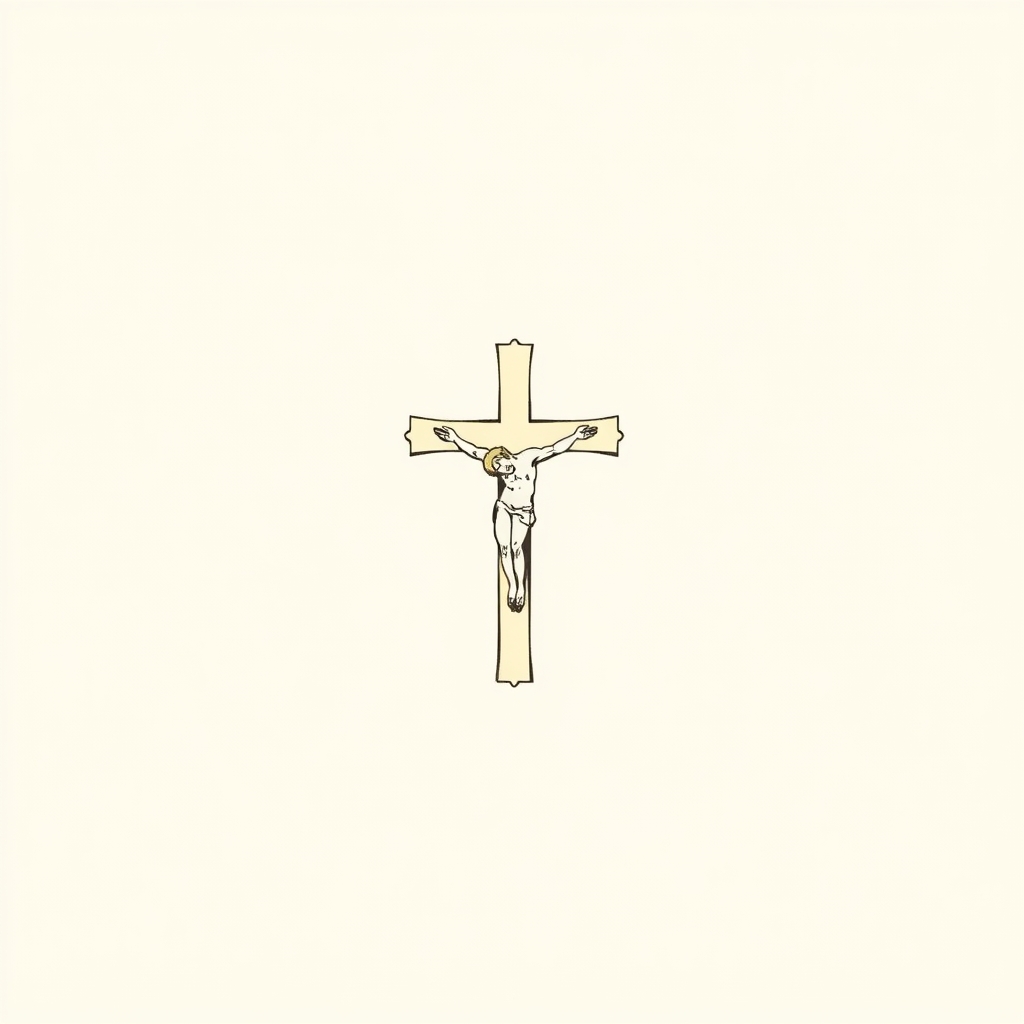
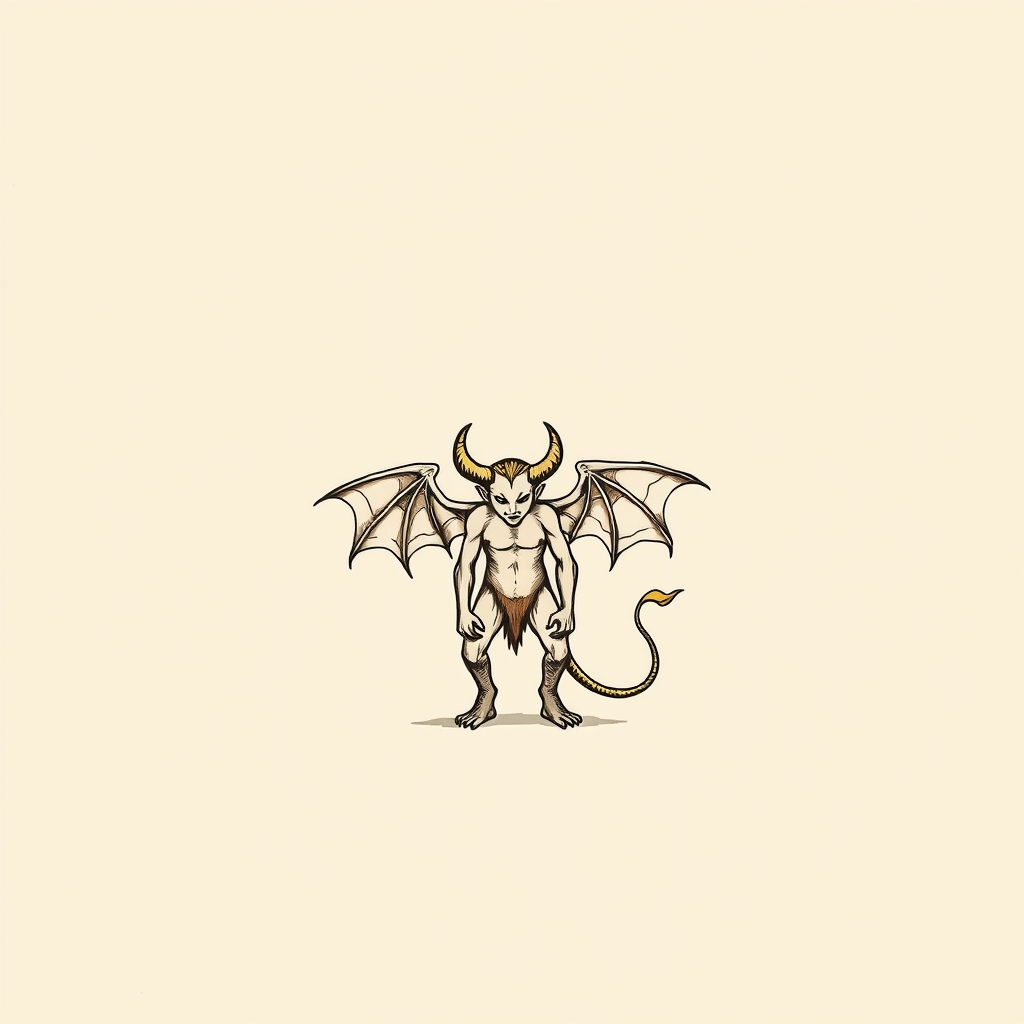
Saint Euphrasia is depicted embracing a crucifix, to recall that circumstance of her life where, contemplating a crucifix, she believed she saw in its open arms an invitation to embrace it, and where she ran to surround it with her child's arms, to promise Him never to have any other love. She is also depicted trampling underfoot the demon who strives to throw her into a well.
The Roman Martyrology and that of Usuard commemorate this holy Virgin on March 13, and the Greeks on July 25. Surius reports her life in his second volume, and Saint John Damascene speaks of her in the third discourse he wrote on images.
Iconography
Signs and attributes
Entities
Narrative network
The names, places, and concepts most present in the entry, weighted by centrality in the text.
The supernatural in their life
The miracles of Saint Euphrasia (Eupraxia)
Frequently asked questions about Saint Euphrasia (Eupraxia)
Who was Saint Euphrasia (Eupraxia)?
The daughter of a senator of Constantinople, Euphrasia dedicated herself to God from childhood in a monastery in the Thebaid in Egypt. She refused an imperial marriage to lead a life of extreme austerities, triumphing over the persecutions of the demon and performing miracles. She died at the age of thirty, leaving an example of holiness celebrated by both the Greeks and the Roman Church.
How is Saint Euphrasia (Eupraxia) depicted in Christian art?
In iconography, Saint Euphrasia (Eupraxia) is recognizable by: kissing a crucifix, demon under her feet, well and stones carried.
What miracles are attributed to Saint Euphrasia (Eupraxia)?
5 miracles are attributed to this saint, notably: Healing, Exorcism, Protection / deliverance and Sign / wonder.
Which saints were contemporaries of Saint Euphrasia (Eupraxia)?
Contemporaries include: Saint Augustine of Hippo, Saint Honoratus of Arles, Saint James of Tarentaise and Saint Jerome of Stridon.
When did Saint Euphrasia (Eupraxia) die?
Saint Euphrasia (Eupraxia) died around 500.
What are the other names of Saint Euphrasia (Eupraxia)?
Other forms of the name: Eupraxie.
Who are the relatives of Saint Euphrasia (Eupraxia)?
Relatives of Saint Euphrasia (Eupraxia): Antigone (father), Euphrasie (mother) and Théodose le Jeune (family ally).
Annexes & related entities
Structured data for exploration: events, miracles, quotes, places, attributes, patronages, and important entities cited in the text.
Key Events
- Betrothed at the age of five to a senator
- Retirement to Egypt with her mother at the age of seven
- Perpetual vow before a crucifix at the monastery of the Thebaid
- Refusal of imperial marriage to remain consecrated to God
- Practice of extreme austerities and victories over demonic temptations
- Miraculous healing of a deaf, mute, and paralyzed child
Quotes
-
How reasonable it was that she should leave her spouse Jesus Christ, who was an immortal God, to marry a man destined to be food for worms
Letter to Emperor Theodosius