
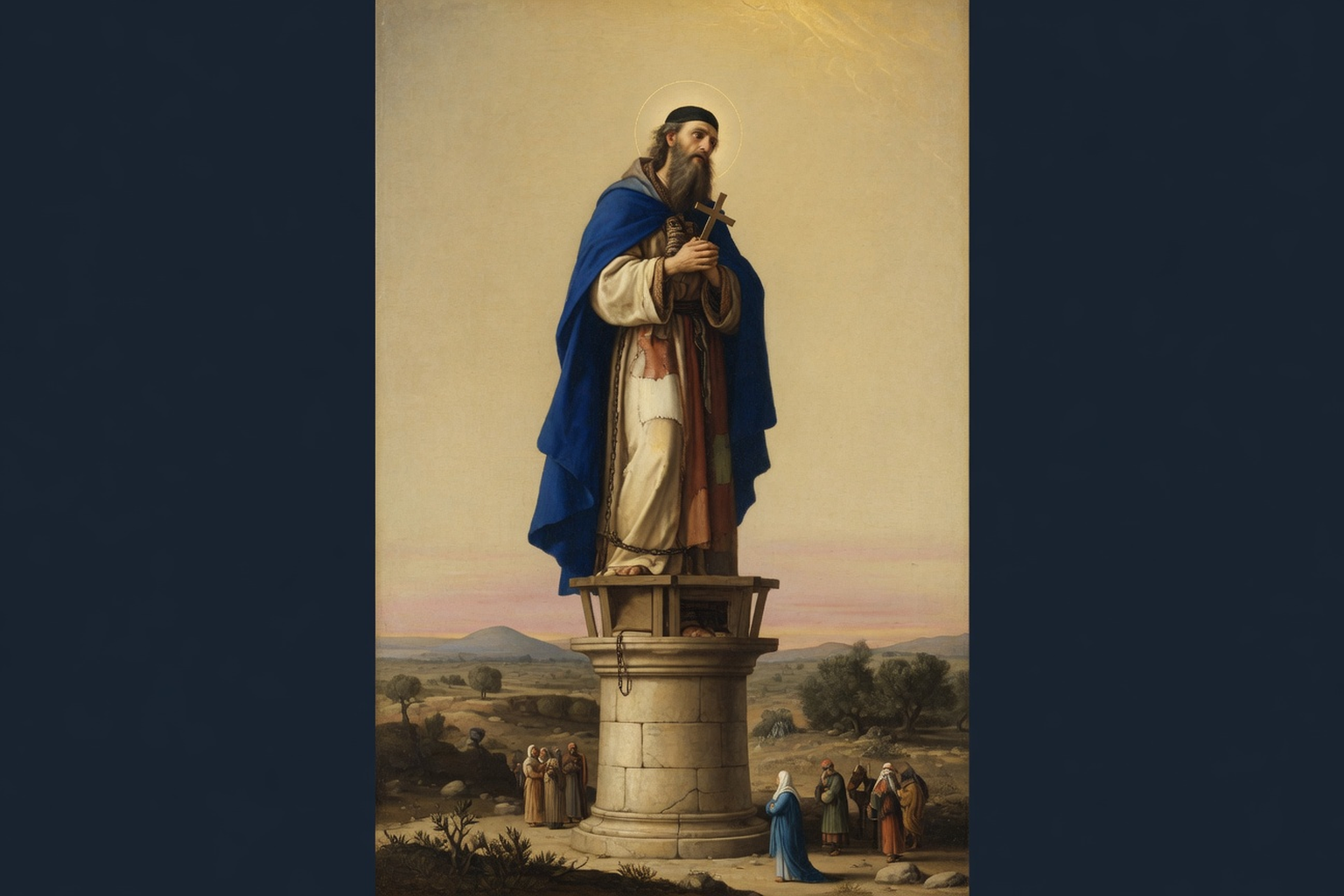
Saint Simeon Stylites the Elder
Born in Syria in the 4th century, Simeon left herding to embrace a life of extreme asceticism. He became famous for living for several decades atop a pillar, becoming a spectacle to angels and men. His humility and miracles attracted crowds from the entire known world, converting thousands of infidels.
Contemporaries

Figures and markers around the normalized period for this entry.
Guided reading
9 reading sections
SAINT SIMEON STYLITES, THE ELDER
Historical Context and Sources
Presentation of the historical framework of the 4th and 5th centuries and hagiographic sources, notably the eyewitness testimony of Theodoret of Cyr.
In the 4th century. — 459. — Popes: Saint Siricius; Saint Leo the Great. — Emperors: Theodosius I, in the East; Leo I.
One must first apply oneself to overcoming oneself, and then one easily rises to the highest perfection.
Voice from heaven that made itself heard to Saint Simeon.
One should not be surprised if one finds in this life unheard-of actions, which seem to surpass all belief. God did not give Saint Simeon to the world to be simply the model of common virtues, but to show, by experience, how far His inspiration and assistance can carry the weakness of a mortal man. He raised him upon the pillar to serve, to angels and to men, as a spectacle of more than human virtue, and to be, in the order of grace, what prodigies are in the ordinary course of nature. Theodoret, Bishop of Cyr, who was his particular friend, and who did not forget his life in his History of the Holy Fathers, entitled: Philotheus, or Theophilus, declares that, although he saw, with his own eyes, the marvelous actions he reports, and that he has almost all men as witnesses to their truth, he fears, however, that posterity might take them for fables, so extraordinary are they and above all our thoughts; but we believe that our century is too prudent and has too much respect for antiquity not to add faith to what great personages have left in writing about them; not upon the deposition of one or two persons, but upon the report of an infinity of witnesses, some of whom were eyewitnesses.
Landamus te, Dominum, te collaudamus, te benedicimus, te glorificamus, te adoramus, per magnum pontificem.
Te Deum ingentem, inaccessum, solum, propter magnam gloriam tuam.
Domine, Rex cœlestis, Deus pater omnipotens.
Domine Deus, pater Christi agni immaculati, qui tollis peccata mundi, suscipe deprecationem nostram.
Qui sedes super cherubim, quoniam tu solus sanctus.
Te solum Dominus Jesus Christus Dei omnis naturae creator, regis nostri per quem tibi gloria, honor, in sæcula.
It is especially since Saint Gregory the Great that this beautiful hymn was sung or recited at Mass, first by bishops, then by priests, who originally only had the right to do so on Easter Day.
The Bishop of Bethlehem, who had his see in the chapel of the hospital of Clamory, given by Nevers, alone could say the Gloria in excelsis at all Masses, even during Advent, Septuagesima, and Lent, in memory of the one that was sung by the angels. Is there anything more touching than this privilege: Hymn of the Manger sung by the Bishop of Bethlehem?
Origins and first conversion
Born in Sisan, Simeon leaves his life as a shepherd after hearing the Beatitudes and receives a prophetic vision regarding the foundations of his spiritual life.
This wonderful man was born in t he village of Sisan, which is between Syria and Cilicia, to poor but Christian parents. His father was named Susocion or Ysicius, and his mother Matane or Martha. His occupation, in his childhood, was to tend the flocks. One day, when he could not lead them to the fields because of the snow, he entered the church and heard these words of the Holy Scripture: 'Blessed are those who mourn, blessed are the pure in heart.' Being touched by this lesson, he asked an old man what he must do to merit this happiness. The old man answered him that the surest way was to leave the world and to retire promptly into a monastery. Upon this answer, Saint Simeon went to another church where, having prostrated himself face to the ground, he prayed to Our Lord to show him the path of perfection and to teach him to do His divine will in all things. After this prayer, which was long, having peacefully fallen asleep, he had this vision: It seemed to him that he was digging in the earth to lay foundations and that someone was saying to him: 'You are not low enough, dig boldly, and make the pit deeper'; and when he had dug for a long time more, the same command was reiterated to him: which took place four times; then the voice said: 'It is enough, work now to raise the edifice, and the thing will be easy for you; for one must first apply oneself with a kind of stubbornness to overcoming oneself, and then one rises easily to the highest perfection.' Having awakened, and feeling filled with a new courage and a heavenly vigor, he ran to the nearest monastery, governed by the holy abbot Timothy. He remained there prostrated for several days in a row, without drinking or eating, asking for no other grace than that of being received in the capacity of a servant, destined for the humblest duties of the house. Having been admitted to the number of those who were being tested, he began by learning the Psalter by heart, which was the first thing required of novices. He could not leave this divine book. He spent two years there in extreme austerity and perfect innocence; but, not yet finding there all the perfection he desired, he left at the end of this time and went to the solitude of Theleda, near Mount Coryphaeus, where a holy abbot, named Heliodorus, sixty-five years old and of consummate virtue, governed a convent of eighty religious, in which he had been raised since the age of three.
The Apprenticeship of Asceticism
Simeon practices extreme discipline at the monastery of Telanissos, engaging in bodily mortifications that alarm his own brethren.
Simeon surrendered himself to this man of God and remained with him for several years. He considered himself the servant of everyone and took pleasure in performing the most repulsive tasks. His abstinence was so prodigious that he would go from one Sunday to the next without eating, distributing to the poor what was given to him for his sustenance. Having found a rope woven from wild myrtle, a type of palm that is very rough and prickly, he placed it against his bare flesh all around him, from his loins to his neck, and tightened it with such violence that it sawed into his entire body and caused great wounds. The worms that fell from them, the blood that flowed abundantly, and the stench that emanated from them soon revealed this new form of mortification. The brothers informed the abbot, who ordered his clothes to be removed: it took three days to moisten them, so stuck were they by the corrupted blood, before they could be detached. It was found that this rope was already so embedded in the flesh that only the surface was visible: everyone was horrified, especially since it could not be removed without causing him extreme pain. He did not want to be bandaged, in order to carry the mortification of Jesus Christ continually in his body; but the holy abbot insisted, and after he was healed, he dismissed him from the monastery, for fear that his extraordinary fervor might be a cause of scandal for the weaker ones. Having left, Simeon placed himself nearby in an abandoned well where there was no water, and spent five days there in prayer and continuous tears, considering himself a very great sinner. At the end of this time, the abbot, intimidated by terrible visions, went himself to find him with five of his monks, threw himself humbly at his feet, asked his forgiveness, and begged him to return to the monastery. The Saint, who believed he had been treated according to his merits, was extremely confused by this action, and although he had wished to remain a solitary, he did not fail to yield to what was desired of him.
The solitude of Telanissa
He settled near Telanissa where he practiced forty-day fasts and chained himself to a rock before being freed by Bishop Meletius.
A year later, the Holy Spirit, who was calling him to greater things, led him to the foot of a mountain, near the village of Telanissa, where, having retired into a hut that he made himself with simple stones, without mortar, or which he found already made at the foot of a mountain, he remained there for three years in the exercises of a life more angelic than human. He felt a devotion to fast for forty days and forty nights in imitation of Our Lord, of Moses, and of Elijah: he communicated this to a holy priest named Bassus, who presided over all the priests of the solitude and who served as his director. This priest approved his plan, provided that he had bread and water in his cell, so that he would not appear to be tempting God. Simeon accepted this condition, but these foods were useless to him. He spent the entire forty days in a continuous fast, and this happy trial gave him the courage to often undertake the same thing, but with such success that, whereas the first times he would fall into a faint toward the end, he finally became so strong and vigorous that in the last days he did not even need to lie down, nor sit, nor lean. He spent the first days of the forty-day period standing, praising God; the following days, his body, weakened by the fast, no longer having the strength to remain in that state, he would remain seated and thus recite his office; and the last days, his strength being entirely spent, and finding himself as if half-dead, he was forced to lie on the ground. After such a novel Lent, which he ended with the Holy Communion that Bassus gave him, he chose for his dwelling the top of a mountain in Syria, beyond the village of Teleda. He made an enclosure there with a small wall of simple stones and attached himself in the middle with a chain of twenty cubits, one end of which was held by a large stone and the other end to his right foot; thus, having no freedom to leave, nor any shelter other than the sky, he continually raised his eyes there to contemplate Him who is above the firmament. Meletius, that admirable bish op or rather chorepiscopus, who then had the care of the country of Antioch, visited him in this voluntary prison, and learning from his own mouth that he had chained himself in this way to remove the power to pass the boundaries of his enclosure, he told him that wild beasts needed such bonds, but that for man, reason aided by grace was enough to bind him. Simeon, understanding this truth, yielded immediately: a locksmith was brought who broke his ring. Meletius at the same time had him remove a piece of hairy leather with which he had surrounded his leg, for fear that the iron would cut the skin; and then it was noticed that it was full of large bedbugs, the stench and bites of which the Saint suffered with invincible patience; this filled all the spectators with astonishment, and principally Meletius and Theodoret.
Life on the Column
To flee the crowds, Simeon ascended columns of increasing height, living without shelter in perpetual prayer and total abstinence.
The life that Saint Simeon led in this place was so prodigious that his reputation flew immediately throughout the universe. An immense crowd flocked around him, some to be healed of their illnesses, others to receive consolation in their afflictions and relief in their sorrows; others still, for their conversion and the remission of their sins; and there was no one who returned dissatisfied and without having obtained the object of their requests. This caused the gathering to grow ever larger; so much so that his hermitage, in the words of Theodoret, was like a great sea of men and women of all conditions, and the roads that led to it resembled great rivers coming to discharge themselves into this sea. One even saw pilgrims from the most distant parts of the earth: Ishmaelites, Persians, Armenians, Georgians, and Homerites, as well as inhabitants of our most western regions, namely: Italy, Spain, Gaul, and Great Britain. The same historian, an eyewitness, gives us undoubted assurances of this.
The holy man, seeing this great influx and unable to bear that people should press so hard to touch him and to cut off pieces of the vile skins with which he was covered, devised a manner of dwelling and retreat unheard of until then, and which has since that time been the astonishment of all centuries. This was to raise himself upon a column, first six cubits high, then twelve, then twenty-two, and finally thirty-six. His disciple Anthony gives five measurements: the first of four cubits, the second of twelve, the third of twenty, the fourth of thirty, and the fifth of forty. And perhaps it is more credible, on this point, that Theodoret and Metaphrastes, who gave us the first measurements, he who had climbed up and down so often; but this diversity is of little importance. The top of these columns was surmounted by a balustrade three feet in diameter, which meant that the Saint could neither lie down nor sit. Would that I had the tongue of angels to be able to worthily represent the manner in which this heavenly man lived on these columns, the great fruit he bore in the world, and the incredible wonders that God worked through him! He had neither room nor shelter; he was exposed to the heat of the sun, the rigors of the cold, to rain, snow, hail, storms, and all the injuries of the air. One cannot say that he ate, since Theodoret assures that he took food only once every forty days, except for the Holy Eucharist which he received every eight days. Never was he seen lying down or sitting; but he was always standing or with his face prostrate in prayer. His prayer lasted from evening until the following day at noon, and when he spoke while standing, he made an infinite number of bows to adore the majesty of God, to the point that someone in Theodoret's company counted up to twelve hundred and forty-four in one day, and finally, becoming tired, was obliged to give up. On the principal feasts of the Church, he prayed all night, his eyes and hands raised to heaven, without anyone ever noticing that such an uncomfortable posture tired him, and without him being obliged to interrupt it.
Spiritual Combats and Wonders
The saint overcomes a diabolical temptation and performs numerous miracles, including the healing of the King of the Saracens and the conversion of sinners.
This faithful disciple, who composed his life, reports that he spent an entire year standing on only one foot, to which he had condemned himself for having inconsiderately lifted the other. This came about in the following circumstance: Despite his habit of eluding all the artifices of the demon, God permitted, in order to make him ever more humble and vigilant over himself, that he be once caught in a dangerous trap. He thought he saw, not the tempter spirit, but an angel of light coming toward him with a chariot all radiant with celestial fire. The spirit, having approached, told him that he was sent by God to have him mount and take him up into the glory that was prepared for him. This Saint, devoid at that moment of his ordinary discernment, lifted his foot to step into the chariot; but at the sign of the cross that he made to bless his departure, the whole phantom disappeared. He then recognized his error and punished himself for it in the cruel manner we have mentioned. He endured searing pains from an ulcer he had on his thigh; worms fell from it continually; but far from having it dressed, he obliged Theodoret to gather these worms when they fell to the bottom of his column and put them back into his wound, saying to them: "Eat what God has given you." This ulcer was discovered in the following circumstance: a deacon of great consideration having come to visit him, and learning that he neither ate, nor drank, nor slept, took the boldness to ask him if he were a man, or a spiritual nature that had taken only the appearance of a man. Those present were offended by this request; but the Saint, without being troubled, asked him to climb up with a ladder to his column to recognize, by his own experience, what he was. The deacon climbed up, and Saint Simeon, lifting the edge of his hair shirt, showed him this horrible wound which clearly showed that he was composed of flesh and bone, and subject, like others, to decay. One of the worms that swarmed in this ulcer having fallen, Basil, King of the Saracens, who was at the foot of the column, ran promptly to pick it up and placed it on his eyes; and immediately this worm was changed into a very beautiful and very fine pearl, which he carried away as a treasure that he valued more than his empire.
The honors that were continually rendered to Saint Simeon did not prevent him from being supremely humble, from regarding himself as the last of all men, and from being ready to obey everyone. Here is an illustrious example, reported by Evagrius, Simeon Metaphrastes, and Nicephorus Callistus. The neighboring solitaries, astonished by such a new life, and fearing that it did not come from the spirit of God, but rather from that of the demon, who sometimes leads men by extraordinary ways to precipitate them into pride, resolved among themselves to test the saint. They therefore sent him two monks of their company, with orders to rebuke him for abandoning in this way the path that so many holy Fathers had blazed, and by which they had undoubtedly arrived at eternal happiness, to follow the inventions of his own mind and a way that no one other than he had taken. These deputies were also to order him to descend from his column; if he humbly received this command and showed himself disposed to descend, they would not permit him to do so, because it would be a sign that his enterprise was from God; but if he showed, on the contrary, resistance and obstinacy, they would make him descend immediately, even by force, and would have his column razed. When they arrived near him, they were seized with such great respect that they hardly dared to speak to him or look him in the face; nevertheless, so as not to fail in their mission, they gave him the reprimand and the command they were charged to give him. Immediately this admirable man, who was dead to his own will and judgment, and who knew that God asks of us obedience rather than sacrifices, set about to descend; he asked for a ladder, approached the edge of the column, and testified to these solitaries that he was extremely obliged to them, and to the holy Fathers who had sent them, for the care they took of him; thus he showed that he was led by the spirit of God, and that humility and obedience had cast deep roots in his soul. This was all that these deputies wanted to recognize. After such a strong test, they told him to continue freely what he had begun, and wished him for this the blessing of God and the gift of perseverance until death.
This great humility of Saint Simeon was accompanied by a marvelous modesty, grace, and affability; he received everyone pleasantly, rich or poor, great lords or artisans, faithful or infidels, and won them all by the sweetness of his words and his looks full of benevolence. He satisfied their doubts, he accommodated their differences, he remedied their ills, and no one withdrew from him without being very content with his charity. The zeal he had for the Church and for the salvation of souls was admirable. He preached every day twice, from the top of his column, to an infinity of people who assembled to hear him, and his discourses tended only to inspire the contempt of all the things of the earth and the desire for eternal goods. He fought vigorously against pagans, Jews, and heretics, less to confound them than to win them to God, and his historians assure that he converted thousands of Saracens, Georgians, Persians, and Armenians, who asked in crowds for holy Baptism. The most hardened sinners were softened in his presence; witness this notorious thief and murderer, named Antiochus, who conceived near the saint's column, where he had taken refuge, such a vehement contrition for his crimes, that a celestial voice having assured him that they were forgiven, he died of sorrow while pronouncing these words: "My Lord Jesus Christ, only Son of the eternal Father, who did not come for the just but for sinners, receive my spirit into your hands."
Advisor to Emperors
Simeon intervened in the affairs of the Empire and the Church, advising Emperors Theodosius II, Leo I, and Marcian on the orthodoxy of the faith.
Our Saint even took the boldness to warn, by word of mouth or by letter, the prelates and princes of what was their duty, and his advice was received as if it had been given by an angel. The Emperor Theodosius the Youn ger always deferr ed greatly to his counsel. We have, in the acts of the Council of Ephesus, a letter from this prince, by which the same emperor begs our saint to work for the peace of the Church, and to ensure that John, Patriarch of Antioch, cease to support the cause of the impious Nestorius. The Emperor Leo, who succeeded Theod osius after Marcian, wrote to him concerning the Council of Chal cedon and the affair o f Timothy Aelurus who, having caused the death of Saint Proterius, Patriarch of Alexandria, had seized his see. Saint Simeon did not fail, on this occasion, to show his great zeal for religion. He wrote to the emperor to confirm him in his respect for this holy Council and in the just indignation he had conceived against this false bishop. He rendered the same duty to Basil, Patriarch of Antioch, his own prelate, but with such humility that he called himself in this letter a vile and abject worm, and the abortion of monks, he who was their example or rather their miracle. This holy letter is found in Evagrius and in Nicephorus. The Empress Eudocia, widow of the young Theodosius of whom we have just spoken, having inconsiderately allowed herself to be drawn into the heresy of the Eutychians by a monk, also named Theodosius, who had usurped the episcopal chair of Jerusalem, sent deputies to our saint to learn what was his sentiment regarding Eutyches and the Council of Chalcedon which had condemned him. He answered her with admirable courage and freedom, that the demon, seeing her so rich in good works, had undertaken to strip her, by corrupting her faith and poisoning her mind through the pernicious Theodosius; but that, if she wished to escape this misfortune, she should have recourse to Saint Euthymius, who was not far from Jerusalem where she had chosen her dwelling. The Emperor Marcian disguised himself as a private citizen, to satisfy with more freedom his ardent desire to see the Saint with his own eyes and to hear him with his own ears. Varanes, King of the Persians, and the queen, his wife, gave him public marks of their veneration. Princes and princesses of Arabia came to receive his blessing and let their subjects enjoy the same favor. Thus, this great man served all as salt, light, guide, master, and instrument of salvation.
Gifts of prophecy and rigor
He predicted famines and invasions, while maintaining a strict rule forbidding women from entering his enclosure, including his own mother.
He possessed, in an excellent manner, the gift of prophecy. One day, he saw a rod that threatened the earth with a great and frightful calamity. God made it known to him that it was the sign of an extreme drought, followed by famine and plague, which He intended to send to the world to punish it for its crimes. He warned the people who were around his pillar, and two years later, the dire fulfillment of his prediction was seen. Another time, he saw two rods descending from the sky, one from the East and the other from the North, and it was told to him that they prognosticated the incursion of the Persians and the Scythians into the Roman Empire. Indeed, they made great preparations for war to invade it; but the Saint did so much, through his prayers and tears, that he averted or at least deferred these great scourges. He also predicted, in a certain year, that such a prodigious army of locusts, cockchafers, and other insects would soon be born that it would cover the entire countryside, but that the damage would not be as great as one might fear. Indeed, fifteen days later, such a great quantity rose up that the air was even darkened by them; but they only spoiled the meadows and did no harm to the grains intended for human use. Saint Daniel the Stylite reports an even more admir able fact; for not only did Saint Simeon reveal to him, while on his pillar, many things that were to happen to him; but also, while still alive, he appeared to Daniel in the form of a traveler on the road to Jerusalem, where the latter was going, to prevent him from continuing his journey, which would have caused him to fall into the hands of the Samaritans; he exhorted him to head toward Constantinople, where God wished to use him for great things; after his death, he appeared to him again to assure him of his happiness and to advise him to mount a pillar following his example. Finally, Theodoret assures that he predicted to him personally the end of a persecution from which he was suffering greatly, and that this persecution ceased precisely at the time the Saint had indicated to him.
It would be too long to report all his miracles: I will touch upon only a few of the most remarkable ones. He caused a fountain to spring forth in a dry place, where there was an extreme need for water. He obtained a son for the queen of the Ishmaelites, who was barren, and a daughter for the queen of the Saracens, who was in the same distress. And this child having become paralyzed at the age of three, he restored her, through his prayers, to perfect health. The entire court of Persia recognized, through a great number of miraculous healings, the virtue of an oil he had blessed, and his image itself, as we have already said, performed so many wonders that everyone wanted to have one in their home. He had established, as an inviolable law, that women would never enter his hermitage, that is to say, the enclosure of the wall that surrounded his pillar, and he even kept this rigorous measure with regard to his own mother, who had an extreme desire to see him. However, there was one who had the temerity to disguise herself to violate this holy enclosure; but she had barely set foot on the threshold of the door to execute her design when she fell dead in the presence of everyone, leaving to posterity a terrible example of the wrath of God against persons who violate the enclosure of religious houses.
Death and Posterity
After his death in prayer, his body was solemnly transferred to Antioch, where his relics became a spiritual rampart for the city.
When the hour of his death arrived, he bowed, according to his custom, to pray, and in this posture, he rendered his blessed soul to God, which was carried by the angels to the place of eternal rest. He appeared immediately afterward to his disciple Anthony, and assured him that he was enjoying glory. The news of his death having been brought to Antioch , the patriarch, with three other bishops and Ardabur, commander of the military forces, hastened there with soldiers to guard the holy body. The bishops, having taken him down from the column, placed him near the altar that was in front, where it was customary to celebrate Mass for him. The desolation of the country was so great that the weeping of the people and the cries of the animals could be heard from seven miles away. The mountains themselves, the fields, and the trees of the surroundings appeared to be in sadness, the whole region being covered by a very dark cloud, like a mourning cloak.
As he was being carried solemnly to Antioch, he stopped short in a village named Meroe, to allow a man possessed for forty years by a demon that made him deaf and mute and kept him in the sepulchers, to touch his coffin so that he might be delivered and receive his healing. All of this great city came out to meet him, and deposited him first in the church of Saint Cassian, then in another that was built in his honor under the name of Concord or Penance, and more miracles occurred at his tomb than had occurred during his lifetime. Emperor Leo wished to have his relics brought to Constantinople; but the inhabitants of Antioch obtained from him the preservation of this great treasure, a treasure that served them as walls and ramparts, their ancient fortifications having been toppled by a horrible earthquake. Nevertheless, we read in the acts of Saint Daniel the Stylite, a worthy imitator of our Saint, that some parts of his relics were given to this emperor, along with the cowl that the servant of God wore on his head. A magnificent temple was also built on the mountain where Saint Simeon had lived, in the shape of a cross, adorned with four beautiful porticos, in the middle of which was his holy column, exposed to view. Every year, on the day of his feast, a marvelous star appeared, which Evagrius Scholasticus, writing more than one hundred and thirty years after the Saint's death, claims to have seen, as well as his precious head still covered with its skin and hair.
There are two other Simeons who were also Stylites, that is to say, living on columns, whose memory is celebrated on other days. Mention is made of this one in all our Martyrologies on January 5, and in the Menologion of the Greeks on September 4.
It is quite natural to represent Saint Simeon Stylite on his column: to distinguish him from the other Stylites, he is given a column with marked levels; for the first, upon which he climbed, was six cubits; the second, twelve; the third, twenty-two; and the fourth, forty.
We have drawn this life from those written by Anthony his disciple, Theodoret as reported by Rosweyde, and Simeon Metaphrastes as reported by Rollandus, along with what Evagrius, Cedrenus, Suidas, and Nicephorus Callistus added to it.
Iconography
Signs and attributes




Entities
Narrative network
The names, places, and concepts most present in the entry, weighted by centrality in the text.
The supernatural in their life
The miracles of Saint Simeon Stylites the Elder
Frequently asked questions about Saint Simeon Stylites the Elder
Who was Saint Simeon Stylites the Elder?
Born in Syria in the 4th century, Simeon left herding to embrace a life of extreme asceticism. He became famous for living for several decades atop a pillar, becoming a spectacle to angels and men. His humility and miracles attracted crowds from the entire known world, converting thousands of infidels.
What is Saint Simeon Stylites the Elder the patron saint of?
Patronage of Saint Simeon Stylites the Elder: Antioch.
What is Saint Simeon Stylites the Elder invoked for?
Saint Simeon Stylites the Elder is invoked for: healing of diseases, consolation of the afflicted and conversion of sinners.
How is Saint Simeon Stylites the Elder depicted in Christian art?
In iconography, Saint Simeon Stylites the Elder is recognizable by: multi-tiered column, chain, hairshirt and worms from his ulcer.
What miracles are attributed to Saint Simeon Stylites the Elder?
5 miracles are attributed to this saint, notably: Sign / wonder, Mastery of the elements, Healing and Exorcism.
Which saints were contemporaries of Saint Simeon Stylites the Elder?
Contemporaries include: Saint Augustine of Hippo, Saint Honoratus of Arles, Saint James of Tarentaise and Saint Jerome of Stridon.
When did Saint Simeon Stylites the Elder die?
Saint Simeon Stylites the Elder died around 459.
What are the other names of Saint Simeon Stylites the Elder?
Other forms of the name: Siméon l'Ancien.
Who are the relatives of Saint Simeon Stylites the Elder?
Relatives of Saint Simeon Stylites the Elder: Susocion (ou Ysicius) (father) and Matane (ou Marthe) (mother).
Annexes & related entities
Structured data for exploration: events, miracles, quotes, places, attributes, patronages, and important entities cited in the text.
Key Events
- Shepherded flocks in his childhood
- Entered the monastery of Abbot Timothy
- Retreat to the solitude of Telanissos under Abbot Heliodorus
- Forty-day fast at Telanissos under the guidance of Bassus
- Ascended a pillar (stylitism) to escape the crowds
- Attempted seduction by the demon in the form of an angel of light
- Conversion of thousands of Saracens and Persians
- Died in prayer on his pillar
Quotes
-
One must first apply oneself to overcoming oneself, and then one easily rises to the highest perfection.
Voice from heaven heard by Saint Simeon -
Eat what God has given you
Words addressed to the worms in his wound