
Saint William Firmat
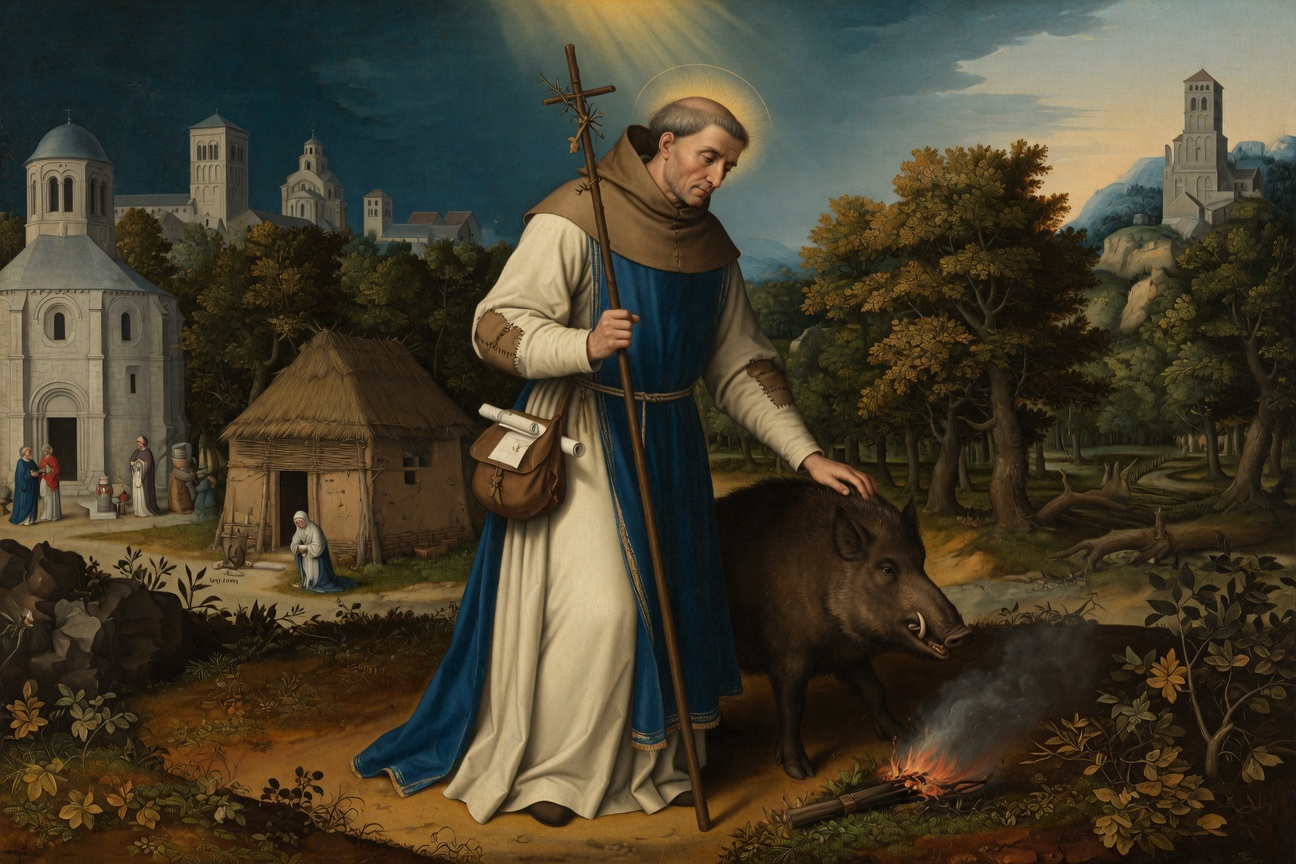
Born in Tours in 1026, Guillaume Firmat was initially a physician and canon before choosing the eremitic life. After two pilgrimages to Jerusalem and a life of austerity in the forests of Maine and Normandy, he died in Mortain in 1103. He is famous for his mastery over animals, notably a wild boar he tamed.
Contemporaries

Figures and markers around the normalized period for this entry.
Guided reading
10 reading sections
SAINT GUILLAUME FIRMAT
Youth and medical career
Born in Tours in 1026, Guillaume distinguished himself by his intelligence and piety before becoming a renowned physician within the chapter of Saint-Venant.
Saint Guillaume Firmat was born in To urs in 1026. From his childhood, he was favored with the graces of God and responded to them with a faithfulness rarely encountered at that age. Gifted with an open mind, a sound judgment, and a happy memory, he had a conversation as attractive as it was serious; his rare modesty enhanced its charm even further and added an invaluable price to all his other virtues.
The world would have liked to keep this young man whose brilliant qualities would have done it honor, but God was calling him to a more perfect life. He requested and obtained the favor of becom ing part of the Chapter of Saint-Venant. There, he set the example of the most complete obedience and the most unalterable charity. Having become very skilled in the art of medicine, he quickly acquired a great reputation, and the sick came in crowds to consult him. At that time, the practice of medicine and the ecclesiastical profession were not at all incompatible.
Call to poverty and eremitic life
Responding to a divine call, he convinces his mother to sell their possessions for the poor and retires with her to the hermitage of the Seven Brothers.
The demon took advantage of his successes, his fortune, and his other external advantages to whisper a few words of pride in his ear and to make a brilliant future in the world shine before his eyes. William knew how to thwart the enemy's ruses; knowing the full extent of human fragility, he had recourse to prayer, and he heard this divine voice resound in his heart: "Sell all that you have, give the price of it to the poor, and follow me!".
Strongly shaken by grace, he went to find his mother and shared his plan with her in these terms:
"You know, mother, that the world passes away and that to lean upon it is to lean upon a reed. God made us in his image and he wants us to become participants in his divine nature. Let us therefore exchange the goods of the earth for those of heaven. Of all the riches that God has given us, take everything you desire and let the rest become the property of the poor. As for me, with your consent, I am thinking of entering religious life."
— "What! my son," replied the mother, bursting into tears, "what! you are thinking of leaving me! who will now be the support of my old age and the consolation of my widowhood? Why then, if you wish to serve your God, not associate me with your plan? If you wish to live in solitude, can you not admit me, me alone with you, I who was your devoted nurse and who would now be your humble servant? Allow this, my son, so that she who, at your entry into this corruptible life, showed you the way, may today follow you, when you cross the road to heaven. My son, you may dispose of your goods as you see fit."
After these touching words, mother and son, in a holy transport of joy, mingle their tears and their embraces: both immediately sell their goods, distribute the price to the poor, and leave the city to retire to a hermitage called the Seven Brothers.
The Trial of Temptation
After his mother's death, he isolated himself in the forest of Concise, where he heroically resisted an attempt at seduction by voluntarily burning his arm.
While his mother prepared the daily food for her son, the son gave his mother, and in abundance, the spiritual feast of the divine word. As long as his mother lived, Saint Guillaume remained in that place; but upon her death, having no further reason to stay there, and being troubled moreover by the numerous visits he received, he left his homeland and withdrew into the depths of the for est of Concise, near Laval.
The Saint did not find in this place the tranquility he had hoped for.
Young libertines conspired with a woman of ill repute to launch an assault on his virtue. She came during the night to knock at the door of his cell and did everything in her power to seduce him. But Firmat, in her presence, took a burning brand and applied it to his own arm so forcefully that he bore the marks of the burn for the rest of his days.
Moved by this heroic action, the unfortunate woman threw herself at the knees of the solitary and asked for his forgiveness. Those who had advised her had followed her into the forest to see what would happen. The courage of the Saint triumphed over their perversity; as a sign of repentance, they published everywhere the infamous plan they had conceived and how the Saint had managed to thwart it.
This action caused the virtue of our solitary to shine with even greater brilliance, and the crowd was more eager than ever to seek his counsel and implore the aid of his prayers.
Pilgrimage to the Holy Land
Fleeing his fame, he departed for Palestine where he performed miracles and endured persecutions from the enemies of the Christian name.
The influx of people became such that his humility was alarmed by it: he left his solitude and went to Palestine to visit the places sanctified by the Savior of the world.
God assisted him in a tangible way during his pilgrimage: at his prayer, He caused a spring to gush forth in the middle of the desert, the aridity of which was causing him terrible suffering.
Another time he lost his way, and as he could not find his route, God sent him a raven to guide him. This bird preceded him, and by its voice and repeated flapping of its wings, it encouraged him to follow it.
He was also visited by trials, but the Saints welcome them as favors. Captured by the enemies of the Christian name, he was chained, struck with rods, and put in prison. He was only taken out to be loaded with heavy burdens and then forced to walk in the manner of quadrupeds. The courageous athlete of Christ endured all this with joy, and if he did not then have the glory of martyrdom, one can affirm that he acquired all its merit.
Itinerancy and miracles in France
Returning to France, he traveled through Brittany and Maine, causing miraculous springs to gush forth at Dordenay before settling in the forest of Mayenne.
Once set free, he returned to France and went to Vitré, in Brittany, where he remained for a very short time. At Dordenay, he miraculously caused a spring of water to gush forth by fixing his staff into the ground, and the inhabitants, in memory of this miracle, called this place the fountain of Saint-Firmat.
This prodigy having attracted a large number of people to his hermitage, he returned towards Maine and lived in the forest of Mayenne, at Fontaine-Géhard.
Asceticism at Mantilly
He settled permanently in Mantilly, leading a life of extreme austerities, fasting, and prayer, while redistributing alms to the poor.
After wandering in several other places, he settled permanently in Mantilly, ne ar Passa is, in the diocese of Le Mans. There he gave himself over to all kinds of austerities and rigorous fasts; he often ate only in the evening, and even then he took only a few roots. He had for a bed only a few pieces of rush upon which he lay, granting only two or three hours to a sleep that nature imperiously demanded.
Detached from earthly goods, he accepted only what was indispensable for his nourishment, and he distributed to the poor all the offerings that came to him from the piety of the faithful.
Travels and final return
After a stay on the banks of the Rhône and a second journey to Jerusalem, he was brought back by the inhabitants of Mantilly who demanded his return.
William was living in peace in solitude, when a circumstance once again forced him away. His clerk having been the object of mistreatment by certain local workers, he fled stealthily and went to hide on the banks of the Rhône in a place called Eosne.
He returned a second time to Jerusalem and came back once again to his solitude.
However, the inhabitants of Mantilly could not be consoled for his departure, and they deputized two of their fellow citizens to go in search of him. They set off barefoot, fully resolved not to return without having discovered the Saint's retreat and without bringing him back with them. They begged God to guide them and to put them on the trail of the pious hermit. Arriving on the banks of the Rhône, they questioned a fisherman who seemed to be there specifically to reveal to them the retreat of Saint Firmat. The Saint already enjoyed a great reputation in this place, and the sick went there with eagerness. Having finally found him, the two travelers threw themselves at his knees and begged him with tears to return to Mantilly. The Saint allowed himself to be swayed by their entreaties and consented to return to his former solitude.
William kept his word, and as soon as the day of his arrival was known, all the people went to meet him and gave him a reception worthy of his virtue and the love they had for him.
Power over nature and social influence
The saint manifests a mystical dominion over wild animals and uses his influence to convert the wealthy to charity, such as Délicata of Landivy.
He had barely arrived in his solitude when one of his relatives from Tours came to find him and sought the help of his prayers for the deliverance of her son who was a prisoner. The Saint had her told that she could be at peace, that her son would be set free. The poor mother had barely returned to her home when her son, free and joyful, threw himself around her neck and affirmed to her that the prayer of Guillaume alone had delivered him.
Our Saint, as we read in the life of some of the privileged servants of God, exercised a great dominion over animals. It is said that birds, even the wildest ones, approached him without fear, came to eat from his hand or to take refuge under his clothes to shelter themselves from the cold. When he sat on the edge of the pond near his cell, the fish arrived at his feet and willingly let themselves be caught by the servant of God, who returned them to the water without having done them any harm.
One day his clerk ran up, all in a stir, and announced to him that a wild boar was causing great havoc in the garden and destroying almost all the vegetables. Guillaume then went toward this terrible animal, gently took its ear, and the boar, gentle as a lamb, let itself be led, followed the Saint into his cell, spent the night there, and only regained its freedom very early the next day, but after a charitable warning not to ravage his clerk's garden henceforth.
In his final years, this holy old man was like the oracle of the inhabitants of Mayenne, Domfront, Passais, and all the neighboring regions. All his words were listened to with sovereign respect, and he knew how to use his influence for the relief of the poor. Délicata, wife of Grimald, lord of Landivy, did not share the sentiments of libe rality o f her husba nd, who was the possessor of immense riches. The saint energetically rebuked her for her avarice and predicted that she would one day be condemned to beg for her bread. Délicata took advantage of the warnings of the servant of God and became as generous as she had been avaricious.
Death and cult at Mortain
He died at Mortain in 1103. His body, placed in the church of Saint-Évroul, became the object of an important pilgrimage and he is honored as the patron saint of the city.
His life was full before God, and the hour of reward was about to strike. One day when he was at Mortain , in th e diocese of Avranches, where he often went to pray, he fell ill, and a few days later, with a joyful spirit and a face radiant with serenity, he passed away gently. His death occurred on April 24 in the year 1103.
His body was buried in the church of Saint-Évrou l, which has since taken the name of Saint-Guillaume. His tomb was made illustrious by numerous miracles, and a great concourse of pilgrims gathered there. He is the patron saint of Mortain.
The church of Tours celebrates the feast of its illustrious citizen every year on February 28.
Iconographic attributes
Artistic tradition represents him with the attributes of a hermit, accompanied by a wild boar or recalling his victory over carnal temptation.
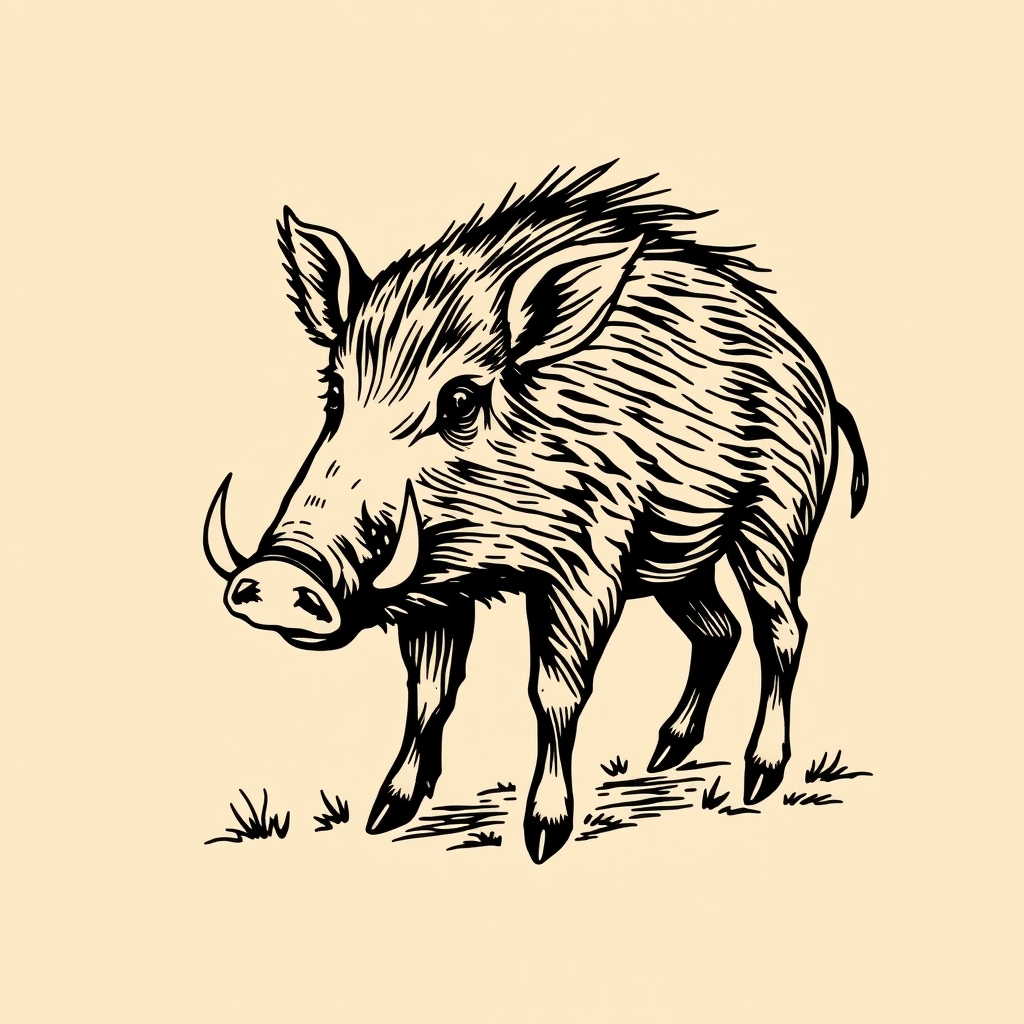
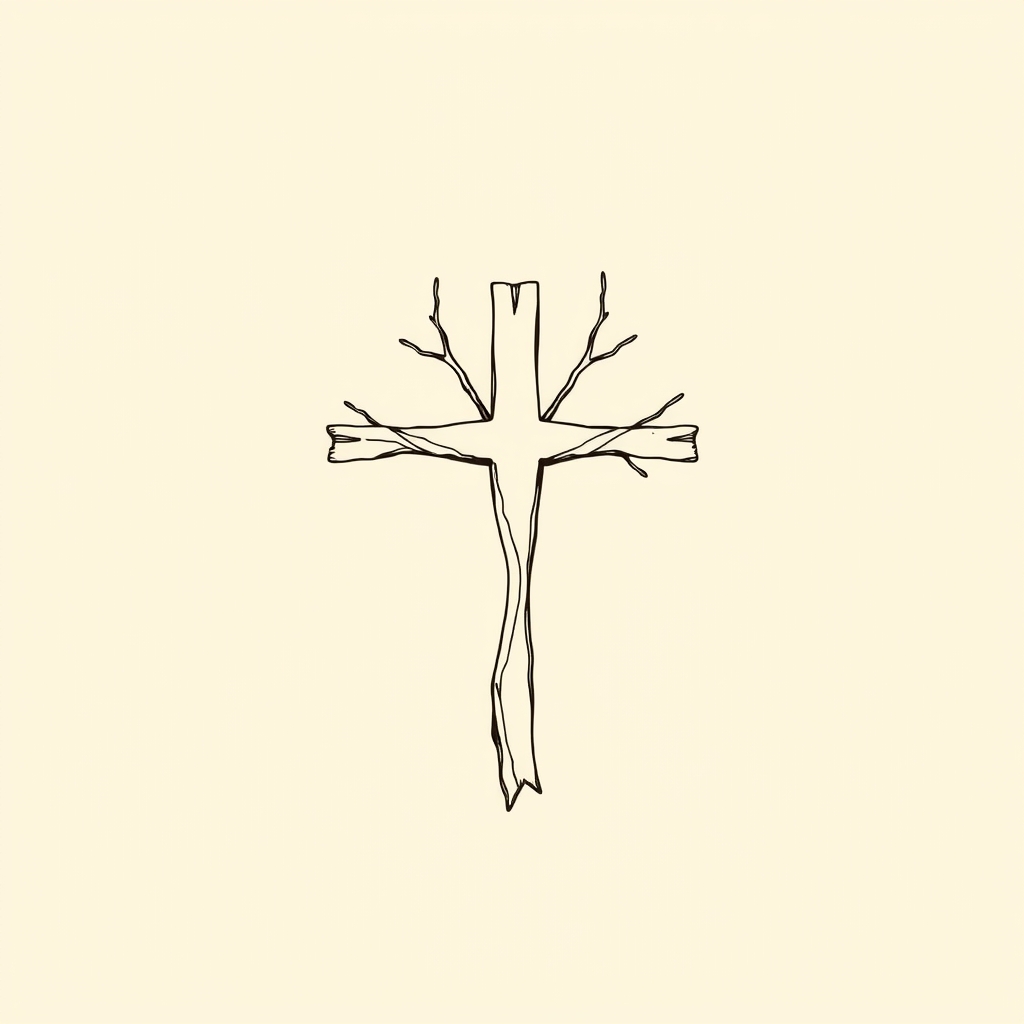
Painters and sculptors may place Saint Guillaume Firmat among the hermits, and give him all the attributes that characterize the inhabitants of solitude: a hut, a knotted rope, a staff, a cross made of branches, wild animals in the landscape, a habit, a long beard, etc. — The solicitations of the shameless woman, the sermon in action on the hell to which forbidden pleasures lead, would provide the subject for a beautiful painting for some imaginative painter. One must not forget, as an attribute of Saint Guillaume, the wild boar that he forced to fast all night in his cell.
Abbé Rolland, honorary canon, chaplain of the Brothers' Boarding School, in Tours.
Iconography
Signs and attributes



Entities
Narrative network
The names, places, and concepts most present in the entry, weighted by centrality in the text.
The supernatural in their life
The miracles of Saint William Firmat
Frequently asked questions about Saint William Firmat
Who was Saint William Firmat?
Born in Tours in 1026, Guillaume Firmat was initially a physician and canon before choosing the eremitic life. After two pilgrimages to Jerusalem and a life of austerity in the forests of Maine and Normandy, he died in Mortain in 1103. He is famous for his mastery over animals, notably a wild boar he tamed.
What is Saint William Firmat the patron saint of?
Patronage of Saint William Firmat: Mortain.
What is Saint William Firmat invoked for?
Saint William Firmat is invoked for: healing of the sick and deliverance of prisoners.
How is Saint William Firmat depicted in Christian art?
In iconography, Saint William Firmat is recognizable by: wild boar, burning brand, staff, cross made of branches, long beard and hermit's habit.
What miracles are attributed to Saint William Firmat?
5 miracles are attributed to this saint, notably: Mastery of the elements, Sign / wonder and Protection / deliverance.
Which saints were contemporaries of Saint William Firmat?
Contemporaries include: Saint Stephen of Hungary, Saint Bernard of Menthon (Apostle of the Alps), Saint Norbert of Magdeburg and Saint Bernard of Clairvaux.
When did Saint William Firmat die?
Saint William Firmat died around 1103.
What are the other names of Saint William Firmat?
Other forms of the name: Guillaume Firmat and Firmat.
Who are the relatives of Saint William Firmat?
Relatives of Saint William Firmat: Inconnue (mother).
Annexes & related entities
Structured data for exploration: events, miracles, quotes, places, attributes, patronages, and important entities cited in the text.
Key Events
- Born in Tours in 1026
- Member of the Chapter of Saint-Venant and medical practitioner
- Retreat at the Sept-Frères hermitage with his mother
- Eremitic life in the forests of Concise, Mayenne, and Mantilly
- Pilgrimages to Jerusalem (twice)
- Captivity and mistreatment in the Holy Land
- Miracle of the burning brand to resist temptation
- Taming of a destructive wild boar
Quotes
-
Sell everything you have, give the proceeds to the poor, and follow me!
Divine voice heard by the saint -
You know, mother, that the world passes away and that to lean upon it is to lean upon a reed.
Words of Guillaume to his mother