
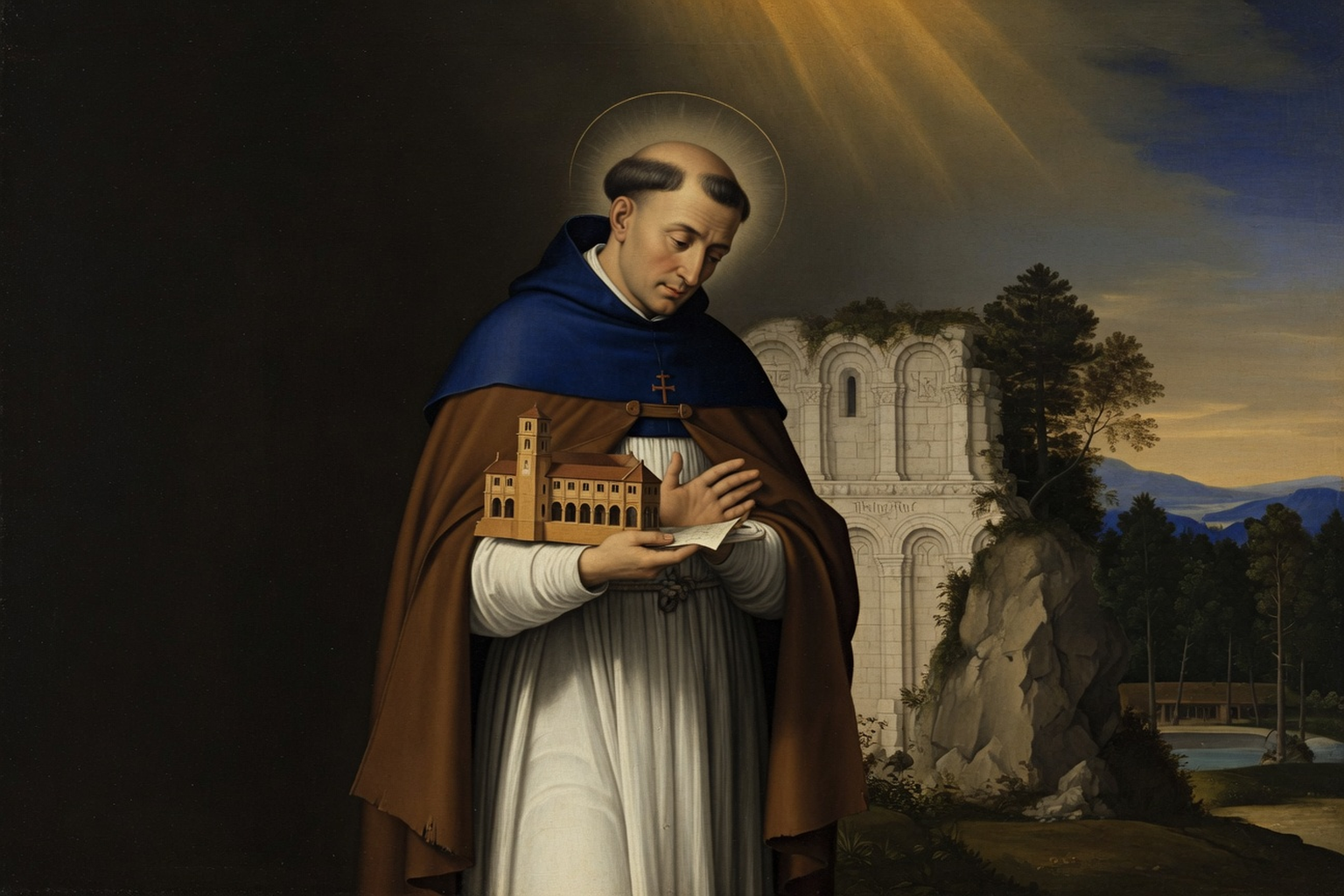
Saint Stephen of Bourg
A canon of Saint-Ruf in Valence, Étienne de Bourg joined Saint Bruno to found the Carthusian Order in 1084. After thirty-three years of eremitic life, he founded the Charterhouse of Meyria in 1116 at the command of his prior. He died there in 1118, leaving behind a reputation for holiness confirmed by miracles.
Contemporaries

Figures and markers around the normalized period for this entry.
Guided reading
4 reading sections
SAINT ÉTIENNE DE BOURG
Vocation and desire for solitude
Étienne de Bourg began his religious life as a canon at Saint-Ruf in Valence, but he was quickly drawn to a life of deeper solitude.
Saint Étienne de Bourg was a canon of Saint-Ruf, in Valence, in the Dauphiné. Nothing was more edifying than his life in that house. But solitude, where, as Origen says, the air is purer, the heavens more open, and where God communicates with greater familiarity, solitude charmed him and drew him irresistibly.
The meeting with Saint Bruno
Accompanied by Étienne de Die, he joined Saint Bruno at Sèche-Fontaine under the spiritual direction of Saint Robert of Molesmes.
Accompanied by another canon of Saint-Ruf, named Étienne de Die, he went to Sèche-Fontaine, in the diocese of Langres, where Saint Bruno, with a few companions, had already begun to lead the eremitic life. Saint Robert, abbot of Molesmes, had attracted them there and had given them a rule.
The foundation of the Grande-Chartreuse
Étienne proposes the Chartreuse desert to Saint Bruno. With the support of Bishop Hugh of Grenoble, they founded the monastery there in 1084.
However, Saint Bruno did not find this solitude wild enough: so the two newcomers proposed that he go and settle in a desert in the diocese of Grenoble called Chartreuse. They assured Saint Bruno that he would be pleased with the harshness and aridity of this retreat. They added that Hugh, Bishop of Grenoble, a great friend of the religious life, would be happy to see them settle in his diocese.
Saint Bruno, persuaded, set out with his companions; the pilgrims were seven in number; warned by a mysterious dream, Saint Hugh received them with transports of joy and led them to the Chartreuse; they arrived there on Saint John's Day in the year 1084. On this same day, the foundation of the Grande-Chartreuse was begun.
Foundation of Meyria and end of life
After 33 years at the Charterhouse, Étienne founded the Charterhouse of Meyria in 1116 before passing away in 1118.
Saint Étienne de Bourg spent thirty-three years of his life there. This period having expired, God, before calling him to Himself, wished to have him crown his career with the work of an important foundation. At the request of the blessed Ponce de Balmey, his relative, Dom Guigue, his prior, gave him the order to go and found a Charterhouse at Meyria. It was begun in 1116; it was populated by a flourishing colony of religious two years later, when its holy founder left it (January 4, 1118) for the heavenly dwelling. Miracles occurred at his tomb. The Charterhouse of Meyria lasted until 1792, always governed by men eminent in virtue and holiness. This date of 1792 says enough about whose hands destroyed it; it is now nothing more than a heap of ruins.
Additional passages recovered from the sources
These passages from Les Petits Bollandistes supplement the entry. The references identify their context in the original volume.
Read the supplementary notes and passages (1)
Note on Saisse-Fontaine
Historical supplement to the Petits Bollandistes, transcribed from the image of the 19th-century edition. The traditions, assessments and expressions describing a "current" situation are those of the source in its time; they do not constitute contemporary verification.
Or better Saisse-Fontaine, in Latin Saxi-Fontana, rock fountain.
Paul Guérin, Les Petits Bollandistes, volume 1, p. 133. Bibliothèque nationale de France: https://gallica.bnf.fr/ark:/12148/bpt6k30731s
Entities
Narrative network
The names, places, and concepts most present in the entry, weighted by centrality in the text.
The supernatural in their life
The miracles of Saint Stephen of Bourg
Frequently asked questions about Saint Stephen of Bourg
Who was Saint Stephen of Bourg?
A canon of Saint-Ruf in Valence, Étienne de Bourg joined Saint Bruno to found the Carthusian Order in 1084. After thirty-three years of eremitic life, he founded the Charterhouse of Meyria in 1116 at the command of his prior. He died there in 1118, leaving behind a reputation for holiness confirmed by miracles.
What is Saint Stephen of Bourg the patron saint of?
Patronage of Saint Stephen of Bourg: Meyria Charterhouse.
What miracles are attributed to Saint Stephen of Bourg?
1 miracle are attributed to this saint, notably: Sign / wonder.
Which saints were contemporaries of Saint Stephen of Bourg?
Contemporaries include: Saint Norbert of Magdeburg, Saint Bernard of Clairvaux, Saint Stephen of Hungary and Saint Arthaud of Belley.
When did Saint Stephen of Bourg die?
Saint Stephen of Bourg died around 1200.
Who are the relatives of Saint Stephen of Bourg?
Relatives of Saint Stephen of Bourg: Ponce de Balmey (parent).
Annexes & related entities
Structured data for exploration: events, miracles, quotes, places, attributes, patronages, and important entities cited in the text.
Key Events
- Canon at Saint-Ruf of Valence
- Joined Saint Bruno at Sèche-Fontaine
- Settled at the Grande-Chartreuse on Saint John's Day 1084
- Thirty-three year stay at the Grande-Chartreuse
- Foundation of the Charterhouse of Meyria in 1116