
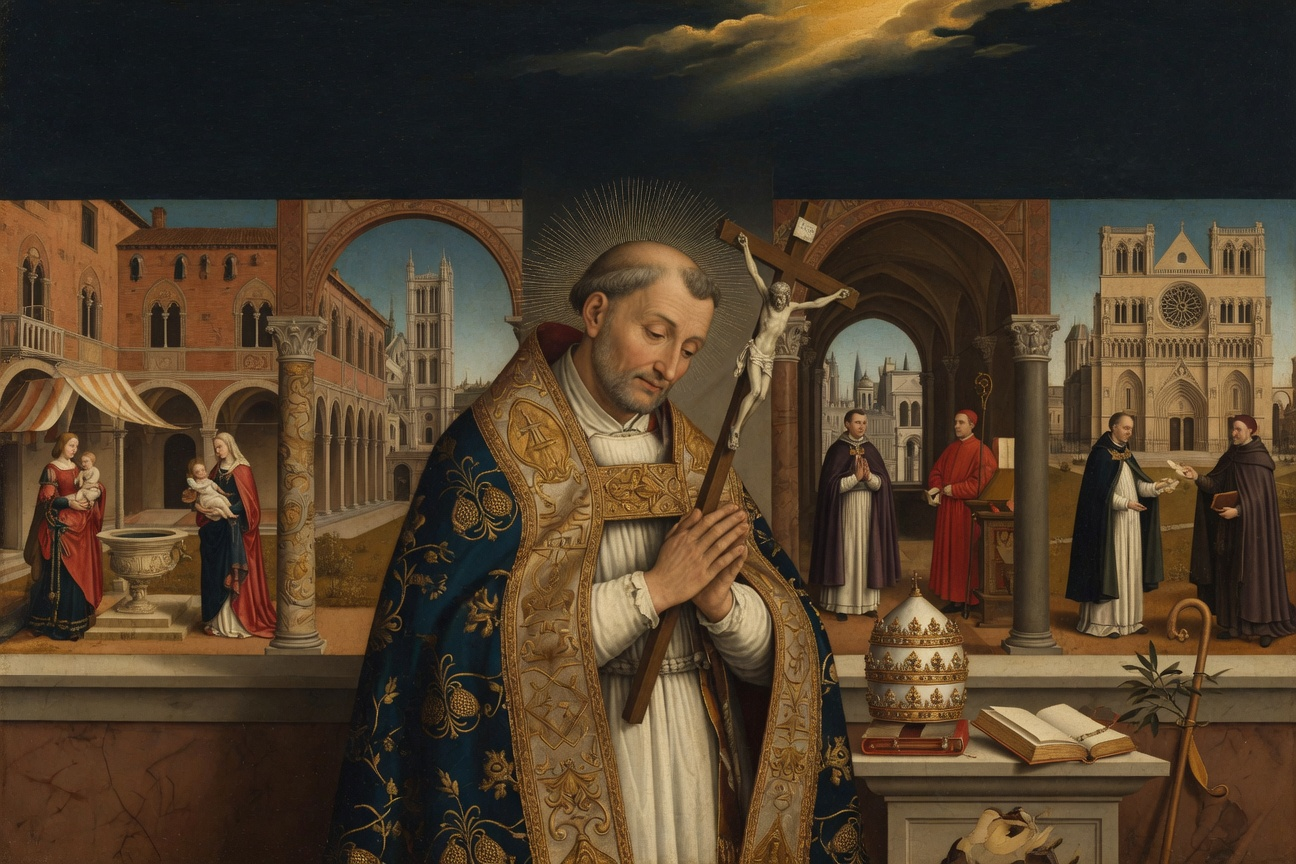
Elected Pope in 1271 while in the Holy Land, Gregory X (Theobald Visconti) dedicated his pontificate to peace, the reform of the Church, and the relief of Jerusalem. He presided over the Second Council of Lyon in 1274, marking a brief union with the Greeks and receiving Tartar ambassadors. He died in Arezzo in 1276, leaving the image of a pontiff of great humility and inexhaustible charity.
Contemporaries

Figures and markers around the normalized period for this entry.
Guided reading
9 reading sections
SAINT GREGORY X, POPE
Youth and ecclesiastical formation
Théobald Visconti, born in Piacenza, distinguished himself through his study of canon law and his service to Cardinal Jacques de Pécoraria before becoming archdeacon of Liège.
Thébald or Théobald , later Gregory X, was born in Piacenza to the noble Visconti family. From his youth, an uncommon virtue and an extraordinary application to study were noted in him; he acquired, above all, a perfect knowledge of canon law. Having heard of the holiness of Jacques de Pécoraria, Cardinal-Bishop of Palestrina, he went to find him and humbly placed himself in his service. He felt all the more joy in this as the cardinal appeared to him even holier than rumor had suggested. He followed him on the legation to France in the year 1239, under Pope Gregory IX. There, he was successively canon of Lyon and archdeacon of Liège. He refused the bishopric of Piacenza, which Pope Innocent IV offered him. He was returning from Rome when the Archbishop of Lyon, Philippe, begged him insistently to remain with him during the general council, in order to teach him how to conduct himself with regard to the Pope and the cardinals. The pious archdeacon of Liège spent part of his time at the University of Paris to perfect himself in the sciences suitable to his station. King Sa int Louis showed h im such great affection and veneration that many were astonished that such an excellent king should honor an ecclesiastic who did not hold a high dignity so much. But the holy king knew well what he was doing. He had learned from him and seen for himself so many wonderful things that he regarded him as a temple of God and a sanctuary of the Holy Spirit. Cardinal-Legate Ottobon, passing through England to restore peace between the king and the barons, took the archdeacon Théobald with him because of his great love for peace and his particular grace in leading others to it.
Commitment to the Holy Land
Inspired by the example of Saint Louis, Theobald took the cross and traveled to Palestine to support the Christians and ease local tensions.
Saint Louis and the barons of France having taken the cross for the second time, the pious Theobald considered it a shame for clerics and prelates not to follow the example of the laity. He therefore took the cross with great devotion and traveled to Palestine. Prince Edward of England and his sister Beatrice, Countess of Brittany, received him there with great joy. And indeed, his presence was not useless. He revived the courage of the faint-hearted, settled disputes, and confirmed a great number in their holy resolution.
Unexpected election to the pontificate
While in Saint-Jean-d'Acre, he was elected pope by compromise after a long vacancy of the apostolic see, taking the name Gregory X.
It was in 1271. Suddenly it was learned in Palestine that the holy archdeacon of Liège had been elected pope. The apostolic chair had been vacant for nearly three years, as the cardinals assembled in Viterbo had been unable to agree on the choice of a pontiff. Weary, in the end, of being unable to conclude anything, they had recourse to a compromise, and the six cardinals, to whom all the others had delegated their powers, unanimously elected our Saint on September 1, 1271. The new pope received the act of his election in Ptolemais or Saint-Jean-d'Acre, acquiesced to it on October 27, and took t he name of Gregory X. The news of his election brought great joy to the Christians of the Holy Land; they hoped that he would send them great aid. He himself, in a sermon he gave at the moment of his departure, cried out with the Psalmist: "If I forget thee, O Jerusalem, let my right hand be forgotten! Let my tongue cleave to my jaws, if I do not remember thee, if I set not Jerusalem at the beginning of all my joy!"
Relations with the Mongol Empire
The new Pope maintained diplomatic relations with the Great Khan of the Tartars, sending missionaries and oil from the Holy Sepulchre via the Polo brothers.
The first task of the new Pope, Saint Gregory X, was to respond, as head of the Catholic Church, and to send nuncios to the Great Khan of the Tartars, the Emperor of China, Kublai or Chi-Tsou. This powerful monarch, with the advice of his princes, sent to the Pope the two Venetian brothers Polo, along with a lord of the Chinese empire named Gogak. These three ambassadors were to ask the Roman Pontiff for one hundred learned men, well-instructed in the Christian law, who could demonstrate that the faith of the Christians is to be preferred to all other diverse sects, that it is the only path to salvation, and that the gods of the Tartars are demons who deceive the Orientals: the Emperor, having heard much about the Catholic faith, but seeing with what temerity the scholars of Tartary and China defended their beliefs, did not know which side to lean toward, nor which path to embrace as the true one. He further requested that the ambassadors bring him a little oil from the lamp that burned in Jerusalem before the Lord, convinced that it would be of great use to him if Christ were indeed the Savior of the world.
After a three-year journey, the Tartar lord having remained behind due to illness, the other two ambassadors arrived at Saint-Jean-d'Acre. Having learned there of the death of Pope Clement IV, they addressed themselves to the Archdeacon Theobald, who was serving as apostolic internuncio in Palestine. He advised them to wait until there was a new Pope. In the interval, they went to Venice, their homeland, and after two years of waiting, returned to Saint-Jean-d'Acre with the son of one of them, the famous Marco Polo, who wrote th e history of their journey. The nuncio Theobald gave them letters with an exposition of the Christian faith. Scarcely had they set out when Theobald, having become Pope Gregory X, recalled them, gave them other letters for the supreme Emperor of the Tartars, and attached to them two Preaching Friars, Nicholas and William of Tripoli. They were received with extreme kindness by the Emperor of the Tartars and China. They presented him with the letters of the new Pope, as well as the oil from the lamp of the Holy Sepulchre, which he had placed in an honorable location. This is what is testified to by Marco Polo, who was present.
Return to Italy and Coronation
Returning to Italy in 1272, he was received with fervor, received the homage of the King of Sicily, and was consecrated at St. Peter's Basilica in Rome.
Saint Gregory X embarked in the middle of winter from Ptolemais. Prince Edward of England provided him abundantly with all things. The Greek Emperor, Michael Palaiologos, complained in a friendly manner that he had not passed through Constantinople, where he would have been received with the greatest pomp and joy. Finally, he arrived safely at the port of Brindisi on January 1, 1272. His arrival spread joy throughout Italy and all of Christendom. At Benevento, King Ch arles of Sicily came to meet him, accompanied him throughout his kingdom, and served as his squire. At Ceprano, he met several cardinals who had come to meet him, entered Viterbo with them on February 10, donned the papal mantle there, and solemnly took the name Gregory, as much because of his devotion to Saint Gregory the Great as because his feast day was near.
While still on the lands of the King of Sicily, he received a deputation of the greatest men of Rome, who urged him to come there. But he considered that in Rome he might find other matters that would distract him from that of the Holy Land, to which he wished to give his first care. He therefore went straight to Viterbo, where the cardinals and the Roman court resided. There, without giving himself time to rest after such a long journey, and closing the door to all other business, he worked solely, for eight days, on the relief of the Holy Land, which he had left reduced to the extreme. He engaged Pisa, Genoa, Marseille, and Venice to each provide three armed galleys, twelve in all; and, to meet the costs of the war, he gave orders for the collection of pious legacies intended for this purpose, which were considerable; then he sent the Archbishop of Corinth to France with a letter to King Philip, in which he speaks with effusion of Saint Louis, whom he testifies to having loved with all his heart; he reminds the son of his father's zeal for the deliverance of the Holy Land. He adds: "When we were there, we conferred with the leaders of the Christian army, with the Templars, the Hospitallers, and the great men of the country, on the means of preventing its total ruin. We have since treated of it with our brothers the cardinals, and we have found that it is necessary to send there now a certain quantity of troops and galleys, while awaiting greater relief, which we hope to procure for it through a general council."
Saint Gregory X was consecrated in Rome, in the Basilica of Saint Peter, on the 27th day of March, which, in this year 1272, was the third Sunday of Lent. He was escorted with pomp from the Basilica of Saint Peter to the Lateran Palace; King Charles of Sicily walked on his right, performing the duties of squire; at the meal that followed, the same prince wished to serve the Pope the first dish. At the end of the solemnity, the King paid the Pope the homage and oath of fidelity that he owed for the Kingdom of Sicily.
Convocation of the Council of Lyon
Gregory X convokes a general council to address the Greek schism, the situation in the Holy Land, and the reform of morals within the Church.
Two days later, the Pope had a circular letter sent to all the bishops to inform them of his ordination, according to custom. This letter was closely followed by another, also addressed to the bishops, for the convocation of a general council. The holy Pope marks three main causes: the schism of the Greeks, the poor state of the Holy Land, of which he had been an eyewitness, and the vices and errors that were multiplying in the Church. "Wishing therefore," he says, "to remedy so many evils through a common council, we ask you to be present on May 1st of the year 1274 at the place we shall indicate to you in due time. We wish that in each province one or two bishops remain to exercise episcopal functions, and that those who remain send deputies to the council, as well as the Chapters, both of cathedrals and collegiate churches. Meanwhile, you shall examine and put in writing what needs correction in order to bring it to the council." The bull is dated the last day of March 1272.
To take care of spiritual matters in the Holy Land, Pope Gregory gave the title of Patriarch of Jerusalem to Brother Thomas of Lentini, in Sicily, a Dominican, previously Bishop of Bethlehem. He also made him his legate in Armenia, Cyprus, the principality of Antioch, the neighboring islands, and the entire coast of the Orient; he recommended above all that he work for the reformation of the morals of the Latin Christians in these provinces. Here is how he speaks to him in one of his letters: "You know for yourselves the enormous crimes that are committed there, and that the wretched slaves of voluptuousness, abandoning themselves to the movements of the flesh, have drawn the wrath of God upon Antioch and so many other places that the enemies have destroyed. It is astonishing that our brothers are so little moved by these examples, that they continue the same disorders, without repenting, until they perish themselves."
Stay in Lyon and personal virtues
In Lyon, the Pope leads a life of asceticism and charity, and performs the miracle of saving a woman from drowning in the Saône through his prayer.
While awaiting the general council that was to be held in Lyon, Pope Gregory worked to pacify the cities of Italy. His holy life was well suited to win hearts. Every day he washed the feet of several poor people with a humility that drew tears from the eyes of all those present. He had officers to go out and discover the unfortunate and distribute his alms to them. He never took more than one meal a day, solely to sustain the weakness of the body, not for any pleasure. At the table, he was so attentive to the reading that, upon leaving, he could not have said what he had eaten. All the time that his affairs left him, he devoted to prayer and contemplation. During his lifetime, this miracle is reported of him: Being in Lyon during a flood of the Saône, he saw from his window a poor woman who had fallen into the river and was submerged in the waves, to such an extent that boatmen who had set out to her rescue returned without any hope; but, from the very first moment, the holy pontiff had prayed to the Divine Mercy, which sustained Saint Peter walking on the waves and saved Saint Paul three times from shipwreck, to extend a helping hand to this poor woman and deliver her from such a grievous death. Soon the woman reappeared on the waters; the surprised boatmen returned to her rescue and saved her in their boat, having no more harm than if she had only taken a bath. The Pope sent one of his chamberlains to question the woman, who told him that she had been delivered by a venerable personage whom she did not know.
To this tender charity for the poor, Gregory X joined an invincible firmness toward great offenders. King Edward of England had asked him for justice for the murder committed on the person of Henry of Almain, his cousin, by Guy de Montfort. Here is how the holy Pope reported to him, on November 29, 1273, what had happened in this affair: "When we had come to Florence, Guy de Montfort sent his wife and several other persons to urgently request permission to come into our presence, assuring that he was ready to obey our orders; but we wished to take time to test the sincerity of his repentance. Upon leaving Florence, about two miles away, he presented himself to us, accompanied by some others, all barefoot, in tunics, with ropes around their necks, prostrated on the ground and melting into tears. As several of our retinue stopped at this spectacle, Guy de Montfort cried out that he submitted without reservation to our commands, and urgently asked to be imprisoned in such a place as we might please, provided he obtained his absolution. However, we did not wish to listen to him then; we gave him no answer; on the contrary, we addressed a reprimand to those who accompanied him, as choosing a bad time. But afterwards, on the advice of our brothers, we ordered our cardinal-deacons, residing in Rome, to assign him a place for his prison in some fortress of the Roman Church, and to have him guarded during our absence by the orders of King Charles of Sicily." Guy de Montfort submitted to all the orders of the Pope, who, the following year, tempered their severity by allowing the Patriarch of Aquileia to restore him to the communion of the faithful, but without prejudice to the rest of his sentence.
Saint Gregory X having arrived in Lyon, King Philip of France went to visit him there, and left for his guard a select troop of soldiers, commanded by Imbert de Beaujeu, his relative. This monarch had returned to the Pope the Comtat Venaissin, which had been ceded to the Holy See under the pontificate of Gregory IX, and which nevertheless Alphonse, Count of Toulouse, whose heir King Philip had just become, had retained until then.
The Second Council of Lyon
The council gathered numerous prelates and ambassadors, leading to a temporary union with the Greeks and alliances with the Tartars.
However, prelates and ambassadors arrived from all parts to Lyon for the Council. There were five hundred bishops, seventy abbots, and a thousand other prelates present. Among the cardinals, one could distinguish Saint Bonaventure, Bishop of Albano, and Peter of Tarentaise, Bishop of Ostia, later Pope under the name Innocent V. Saint Thomas Aquinas had received orders from the Pope to be there, but he died on the way. The Council, the second of Lyon, opened on May 2, 1274, after a three-day fast. On the 24th, the ambassadors of the Greek Emperor, Michael Palaiologos, arrived to work on the reunion of the schismatic Greeks with the Roman Church, which took place on the feast day of Saint Peter and Saint Paul, June 29.
July 4 saw an even more astonishing spectacle, with Tartars arriving at the Council. They were sixteen ambassadors of the Khan Abaga, great-grandson of Genghis Khan. Pope Saint Gregory X, to honor them, wished for the officers of the cardinals and prelates to go and meet them. They were brought to his apartment, where the cardinals were present, to discuss the affairs of the Council. This embassy had no other goal than a treaty of alliance with the Christians against the Muslims. After the Council, the Khan's letter was read in the fourth session; the Pope replied to this prince that he would send his legates to Tartary to treat with him, not only on the proposals he made, but on other matters concerning his salvation. One of the Tartar ambassadors received baptism at the Council. Saint Gregory X published several important constitutions that are part of canon law. One article forbids a bishop appointed to a diocese from interfering in its administration under any pretext until his appointment is confirmed by the Holy See. On July 17, the holy Pontiff ended the Council by giving his blessing to all those present. He dismissed the Greek ambassadors, laden with gifts and delighted by the honorable and cordial manner in which they had been received. He likewise dismissed the Tartar ambassadors, with letters for Khan Abaga. He addressed letters and admonitions to the Christians of Europe, to oblige them to govern their peoples in a Christian manner. In Lausanne, he had an interview with the new King of the Romans, Rudolph of Habsburg, who swore an oath to him as defender of the Roman Church and future emperor.
Death in Arezzo and legacy
The Pope died holily in Arezzo in 1276 while returning to Rome, leaving behind the image of an angelic and peacemaking pontiff.
The holy Pope was thus returning to Rome, doing good everywhere, when he fell ill in Arezzo, i n Tusc any, and died on January 10, 1276, after having held the Holy See for three years, nine months, and fifteen days. He died as he had lived, as a Saint. When he felt his final hour approaching, he asked for the crucifix, devoutly kissed the feet of the Savior, watering them with his tears, addressed the Angelic Salutation to the Blessed Virgin, commended his soul to God, and gave up his spirit so peacefully that he seemed to be falling into a sweet sleep. His feast is marked on February 16 in the Roman Martyrology of Benedict XIV.
All historians speak of Gregory as a saint. The Greeks themselves, in the council they held in Constantinople after his death, call him a blessed and most holy man: if, however, they add, one should call him a man, and not an angel. We therefore had to add him to Father Giry's collection.
Iconography
Signs and attributes

Entities
Narrative network
The names, places, and concepts most present in the entry, weighted by centrality in the text.
The supernatural in their life
The miracles of Saint Gregory X (Theobald Visconti)
Frequently asked questions about Saint Gregory X (Theobald Visconti)
Who was Saint Gregory X (Theobald Visconti)?
Elected Pope in 1271 while in the Holy Land, Gregory X (Theobald Visconti) dedicated his pontificate to peace, the reform of the Church, and the relief of Jerusalem. He presided over the Second Council of Lyon in 1274, marking a brief union with the Greeks and receiving Tartar ambassadors. He died in Arezzo in 1276, leaving the image of a pontiff of great humility and inexhaustible charity.
What is Saint Gregory X (Theobald Visconti) the patron saint of?
Patronage of Saint Gregory X (Theobald Visconti): Piacenza and Arezzo.
What is Saint Gregory X (Theobald Visconti) invoked for?
Saint Gregory X (Theobald Visconti) is invoked for: peace between peoples and unity of the Church.
How is Saint Gregory X (Theobald Visconti) depicted in Christian art?
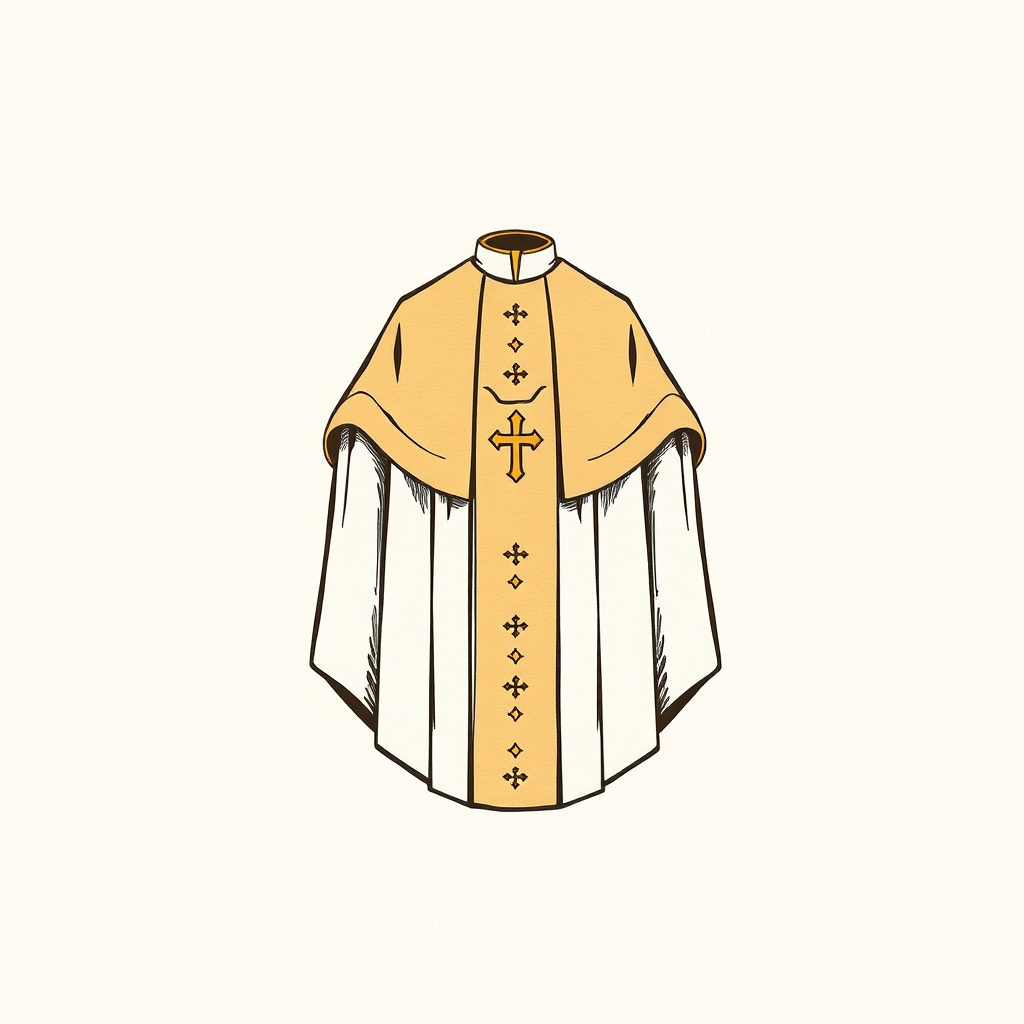
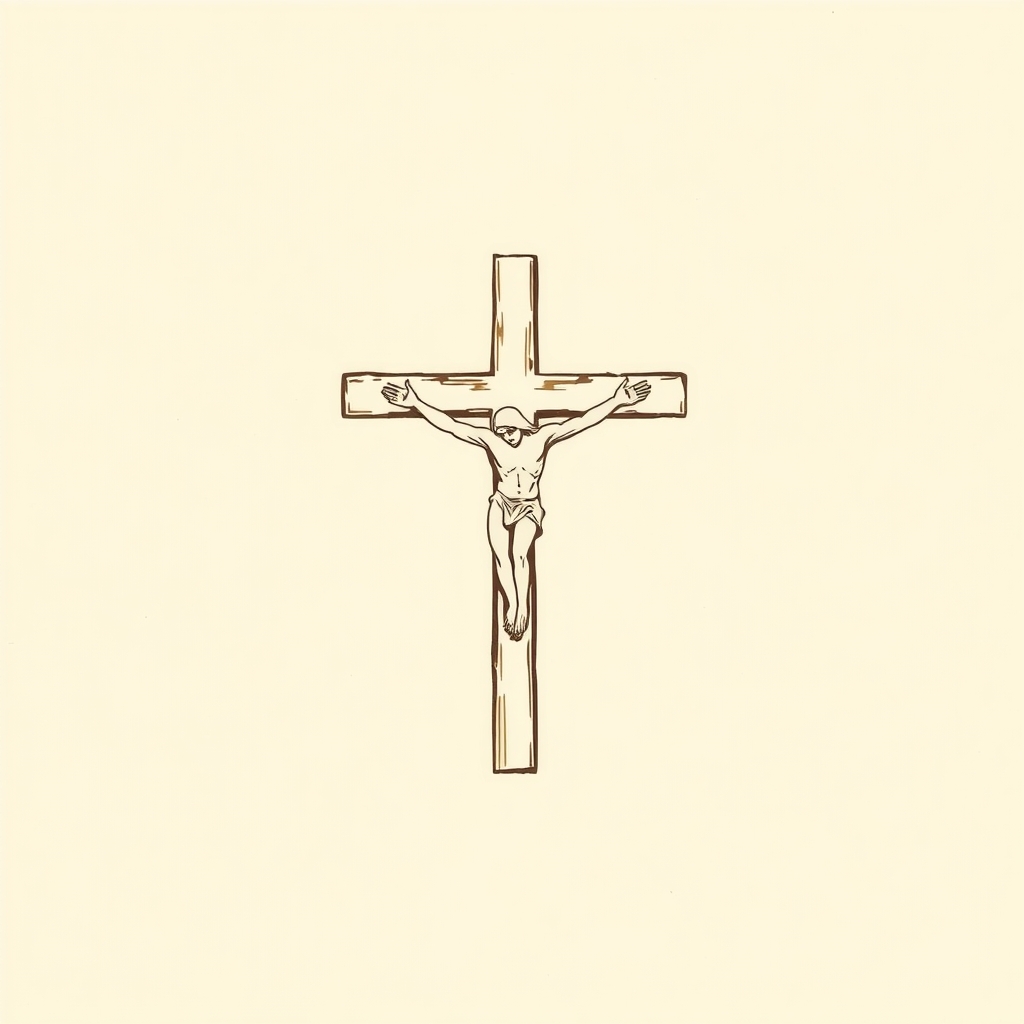
In iconography, Saint Gregory X (Theobald Visconti) is recognizable by: papal mantle, crucifix and tiara.
What miracles are attributed to Saint Gregory X (Theobald Visconti)?
1 miracle are attributed to this saint, notably: Mastery of the elements and Protection / deliverance.
Which saints were contemporaries of Saint Gregory X (Theobald Visconti)?
Contemporaries include: Saint Thomas Aquinas, Saint Anthony of Padua (Ferdinand), Saint Arthaud of Belley and Saint Peregrinus of Auxerre.
When did Saint Gregory X (Theobald Visconti) die?
Saint Gregory X (Theobald Visconti) died around 1276.
What are the other names of Saint Gregory X (Theobald Visconti)?
Other forms of the name: Thébald, Théobald and Visconti.
Who are the relatives of Saint Gregory X (Theobald Visconti)?
Relatives of Saint Gregory X (Theobald Visconti): Visconti (noble family).
Annexes & related entities
Structured data for exploration: events, miracles, quotes, places, attributes, patronages, and important entities cited in the text.
Key Events
- Born in Piacenza into the Visconti family
- Service with Cardinal Jacques de Pécoraria in 1239
- Archdeacon of Liège and canon of Lyon
- Participation in the crusade in Palestine with Prince Edward of England
- Election to the papacy on September 1, 1271, in Viterbo
- Consecration in Rome on March 27, 1272
- Opening of the Second Council of Lyon in 1274
- Temporary reunion with the schismatic Greek Church
- Reception of Tatar ambassadors at the council
Quotes
-
If I forget thee, O Jerusalem, let my right hand forget her cunning!
Farewell sermon at Saint-Jean-d'Acre