
Saint Severus
PRIEST, HONORED IN THE DIOCESE OF TRIER (6th century).
A 6th-century Italian priest who combined spiritual life with manual labor, Saint Severus is famous for having resurrected a dead man to allow him to receive the sacrament of penance. His relics, transported to Germany near Koblenz, became a major pilgrimage center attracting crowds from all over Europe.
Contemporaries

Figures and markers around the normalized period for this entry.
Guided reading
4 reading sections
SAINT SEVERUS,
PRIEST, HONORED IN THE DIOCESE OF TRIER (6th century).
Life of labor and charity
Saint Severus, a priest in Italy, divides his time between prayer and field work to help the poor. His holiness attracts the sick who seek healing through his intercession or through blessed food.
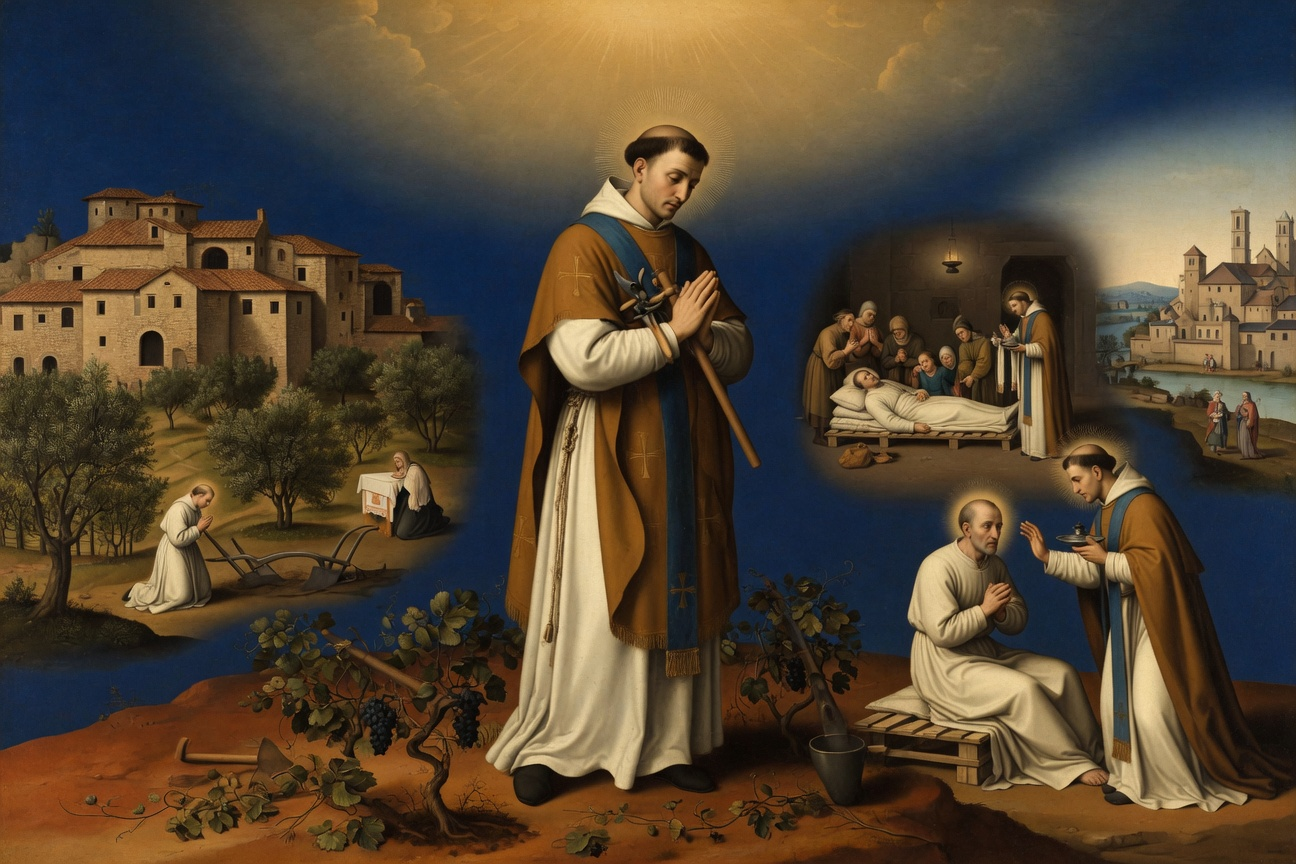
Saint Severu s, a priest of admirable life, lived in the Italian province named Vale ria, to day known as A bruzzo Ulteriore. W hatever time his piety and spiritual exercises left him, he devoted to the cultivation of his fields so as not to become sluggish in rest. All the fruits and all the gain that this work provided him were for the poor and for anyone in need. Such was the opinion and the glory of his holiness that the infirm flocked around him to obtain the grace of healing, and those who could not approach him were content with a piece of bread or any other food which, blessed by him, restored their strength and health.
The miracle of the resurrection
Having delayed in going to a dying man, Severus obtains through his tears the temporary resurrection of the deceased. The man is thus able to confess and perform seven days of penance before dying in peace.
But here is a most extraordinary grace that God granted to his prayers. He was by chance occupied with pruning his vineyard when he was sought out to confer the sacrament of penance upon a dying man; he remained for some time and waited until he had finished his task. He then hurried over, but the sick man had just expired; when he arrived, at this sight, he shuddered, and, throwing himself upon the ground, he accused himself with a lamentable voice and groans of being the murderer of this soul, and he implored the divine mercy; suddenly the dead man began to breathe and to prepare himself for penance. Such an unexpected spectacle struck the bystanders with admiration and excited in the heart of Severus a joy that made his tears flow. The sick man, having finished his confession and spent another seven days in works of penance, bowed his head again in death, but with a better hope.
Translation and expansion of the cult
His relics were transferred from Italy to Germany by Archbishop Rutherf with the support of Emperor Otto I. The place of deposit, Meinfeld, became a town thanks to the influx of pilgrims.
His relics were transported by Ruther f, Arch bishop of Trier, with the assistance of Emperor Otto I , from It aly to the monastery of Mei nfeld, n ot far from Ko blenz, a nd deposited in a church dedicated to S aint Martin. As the miracles performed by his relics attracted a great concourse of people, the town soon took on the dimensions of a city; a church was built in honor of Saint Severus, and a fairly large college of canons was installed there. Egbert, A rchbis hop of Trier, founded it because of the ever-growing fame of the miracles that attracted multitudes to this place from all countries, even from the depths of Aquitaine .
Foundation of the college of canons
Archbishop Egbert founded a college of canons and a church dedicated to Severus to respond to the growing fame of his miracles, attracting crowds from distant regions such as Aquitaine.
Proper of Trier.
Iconography
Signs and attributes


Entities
Narrative network
The names, places, and concepts most present in the entry, weighted by centrality in the text.
The supernatural in their life
The miracles of Saint Severus
Frequently asked questions about Saint Severus
Who was Saint Severus?
A 6th-century Italian priest who combined spiritual life with manual labor, Saint Severus is famous for having resurrected a dead man to allow him to receive the sacrament of penance. His relics, transported to Germany near Koblenz, became a major pilgrimage center attracting crowds from all over Europe.
What is Saint Severus the patron saint of?
Patronage of Saint Severus: Meinfeld.
What is Saint Severus invoked for?
Saint Severus is invoked for: healing of the infirm.
How is Saint Severus depicted in Christian art?
In iconography, Saint Severus is recognizable by: vine and agricultural tools.
What miracles are attributed to Saint Severus?
2 miracles are attributed to this saint, notably: Healing and Resurrection.
Which saints were contemporaries of Saint Severus?
Contemporaries include: Saint Remigius (Apostle of the Franks), Saint Antide of Besançon, Saint Eugene of Carthage and Saint Nicaise of Reims.
When did Saint Severus die?
Saint Severus died around 600.
Annexes & related entities
Structured data for exploration: events, miracles, quotes, places, attributes, patronages, and important entities cited in the text.
Key Events
- Life of prayer and agricultural work in Italy
- Delay in administering extreme unction to a dying person
- Miraculous resurrection of a dead man to allow him to confess
- Translation of relics to Germany by Archbishop Rutherf