
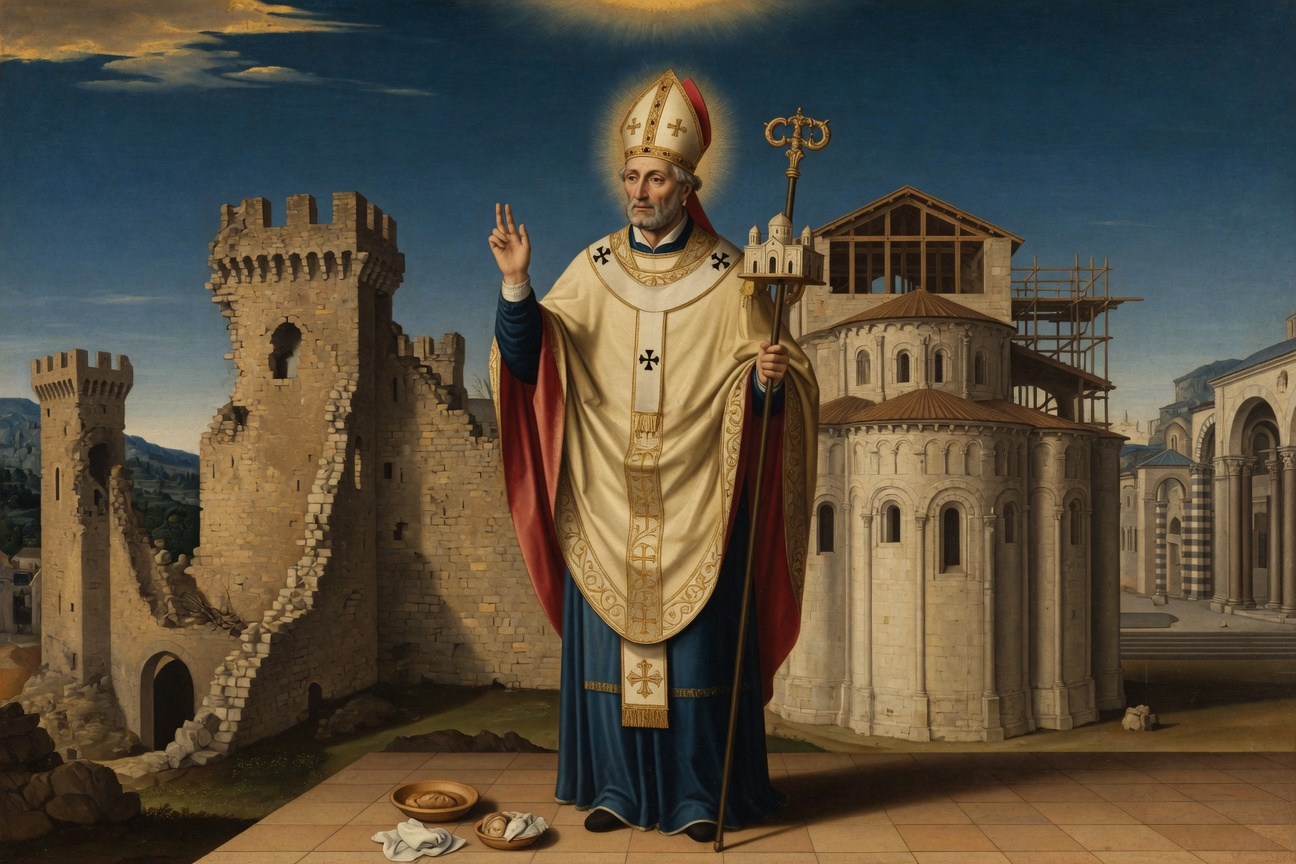
Saint Fulcran of Lodève
Bishop of Lodève in the 10th century, Fulcran distinguished himself by his great purity and apostolic firmness, notably against the Count of Toulouse. He rebuilt the Basilica of Saint-Geniez and served the poor with humility during his 57-year episcopate. His relics, which remained intact for a long time, were partially saved from Huguenot and revolutionary destruction.
Contemporaries

Figures and markers around the normalized period for this entry.
Guided reading
7 reading sections
SAINT FULCRAN, BISHOP OF LODÈVE (1006).
Origins and formation
Fulcran, coming from the nobility of Soustancion, distinguished himself from childhood by his piety, his study of the Scriptures, and an exemplary chastity.
Fulcran , born in the territor y of L odève, in Gallia Narbonensis, and descending through his mother from the illustrious lineage of the counts of Soustancion, began from childhood to build the edifice of his future holiness, making himself remarkable by the gravity of his conduct and by the assiduous study of the Holy Scriptures, in which he became very learned.
Very applied to fasts, vigils, and prayer, he made great progress in goodness and became the accomplished model of all virtues. In particular, he was so faithful in practicing chastity that, at the point of death and in the presence of the most holy body of Our Lord which was offered to him as viaticum, he declared, while giving thanks to God, that never had the slightest stain reached the purity of his soul. So many virtues brought him to the order of the priesthood, and he made himself so agreeable t o Theodoric or Thier ry, his bishop, that the latter strongly wished to have him as his successor.
Election and Consecration
Succeeding Theodoric, Fulcran was elected bishop of Lodève and consecrated in Narbonne in 949 by Archbishop Aimeric.
Therefore, Theodoric having died, in accordance with his desire and that of the entire city, the canons of the cathedral church elected the venerable Fulcran as bishop, and, leading him despite his reluctance to Narbonne, the metropolis of the province, they had him consecrated by Archbishop Aimeric, in the basilica of Saint Paul, the first bishop of that city, on the 4th of February, in the year of our salvation 949. Upon his return to Lodève, he was received with great pomp and the applause of the people.
Firmness in the face of temporal power
The bishop publicly reprimands Count Guillaume Taillefer for his adultery, demonstrating great moral authority.
A story is told of the holy bishop that does honor to his firmness. Guillaume Taillefe r, Count of Toulouse, had married, in 975, Arsinde of Anjo u, sister of Fulk Nerra, Count of that latter province. This lady did not give him any children in the first years of their marriage; this is what determined Guillaume, against all the laws of nature and religion, to leave her to take another who was at that moment married. Saint Fulcran, Bishop of Lodève, whose holiness then shone with the brightest luster, knew the Count of Toulouse particularly well; no sooner had he learned of his conduct than he was deeply afflicted. One day, Guillaume, having met the holy bishop, hastened to embrace him. Fulcran pushed him away and even publicly reproached him for his scandalous life. As for the Countess Arsinde or Arsens, she had recourse to prayer in her misfortune, and went on a pilgrimage to the monastery of Conques in Rouergue, where the relics of Saint Faith of Agen rested. An anonymous author ha s preserved for u s the story of this pilgrimage, written in Gascon verse.
The pilgrimage of Arsinde
Forsaken, Countess Arsinde obtains the birth of her sons after a pilgrimage and a promise to Saint Faith of Conques.
It is recounted that one evening, as the countess lay in her bed, Saint Faith appeared to her in a dream and said: "I wish for you to consecrate to me, upon the altar of Saint-Sauveur at my monastery of Conques, the rich sleeves that you wear." — "I will do so," said the countess, "but obtain for me a son." — "I will pray to the Lord," said the holy martyr; "but you, fulfill your promise." Saint Faith disappeared and the countess fell asleep. The next day, after hearing Mass, she set out on her journey. Saint Faith showed her the paths, for the ways that led to Conques at that time were difficult to travel. She made this journey with great honor and a numerous company; the lords of the land and all the notables of the place received her with extreme joy. Scarcely had she entered the monastery when she asked to be led to the altar of Saint-Sauveur. Guided by the lord of the place, she presented herself at this altar and deposited there the sleeves she had promised. These bracelet-sleeves were woven with gold, artistically crafted, and enriched with precious stones; they were attached to the altar table. Afterward, she was led before the reliquary of the Saint. She remained at Conques for Easter day, and then departed for Toulouse. Shortly thereafter, she gave birth to a son who was named Raymond at baptism, and then a second who was called Henri.
Episcopate and Charity
Fulcran devoted himself to the poor, rebuilt the church of Saint-Geniez, and performed miracles, notably the healing of a blind man.
Fulcran had made it a habit, on the feasts of Our Lord and the Apostles and during Lent, to serve twelve poor people at table himself, to wash their feet, and to give them clothing. God manifested this great holiness of His servant through miracles; and notably, the water with which he had washed his hands opened the eyes of a blind man from Albi. He rebuilt the basilica of Saint-Geniez from its foundations, and having summoned Aimeric of Narbonne, Ricoin of Maguelonne, and Deus-Dedit of Rodez, he consecrated it with these bishops according to the ancient rite. He held the see for fifty-seven years. Seized by fever, he summoned Manfred, Bishop of Béziers, his devoted friend, and the canons of his church, and rendered his soul to God. His body was found intact one hundred years after his death. He received the pious homage of the faithful when the heretics, towards the end of the 16th century, tore it to pieces and scattered it. God had confirmed by miracles performed at his tomb the opinion held of his holiness. His body was raised from the earth in 1427. A few fragments of his relics escaped the Huguenots. They are kept in Lodève, of which he is the second patron. At the time of the Revolution, these precious remains were enclosed in a magnificent silver reliquary. Saved from revolutionary fury, they were identified in October 1805 by Mgr Rollot, Bishop of Montpellier, and replaced in the old cathedral, now a parish church.
Passing and fate of the relics
After 57 years of episcopate, he died; his body, preserved and later profaned by the Huguenots, was partially saved and honored in Lodève.
Saint Fulcran is depicted causing the walls of the fortress of Gibret, in his d iocese, to fall thro ugh his prayers, which was occupied by brigands who from there infested the entire region.
Iconographic representation
The saint is traditionally depicted causing the fortress of Gibret to collapse in order to drive out brigands.
Propre de Rodez and Hist. de l'Église de Toulouse, by M. Salvan.
Iconography
Signs and attributes

Entities
Narrative network
The names, places, and concepts most present in the entry, weighted by centrality in the text.
The supernatural in their life
The miracles of Saint Fulcran of Lodève
Frequently asked questions about Saint Fulcran of Lodève
Who was Saint Fulcran of Lodève?
Bishop of Lodève in the 10th century, Fulcran distinguished himself by his great purity and apostolic firmness, notably against the Count of Toulouse. He rebuilt the Basilica of Saint-Geniez and served the poor with humility during his 57-year episcopate. His relics, which remained intact for a long time, were partially saved from Huguenot and revolutionary destruction.
What is Saint Fulcran of Lodève the patron saint of?
Patronage of Saint Fulcran of Lodève: Lodève.
What is Saint Fulcran of Lodève invoked for?
Saint Fulcran of Lodève is invoked for: healing of blindness.
How is Saint Fulcran of Lodève depicted in Christian art?
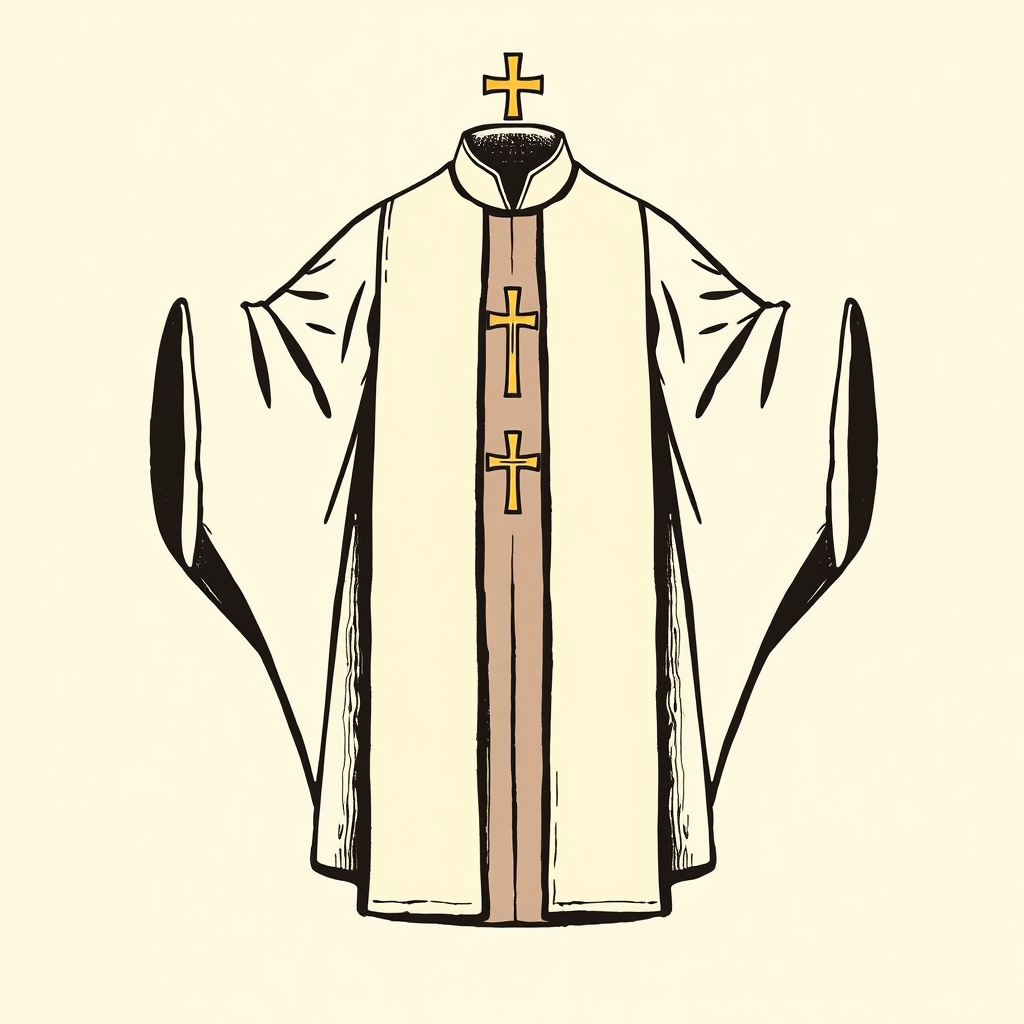
In iconography, Saint Fulcran of Lodève is recognizable by: episcopal vestments and collapsing fortress walls (Gibret).
What miracles are attributed to Saint Fulcran of Lodève?
3 miracles are attributed to this saint, notably: Healing, Sign / wonder and Incorruptibility.
Which saints were contemporaries of Saint Fulcran of Lodève?
Contemporaries include: Saint Bernard of Menthon (Apostle of the Alps), Saint Stephen of Hungary, Saint Norbert of Magdeburg and Saint Bernard of Clairvaux.
When did Saint Fulcran of Lodève die?
Saint Fulcran of Lodève died around 1006.
Who are the relatives of Saint Fulcran of Lodève?
Relatives of Saint Fulcran of Lodève: Comtes de Soustancion (maternal ancestry).
Annexes & related entities
Structured data for exploration: events, miracles, quotes, places, attributes, patronages, and important entities cited in the text.
Key Events
- Consecrated as bishop by Archbishop Aimeric on February 4, 949
- Opposition to the illegitimate remarriage of Count Guillaume Taillefer in 975
- Reconstruction of the Basilica of Saint-Geniez
- Episode of the fortress of Gibret
- Died after 57 years as bishop
- Discovery of his intact body one hundred years after his death
- Elevation of the body in 1427
- Dispersion of relics by the Huguenots in the 16th century
Quotes
-
Never had the slightest blemish touched the purity of his soul.
Declaration at the viaticum