
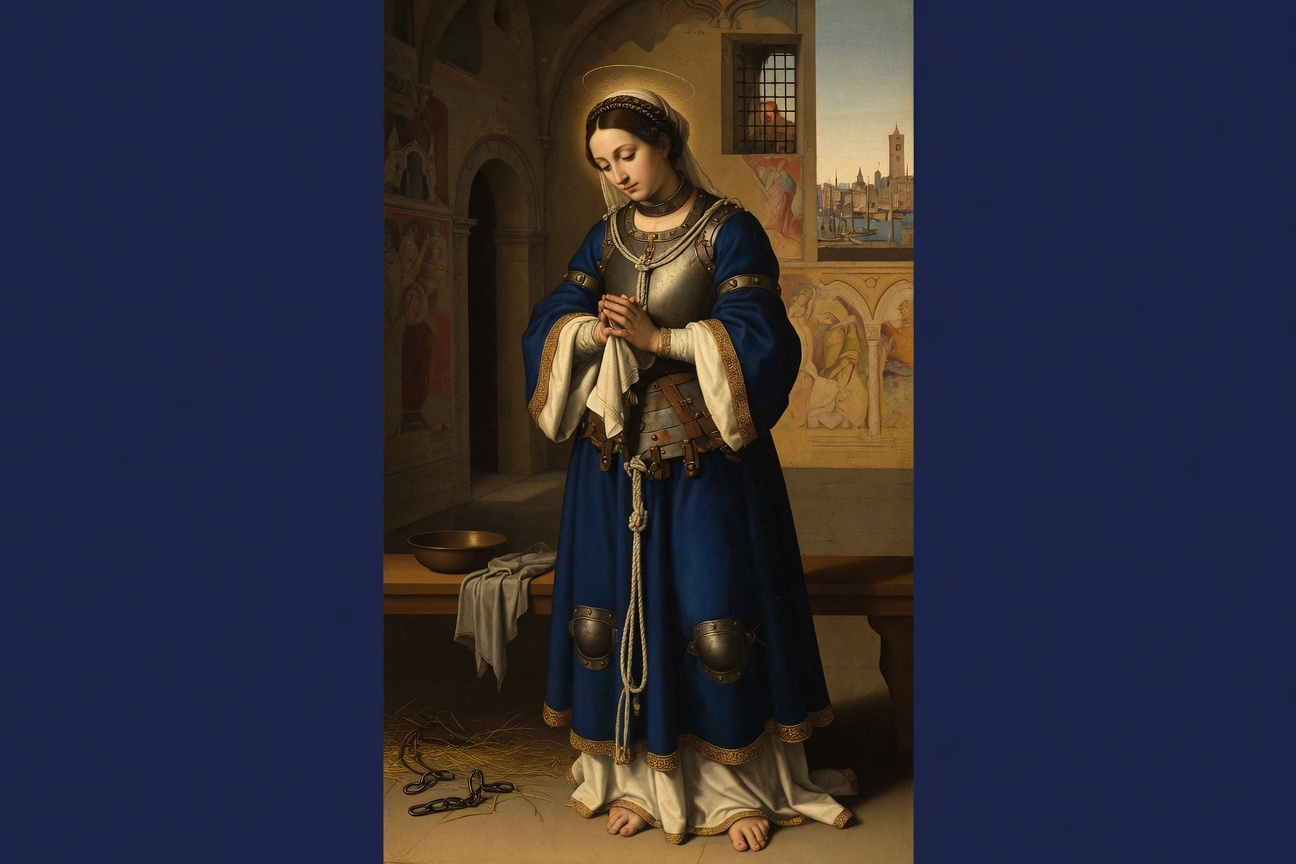
Blessed Clare of Rimini
A noble lady of Rimini in the 13th century, Clare turned to heroic penance after a second marriage and family tragedies. She founded a monastery, devoted herself to the poor and prisoners, and practiced extreme mortifications. She died in 1346, renowned for her miracles and mystical ecstasies.
Contemporaries

Figures and markers around the normalized period for this entry.
Guided reading
7 reading sections
SAINT CLARE OF RIMINI
Origins and worldly life
Clare was born in Rimini into a noble family in the 13th century. After being widowed for the first time and enduring family hardships linked to civil war, she led a life turned toward worldly vanities.
There are beautiful things to be said about Blessed Clare of Rimini : they may be seen in her Legend, published by Cardina l Joseph Garampi; we sh all provide here only an abridgment. She was born around the middle of the 13th century, in Rimini, where a great miracle was to occur in our own days. Her father w as named Chiarello an d her mo ther Gaudiana; they both belonged to a noble and opulent family. Clare married young, and, having been left a widow some time later, her heart became like a high road, where the good seed cast there by the Holy Spirit was trampled underfoot by the world and carried away by the devil; for this heart was so open to vanities that even misfortunes could not close it: exiled following a civil war, she returned only to see her father and one of her brothers mount the scaffold; she had even entered into a second marriage, when Our Lord, who had long been seeking her as His spouse, finally invited her to this divine union.
Conversion and repentance
Touched by a mystical voice at the Franciscans' and then by a vision of the Virgin Mary, Clare renounces the world to embrace a life of extreme penance with the consent of her second husband.
One day, having entered the Franciscan church, it seemed to her that she heard a voice saying: "Strive, Clare, to say a Pater and an Ave to the praise of God, and, as a mark of your remembrance, to recite them with attention, without thinking of anything else." She did not at first understand what this advice meant, but it led her to reflection. From then on, she abandoned tumultuous gatherings to withdraw into her gardens and the most solitary places.
It is in recollection that God speaks to our souls: Clare received a heavenly visit: the Blessed Virgin came, so to speak, to take her by the hand and tear her away from the world; this Queen of virgins, surrounded by a multitude of angels, appeared to our Blessed one in the same church of Saint Francis, and, having turned toward her, said: "Clare, what use were your first husband's great riches, his strong youth, the help of doctors, the grandeur of his house, his superb palaces, to you, whom he loved so much, since a little fever, leading him to death, finally separated him from you?" These words touched her heart: this light from heaven made her see the wanderings of her life; she resolved to spend it from then on at the feet of her Savior, watering them with the tears of penance. Her husband allowed her to live as a religious and to wear the habit; and, as he died shortly after, Clare, seeing herself free to take Jesus Christ as her only spouse, vowed herself to great austerities; to mortify her delicacy, she walked barefoot: which she did for the rest of her life. To punish her body for the jewels and pearls that had adorned it, she wore iron circles on her neck, arms, and knees; she also had a kind of cuirass of the same metal, which is still preserved in Rimini; she no longer slept on anything but thick planks, to expiate the pleasure of having rested on soft beds, and her stomach did penance for its good fare by receiving only the poorest food; it was usually bread and water, to which she added a little oil on Sundays and great feast days.
Asceticism and spiritual combats
She imposed rigorous mortifications upon herself, wearing iron circles and practicing severe fasts to triumph over temptations, particularly that of gluttony.
These were the weapons she employed to combat her former habits, which, especially in the beginning, waged great battles against her. What courage she required, mainly to triumph over the demon of gluttony, who reminded her of the delights of her feasts of old! One day, when she was almost defeated on this point, Jesus Christ, whom she prayed to with fervor, inspired her to say these words: "Arise, O Christ, and help me! Arise, O you who are the Defender of men; O offspring of David! Alleluia." No sooner had Clare pronounced these words than she felt full of strength against the temptation; but wishing to destroy it even to its root, I mean in the inclination and habit, which had become a second nature, she went to find a disgusting beast, had it roasted, and brought it to her mouth, saying to herself: "Eat, glutton; eat this delicious dish!" Annihilated after such a defeat, this enemy did not attack her again thereafter. Not content with these austerities and the rigorous fasts she imposed upon herself, from the feast of Saint Martin until Christmas, and from the Epiphany until Easter, she added vigils, spending the greater part of the nights in prayer; during Lent, she would withdraw into a small space offered to her by the old city wall; there, exposed to the cold, the rain, and all the inclemencies of the weather, she asked God for mercy, confessed her faults, and recited the Lord's Prayer more than a hundred times a day, shedding abundant tears.
Charity and Exile in Urbino
Exiled to Urbino to care for her brother, she led a life of mendicancy and service to the poor and prisoners there before returning to Rimini.
From this love for God, she drew a supernatural tenderness for the unfortunate, and her own brother was one of the first to experience its effects. He had been proscribed a second time, following the troubles that agitated his homeland, and he was ill in Urbino. Clare flew to his side, gave him all the help he needed, and helped him to sanctify his sufferings. There was, near the cathedral of Urbino, a solitary and abandoned tower; it was there that this holy dove withdrew, addressing to the Lord, from the midst of the stone, groans inspired by the Holy Spirit. She only left it to beg for a little bread at the doors, from which the poor benefited more than she did; to give her brother the care of a mother, to help the servant with the most menial household tasks, to console the prisoners, to relieve the sick whose wounds seemed to her those of her Savior. In the evening, she visited the churches and returned to groan in her tower: "My God," she would often cry out, "help me; my God, succor me; you are our only support, O Son of David!" Calm having been restored, she returned to Rimini with her brother and the rest of her family, and continued her works of charity there, which she knew very well how to combine with her pious exercises and with holy communion, which she received often. The misfortunes of war having forced the Poor Clares of Begnode to take refuge in Rimini , where they found t hemselves in great distress, no sooner was Clare informed than she went from house to house begging for these poor nuns.
They lacked wood: one day, our Blessed one having found a tree trunk in the countryside, loaded it onto her shoulders for her dear protégées. As she passed in front of Dino's palace, this man, who was her relative, saw her and ordered one of his servants to tak e the tree and carry it wherever she wished; but Clare, after having given a thousand blessings to her relative for his charity, did not want to be deprived of the merit of carrying, without human respect, through the city of Rimini, this wood for her Savior, who had not blushed to carry for her the wood of the cross before all the people of Jerusalem. A poor man of Rimini having the most pressing need to send a message to Urbino during the winter, the humble servant of the poor made this arduous journey through the cold and snow: the fire of divine love warmed her against the icicles that bristled on her tunic. She housed pilgrims, she reconciled enemies and divided families, she appeased factions. She even put herself up for sale to redeem a man condemned to have his hand cut off; and the lords of the city, moved by this charity, granted grace to the culprit. But she, who obtained grace for others, never granted it to herself when she believed she had offended her brothers. A word had escaped her towards someone that was not polite enough; the sorrow of having caused him pain made her return immediately to her cell, and, taking pincers, she held her tongue out of her mouth for such a considerable time that she made it all bloody, and she was subsequently unable to speak for several days. Her love of neighbor was not limited to bodily necessities; she burned with zeal for the salvation of souls, and God favored her with the grace of conversions.
Conversions and monastic foundation
Claire converts sinners of all conditions and founds the monastery of Our Lady of the Angels in Rimini to gather her companions.
Among the souls she won for the kingdom of heaven, one notes especially a widow who abandoned herself to luxury and all the pleasures of the earth, whose hair she cut herself and whom she clothed in a hairshirt; the tyrant of Mescotello, who aba ndoned his domains for the life of a hermit; and finally, a scholar given over to his passions: this was undoubtedly the most difficult of her conquests; she did so much that he left everything to give himself to God.
Several pious persons, wishing to profit from the graces that God granted to our Blessed one, placed themselves under her guidance, and, according to the advice of God Himself, who explained it to her at night during her prayer, she bought, with the help of good people, instruments of Providence, the land where her cell was located, in the old wall of the city; she built there a monastery which was first known under the title of the Annunciati on and later took th at of Our Lady of the Angels, a name it still bore in the last century. Claire did not restrict herself to the enclosure in this house; but if she went out, it was only to attend more freely to works of mercy. Nothing was lacking for her to make her zeal toward her neighbor bear fruit: God had given her the graces called gratuitous; above all, He favored her with the gift of mi racles. In Gubbio, she healed a seriously ill lord by touching him with her hand. At the gate of the city of Baroncello, a blind child recovered his sight when she had placed her hand on his head. As she was going from Assisi to the chur ch of the P ortiuncula, which is about a mile away, her companions saw that her feet did not touch the ground: the angels carried her to the church of their Queen. Her nuns had one day locked her in her cell, so that she could not return to her retreat in the city walls, where she was accustomed to giving herself to the most rigorous penances: she disappeared, although the door remained closed. Far from taking advantage of these miracles, she punished herself for them as one would for a fault: in such cases, she would hide from the applause of the people, spending the night in tears and macerations, to avoid vainglory. It is with the same thought of humility that she went out to meet trials. Sometimes she drew from her charity only insults and calumnies; only then did she believe herself well paid. She was even publicly accused of heresy. This resemblance to her Jesus was not enough; she wanted to represent in her person all the most painful circumstances of his passion: one year, on Good Friday, she put a rope around her neck, had her hands tied behind her back, then she was dragged through the streets of the city, as Our Lord was formerly in those of Jerusalem; she was tied to a column where she endured the mockery and contempt of the crowd; she was struck with rods, she was made, in a word, according to her order, to drink the chalice of her Savior to the dregs. She repeated this scene for several years, more worthy of the admiration of heaven than imitable for the children of the earth. In reward, she had the happiness of contemplating, in a vision that lasted fifteen days, all the details of the sufferings of her Spouse, as if she had been present at this bloody tragedy. What was her tender compassion, when this beloved Lover held out to his Beloved, from the height of his cross, his arms nailed by love! When he wanted to draw her to him, he often called her with these words: "Arise, my Beloved, and come." It would be too long to recount here her ecstasies and the other caresses with which God favored her. She once remained five whole days without the use of speech, lost in the highest contemplation. Another day after holy communion, an invisible hand placed on her head a crown so heavy that she could not make any movement, and the angels were obliged to carry her back from the church to her cell. Our Lord having appeared to her one night, on a majestic throne, and surrounded by the Apostles and Saint John the Baptist, he deigned to show his dear Claire the wound in his side, telling her to draw from this source al l the graces she might wish.
Miracles and imitation of the Passion
Endowed with gifts of healing and levitation, she inflicted public torments upon herself to imitate the Passion of Christ and received numerous mystical visions.
She often prayed for her companions and benefactors before an image of Our Lord: one day this image said to her: "I cannot refuse your requests; be assured that the people you love, we shall inscribe in the Book of Life"; a promise that the event showed to be viable. Crowds still flock to the church of our Blessed one, during the Octave of its dedication, to obtain the forgiveness of sins; this feast is called the Pardon of Blessed Clare, who obtai ned this indulgence from God, as testified by the inscription on the high altar, placed in 1568. The demons, jealous of so many favors, forgot nothing to make her lose them; they went so far as to rush upon her with frightful howls; they threw her to the ground, they violently chased her from her bed; but she easily triumphed over all their malice through her humility and her austerities. Meditating on the fast of Our Lord, she resolved to deprive herself of all drink: when this deprivation was about to cause her death, heaven brought a divine beverage in a golden cup to her lips: having drunk it, her thirst disappeared entirely. Our Lord himself brought her, during the night, a liquor so sweet that, during the last twelve years of her life, she could never, despite her devouring thirst, drink anything else in her exile but the blood of Our Lord, thus fulfilling the words of the Prophet Jeremiah: "There will be people who will no longer be able to drink wine or water, and who will thirst only for the spotless Lamb." Towards the end of her life, she seemed to return to the simplicity of childhood; she remained for six months deprived of all external feeling, living only in God: she lost her sight, and, finally emerging from this ecstasy, she could no longer converse with anyone. Finally, when Our Lord had gradually detached her from the earth, the last thread that bound her to it was broken by an effort of love. She flew away to the dwelling of her Spouse, saying: "Lord, I commend my soul into your hands," on February 13, 1346. After her death, her face became resplendent, and her whole body gave off a sweet odor, to testify to the glory in which her soul dwelt. She was honored from then on as a Saint. She was buried in the church of her monastery, where her relics are kept, honored by several miracles. Her cult was approved in 1784, by Pope Pius VI, on February 10.
Death and recognition of the cult
She died in 1346 after a period of prolonged ecstasy. Her cult was officially approved by Pope Pius VI in 1784.
Seraphic palm.
Iconography
Signs and attributes





Entities
Narrative network
The names, places, and concepts most present in the entry, weighted by centrality in the text.
The supernatural in their life
The miracles of Blessed Clare of Rimini
Frequently asked questions about Blessed Clare of Rimini
Who was Blessed Clare of Rimini?
A noble lady of Rimini in the 13th century, Clare turned to heroic penance after a second marriage and family tragedies. She founded a monastery, devoted herself to the poor and prisoners, and practiced extreme mortifications. She died in 1346, renowned for her miracles and mystical ecstasies.
What is Blessed Clare of Rimini the patron saint of?
Patronage of Blessed Clare of Rimini: Rimini.
What is Blessed Clare of Rimini invoked for?
Blessed Clare of Rimini is invoked for: forgiveness of sins, conversion of sinners and relief of the sick.
How is Blessed Clare of Rimini depicted in Christian art?
In iconography, Blessed Clare of Rimini is recognizable by: iron circles (neck, arms, knees), iron breastplate, barefoot, rope around the neck and heavy crown.
What miracles are attributed to Blessed Clare of Rimini?
5 miracles are attributed to this saint, notably: Healing, Levitation / bilocation, Vision / apparition and Multiplication / provision.
Which saints were contemporaries of Blessed Clare of Rimini?
Contemporaries include: Saint Peregrinus of Auxerre, Saint Thomas Aquinas, Saint Francis of Assisi (Confessor) and Saint Colette (Nicole).
When did Blessed Clare of Rimini die?
Blessed Clare of Rimini died around 1400.
What are the other names of Blessed Clare of Rimini?
Other forms of the name: Chiara Agolanti.
Who are the relatives of Blessed Clare of Rimini?
Relatives of Blessed Clare of Rimini: Chiarello (father), Gaudiana (mother), Non précisé (brother) and Dino (parent).
Annexes & related entities
Structured data for exploration: events, miracles, quotes, places, attributes, patronages, and important entities cited in the text.
Key Events
- Born in Rimini in the mid-13th century
- Early marriage followed by widowhood
- Exile following a civil war and the execution of her father and brother
- Second marriage and conversion in the Franciscan church
- Life of extreme penance with the consent of her second husband
- Retreat in a tower in Urbino to care for her brother
- Foundation of the Monastery of the Annunciation (Our Lady of the Angels) in Rimini
- Approval of the cult by Pius VI in 1784
Quotes
-
Arise, O Christ, and help me! Arise, O you who are the Defender of men; O offspring of David! Alleluia
Claire's prayer against temptation -
Lord, I commend my soul into your hands
Last words