
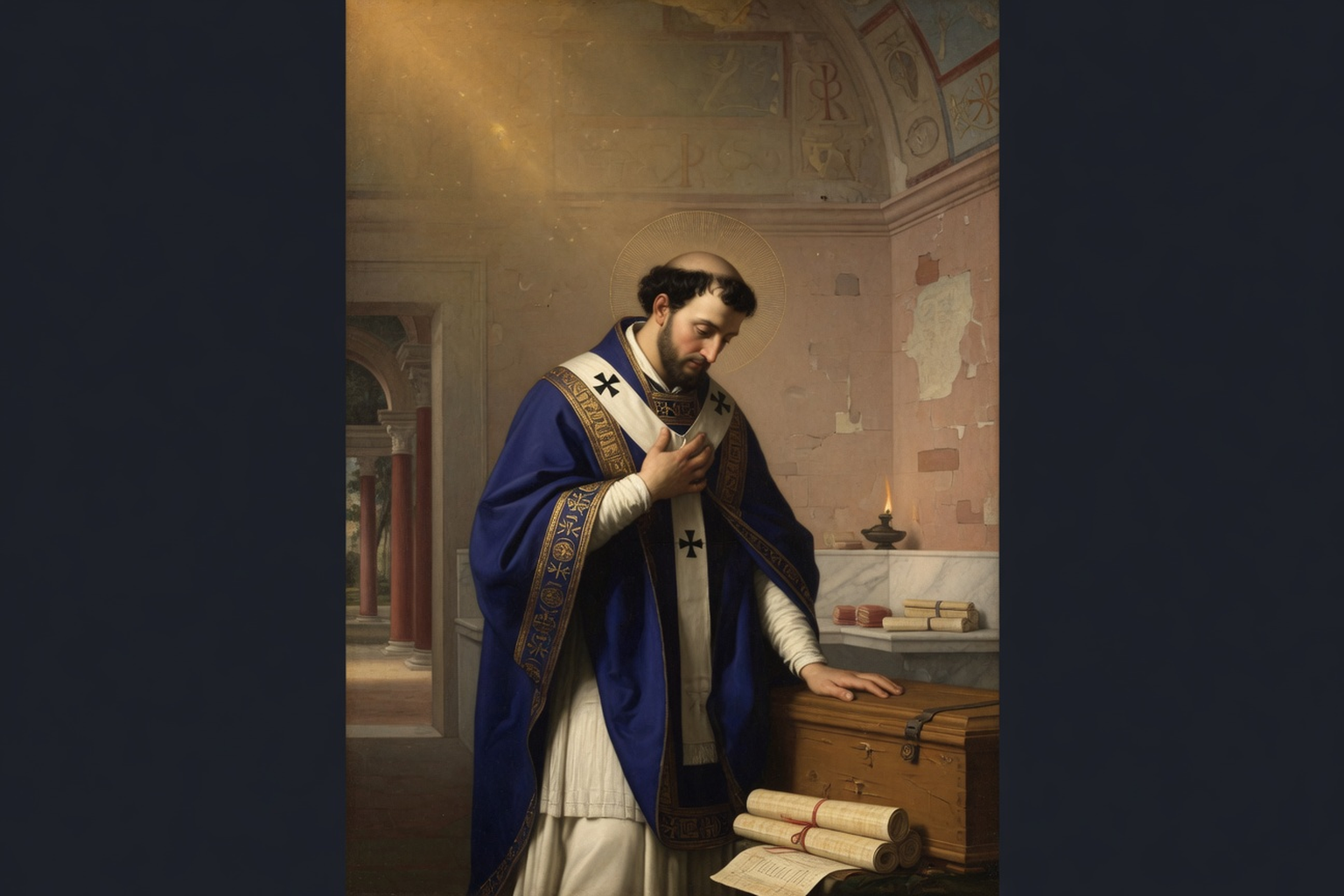
Saint Anterus
Of Greek origin and son of Romulus, Anterus was pope for a little over a month in 236. He distinguished himself by his zeal in collecting and protecting the Acts of the martyrs, which led to his execution by the prefect Maximus after he refused to surrender these sacred archives.
Guided reading
4 reading sections
SAINT ANTERUS, POPE
Origins and brief pontificate
Anterus, of Greek origin, exercised a very short pontificate of a little over a month in the year 236.
Anteru s, Greek by origin, says the Liber Pontificalis, was the son of Romulus. He sat for one month and twelve days under the consulship of Severus and Quintianus. He had caused the Acts of the martyrs, collected by the notaries, to be deposited in the most hidden p lace of the church. The p refect of Rome, Maximus, had this precious deposit searched for and sent the blessed Anterus to his martyrdom, as he refused to hand it over. In one ordination, in the month of December, Anterus consecrated one bisho p. He was buried in the catacomb of Callixtus, on the Appian Way, on the third of the nones of January (January 3, 236).
The preservation of the Acts of the martyrs
The pope distinguished himself by collecting and securing the accounts of the martyrs through the notaries of the Church.
The episcopal see remained vacant for thirteen days. "The glorious Memoirs, the drafting of which was entrusted to the notaries of the Roman C hurch," says Dom Guéranger, "must have increased considerably in number and importance during the persecutions of Trajan, Antoninus, Marcus Aurelius, and Severus. We have seen what sublime pages the tyranny of Almachius, under Alexander, gave them the opportunity to add. The holy Pope Anterus occupied himself with gathering these Acts, of which he had the *notarii* render an account, in order to collect them in the archives of the Apostolic See."
Martyrdom and archaeological traces
Executed by the prefect Maximus for refusing to hand over the archives, he leaves iconographic and epigraphic traces in the Roman catacombs.
A fresco, painted on the ceiling of the cubiculum of the cemetery of Saints Nereus and Achilleus, which is near that of Callixtus, would seem to have had as its object the preservation for posterity of the memory of this provident measure of Anterus. One notices a venerable personage seated on a chair, between two ministers standing at his sides. His two hands are extended to bless three personages, one of whom is on his knees and the other two in an attitude of profound veneration. They have just deposited at his feet a round-shaped box, filled with rolled volumes, which they seem to be presenting to him as an homage. The learned archaeologist Bianchini does not hesitate to recognize here a monumental souvenir of the brief ponti ficate of Anterus, whose sepulchral epitaph M. de Rossi recently rediscovered in the catacomb of Saint Callixtus.
Be that as it may, Anterus left only a name in the catalogue of popes, an image in the catacomb of Saints Nereus and Achilleus, and an inscription in the papal crypt of the cemetery of Callixtus.
Cult and relics
A relic of the saint is kept at the Carmel of Amiens.
One of his relics is at the Carmel of A miens.
Entities
Narrative network
The names, places, and concepts most present in the entry, weighted by centrality in the text.
Frequently asked questions about Saint Anterus
Who was Saint Anterus?
Of Greek origin and son of Romulus, Anterus was pope for a little over a month in 236. He distinguished himself by his zeal in collecting and protecting the Acts of the martyrs, which led to his execution by the prefect Maximus after he refused to surrender these sacred archives.