
Saint Adalbaud of Ostrevant
A noble leude at the court of Dagobert I, Adalbaud married Saint Rictrude and founded the monastery of Marchiennes. Father of four children all recognized as saints, he was assassinated in 652 by members of his in-laws during a journey in Gascony. His cult developed due to miracles occurring near his relics in Périgord and Flanders.
Contemporaries

Figures and markers around the normalized period for this entry.
Guided reading
6 reading sections
SAINT ADALBAUD OR ADALBÉ OF OSTREVANT (652).
Origins and family background
Adalbaud was born into a family of the high Frankish nobility, the son of Saint Gertrude and brother of Erchinoald, Mayor of the Palace.
Saint Adalbaud was one of the three sons o f Saint Gertrud e, who founded the monastery of Hamage, near Marchiennes, where she spent the last years of her life. His father, whom he lost at an early age, was named Rigomer; one of his brothers, Erchinoald, was Mayor of the Palace under the regency of Saint Bathilde; the other, named Sigebert, married Saint Berthe, who, having become a widow, built the monastery of Blangy, in Artois, and retired there.
Religious commitment and foundation
Under the influence of Saint Amand, Adalbaud undertook the construction of the monastery of Marchiennes.
Saint Amand , who preached the faith in these provinces, knew the house of Adalbaud early on and maintained close relations with it. It was even by his counsel and in gratitude for the services he had received from them that the virtuous Adalbaud began the construction of the monastery of Marchiennes.
Life at court and marriage in Gascony
A faithful leude of King Dagobert I, he distinguished himself by his bravery and married Rictrude, who came from an illustrious family of Gascony.
Later, in his capacity as a leude, he frequented the court of Dagobert I, who liked to gather around him the sons of the principal families in order to attach them more closely to his dynasty. He distinguished himself there by brilliant qualities, which made him loved by all the nobles of the palace, and which inspired in the monarch himself great confidence in his bravery and his fidelity.
Still young, he took part in several military expeditions in Gascony, where a bellicose and indomitable people were always stirring. The details are little known. As for what concerns Adalbaud, we only see that having frequented, in the Basque country, the illustrious family of the lord Ernold, he asked for and obtained his daughter Rictrude in marriage.
It was in this same country that S aint Amand had retired, after the unjust exile to which Dagobert had condemned him; and some authors believe that he had the consolation of consecrating himself the union of Adalbaud and Rictrude, who both looked upon him as their guide and spiritual father.
This marriage, blessed by heaven, had received the approval of all the relatives, with the exception of a few who saw with spite the alliance of a princess of their blood with a Frank of Austrasia. This antagonism of the races of the North and the South was still vivid at that time, and the wars, so long and so deadly, that the kings who succeeded Dagobert had to sustain later, testify to it sufficiently.
The marriage ceremony was performed with solemnity, and on both sides the customary gifts were offered and accepted. But, adds the biographer, the most beautiful gift was that which the betrothed made mutually of their own persons.
"Adalbaud offered his young wife hereditary virtues, an illustrious blood, a manly beauty, a wisdom and a prudence that had outpaced his years. Rictrude brought him in return modest and chaste charms, a noble birth, great wealth, and above all, a pure and chaste life."
Beautiful and holy union of two spouses whom God had made for one another, and whom, despite the distance of places, He knew how to unite for the accomplishment of His designs.
Exemplary life in Ostrevant
Upon returning to his lands, the couple led a life of exemplary charity and raised their four children in piety.
Adalbaud, upon returning with his wife to his possessions in Ostrevan t, continued to provide all the examples of virtue that had been admired in him since his adolescence. He often received in his home the missionaries who preached the Gospel. Saint Amand and Saint Riquier, in particular, came to offer them counsel, which they received with joy.
Jealous to see the children that heaven had given him walk in the path of goodness, he took care to entrust them to virtuous masters. Adalbaud and Rictrude applied themselves to confirming these lessons through their own conduct. Thus, it was usually with their children that they practiced works of religion and charity, in order to inspire in these young ones the love of God and a tender compassion for the poor.
"With them they brought aid to the needy, gave food to those pressed by hunger, and clothing to those shivering with cold; with them they visited the unfortunate to console them, the sick to provide them with remedies, and sometimes criminals to recall repentance to their souls."
It is in this way that Adalbaud and his wife formed their children, Mauront, Eusébie, Clotsende, and Adalsende, who grew in wisdom and grace b efore God and before men.
Assassination and martyrdom
During a journey to Gascony, Adalbaud was assassinated near Périgueux by relatives of his wife, driven by an ancestral hatred.
He had been faithfully fulfilling these duties, so sweet to a Christian father, for nearly sixteen years when he was recalled to Gascony. Adalbaud departed with regret from his family, where he enjoyed so much happiness. Upon his departure, his v irtuous wife Rictrude could not tear herself from his arms: one would have said she sensed the blow that was about to strike her. She wished to accompany him for some time and as far as possible; but finally, they had to separate, their hearts filled with sad forebodings that were to be realized all too soon.
Indeed, Adalbaud, having arrived in the vi cinity of Périgueux, was attacked unexpectedly by men from Rictrude's own family, who were burning to satisfy their hatred and vengeance. The unfortunate lord succumbed to their blows in the solitudes of Périgord and went to receive in heaven the reward for his piety and good works.
The news caused by this murder quickly reached the ears of Rictrude, whose grief it would be impossible to express. Rictrude had funeral honors rendered to her husband and shortly after obtained that his mortal remains be returned to her. Miracles performed near these relics determined the cult that was rendered to him in Périgord, where he was assassinated, and in the regions from which he originated.
Saint Adalbaud is usually given the title of martyr, either because at that time this name was sometimes used to designate persons of high virtue who died a violent death, or because it is believed that the motive of religion was not foreign to this murder, in a country where there were still many idolaters.
Cult and posterity
His relics, sources of miracles, were honored at Elnoo and later at Douai, where his memory is perpetuated through iconography.
His relics rested at the monastery of Elnoo during the lifetime of Saint Amand himself; subsequently, the head was tra nspor ted to Douai, as seen in an ancient manuscript of the church of Saint-Amé. There formerly existed in this collegiate church a magnificent chapel with an altar dedicated to Saint Mauront and his parents. From time immemorial, their statues were exposed there for public veneration.
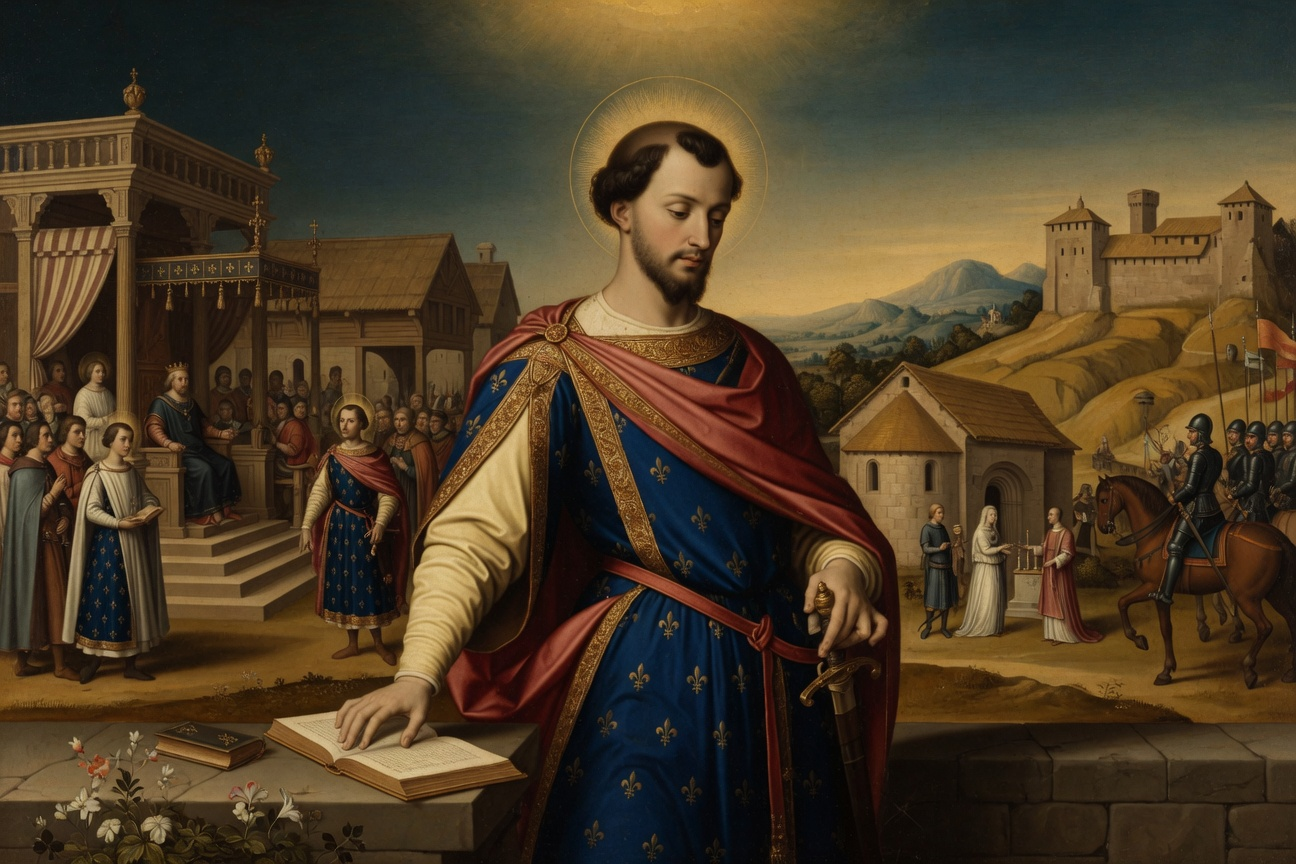
The first represented Saint Adalbaud dressed in a robe covered with fleurs-de-lis, holding a book in his right hand and a sword in his left. Between Saint Adalbaud and Saint Rictrude was Saint Mauront, their son, also dressed in a magnificent robe, a scepter in his right hand and a building equipped with towers in his left; then Saint Rictrude, in the habit of a Benedictine, and holding in her hand the sacred building that represented the abbey of Marchiennes. All authors place the feast of Saint Adalbaud on February 2, which is undoubtedly the day of his death or that of the translation of his relics.
Abbé Destombes: Sainte Gertrude de Cambrai et d'Arras. — See the Life of Saint Amand, on February 6, and that of Saint Rictrude, on May 12.
Iconography
Signs and attributes



Entities
Narrative network
The names, places, and concepts most present in the entry, weighted by centrality in the text.
The supernatural in their life
The miracles of Saint Adalbaud of Ostrevant
Frequently asked questions about Saint Adalbaud of Ostrevant
Who was Saint Adalbaud of Ostrevant?
A noble leude at the court of Dagobert I, Adalbaud married Saint Rictrude and founded the monastery of Marchiennes. Father of four children all recognized as saints, he was assassinated in 652 by members of his in-laws during a journey in Gascony. His cult developed due to miracles occurring near his relics in Périgord and Flanders.
What is Saint Adalbaud of Ostrevant the patron saint of?
Patronage of Saint Adalbaud of Ostrevant: Ostrevant.
How is Saint Adalbaud of Ostrevant depicted in Christian art?
In iconography, Saint Adalbaud of Ostrevant is recognizable by: fleur-de-lis robe, book and sword.
How did Saint Adalbaud of Ostrevant die?
Saint Adalbaud of Ostrevant suffered martyrdom for the Christian faith (7th century).
What miracles are attributed to Saint Adalbaud of Ostrevant?
1 miracle are attributed to this saint, notably: Sign / wonder.
Which saints were contemporaries of Saint Adalbaud of Ostrevant?
Contemporaries include: Saint Priest (Prix), Saint Gregory the Great (Pope and Doctor of the Church), Saint Die (Didier, Deodat) and Saint Augustine of Canterbury.
What are the other names of Saint Adalbaud of Ostrevant?
Other forms of the name: Adalbé and Adalbaldus.
Who are the relatives of Saint Adalbaud of Ostrevant?
Relatives of Saint Adalbaud of Ostrevant: Rigomer (father), Sainte Gertrude (mother), Erchinoald (brother), Sigebert (brother), Sainte Rictrude (wife), Saint Mauront (son), Sainte Eusébie (daughter) and Sainte Clotsende (daughter).
Annexes & related entities
Structured data for exploration: events, miracles, quotes, places, attributes, patronages, and important entities cited in the text.
Key Events
- Attended the court of Dagobert I as a leude
- Military expeditions in Gascony
- Marriage to Saint Rictrude
- Foundation of the monastery of Marchiennes on the advice of Saint Amand
- Assassinated by his wife's family in Périgord
Quotes
-
Adalbaud offered his young wife hereditary virtues, an illustrious lineage, manly beauty, and a wisdom and prudence that had outpaced his years.
Biographer cited by the author