
Born in Bethlehem in a stable to fulfill the prophecies, Jesus Christ, the Incarnate Word, is laid in a manger between an ox and an ass. His birth is announced by angels to shepherds and marked by miraculous signs throughout the world. The feast of the Nativity celebrates this mystery of the Incarnation and Redemption.
Contemporaries

Figures and markers around the normalized period for this entry.
Guided reading
8 reading sections
THE NATIVITY OF OUR LORD
The Mystery of the Double Birth
Distinction between the eternal birth of the Word and His temporal birth in the flesh for the redemption of mankind.
In the year of the world 5199.
Hunc aetra, tellus, aquora, Hunc anna quod anlo subest, Salatis auctorem nova Novo salutat cantica.
Let the stars on this day, let the earth, let the Ocean itself and all the creatures that move under the vault of the heavens, come to salute the event of the Liberator and intone to his praise a canticle worthy of him.
Roman Liturgy.
This feast is so august and the faithful people are moved of their own accord with such ardor and devotion to celebrate it that we would deceive their expectation if we did not dwell a little on the great mystery that is honored therein, in order to give them a more perfect knowledge of it. It is not strictly the birth by which the divine Word proceeds from the understanding of His Father: a permanent birth, an eternal birth, a birth that has never had a beginning and will never have an end; a birth that has no determined day, because it is before all days and yet there are no days that it does not contain; a birth that has given, gives, and will give eternally, without succession and without defect, to this adorable Word the very nature of His Father, which is His divinity. It is true that the Church proposes it to us in the third Mass of this day, since she has the first chapter of the Epistle to the Hebrews and the beginning of the Gospel according to Saint John read there, which are the places where Holy Scripture speaks of it with the most light and depth, but it is constant that her principal intention is to revere the second birth of her Savior, that by which He was born of a Virgin in the fullne ss of time, to enlighten the world with His presence and to begin among men the great work of their redemption, after having been conceived by the Holy Spirit in the womb of this Virgin and enclosed for nine months, according to the ordinary course of human generations.
It is with a view to this mystery that she sings in her offices: "Today, true peace has descended to us from heaven. Today the heavens have become sources of honey throughout the world. Today, the day of a new redemption, of an ancient reparation and of an eternal felicity, has dawned for us." And this is what makes Saint Leo, Pope, say in the first sermon of the Nativi ty: "Our Lord is born today, my beloved, let us rejoice; for it is not permitted to remain sad, when life takes birth. No one is excluded from the participation of this gladness; everyone has reason to take part in it, because Our Lord, destroyer of sin and death, having found no one exempt from crime, has come to redeem and set free all men. Let the just man thrill with joy, because he is near to receiving the reward of his justice; let the sinner be consoled in his misery, because he is offered the pardon of his offenses; let the Gentile himself take courage, because he is called to be given life."
The fulfillment of the promises
The birth of Christ realizes the promises made to the patriarchs and prophets of the Old Testament.
Indeed, we see in this birth, predicted so many centuries before, the fulfillment of all that God had promised to Noah, to Abraham, to Jacob, to Moses, to David, to Isaiah, and to the remnant of the Babylonian captivity. He had promised them all a true Savior who would deliver the human race from the slavery of sin and the tyranny of the demon. Behold, at last, He is born; the angels announce Him to us with their songs of joy and celestial harmony. The heavens indicate Him to us by a new and extraordinary star. The earth assures us of it through a great number of wonders occurring on all sides. Let us go ourselves to recognize Him, let us run with the shepherds to Bethlehem, let us enter the stable in their company and consider there, according to the angel's warning, this child born of God in eternity and born of the Virgin in time, wrapped in swaddling clothes and lying in a manger.
Since the angel of the Lord had revealed to Saint Joseph t he ineffable mystery of the Incarnation of the Word, Joseph and Mary did nothing else together but raise themselves to God to bless, adore, praise, and thank Him for His inestimable charity toward sinners, and to pray to Him urgently to complete the design of His mercy by giving to the whole world, through a blessed birth, Him whom He had already given them through a virginal conception. They accomplished within themselves, to prepare for this signal favor, what was still lacking in the inflamed desires of the Patriarchs, the urgent prayers of the Prophets, the cries and sighs of the just, the hope of all the ages, and the expectation of all nature, which, groaning under the captivity of sin, awaited with impatience the coming of a liberator; and they did so with all the more perfection as Mary, already mother of the Child, and Joseph, His guardian, tutor, and foster-father, had in this capacity a sovereign knowledge of His merit and a love for Him proportionate to the eminence of their dignity. Moreover, the Virgin knew, by revelation of the angel, that having conceived by the operation of the Holy Spirit, she would also give birth by this same operation, which would not only preserve the seal of her virginity but would also give it a new luster, so that the Child could say what the King-Prophet puts into His mouth: *Tu es qui extraisiti me de ventre*; "It is You, Lord, who, by a miracle of Your power and by a most singular work of Your wisdom, have drawn me from my mother's womb." Thus, she bound and united herself unceasingly to the holy dispositions of divine Providence, with no other care than to receive its impressions and to follow the movements of His grace.
The Journey to Bethlehem
Under the edict of Caesar Augustus, Joseph and Mary travel to Bethlehem for the census of the tribe of David.
However, the time to bring this divine Child into the world arrived, and as He wished one day to be executed in Jerusalem, in the presence of the whole earth, to suffer greater confusion, He also wished to be born without any splendor, in the small town of Bethlehem, in order to teach us, in His birth as well as in His death, to humble ourselves; for this purpose, He created an occasion for His parents to travel to this city which the Prophets had predicted would be the cradle of the Messiah. This occasion was that Caesar Augustus, emperor of the world, wishing to know the strength of his empire, the number of families and persons who composed it, and to levy a poll tax on his subjects, issued an edict by which all provincial governors were ordered to make an exact census everywhere, and every individual was to be registered in the rolls that would be made in the place where the head of his family was located. Saint Joseph, who was of the house and tribe of David, whose lineage was in Bethlehem, found himself obliged by this to travel there to obey the prince's command.
He departed from Nazareth, according to the text of the Gospel; he set out on the road to Bethlehem, and he took his pregnant wife with him, in order to be registered with her. This city, already very populous in itself, was overflowing with strangers at that time. Joseph and Mary, because of their pove rty, being unable to find a place in the inns, left the confines of Bethlehem. David, having become king, had built a fortress in Bethlehem which had been his cradle, where he had led his father's flocks to pasture and where Samuel had anointed him king: this fortress, fallen into ruins, served as a shelter for travelers, for them and their beasts of burden, and for the shepherds who took refuge there with their flocks. It is there, in an underground cave, that Mary, exhausted by the fatigues of the journey, so harsh for her age (she was only fourteen), was obliged to take shelter with her spouse against the rigors of the season; it was a kind of stable with a manger, straw, and hay. One cannot conceive of a humbler dwelling; however, the wisdom of God had chosen it from all eternity for His birth; for then, says Saint Luke, impleti sunt dies Maria ut pareret: "the time for Mary's delivery arrived"; not only the time that nature required, according to the order of human generation, but also the time marked before all ages in the order of God's designs, the time of the world's final preparation to receive such a great benefit, and the time when Mary had reached the final degree of grace she was to have to bring into the world this infinite light, and this spotless mirror of the beauty and goodness of God.
The Virginal Birth
Account of the miraculous birth in a cave, preserving Mary's virginity according to the Church Fathers.
She was warned by revelation of this moment, and having retired to the deepest part of the cave, which she took care to clean, she knelt there facing the East, to await in this humbled posture the wonder that the Holy Spirit was about to work within her. She was then filled with an extraordinary splendor. She was raised there in an unusual contemplation of the greatness of God and the excellences of his incarnate Word; she was inflamed with a fire of love so great and so vehement that she had never felt the like; finally, she entered into an admirable participation in the perfections of the eternal Father begetting his Son, of whom she had the honor of being the Mother. Saint Bridget writes in her Revelations that, out of humility, she took off her shoes, laid aside the veil from her head and the white mantle she was wearing, unfolded the small swaddling clothes and sheets she had prepared, which, although coarse and of vile fabric, were nonetheless very clean and neatly arranged, and, with her hands and eyes raised toward heaven, all filled with a celestial unction and sweetness, she addressed this prayer to God: "Eternal Father, who have done me the honor of choosing me to be the Mother of your only Son; who have enclosed in my womb the inestimable Treasure of your wisdom, and who have hidden in my body, as in a mysterious shell, the priceless pearl of your figure, I pray you to make this perfect image of your infinite goodness appear to the world now, so that through it all men may be drawn to your knowledge. May the Creator of heaven and earth come forth from his creature, the source from his stream, the shoot from his root, the vine from its branch, the sun from its ray, and the bridegroom from his nuptial bed. May the world see its author, the angel its king, the just its life, the sinner its remedy, the Gentile its light, the Jew its glory, and the afflicted its consolation. Finally, may your most humble Servant see her only Son and her Beloved."
After this prayer, or some other more excellent one that the weakness of our mind could not imagine, the divine Child appeared before her eyes with ravishing grace and beauty, carried by his own virtue. Some holy souls have known, by revelation, that he remained at first slightly raised from the ground and then settled gently onto the floor. The child had come out of her womb without violating the seal of her virginal enclosure, with the same purity that desires come out of the heart, that thoughts are born from the mind, that the ray flashes from the sun and passes through a perfectly clear glass to illuminate an entire room.
This is how all the holy Fathers of the Church and the Scholastic Doctors teach it, against the pagans, the Jews, and the heretics. They prove it against the pagans by the oracles of the sibyls, who, being enlightened by the spirit of prophecy, predicted almost all that the Savior who would come into the world would be conceived and born of a Virgin: Saint Augustine uses this argument in book XVIII of the City of God, chapter XIII. They prove it against the Jews by beautiful figures and evident testimonies of the Old Testament. If the first Adam, says Saint Irenaeus, was formed from a virgin earth, which the rain had not yet moistened, and which the hand of man had not worked, why should the second Adam not have been formed and come forth from a Virgin Mother: *Nullâ ex parte corruptâ virginitate*: "without her virginity having received the slightest alteration?" If the barren have conceived, add Saint Cyril of Jerusalem and the same Saint Augustine; if the rod of Aaron, without being watered, produced leaves and flowers; if one has seen the earth loaded with fruits without having been sown, let us give this glory to God, that he was able to make a virgin bring a son into the world without losing anything of her virginal integrity. Is this not what the prophet Isaiah had predicted, chapter VII: *Ecce Virgo concipiet et pariet filium et vocabitur nomen ejus Emmanuel*: "Behold, a virgin shall conceive and bear a son, and his name shall be called Emmanuel?" And one must not translate with the Jews and the heretics: Behold, a young girl; but with the Septuagint: Behold, a virgin. For this is what the Hebrew word properly signifies: *alma*; and, as Origen remarks very well, the prophet Isaiah wishes to give in this place an extraordinary and miraculous sign of divine power; now, it would not be a miracle for a young person to conceive and give birth through marriage; but the miracle is that a virgin has conceived and given birth while remaining a virgin forever. Is this not also what the prophet Ezekiel teaches us, by that gate of the house of God which he saw always closed, although the Lord, the God of Israel, had passed through it? *Quid est porta illa clausa in æternum*, says Saint Augustine in sermon XIV on the Nativity, *nisi Maria Virgo ante partum, Virgo in partu, Virgo post partum*? "What is this gate always closed, if not Mary Virgin before childbirth, Virgin in childbirth, Virgin after childbirth?"
Finally, they prove it in particular against the heretics who receive the Gospel by the words of the angel Gabriel, who, having assured Mary that she would conceive and bear a Son, and the Virgin having asked him how both would come to pass, told her that it would be by the power of the Most High and by the ineffable operation of the Holy Spirit. From which it is easy to conclude that the Holy Spirit acted no less to preserve her purity in the mystery of the birth of this adorable Son than in that of his conception. The Apostles' Creed, the rule of our faith, also teaches us this important truth, since we make a solemn profession and admission there that Jesus Christ was born of a Virgin: *Natus ex Mariā virgine*. We find it similarly, either assumed as an incontestable point, or defined in the Councils: "If anyone," says the holy Council of Lateran, under Pope Martin I, "does not recognize the glorious Mother of God, ever Virgin and Immaculate, as having conceived and given birth to him withou t corruption, and her v irginity having remained inviolable, even after childbirth, let him be anathema!" It is true that this miracle is great, and that Theophylact prefers it to the resurrection of the dead; it is so singular that it has only been done once; but is there anything impossible for God, and did the birth of his Word on earth not deserve that he should make a masterpiece of his power, so that he was born there in a purity consistent with that of his eternal birth? "To be born of a Virgin," says Saint Augustine in his Epistle 137 to Volusianus, "was such a great miracle in Jesus Christ that one could not expect a greater one from God. If one could penetrate its secret, it would no longer be admirable; if one could produce an example of it, it would no longer be singular: let us give this glory to God, that he can do what, by our own admission, we cannot conceive. In these supernatural works, all the reason that must be brought to them is the omnipotence of the worker." We have dwelt a little on this matter, to strengthen the faithful in this article of their belief and to enlighten the heretics who might cast their eyes on this work, who dare to dispute with Mary the august quality of Virgin and ever Virgin, which has been attributed to her from all time, with a consent so solemn and so unanimous that it has become like her proper name.
The Annunciation to the Shepherds
The angel Gabriel announces the news to the shepherds who come to adore the child in the manger.
We do not undertake now to describe the acts performed by this august Mother with her spouse, Saint Joseph, at the first sight of the divine Child whom they recognized as the Son of the eternal Father and as the Creator and Master of all things. One may see on this subject the pious Meditations of Saint Bernard, Saint Bonaventure, Louis of Granada, and other holy Doctors who have excelled in these sentiments of devotion. All that we can say is that our understanding could conceive nothing that is not infinitely below all that the heart and spirit of these two spouses produced on this occasion. There were adorations, homages, most profound self-annihilations, praises, sentiments inflamed with love, acts of thanksgiving, surrenders of themselves to the guidance of this lovable Child, and protestations to serve Him with all the ardor and reverence possible for them; but they performed these acts in a manner far above our reach, which it is better to honor by our silence than to weaken by our expressions. Moreover, the Child who offered Himself on one side to His eternal Father to be the victim of His justice, and who on the other deplored the miseries into which sin had plunged the human race, gave them a lovable smile to reward their fervor and to begin to acknowledge the favors He was about to receive from them.
The Virgin did not leave Him long in this state, where, being naked, He felt the rigor of the season violently: she lifted Him from the ground, she pressed Him to her bosom, she took the liberty of giving Him a respectful kiss, she wrapped Him in swaddling clothes and bands, and she laid Him in the manger. The Church says that it was on hay; in effect, she had neither wool, nor cotton, nor feathers, nor down to lay Him on. This was the bed of the King of kings, of Him who rests eternally in the bosom of the eternal Father. "Augustus and Herod," says Saint Bernard, "were born in a palace, but Jesus Christ is born in a stable; Augustus and Herod at their birth had been laid softly in precious cradles, but Jesus Christ, at His, is harshly laid in a vile manger, where the beasts ate." — "It was necessary," adds Saint Gregory of Nyssa, "that the divine Wisdom, which is the bread of life, should place Himself in the manger of animals, since man, of whom He wished to make Himself the food and the life, had placed himself in the rank of irrational beasts and had become like them."
It is an undoubted tradition of the Church that He was warmed there by the breath of an ox and an ass. Saint Gregory of Nazianzus, Saint Ambrose, Saint Jerome, Saint Paulinus, and Saint Peter Chrysologus conclude this from the passage of Isaiah: "The ox has recognized his Master, and the ass the manger of his Lord," and Saint Cyril of Jerusalem applies to this same subject the words of the prophet Habakkuk, according to the Septuagint version: *In medio duorum animalium*: "You will be perceived in the midst of two animals." And all the paintings of our mystery, made according to the tradition of the first centuries, have always represented Him in this manner.
The Evangelist Saint Luke, continuing the history of this Nativity, adds that there were then in the vicinity of Bethlehem shepherds who were watching by night to guard their flocks. The Venerable Bede says that they were three and that they stayed in the tower of Ader, a thousand paces from the city, where Jacob formerly pastured his cattle. The angel of the Lord, finding them awake, appeared to them; at the same time a great light surrounded them on all sides, which filled them with fear: "Fear not," said this angel to them, who, according to Saint Chrysostom and Saint Jerome, was Saint Gabriel; "for behold, I bring you good news which will give joy to all the people. It is that a Savior, who is Christ and the Lord, is born to you today in the city of David, and here is the sign I give you; you will find the child wrapped in swaddling clothes and in a manger." These are truly very vile and very contemptible marks to designate such a great prince, but Our Lord Jesus Christ not having blushed to cover Himself with them, this divine ambassador did not blush to indicate them. Scarcely had Gabriel finished his discourse when a great troop of the heavenly militia joined him to praise the Almighty. They sang then in the presence of the shepherds, who were witnesses of their harmony: "Glory to God in the highest, and may peace be given to men of good will!"
The Evangelist notes only these two phrases for us; but it is easy to judge that they were only the beginning and as it were the theme of their canticle. They continued it with marvelous gladness, and they inflamed the hearts of these shepherds with such holy ardor that no sooner had the harmony ceased than they said to one another: "Let us go even unto Bethlehem, and see what has happened and what the Lord has revealed to us." They went there with diligence and they found Mary, Joseph, and the child lying in the manger. By this they knew the truth of the discourse that the angel had held to them about this child, they divulged it, and all those who heard them speak were very rejoiced at what they told them. This is approximately the text of the Gospel. It does not explain to us what these shepherds did in the stable, in what manner they behaved toward the child and toward this adorable mother who had brought Him into the world, what they said to Saint Joseph, and the offers of service they made to him for his holy Family. It has left all these things to our meditations, and we can form such sentiments as piety will inspire in us; but we must take great care not to imagine anything on this subject that is not holy and that does not correspond to the majesty of such a great mystery.
Signs and wonders in Rome and Delphi
Evocation of miracles contemporary to the birth, such as the fall of Romulus's palace and the silence of the Delphic oracle.
The stable of Bethlehem has been, from the birth of Christianity to the present day, the object of astonishment and admiration for all the Saints. They have contemplated there the surprising union of things that appear the most incompatible: the Eternal, born but a moment ago; the Almighty, bound, wrapped, and as if chained in swaddling clothes; the Immense, confined within the poverty of a stable; the Governor of the world, dependent on the guidance of a mother; the Joy of paradise, shedding tears in abundance; the Nourisher of men and animals, in need of milk for his sustenance, and the Savior of the human race, unable to move or procure any help for himself. They have recognized therein at the same time the highest lessons of the doctrine of the Gospel and the practice of all the virtues that Jesus Christ came to teach the world: poverty, obedience, humility, the desire for crosses and sufferings, simplicity of heart, contempt and detachment from all earthly things, the love of God, mercy toward one's neighbor, and many others. Finally, they have admired the incomparable strength and the surprising effects that this humiliated state of the Son of God produces in us, since his poverty enriches us, his simplicity enlightens us, his weakness strengthens us, his annihilation raises us up, and he is no less terrible to the demon and to proud kings in his manger than he will be while performing miracles in the midst of Jerusalem. Furthermore, God did not only perform wonders in Bethlehem and in Judea to make known the new birth of his son. Saint Peter Damian reports that King Romulus having said, while building the city of Rome, that a palace he was constructing would not fall until a virgin gav e birth, this edifice fell the very night that Jesus Christ appeared to the world. Around the same time, the famous Apollo of Delphi, according to Suidas, became mute and ceased to render oracles; Augustus having pressed him to declare the reason for his silence, he replied that a Hebrew child, master of the gods, was closing his mouth and forcing him to confine himself to the underworld. Nicephorus adds that this prince, having returned to Rome, had an altar erected for this reason on the Capitoline with this inscription: *Ara primogeniti Dei*: "Altar of the firstborn of God." Other authors write that the same emperor perceived in the clouds a virgin holding a child in her arms. Paul Orosius reports other signs of the coming of the Redeemer: among others, that, in the hospice for old soldiers in Rome, a fountain of oil flowed for an entire day, without anyone knowing from where it could have come. This hospice has since been changed into a church under the name of Our Lady Beyond the Tiber.
Veneration of the site and relics
History of the grotto of Bethlehem, the Church of the Nativity, and the transfer of the relics of the manger and the swaddling clothes.
Regarding the sacred grotto where the Savior was born, it has always been held in very great veneration among Christians. It is true that the Emperor Hadrian had a temple to Adonis built above it, out of hatred for the faithful, hoping that this profanation would entirely abolish its memory; but this did not prevent even the pagans from always pointing out this place with respect, saying: "This is the place where the God of the Christians chose to be born." Later, once the persecutions had ceased, a magnificent church was built there: it was covered with silver plates and the walls were inlaid with marble; the holy cavern was also very richly adorned. This church was subsequently accompanied by several monasteries, both for men and women, and several hospitals for the lodging and nourishment of the pilgrims who arrived there from all sides. Saint Jerome was one of the first to attach himself to this holy place, and he was the author of these sacred establishments. He held it in such respect that he invited everyone to make the pilgrimage there and to choose it as their dwelling. He attracted Saint Paula and Saint Eustochium there, who gathered nuns there, just as he had gathered monks. In his letter to Saint Marcella, a Roman lady, he urges her, with words full of majesty and heavenly unction, to leave those brilliant palaces, those gilded ceilings, those precious furnishings, those charming companies, those ever-new pleasures of the city of Rome, to come and take refuge in this small retreat consecrated by the birth of the King of heaven and earth. Saint Paula, whom he had attracted there, imitated his devotion and fervor. Upon entering, she said: "This is the place of my rest, because it is the homeland of my God." She remained there for twenty years with inexplicable transports of joy.
As for the manger where the divine Child was laid, having become a very precious relic through His touch, a fragment was brought to Rome in the course of time, and it can be seen in Saint Mary Major, called for this reason *Saint Mary ad præsepe*.
the sw addling clothes of the i nfant Jesus were also very preciously preserved when the Church was at peace. They were brought to Constantinople, where a magnificent temple was built to house them. The feast of the dedication of this temple was celebrated on August 31. We still have very excellent sermons that Saint Germanus, Patriarch of Constantinople, delivered on this solemnity. This treasure was transported to Paris towards the middle of the 13th century, Emperor Baldwin II having presente d it to Kin g Saint Louis, and this prince had it placed in the Sainte-Chapelle.
The Three Masses of Christmas
Explanation of the tradition of the three masses (midnight, dawn, day) and the historical origin of the date of December 25th.
We cannot finish without rendering infinite thanks to the divine Word for having given Himself to us in a manner so sweet and so tender. What more could He do to excite us to His love? And what heart is so barbaric as not to love Him, after such authentic and favorable marks of His estimable charity? What more could He do to convince us of the vanity of all the goods and pleasures of the earth, and to detach our hearts from them entirely? "Either Jesus Christ is mistaken," says Saint Bernard excellently, "or the world is in error; for it loves, chooses, and seeks things directly opposed: Jesus Christ, poverty; the world, riches; Jesus Christ, obedience; the world, superiority and independence; Jesus Christ, humiliation and contempt; the world, esteem, applause, and praise; Jesus Christ, finally, sorrows; and the world, delights; now, it is impossible for Jesus Christ to be mistaken, since He is the wisdom of God, and He knows how to reject evil and choose good. The world is therefore in illusion; it takes for good what is evil, and for evil what is good; thus, it is a great folly to attach oneself to its sentiments. Let us attach ourselves rather to those of this divine child; let us consider Him in His manger as a master in his chair; let us receive the divine lessons He gives us there; let us faithfully put them into practice; and let us be convinced that there will be no salvation for us except insofar as we conform ourselves to His doctrine and His examples. This is the fruit we must draw from the contemplation of this mystery, and which we will draw very easily if we make ourselves devout to the manger, to the stable, to the childhood, to the weaknesses, and to the humiliations of the Word-Child."
It remains for us to remark that three masses are celebrated on this day, according to the very ancient usage of the Church, reported by Saint Gregory, Pope, in Homily VIII on the Gospels: one at midnight, in relation to the temporal birth of Our Lord in the stable of Bethlehem, which took place, according to a Prophet: *Dum silentium tenerent omnia, et nox in suo cursu medium iter haberet*; "when all nature was in deep silence, and the night was in the middle of its course"; the other at daybreak, in relation to His resurrection, which took place toward sunrise; the third, in broad daylight, in relation to His eternal birth, which was without darkness, but in an inaccessible splendor.
One could see in the Roman Martyrology a very pious exposition of this mystery; but it must be noted that for the time of its fulfillment, it follows the calculation of the Septuagint, which is neither the most common nor the most probable.
## THE MANGER OF OUR LORD.
## CRITICAL NOTE ON THE ANTIQUITY OF THE FEAST OF CHRISTMAS.
I. One must distinguish between the manger properly so-called (*præseptum*, as the Gospel says), a type of recess made in the living rock of the cave, and the holy cradle (*santo rudio*) formed of planks, made by Saint Joseph to transport the divine Child more conveniently into exile.
Generally, these two holy relics are confused: it is therefore necessary to say a word about both.
The manger properly so-called, where the Savior was placed after His birth on a little straw, is still preserved today in Bethlehem, in the Grotto of the Nativity, the primitive stable. It is a recess hollowed into the wall of the rock, and the bottom of which is supported by a marble column that replaces several stones of the manger given to certain churches. One of these stones, quite considerable, was transported to Rome, and, even today, it is venerated in the Basilica of Saint Mary Major, on the Esquiline; it is embedded in the altar of the crypt of the magnificent Chapel of the Blessed Sacrament. On this very precious stone, a recess has been made, where one sees represented the holy child Jesus lying on the straw, the Blessed Virgin and Saint Joseph kneeling in the attitude of contemplation.
In Bethlehem, to preserve the manger from the pious reach of pilgrims, it has been covered with white marble, in the shape of a cradle four feet long by two wide. Once a year, the Reverend Franciscan Fathers, who serve the Church of the Nativity, remove the marble, and, with a brush, collect and distribute the small fragments that naturally detach from it.
The holy cradle (*santa culla*) was transported from the Holy Land to Rome in the year 642, and it was deposited in the Liberian Basilica. The magnificent reliquary that conta ins it may be six feet high. It consists of a pedestal about one meter in length and of equal height, and an urn containing the pieces of the holy cradle. The pedestal is of porphyry, adorned on the corners with beautiful silver sculptures, and in front with a bas-relief, also in silver, representing the adoration of the Magi. One reads on the base of this pedestal, written in letters of gold: *Gloria in excelsis Deo et in terra pax*.
The urn, which is oval in shape, is supported by statuettes of angels and decorated with gilded festoons; it is formed of two superb crystal shells, simulating a cradle, set in richly sculpted silver mounts. One can see very well through the crystal the five small planks that formed the holy cradle, circled with gilded silver bands and surrounded by ribbons with wax seals; these planks may be fifty centimeters in length.
The urn is formed by a dome-shaped lid, and surmounted by a small bed imitating straw on which is half-lying a pretty statuette in gilded silver of the child Jesus.
On Christmas Eve, this precious relic is exposed in a small chapel adjoining the sacristy of the basilica, and all afternoon the public is admitted to view and venerate it. Pius IX has just had a sumptuously adorned chapel built under the high altar of the basilica, resembling that of the Confession of Saint Peter. On April 17, 1864, he consecrated it and deposited the *santa culla* there, which now remains enclosed and is only removed for the feast of Christmas.
In the crypt, under the Chapel of the Blessed Sacrament, which we have already mentioned, a part of the swaddling clothes in which the Savior was wrapped and the hay on which He was laid are preserved. The cloak that Saint Joseph used to cover Him and protect Him from the cold is venerated in the Church of Saint Anastasia, and the Basilica of the Holy Cross in Jerusalem has the advantage of having hairs of the holy child Jesus.
In the Cathedral of Aachen, a part of these same swaddling clothes, given by Saint Helena, is also kept; they have the color of tinder.
II. The common opinion is that the feast of Christmas is older in the Churches of the West than in those of the East, and that the latter only borrowed it from the Latins toward the 4th century. One believes one sees the proof of this in the homily of Saint Chrysostom for the day of the Nativity. Indeed, this Father, addressing the people of Antioch, reminds them that ten years earlier this feast was unknown to them; and, after a rather long discussion on the day of the Savior's birth, he affirms that the Church of Rome possesses the most certain information in this regard, and that it is from this Church that the usage of the feast of the Nativity passed to the East.
But perhaps Saint Chrysostom only wishes to speak of the practice of celebrating this feast in isolation on December 25th. For there is no doubt that the Eastern Churches celebrated it from the first centuries, but on January 6th and jointly with the Epiphany. Most often, indeed, the Greek Fathers designate the feast of the Epiphany by the name of Theophany, a name which, according to the testimony of Saint Gregory of Nazianzus, was also given to the Nativity, for it properly signifies the apparition of God. This would explain why there was formerly no special feast of the Nativity among the Orientals. Cassian affirms this formally for the Churches of Egypt, and even notes precisely the difference that existed between the Westerners, who celebrate, he says, the two feasts separately, and the Orientals, who solemnize them simultaneously on January 6th. Similar testimonies are found for the Church of Cyprus in Saint Epiphanius, for that of Antioch and the other oriental ones in Saint Chrysostom, and finally for that of Jerusalem and Palestine in numerous documents that Cotelier gathered in his notes to the Apostolic Constitutions.
On the contrary, the Latin Churches, those of Africa, and even the others of the Greeks always held to December 25th, as proof of which is found in Saint Jerome, Saint Augustine, and even in Saint Chrysostom, Saint Gregory of Nazianzus, and Saint Basil.
However, uniformity seems to have been established as early as the 4th century between the different Churches of the East and West, which all would definitively adopt December 25th. One finds in the Acts of the Council of Ephesus a homily of Paul, Bishop of Ephesus, which was pronounced on the 29th of the month of Chojak (December 25th) in the great church of Alexandria, in the presence of Saint Cyril, which has the title: *De Nativitate Domini et Salvatoris nostri Jesu Christi*.
At all times, the Church solemnized the feast of the Nativity of Jesus Christ with great pomp. Some epigraphic monuments seem to authorize us to think that, from all antiquity, this feast bears the name that the Church gives it today; these are those that offer the word *Nativis* in isolation. Such is the epitaph of a child who died at the age of five, *PRIDIE NATALIS*, the eve of the *Birth* par excellence. We see that, from the time of Saint Augustine, the liturgy of this feast began with the night that precedes December 25th. All the faithful were required to go to church during this holy night. It was forbidden to celebrate the holy Mysteries in private oratories or in rural churches; but all had to attend in the cathedral church and receive communion at the liturgy celebrated by the bishop, and this under penalty of an excommunication of three years.
The oldest sacramentaries of the Roman Church, that of Saint Gelasius, for example, and that of Saint Gregory, have three masses for that day; and Saint Gregory still notes this fact in his eighth homily on Saint Matthew. The ancient Gallican and Mozarabic liturgies have only one; it was the same for the Ambrosian, as it appears by the Missal of Milan, edited by Pamelius. In the Gauls, there were already two masses in the time of Saint Gregory of Tours. The usage of the three masses was only introduced in Spain in the 14th century, and after the 15th in Milan.
On Christmas Day, according to the *Apostolic Constitutions*, servants were relieved of their ordinary work, and fasting was strictly forbidden, as we are taught by Pope Saint Leo and the Council of Prague. A law of Theodosius the Younger forbade fasting and spectacles on this holy day.
We have completed the account of Father Giry, mainly with the *Trois Rome*, by Mgr Gaxmo; and the *Dictionnaire des Antiquités chrétiennes*, by the Abbé Martigny.
Iconography
Signs and attributes


Entities
Narrative network
The names, places, and concepts most present in the entry, weighted by centrality in the text.
The supernatural in their life
The miracles of Jesus Christ (The Nativity)
Frequently asked questions about Jesus Christ (The Nativity)
Who was Jesus Christ (The Nativity)?
Born in Bethlehem in a stable to fulfill the prophecies, Jesus Christ, the Incarnate Word, is laid in a manger between an ox and an ass. His birth is announced by angels to shepherds and marked by miraculous signs throughout the world. The feast of the Nativity celebrates this mystery of the Incarnation and Redemption.
What is Jesus Christ (The Nativity) the patron saint of?
Patronage of Jesus Christ (The Nativity): All of humanity and Christendom.
What is Jesus Christ (The Nativity) invoked for?
Jesus Christ (The Nativity) is invoked for: redemption of sinners and world peace.
How is Jesus Christ (The Nativity) depicted in Christian art?
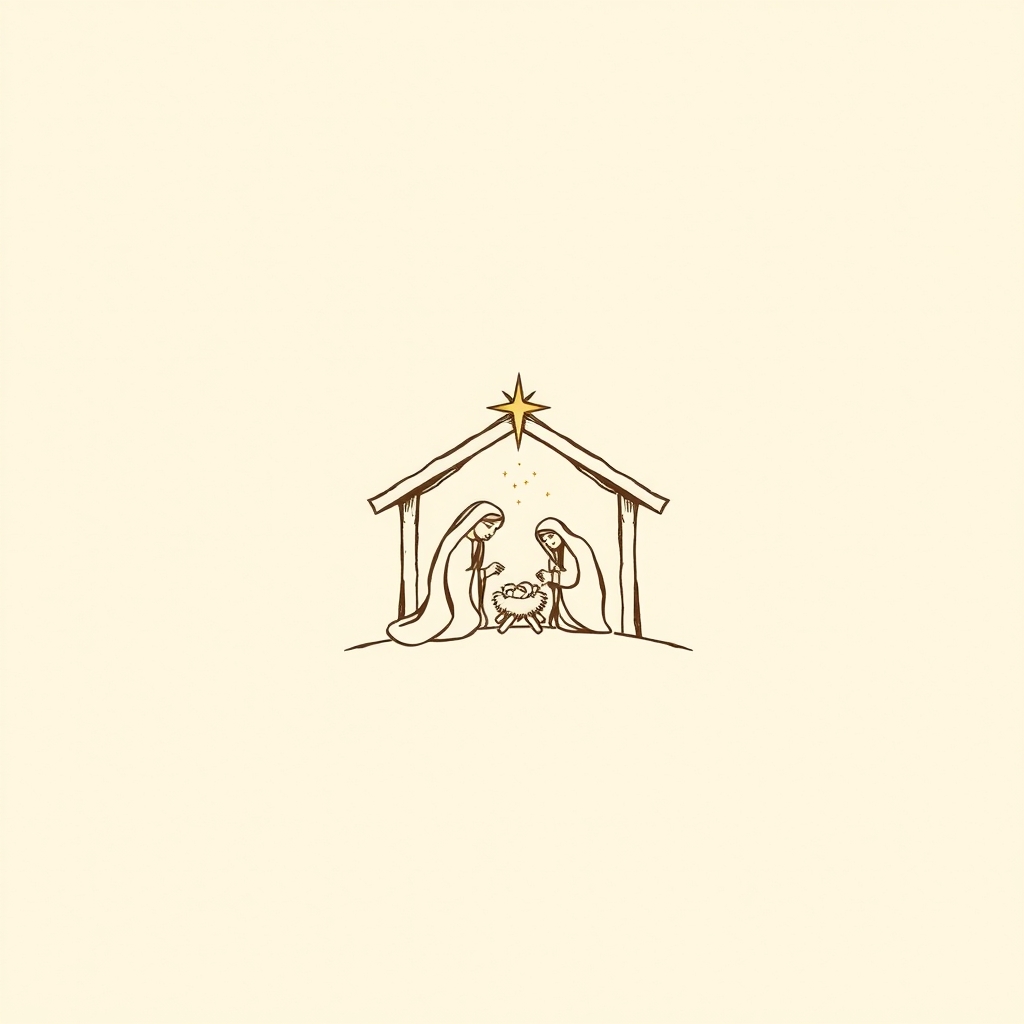
In iconography, Jesus Christ (The Nativity) is recognizable by: nativity scene, swaddling clothes, star, ox and donkey and straw.
What miracles are attributed to Jesus Christ (The Nativity)?
5 miracles are attributed to this saint, notably: Sign / wonder.
Which saints were contemporaries of Jesus Christ (The Nativity)?
Contemporaries include: Saint Martial, Apostle of Aquitaine, Saint James the Greater (Apostle), Saint George of Velay and Jesus Christ (Relics of the Passion).
What are the other names of Jesus Christ (The Nativity)?
Other forms of the name: Emmanuel, Verbe divin and Christ.
Who are the relatives of Jesus Christ (The Nativity)?
Relatives of Jesus Christ (The Nativity): Marie (mother), Joseph (foster father / guardian) and Dieu le Père (Eternal Father).
Annexes & related entities
Structured data for exploration: events, miracles, quotes, places, attributes, patronages, and important entities cited in the text.
Key Events
- Decree of Caesar Augustus for the census
- Journey from Nazareth to Bethlehem
- Birth in a cave/stable
- Adoration of the shepherds
- Annunciation to the shepherds
Quotes
-
Gloria in excelsis Deo et in terra pax
Song of the Angels / Liturgy -
Ecce Virgo concipiet et pariet filium
Isaiah VII