
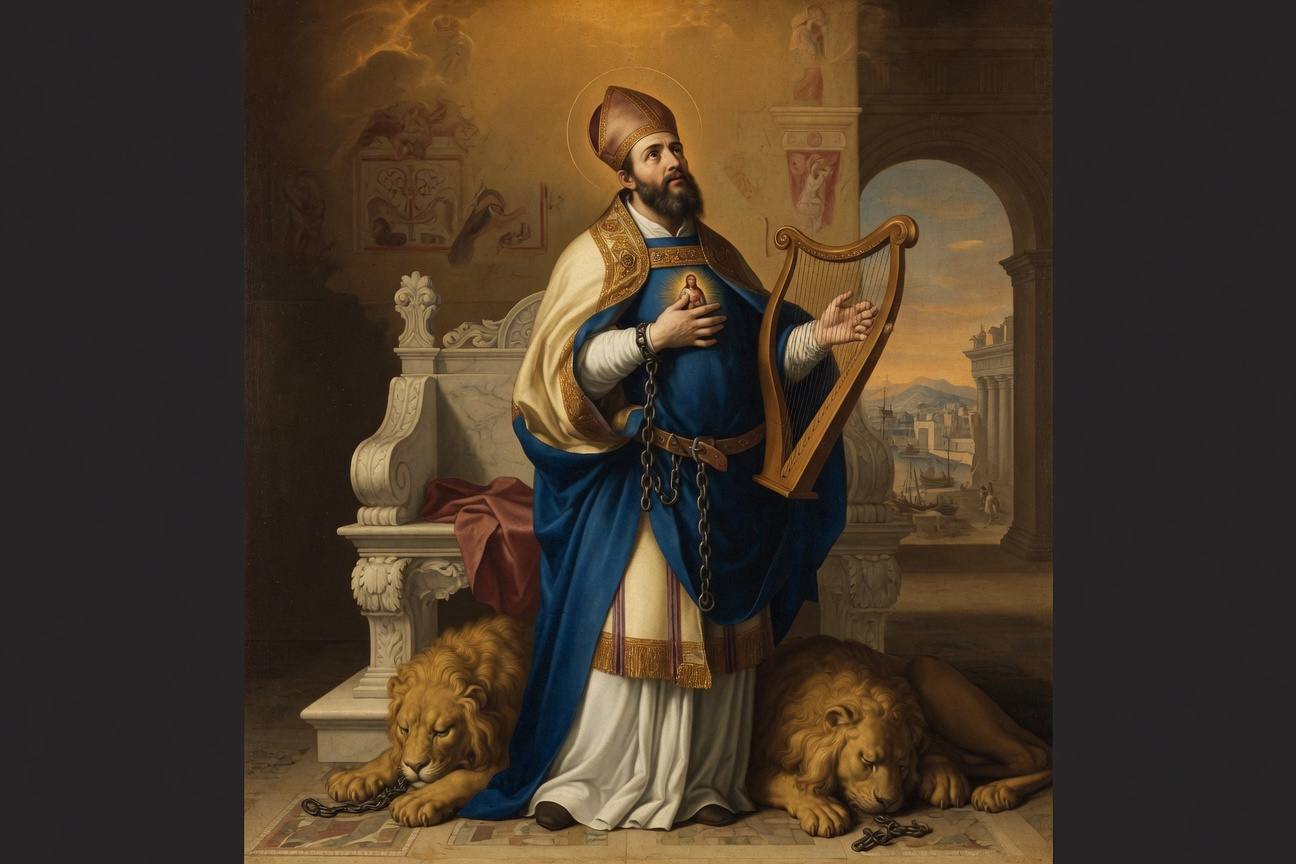
A disciple of Saint John and Bishop of Antioch, Ignatius was condemned by Emperor Trajan to be thrown to the beasts in Rome. During his journey to martyrdom, he wrote seven famous letters to the Churches, expressing his ardent desire to be united with Christ. He died devoured by lions in the amphitheater, affirming he was the 'wheat of God'.
Contemporaries

Figures and markers around the normalized period for this entry.
Guided reading
7 reading sections
SAINT IGNATIUS, PATRIARCH OF ANTIOCH,
MARTYR
Origins and Episcopate in Antioch
Ignatius, possibly the child blessed by Christ, became a disciple of Saint John before being elected Bishop of Antioch, where he introduced antiphonal chanting.
This glorious martyr worthily leads the procession of Saints who will pass before us during the month of February, like an august pontiff at the head of his clergy. Simeon Metaphrastes and Nicephorus, speaking of Saint Ignatiu s, assert th at he was the little child whom our Lord Jesus Christ placed in the midst of the Apostles when, to give them a lesson in humility, He said to them: 'Unless you become like little children, you will never enter the kingdom of heaven.' Some other authors attribute this honor to Saint Martial, who later became Bishop of Limoges. But, be that as it may, it is certain that our Saint had a very great familiarity with the first disciples of our Lord, particularly with Saint John the Evangelist, of whom he was even a disciple. He was elected Bishop of Antioch after the school that had succeeded the A postle S aint Peter; and Eusebius of Caesarea, Socrates, and after them Baronius, say that it was he who first instituted cantors in the Church, and the manner of reciting the divine office in verses, and in two choirs; a great multitude of blessed spirits appeared to him, who sang the praises of the Holy Trinity by responding to one another alternately, in various tones which they gave to their celestial hymns. The holy Prelate, thinking that the Church, which fights on earth, should strive to be similar to that which triumphs in heaven, established cantors in his church of Antioch, according to the model that had been shown to him in the heavenly Jerusalem.
Confrontation with Emperor Trajan
During Trajan's passage through Antioch, Ignatius refuses to sacrifice to the idols and affirms his faith, which leads to his condemnation to the beasts in Rome.
In the eighth year of his reign, Trajan, conqueror of the Dacians and several other northern peoples, passed through the East, carrying war to the Parthians. He made a pompous entry into Antioch, accompanied by dignitaries and the great bodies of the State.
Antioch, once the magnificent residence of the Seleucid kings who had founded it, was, under Roman rule, often visited by their emperors. It was, after Rome and Alexandria, the most populous city of the Empire, and, by reason of its location and commercial relations, regarded as the capital of the East. In another sense, it was of no less importance. From the first preachings of the Gospel, it had given a shining example to all the Gentiles by embracing the faith with eagerness, and, since then, it had become increasingly attached to it. It was in Antioch that the Prince of the Apostles had first established his see. From Antioch, the Christian name had spread throughout the universe. Its church, the most numerous of all, was, at the arrival of Trajan, governed for forty years by Ignatius, surnamed Theophorus, the most venerated bishop of Asia.
Trajan, during his stay in Antioch, wished to restore the honor of the cult of false gods. He offered them solemn sacrifices to thank them for his past successes and to make them favorable to his new expedition. Ignatius had foreseen the danger with which the emperor's presence threatened him; but he had wished neither to flee nor to hide, hoping that by his sacrifice he would save his flock. He was not mistaken. Reported to the emperor, the latter had him appear in a solemn audience, in the presence of the senate; and, in a tone that ill-accorded with his reputation for gentleness and benevolence, he subjected him to the following interrogation:
"Is it you," he said to him, "evil demon, who dares to violate my orders and inspire contempt for them in others, by insulting our gods?" "No one other than you, prince, has ever called Theophorus an evil demon," replied Ignatius. "And w hat do yo u mean by this word Theophorus?" "He who carries Jesus Christ in his heart." "You carry Christ within you?" "Yes, because it is written: I will dwell in them and I will walk with them always." "Do you think that we do not also carry our gods in our soul, those gods whom we thank for their benefits, and whom we invoke in our enterprises?" "Gods! They are but demons. There is only one God, who created heaven and earth; there is only one Jesus Christ, the only Son of God, whose reign has no end. If you knew him, O emperor! your throne would be better established." "Let us leave that; do you wish, Ignatius, to make yourself agreeable to my power, and be counted among the friends of the emperor? Change your sentiments, sacrifice to the gods, and immediately, let them know it well, I will make you pontiff of the great Jupiter, and you will be called father of the senate." "What do these honors matter to me, a priest of Christ, who offers him each day a sacrifice of praise, and prepares myself to be immolated to him?" "To whom? To that Jesus who was put on the cross by Pontius Pilate?" "Yes, and who crucified sin with him, and defeated the demon, who is its author." "You admit then that your God is dead," objected some of the senators, "and so how can you worship him? Our gods, on the contrary, are immortal." "Jesus Christ, eternal as God, became man to save men. It is for them that he died on a cross; but he rose again on the third day, and then ascended to the heavens, from whence he had come, and whose entrance he has reopened for us. Who will dare to affirm that any of those you rank among your gods has ever done anything similar and can be compared to him? After having made themselves famous by their turpitudes or their crimes, they underwent death, which was the just penalty; they died, and they did not rise again."
The wisdom of the wise was disconcerted. Trajan, irritated, had the intrepid defender of Christ chained and led to prison. The night did not bring counsel, or rather it brought a fatal one. The next day, Trajan having again called for Ignatius: "Sacrifice to the gods," he said to him, "in order to avoid torments and death." "To which god shall I sacrifice?" replied Ignatius: "shall it be to Mercury the thief? to Mars, who, by reason of an infamous crime, was condemned to irons for thirty months?" "I am guilty of letting you blaspheme against our gods who have done you no harm. Sacrifice to them instantly, otherwise I will not spare you." "I will not sacrifice; I fear neither torments nor death, because I am in haste to go to God." The imperial dignity believed itself engaged in this debate; it believed it was avenging its honor by condemning to a cruel and spectacular punishment the one who had dared to resist it. Trajan pronounced this sentence: "We order that Ignatius, who glories in carrying within him the Crucified, be put in irons and led under good guard to great Rome to be exposed to the beasts and serve as a spectacle."
The journey to Rome and the stop in Smyrna
Transferred under military guard, Ignatius stops in Smyrna where he meets Saint Polycarp and receives delegations from the churches of Asia.
LIVES OF THE SAINTS. — Volume II.
to the people". What gentleness in a prince whose humanity has been so praised! What a society it was that required such amusements!
The emperor rushed to conquests, the Christian to martyrdom. At the departure of the blessed prelate, there was not a single faithful soul who did not shed tears: he alone had a heart full of gladness; his flock wept for the loss of such a lovable shepherd, and he, with a grave and constant demeanor, exhorted them to place all their hope in the protection of the sovereign Shepherd, who never abandons his flock. He placed the irons on his own feet and surrendered himself cheerfully to the soldiers who were to take him away. They were cruel men, and so greedy that, to extract money from the Christians, they mistreated him on purpose, thus abusing the liberality of the faithful who exhausted all their means in order to redeem the holy prelate from their unjust vexation. He went by land as far as Seleucia, and from there, by sea, to Smyrna; this city had as its bishop Polycarp, who had formerly been his friend and fellow student at the school of Saint John, their master; thus he received from his charity all the assistance and consolation he could hope for from a perfect friend in Jesus Christ. He was also visited there by all the people of Smyrna, who had extreme satisfaction in hearing the discourses he gave to encourage the Christians to persevere in their fidelity.
The inhabitants of the city of Smyrna were not the only ones who rendered this duty to the holy Martyr; all the churches of Asia sent their bishops and their clergy to see him, as their spiritual father and the general director of their consciences. One could not see such a holy man persecuted without shedding tears; but he, far from being moved by them, when he took leave of the faithful who were melting into tears, begged them to obtain from God the grace not to be spared by the lions, but to be torn apart by them with all possible cruelty.
But these thoughts are not understood by the people of the world and those who are attached to the pleasures of life. It requires a heavenly and divine spirit to understand the sentiments of this great man transformed into Jesus Christ.
The Letter to the Romans and the Desire for God
Ignatius writes to the Christians of Rome to beg them not to hinder his martyrdom, defining himself as the 'wheat of God' to be ground by the wild beasts.
What he apprehended above all were the prayers and the excessive love of the Romans for him. Having found in Smyrna Christians who were going directly to Rome, he gave them a letter for those in the capital which has, so to speak, no other purpose than to conjure them not to delay the execution of his martyrdom through their prayers. In the inscription of this epistle, one can see an illustrious testimony to the primacy of the Roman Church. When the holy martyr writes to the faithful of other cities, he says, adding many praises: To the Church which is in Ephesus, to the Church which is in Magnesia, to the Church which is in Smyrna. But to the Romans his language is different: To the Church which presides in the region of the Romans. Nothing is more generous, more edifying th an this letter to the Romans; nothing paints better that passionate love of martyrdom which characterizes this heroic age of Christianity than that which he wrote to the Romans to announce his imminent arrival:
"God has heard my prayers; I have finally obtained from His goodness the ability to enjoy your presence. Bound in chains for the love of Jesus Christ, I hope, in a short time, to be with you. If, after having so happily begun, I am judged worthy to persevere until the end, I do not doubt that I shall soon enter into possession of the inheritance that has fallen to me through the death of Jesus Christ. But I fear your charity; I fear that you may have for me an affection that is too human. You could perhaps prevent me from dying; but, by opposing my death, you would be opposing my happiness. If you have a sincere charity for me, you will let me go and enjoy my God. I cannot, to be agreeable to you, consent to avoid the torment that is prepared for me. It is to God alone that I wish to please. You yourselves give me the example. I will never have a happier occasion to be reunited with Him, and you could not have a more beautiful one to perform a good work. You have only to remain at rest. If you do not snatch me from the hands of the executioners, I will go to join my God. But if you listen to a false compassion, you send me back to the labor and you make me re-enter the race. Suffer me to be immolated while the altar is prepared. Give thanks to God that He has permitted a bishop of Syria to be transported from the places where the sun rises, to lose his life in a land where this star loses its light. What do I say? I am going to be reborn to my God. Obtain for me by your prayers the courage that is necessary for me to resist the attacks from within, and to repel those from without. It is little to appear Christian if one is not so in effect. What makes the Christian is not beautiful words or specious appearances; it is greatness of soul, it is the solidity of virtue.
"I write to the churches that I go to death with joy. Let me serve as fodder for the lions and the bears. I am the wheat of God. I must be ground under their teeth to become a bread worthy of Jesus Christ. Since I left Syria, have I not had to fight against wild beasts? The earth and the sea are witnesses to their fury and my patience. They are ten leopards in the guise of ten soldiers, near whom I am chained and who are all the more cruel, as my gentleness does more to tame them. Their ill-treatment instructs me, but is not enough to justify me.
"Upon arriving in Rome, I hope to find the beasts ready to devour me. May they not make me languish! I will first use caresses to engage them not to spare me; if this means does not succeed, I will irritate them against me and I will force them to take my life. Forgive me these sentiments; I know what is advantageous for me. I am beginning to be a true disciple of Jesus Christ. Nothing touches me, everything is indifferent to me, except the hope of possessing my God. Let fire reduce me to ashes, let me expire on a cross with a slow death; let, under the tooth of furious tigers and hungry lions, my bones be broken, my limbs bruised, my whole body crushed; even if all the demons were to unite to exhaust their rage upon me, I will suffer everything with joy, provided that I enjoy Jesus Christ. Could the possession of all the kingdoms make me happy? Is it not infinitely more glorious for me to die for my God than to reign over the whole earth? My heart sighs after Him who died for me; my heart sighs after Him who rose again for me. Let me imitate the sufferings of my God. Would it not be preventing me from living to prevent me from dying?
"If, arrived near you, I had the weakness to make you appear to have other sentiments, do not believe me. Add faith only to what I write to you now; for it is in an entire freedom of spirit that my heart speaks today. And what other language could I hold at the sight of my crucified love? I hear in the depths of my heart a voice that cries to me without ceasing: Ignatius, what are you doing here below? Go, run, fly into the bosom of your God. Neither the most exquisite meats nor the most delicious wines have any more flavor for me. The bread that I want is the sacred body of Jesus Christ, and the wine that I desire is His precious blood, this celestial wine which excites in the soul the vivid and immortal fire of an incorruptible charity. I no longer hold to the earth, and I no longer regard myself as living among men. Pray, ask, obtain for me the peace, which is only given at the end of the race. If I suffer for Jesus Christ, my memory will be dear to you; but if I render myself unworthy of suffering, what could be more odious to you than my name?
"Remember in your prayers the church of Syria, which, deprived of a pastor, turns its eyes and its hopes toward Him who is the sovereign pastor of all the Churches. May Jesus Christ deign to take its guidance during my absence; I entrust it to His Providence and to your charity.
"I greet you in spirit; all the churches that have received me in the name of Jesus Christ greet you also. I have not been a stranger to them. I have as proof the entirely Christian charity with which they have had me accompanied in the cities that were on my route.
"Ephesians of consideration and merit will deliver this letter to you. Regarding those who have left Syria for Rome, you will oblige me by letting them know that I am near. They are persons worthy of the protection of God and of your care. You will render them all the good offices that their virtue deserves."
Final recommendations and arrival in Italy
After writing to various churches and learning of the end of the persecutions in Antioch, Ignatius lands at Ostia for his final combat.
He still had time to write to a few other churches, among others to that of Ephesus, which had sent its bishop Onesimus to him, one of the most distinguished of the primitive Church, whom Ignatius praises in a very particular way. It was probably the same as that slave of Philemon whom Saint Paul converted, and whom he later established as bishop of Beroea. Moreover, the bishops who rushed to meet the martyr, in their eagerness for his person, were preluding, like Polycarp, to their own martyrdom. Ignatius soon tore himself away from their embraces; several of the faithful joined those who had accompanied him from Syria and embarked with him.
He received news at Troas that filled him with joy, and was well capable of strengthening his courage. The consideration of his generous sacrifice had put an end to some divisions stirred up by false brothers in the church of Antioch. At the same time, the persecution, content to have struck the shepherd, had spared the flock. Trajan, as much out of policy as out of humanity, did not want to attack the crowd and multiply the victims. Pressed by the departure of the ship, the saint wrote in haste to Polycarp, and begged him to be his interpreter to the various churches whose deputies had come to greet his passage during his stay in Philippi of Macedonia. The faithful conceived such veneration for his sentiments and his doctrine that several of them went to the bishop of Smyrna, his friend and confidant, to collect all the letters of the bishop of Antioch. These letters, received with respect by all the Christian people, were read in the holy assemblies along with those of the Apostles.
Martyrdom in the Amphitheater
Ignatius is delivered to the lions in Rome; his body is devoured but his heart, according to legend, bears the name of Jesus engraved in letters of gold.
He had intended to disembark at Puteoli, and thus arrive at the end of his journey in the very footsteps of the Apostle of the Gentiles; but a contrary wind drove the ship to the port of Ostia. The faithful of Rome ran in crowds to meet him. They welcomed him with transports of joy, which were soon succeeded by the sad thought that they possessed him only to lose him. They were already forming the plan to try to win over the people, so that they might ask, as had sometimes happened before, for mercy for the old age of the victim. But the Saint, knowing their thoughts, implored them with such insistence not to delay the hour of his deliverance that they associated themselves with his sentiments, and, all having fallen to their knees, he prayed in their midst for the end of the persecution, the peace of the Church, and the union among all her children. The soldiers who were leading him delivered him to the prefect of the city, with the copy of his sentence. The latter waited for a day of solemn feast to produce him in public, according to the will of the emperor. The Roman Martyrology says that the Saint suffered many other torments bef ore being ex posed in the amphitheater; and Ado, in his Martyrology, adds that his whole body was broken with leaded whips; that his ribs were scraped with iron nails and sharp, cutting stones; that salt and vinegar were thrown on his fresh wounds, and that he was kept in prison for three times twenty-four hours without food or drink. He was therefore led to the place of execution, his face radiant with joy and his heart full of consolation for what he was about to endure for Jesus Christ, and seeing that all those present had their eyes fixed on him, he addressed them: "Do not think, O Romans who witness this spectacle, that I am condemned to the beasts for having committed some crime; no, it is because I wish to go to God, whose love inflames me." Saying this, he heard the roaring of the lions that were already coming toward him; and then, with a transport caused by the zeal of his faith, he said loudly: "I am the wheat of Jesus Christ, I shall be ground by the teeth of the beasts and reduced to flour to be a bread pleasing to me. Lord Jesus Christ." Scarcely had he finished these last words when he was thrown to the ground and devoured by the lions as he had prayed to his sovereign Lord. These cruel animals did not touch his bones: only his flesh was torn and served as fodder for their rage, just as the constancy of the Martyr served as a spectacle for the assembled people. This was on September 20, 107 or 116.
The Acts of the martyrdom of Saint Ignatius were written by three of his disciples who accompanied him to Rome and were eyewitnesses of his execution. Here is the touching way in which they end their account:
"We witnessed this sad spectacle with eyes bathed in tears: the following night, having retired to the house of a Christian, we let our tears flow with our prayers. Prostrate, we asked the Lord to make known to us by some sign the outcome of this combat. Exhausted with fatigue, sleep overcame us; Ignatius appeared to us. Some of us saw him in glory, stretching out his arms to press them to his heart. To others, he appeared in the attitude of prayer, interceding before the throne of God for his church. Finally, some others saw him covered in sweat and, as if emerging from a laborious combat, presenting himself as a victor before God..."
Saint Antoninus says that Saint Ignatius was only suffocated by the lions, and not devoured; and that, feeling the bites of these beasts, he had always had on his lips the most holy name of Jesus, which he called to his aid. He was asked why he often invoked this name: "It is," he replied, "because it is engraved in my heart and I cannot forget it." Indeed, after he was dead, his heart was opened and the most holy name of Jesus was found written there in letters of gold.
Cult, iconography and literary posterity
His relics traveled from Rome to Antioch before returning to the West. His seven authentic letters remain pillars of ecclesiastical discipline.
Immediately after the death of Saint Ignatius, a great earthquake occurred in Antioch: a part of the city was ruined, several people were killed, and many others were severely mistreated. The emperor himself found himself in great peril and was saved only by divine Providence, which wished to use him to put an end to the persecution against the Christians; for, from then on, he commanded that they no longer be sought out because of Christianity. It is true that he declared them ineligible for all public offices; but he wished for them to be left to live in peace and freedom, after having assured himself that they were peaceful men who were neither vicious nor enemies of his empire. So that we can say that Saint Ignatius was useful to the Church of God during his life and after his death.
Saint Ignatius of Antioch is represented with a harp near him, listening to a celestial concert, because, as we have said, he is said to have regulated religious chant in Syria, according to what he had heard performed by the Angels.
The Spanish painter Ribera created a large, spirited painting of the martyrdom of Saint Ignatius. Several artists of the 16th century painted the scene of the amphitheater. A lion opens his chest with its claw and one can see the name of Jesus written in brilliant characters on his heart, in allusion, no doubt, to his name of Theophorus, God-bearer.
The monogram of Jesus Christ and a harp are therefore the principal attributes of Saint Ignatius.
A miniature from the Greek Menologion represents the ceremony of the translation of his relics from Rome to Antioch. One notices the coffin containing the holy relics supported by two ecclesiastics. A bishop holding a book and a censer, accompanied by priests carrying torches, is about to enter the city.
## RELICS AND WRITINGS OF SAINT IGNATIUS.
His holy relics, having been collected by the Christians with much veneration, were buried outside of Rome. From there, they were carried to Antioch and deposited outside the Daphne gate; some centuries later, in the time of Theodosius, they were transferred into the city with extraordinary solemnity; the peoples through whom this sacred deposit passed received it, according to Saint Chrysostom, in great ceremony and with beautiful processions. Finally, they were brought back to Rome when, under the reign of Heraclius, Antioch fell into the power of the Saracens, around 638. They are now in the church of Saint Clement, pope and martyr, and at Saint John La teran. Since then, one of the arms of this illustrious martyr has come to our France; it was carefully kept in the famous abbey of Saint-Pierre de la Vallée, of the Order of Saint Benedict, near the city of Chartres. There were also some fragments of his bones among the regular canons of Arrouaise, near Bapaume, in Artois, among the Benedictines of Liessies in Hainaut, etc.
This glorious patriarch and generous martyr of Jesus Christ wrote some letters worthy of admiration; the letter to the Romans, which we have just reproduced, is a masterpiece. Saint Jerome cites seven that are certainly his: the portrait of the nascent Church is wonderfully depicted therein, and the customs of the Christians of this golden age perfectly reported along with ecclesiastical discipline and apostolic traditions. He employs a celestial and angelic eloquence to exhort the faithful to observe them, as emanating from the authority of Our Lord Jesus Christ, through the ministry of the Apostles. He makes mention of all the Orders of the Church, and teaches what respect one must bear and what obedience one must render to ecclesiastical persons, and especially to the character and dignity of bishops. "The prince," he says, "obeys the emperor, and the soldiers the princes, the deacons the priests, and the rest of the clergy, as also all the people, the soldiers, the princes and the emperor himself obey the bishop, and the bishop obeys Jesus Christ." He was accustomed to putting at the end of his letters, as if to serve as a seal, Amen Gratia, just as Pope Saint Gregory writes. The epistles of Saint Ignatius were of such great authority that Saint Polycarp made a collection of them. Saint Irenaeus makes mention of them. Saint Athanasius, Saint Jerome, Eusebius, Theodoret and other Fathers speak of them with much respect and veneration. Besides these epistles, some add five more, of which the Holy Fathers make no mention, although they recognize the others. Saint Bernard, Denis the Carthusian and other modern authors, cited by Canisius, also cite a letter from Saint Ignatius to Our Lady, and another from Our Lady to Saint Ignatius, and consider them as genuine, along with two others to Saint John the Evangelist; but it is more probable that they are supposed, as well as these five others, which scholars maintain are not his.
There are relics of the Saint at the Ursulines of Amiens, at Mailly, at Mont-Saint-Quentin and at Montreuil.
Iconography
Signs and attributes




Entities
Narrative network
The names, places, and concepts most present in the entry, weighted by centrality in the text.
The supernatural in their life
The miracles of Saint Ignatius of Antioch (Theophorus)
Frequently asked questions about Saint Ignatius of Antioch (Theophorus)
Who was Saint Ignatius of Antioch (Theophorus)?
A disciple of Saint John and Bishop of Antioch, Ignatius was condemned by Emperor Trajan to be thrown to the beasts in Rome. During his journey to martyrdom, he wrote seven famous letters to the Churches, expressing his ardent desire to be united with Christ. He died devoured by lions in the amphitheater, affirming he was the 'wheat of God'.
What is Saint Ignatius of Antioch (Theophorus) the patron saint of?
Patronage of Saint Ignatius of Antioch (Theophorus): Antioch.
How is Saint Ignatius of Antioch (Theophorus) depicted in Christian art?
In iconography, Saint Ignatius of Antioch (Theophorus) is recognizable by: lions, chains, harp and monogram of Jesus Christ on the heart.
How did Saint Ignatius of Antioch (Theophorus) die?
Saint Ignatius of Antioch (Theophorus) suffered martyrdom for the Christian faith (2nd century).
What miracles are attributed to Saint Ignatius of Antioch (Theophorus)?
3 miracles are attributed to this saint, notably: Vision / apparition and Sign / wonder.
Which saints were contemporaries of Saint Ignatius of Antioch (Theophorus)?
Contemporaries include: Saint Dionysius the Areopagite (First Bishop of Paris), Saint Pothinus and his companions (Martyrs of Lyon), Saint Benignus of Smyrna and Jesus Christ (Relics of the Passion).
What are the other names of Saint Ignatius of Antioch (Theophorus)?
Other forms of the name: Théophore and Ignatius.
Annexes & related entities
Structured data for exploration: events, miracles, quotes, places, attributes, patronages, and important entities cited in the text.
Key Events
- Disciple of Saint John the Evangelist
- Election as Bishop of Antioch
- Institution of antiphonal singing with two choirs
- Interrogation by Emperor Trajan in Antioch
- Journey under military escort to Rome via Smyrna and Troas
- Writing of seven letters to the Churches
- Martyrdom in the Roman amphitheater, devoured by lions
Quotes
-
I am God's wheat. I must be ground by the teeth of wild beasts that I may become the pure bread of Christ.
Letter to the Romans / Acts of the Martyrdom -
My love has been crucified.
Letter to the Romans