
Born in Trancault and initially a lawyer devoted to the poor, Saint Épvre became the seventh Bishop of Toul. Known for his great charity and apostolic zeal, he performed miracles, notably the liberation of prisoners and the exorcism of a possessed person. Upon his death, a dove escaped from his mouth, symbolizing his purity.
Contemporaries

Figures and markers around the normalized period for this entry.
Guided reading
7 reading sections
SAINT ÉPVRE, SEVENTH BISHOP OF TOUL
Youth and charitable vocation
Born in Trancault to a pious family, Evre distinguished himself from childhood by his detachment from worldly games and his great charity towards the poor.
Saint Evre was born in Tranca ult, a small village in the canton of Marcilly-le-Hayer, in the arrondissement of Nogent-sur-Seine, in the diocese of Troyes. Born to parents as pious as they were distinguished by their position in the world, Evre gave signs from his earliest youth of what he would later become: a fervent disciple of Jesus Christ, a religious observer of His holy law. He did not indulge in the games natural to his age; but the attraction of virtue anticipating his years, he took pleasure in visiting churches and monasteries and in conversing with people recommended by a high and solid piety. He especially delighted in the regular practice of works of mercy. How often, upon his return from school or church, was he seen stripping off the clothes he was wearing to cover some indigent person in rags! When he had nothing to give, he sympathized so tenderly with misery that the poor person often valued the sweetness of his consolations more than a material alms, even the most abundant.
As soon as he was master of the goods that came to him as an inheritance upon the death of his parents, he divided them into two parts and consecrated the larger one to the maintenance and relief of the unfortunate. He was their providence and their father, to such a point that one could have applied to him these words of the holy man Job: "Compassion grew with me from my childhood, and from my mother's womb I have guided them."
From Eloquence to the Contemplative Life
After brilliant studies, he became a renowned lawyer devoted to the oppressed before retiring to dedicate himself to meditation and Christian perfection.
Evre did not only cultivate virtue; he had also devoted himself to the study of belles-lettres, and rapid progress soon made him surpass all his peers. His brilliant elocution earned him a name among the most famous lawyers; but, faithful to his inclinations for devotion and charity, he never used his talent except for the defense of the poor, the widows, and the orphans.
The judiciary did not give him the rest and contentment he desired: thus he soon abandoned it to give himself entirely to the meditation of eternal truths. Consumed by the thirst for his sanctification, he frequented those most advanced in perfection and studied their principal virtues with care. Then, like an industrious bee, which from the nectar of different flowers composes an exquisite and delicious honey, he attempted to reproduce in his habitual conduct the purity of one, the mortification of another, and the holy dispositions of all.
Bishop of Toul and missionary
Elected Bishop of Toul, he maintained a humble life, evangelized the countryside, and destroyed pagan idols through the power of his word.
However, his reputation had spread far and wide, and the episcopal see of Toul having become vacant, Evre was elected, despite his resistance, to
¹ Alias: Evre, Apr e, Aper.
fill this eminent position, to the great satisfaction of the people and the clergy. The honor of the episcopate did not change his heart in the slightest. He maintained the same humility of life, the same simplicity of clothing, the same love of mortification. It was always the same affability for all, the same gentleness in conversation. He made himself all things to all men, to win them all to Jesus Christ. The misfortune that struck one of his diocesans saddened him more than if he had been the victim himself, and he equally shared in the happiness of those whom some prosperity rejoiced. He never missed an opportunity to announce the holy word to the people entrusted to him, and the name of Jesus always returned to his lips, which expressed all its sweetness and all its consolations. He was that prudent and faithful steward of the Gospel who distributes spiritual food to his brothers in due time.
Throughout the towns and the countryside that his apostolic zeal led him to traverse, he tore down the temples of idols still frequent at that time, and, by the strength and persuasion of his discourses, he opened the eyes of the pagans to the light of the faith, which had not yet appeared to them.
Miracles and celestial signs
The saint performed miracles, freeing prisoners and exorcising the possessed, before dying and leaving behind prodigious signs such as a dove escaping from his mouth.
God wished to reward such virtues with the gift of miracles. Let it suffice to cite two. During one of his apostolic journeys, Saint Epvre learned that three criminals were about to suffer the ultimate punishment. His heart was moved with compassion; he asked for their pardon, but could not obtain it from the inexorable judge. He then turned to God in fervent prayer. Immediately, the irons fell from the hands of the condemned; the prison doors opened of their own accord and let the captives pass, who, full of gratitude, came to lay their chains at the feet of the Saint, who was still prostrate before the altars. As for the judge who had shown himself rebellious and inflexible, he was immediately possessed by the devil and died in atrocious torture. In the 14th century, one could still see, in the Saint's abbey in Toul, these chains which were placed on the necks of the possessed to procure their deliverance and healing.
The same day, as the Saint was returning to his episcopal city, he found on his path a young man possessed by an evil spirit. From his mouth escaped whirlwinds of flames and torrents of sulfur; everyone fled at his approach. At the sight of the bishop, the wretch was seized with a fit of rage and rushed to meet him. But the man of God, without losing his composure, armed himself with the sign of the cross, and, raising his hand, ordered him to stop. The young man only became more furious; he blew a poisonous flame into the bishop's face and sought to tear his limbs with his teeth; but the Saint extended his hand, made the sign of the cross again, and the demon fled.
Saint Epvre, already advanced in age, had a basilica built under the city walls; but he died before it was finished and was buried there. He had occupied the see of Toul for seven years.
As he was being carried to the grave, a delicious odor escaped from his body, which perfumed all those present. Thus, he who, during his life, had applied himself to spreading everywhere the good odor of Jesus Christ, deserved to be honored after his death. Another prodigy accompanied his funeral: the sky suddenly opened; two luminous clouds descended to the ground, and from the mouth of the holy Pontiff visibly emerged a dove whiter than snow, which took flight toward the heavens: an evident emblem of the simplicity and innocence that had characterized his life.
The Abbey of Saint-Épvre in Toul
His successor Saint Alband completed the basilica and founded an abbey that became a major center of pilgrimage and education in Toul.
[APPENDIX: CULT AND RELICS.] God willed to honor the tomb of His servant with many wonders that the monk Adso collected in his *History of the Bishops of Toul*, reproduced by Dom Calmet in the proofs of his *History of Lorraine*. This tomb was located in the church that the holy Prefect had caused to be raised, not far from the walls of Toul, which death did not allow him to finish, but which his successor Saint Alband had completed. The confidence of the people in the merits of Saint Epvre brought countless pilgrims to the place of his burial; soon several recently constructed churches were placed under his patronage, and the one he had himself begun, in which his mortal remains rested and which he had dedicated to Saint Maurice, was no longer designated by anything other than his own name, as was the cluster of houses that formed around it, which has retained, to this day, the name of the Saint-Epvre suburb. Bishop Alband had a monastery built very close to the house of God, which became the famous Abbey of Saint-Epvre and t he seat of the episco pal schools of Toul. Of this magnificent dwelling, nothing remains but several buildings sold to private individuals; the beautiful conventual church has disappeared, and the site it occupied has become a garden.
Translations and cult in Nancy
The cult spread to Nancy with the construction of a dedicated church, while his relics survived the centuries, invasions, and the Revolution.
Before the end of the 15th century, the Ville-Vi eille of Nancy saw the rise within its walls, not far from the ducal palace, of a church that was dedicated to Saint Epvre. Let us say immediately, and without entering into details which are not the place here, that this old church, decreed to be dilapidated, was demolished in recent years to make way for a new temple which is being completed at this moment and which, by its vast dimensions and the richness of its layout, attracts the curiosity of visitors.
The relics of Saint Epvre were piously preserved in the abbey church, where they had been deposited. At the beginning of the 10th century, at the approach of the Danes and Hungarians who had just invaded Gaul-Belgica, the monks of the monastery saved the head of their protector, and deposited it in the church of Saint-Jean-Baptiste, contiguous to the cathedral of Toul and serving as its baptistery.
When calm was restored, Bishop Drogon thought to keep the holy deposit, under the pretext that it would be more useful to the faithful and more honorable to the memory of Saint Epvre to place it inside his cathedral; but two religious, with the aim of shielding the reliquary from the power of the prefect who wanted to deprive their community of it, deposited it by night in a hiding place that could only be discovered sixty years later, under th e episcopate of Saint Gérard, who returned the relics to the care of the religious of the abbey, and performed their solemn translation on May 17, 978.
In 1527, the abbot of Saint-Epvre obtained from Hector d'Ailly, Bishop of Toul, that the relics of the patron saint of his abbey be transferred from the chest where they rested into a much richer reliquary. A new attempt at fraudulent removal of these precious remains took place in 1635, but without success: the kidnappers were exiled, and the relics returned to their legitimate possessors. Later, fragments were granted to several parish churches.
In 1790, during the dispersion of the religious orders, M. Parisot, parish priest of the Saint-Epvre parish of Nancy, obtained, with the blessing of the abbey of the same name in Toul, the conce ssion of the head of their common protector. On Sunday, November 5, Mgr de Lafore, Bishop of Nancy, solemnly introduced it into the new sanctuary that was to shelter it. Since the restoration of the cult in 1562, it has always been the object of special veneration on the part of the parishioners. After being exposed from the first vespers of the feast until the last day of the Octave, it is carried in procession to the singing of hymns and litanies composed in his honor. This procession was first held inside the church; but since 1854, it has been held in the main streets of the parish, with all the pomp of which it is capable.
Local memory and historical sources
A chapel perpetuates his memory in Trancault, his birthplace, while his life is documented by historians such as Adso and Dom Calmet.
A chapel had been erected at the birthplace of our Saint which, having been ruined by the Huguenots, was rebuilt by the local lord, Bernard Angenoust, around 1620. This chapel still exists today. Later, François le Camus, known as des Caves, had relics of Saint Epvre brought back from Toul. They arrived in Trancault on the fourth Sunday of Lent, and it is the memory of this translation that is celebrated in this region at mid-Lent. They disappeared during the revolutionary turmoil.
Excerpt from the *Vie des Saints du diocèse de Toul*, by Abbé Defor, and from the *Histoire du diocèse de Toul et de celui de Nancy*, by Abbé Guillaume. — Cf. *Histoire de Lorraine*, by Dom Calmet; *Histoire des Autels sacrés et ecclésiastiques*, by Dom Caillet; *Vie de saint Epvre*, by Abbé Etquin, licentiate in theology.
Iconography
Signs and attributes


Entities
Narrative network
The names, places, and concepts most present in the entry, weighted by centrality in the text.
The supernatural in their life
The miracles of Saint Aper (Epvre)
Frequently asked questions about Saint Aper (Epvre)
Who was Saint Aper (Epvre)?
Born in Trancault and initially a lawyer devoted to the poor, Saint Épvre became the seventh Bishop of Toul. Known for his great charity and apostolic zeal, he performed miracles, notably the liberation of prisoners and the exorcism of a possessed person. Upon his death, a dove escaped from his mouth, symbolizing his purity.
What is Saint Aper (Epvre) the patron saint of?
Patronage of Saint Aper (Epvre): Toul, Nancy and Trancault.
What is Saint Aper (Epvre) invoked for?
Saint Aper (Epvre) is invoked for: deliverance of the possessed and protection against injustice.
How is Saint Aper (Epvre) depicted in Christian art?
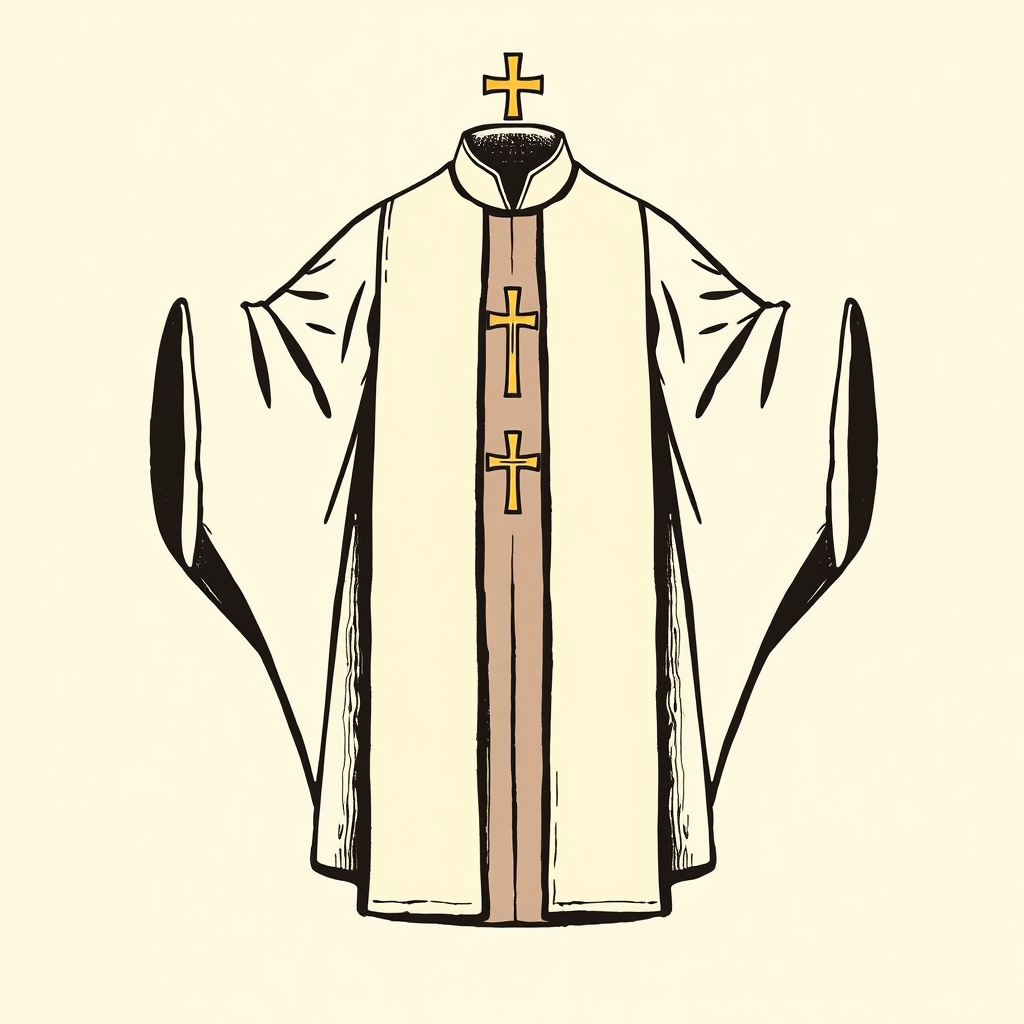
In iconography, Saint Aper (Epvre) is recognizable by: dove emerging from the mouth, prisoner chains and episcopal vestments.
What miracles are attributed to Saint Aper (Epvre)?
4 miracles are attributed to this saint, notably: Protection / deliverance, Exorcism and Sign / wonder.
Which saints were contemporaries of Saint Aper (Epvre)?
Contemporaries include: Saint Bernard of Menthon (Apostle of the Alps), Saint Stephen of Hungary, Saint Anselm of Canterbury and Saint Henry II (the Pious, the Lame).
When did Saint Aper (Epvre) die?
Saint Aper (Epvre) died around 978.
What are the other names of Saint Aper (Epvre)?
Other forms of the name: Evre, Apre and Aper.
Annexes & related entities
Structured data for exploration: events, miracles, quotes, places, attributes, patronages, and important entities cited in the text.
Key Events
- Born in Trancault
- Studies in humanities and career as a lawyer for the poor
- Election to the episcopal see of Toul
- Destruction of idol temples and conversion of pagans
- Miraculous deliverance of three men condemned to death
- Construction of a basilica dedicated to Saint Maurice
- Solemn translation of relics on May 17, 978
Quotes
-
Noli spernas, afflicto et egeno condoleas.
Saint Bonaventure (as an epigraph)