
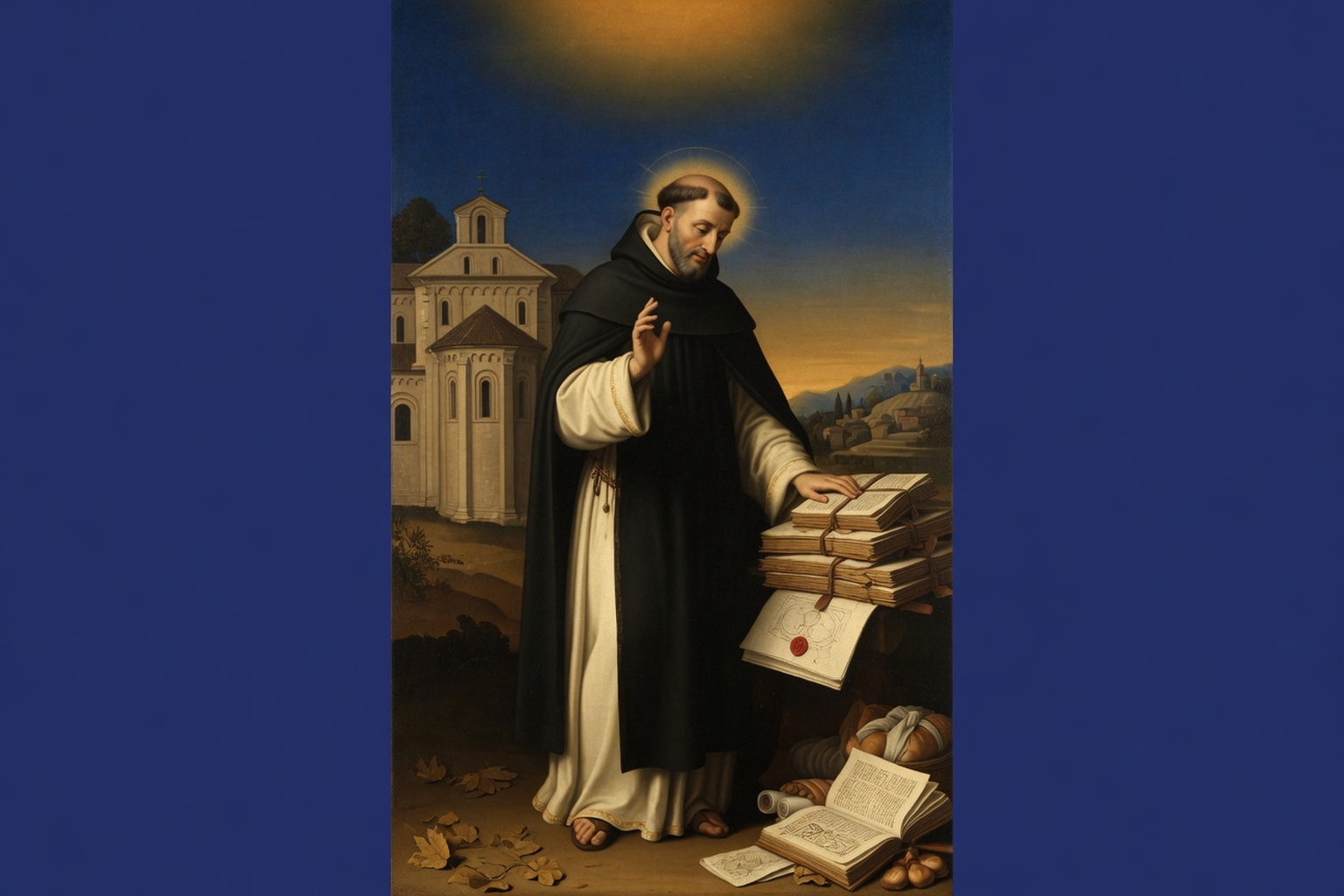
Blessed William of Dijon
A nobleman of Italian origin and disciple of Saint Mayeul at Cluny, William became a great monastic reformer, leading up to forty monasteries including Saint-Bénigne de Dijon. He distinguished himself by creating schools open to all and by his heroic charity during the famines of the 11th century. He died in 1031 at Fécamp, leaving behind a major educational and spiritual legacy.
Contemporaries

Figures and markers around the normalized period for this entry.
Guided reading
6 reading sections
BLESSED WILLIAM OF DIJON (1031).
Origins and entry into religious life
Born of a noble Italian family, William embraced the religious life at Grancey and convinced his father to do the same.
Blessed William, of a no ble family from Italy, was raised at the monastery of Grancey, where he embraced the religious life. He persuaded his father, a relat ive of Otho-William, Count of Mâcon, to follow the same path.
The influence of Cluny
Drawn by the renown of Cluny, William followed Saint Mayeul and quickly became abbot of several important monasteries, including Saint-Bénigne of Dijon.
Saint Mayeul , passing through Grancey on his return from Rome, was followed by William to Cluny, whose fame had long attracted him. Shortly thereafter, Saint Mayeul established him as abbot of Saint-Saturnin, on the Rhône, of Saint-Bénig ne of Dijon, and of Bèze.
The great reformer and educator
Under the protection of Henry of Burgundy, he reformed forty monasteries and founded schools open to all, enriching Dijon with numerous manuscripts.
Henry of Burgundy soon appreciated the merit of William. He gave him the abbey of Saint-Martin-lès-Autun and that of Vergy, where the body of Saint Vivence rested. The holy abbot carried out a successful reform in these monasteries and in thirty-five others that were submitted to him in various provinces. He established schools in all the abbeys he reformed. All those who wished to learn, rich or poor, were admitted there. William made the school of Dijon famous and enr iched it with numerous manuscripts.
Wars, famines, and plagues
The beginning of the 11th century was marked by political conflicts, ergotism, and devastating famines that decimated the population.
These were hard times. The people suffered from three plagues at once: the war of the King of France against Otto-William, ergotism, and famine. Historians count three famines from 1001 to 1014, one of which lasted five years. An even more dreadful one wreaked havoc in 1030 and lasted three years. Torrential rains flooded the land, preventing it from being plowed. A bushel of wheat sold for 60 pieces of silver. Multitudes of men died of hunger. Another plague was born from that one: wolves, attracted by the corpses, acquired a taste for human flesh and devoured the living.
Heroic Charity and Passing
William displayed immense charity during the famine before passing away at Fécamp in 1031, leaving behind a reputation for holiness despite the absence of official canonization.
In such a cruel calamity, the blessed William prescribed abundant alms in his monasteries, and especially at Saint-Bénigne. He had wheat, barley, wine, and all the provisions of the latter abbey distributed under his own eyes. The blessed William, reformer of forty monas teries and superior of twelve hund red monks, departed from this world before the end of the famine, on January 1, 1031, at Fécamp, in Norm andy, where he had g one to make his visitation, and was buried in the abbey. He has not been canonized, although several Martyrologies give him the title of Saint.
Destiny of the relics
The text traces the translations and losses of the blessed one's remains, from the opening of his tomb in the 17th century until the Revolution.
"As for the relics of the blessed one, an ancient manuscript attests that in 1638, four large bones from the arms and legs were taken from his tomb, a portion of which was sent to the Duchess of Savoy who had requested them from Henri de Lorraine, then commendatory abbot of Fécamp, and the rest to Saint-Bénigne of Dijon."
"The same manuscript attests that in 1681, the ashes and some small bones of the Blessed one were enclosed in a small lead box and placed in the new tomb that was built at that time. This tomb still exists, but despite my efforts to have it probed by following the indications which appear quite clear and precise, I have not been able to find the box that must contain what remains of the relics of B. William. As for the part of the relics that was kept in the treasury, it perished during the Revolution."
Iconography
Signs and attributes
Entities
Narrative network
The names, places, and concepts most present in the entry, weighted by centrality in the text.
Frequently asked questions about Blessed William of Dijon
Who was Blessed William of Dijon?
A nobleman of Italian origin and disciple of Saint Mayeul at Cluny, William became a great monastic reformer, leading up to forty monasteries including Saint-Bénigne de Dijon. He distinguished himself by creating schools open to all and by his heroic charity during the famines of the 11th century. He died in 1031 at Fécamp, leaving behind a major educational and spiritual legacy.
What is Blessed William of Dijon the patron saint of?
Patronage of Blessed William of Dijon: schools of Dijon.
What is Blessed William of Dijon invoked for?
Blessed William of Dijon is invoked for: instruction of the poor and aid during famine.
How is Blessed William of Dijon depicted in Christian art?
In iconography, Blessed William of Dijon is recognizable by: manuscripts and Benedictine monk habit.
Which saints were contemporaries of Blessed William of Dijon?
Contemporaries include: Saint Bernard of Menthon (Apostle of the Alps), Saint Stephen of Hungary, Saint Norbert of Magdeburg and Saint Bernard of Clairvaux.
When did Blessed William of Dijon die?
Blessed William of Dijon died around 1031.
What are the other names of Blessed William of Dijon?
Other forms of the name: Guillaume de Fécamp.
Who are the relatives of Blessed William of Dijon?
Relatives of Blessed William of Dijon: Othe-Guillaume (parent (paternal)).
Annexes & related entities
Structured data for exploration: events, miracles, quotes, places, attributes, patronages, and important entities cited in the text.
Key Events
- Education at the monastery of Grancey
- Entered Cluny under Saint Mayeul
- Appointed Abbot of Saint-Bénigne de Dijon
- Reform of forty monasteries and foundation of schools
- Management of the great famine of 1030 through massive almsgiving
- Died in Fécamp during a visit